Wedding Joe Brown & Manon — August 2000
The wedding of Alvin’s best friend Joe. George Harrison was best man.
The wedding ceremony successfully completed, everybody piled into their cars and drove to Joe’s estate where a big tent had been erected for the occasion. After welcome drinks had been passed around and the feast was about to start in earnest with speeches and music, there was a bit of an upset: the bride and groom along with helpful guests gathered around a man writhing on the floor. This turned out to be the bandleader suffering an acute onset of kidney stones! So it came to pass that at a wedding party, where the cream of British and international musicians were attending as guests, there was no live music…
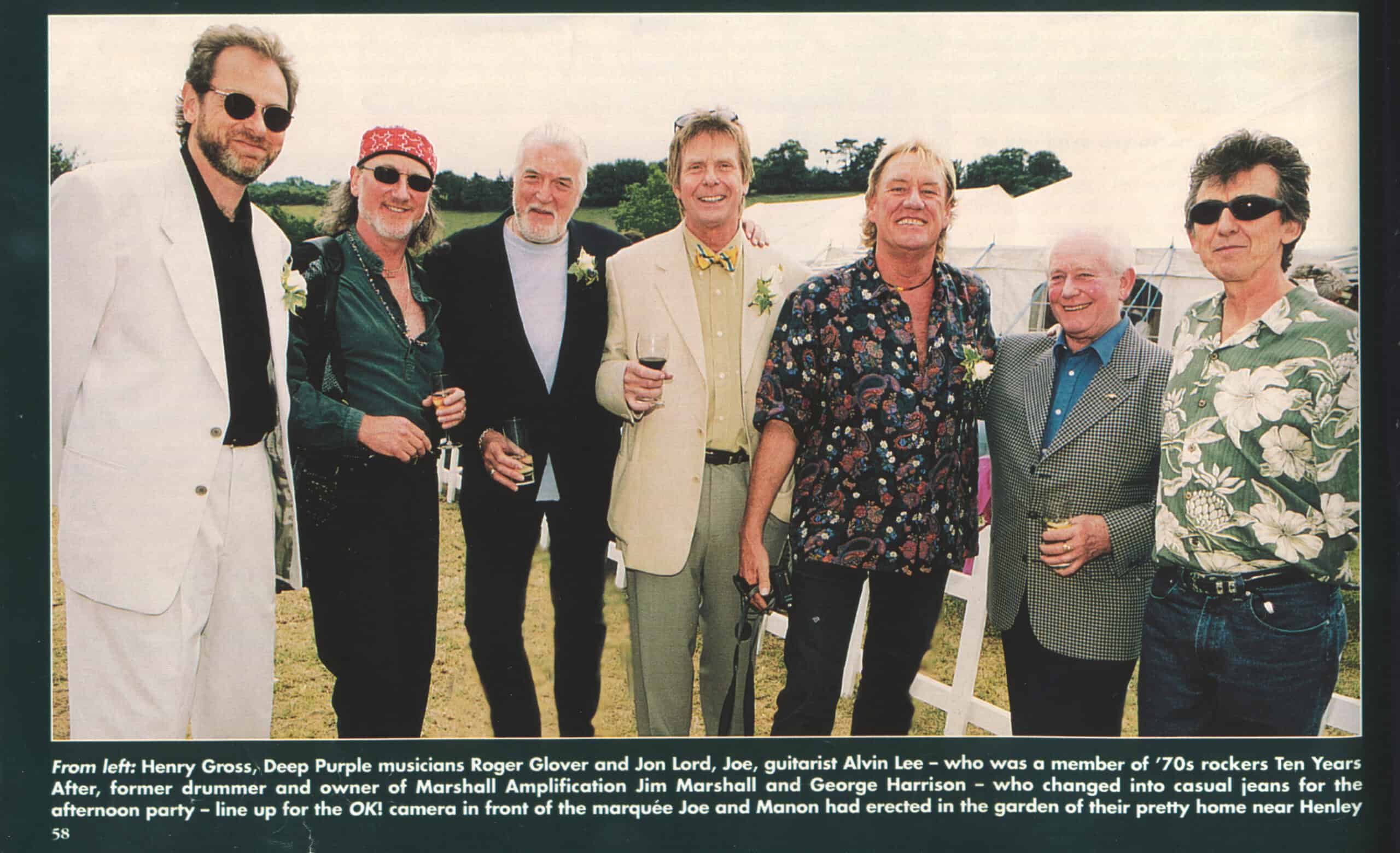
from OK! magazine, December 1, 2000
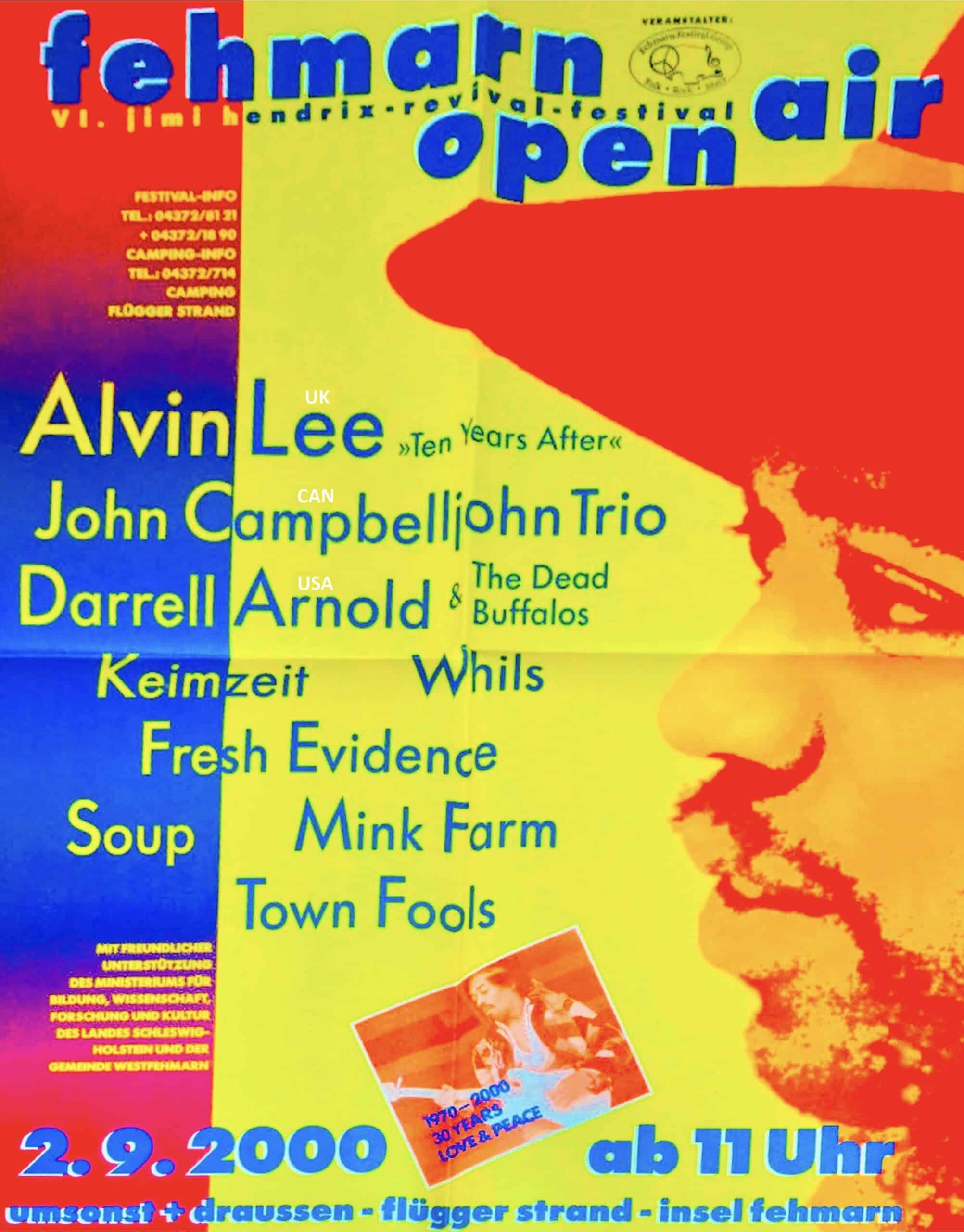
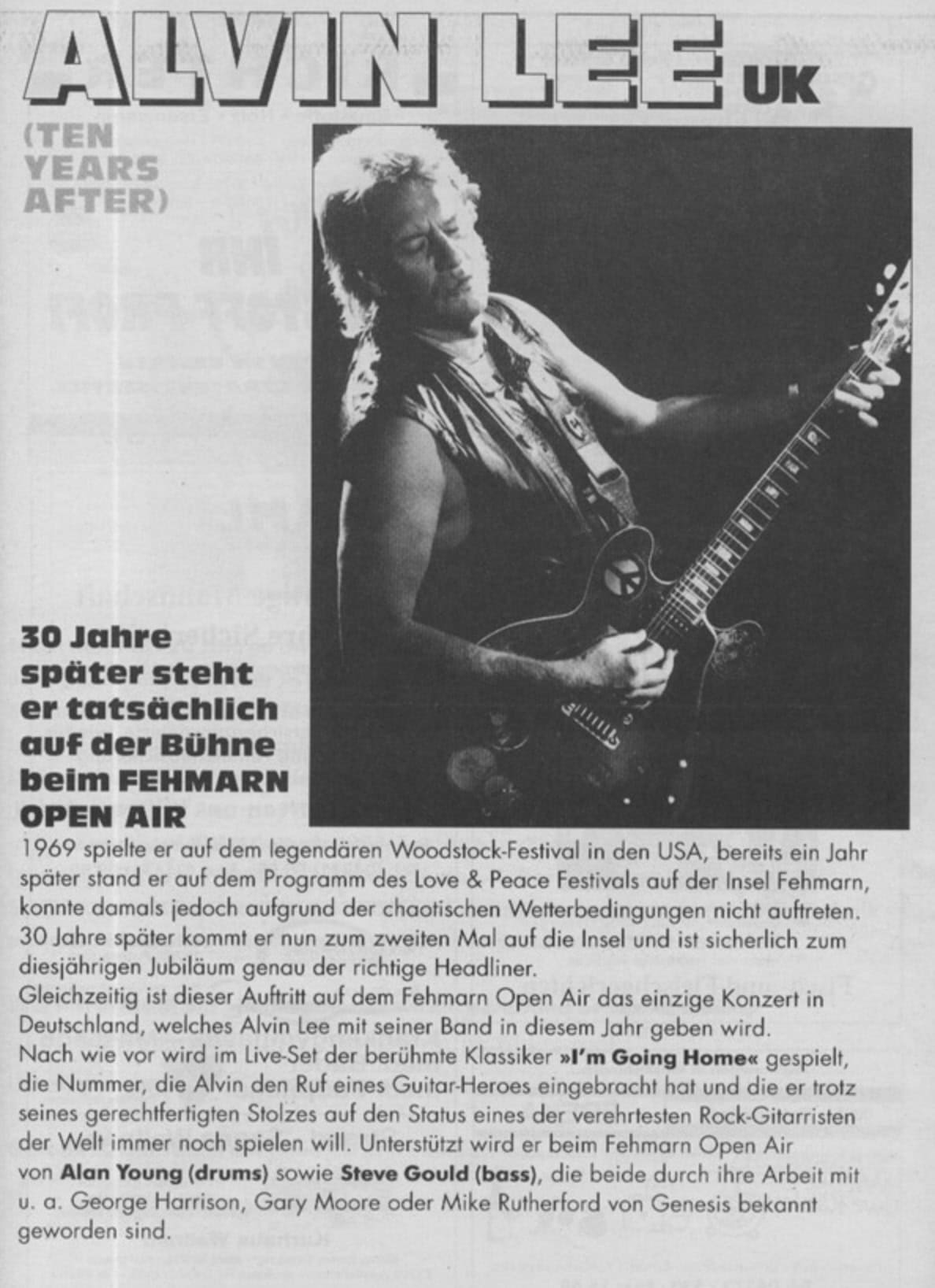
FEHMARN OPEN AIR – September 2, 2000
2001
April 9, 2001 – Bielefeld, Germany
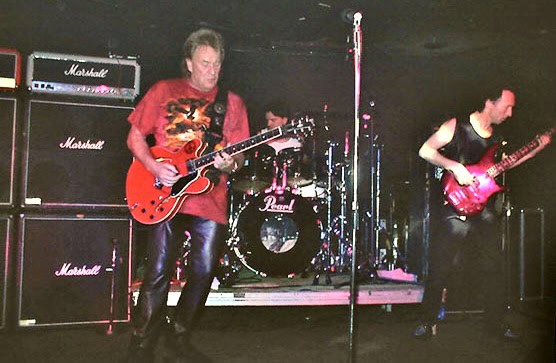
Alvin with Steve Gould (b) and Alvin ‘Shane’ Schrempf (dr)
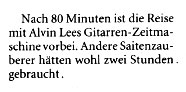
Newspaper Article /Concert Review by Thomas Hagen




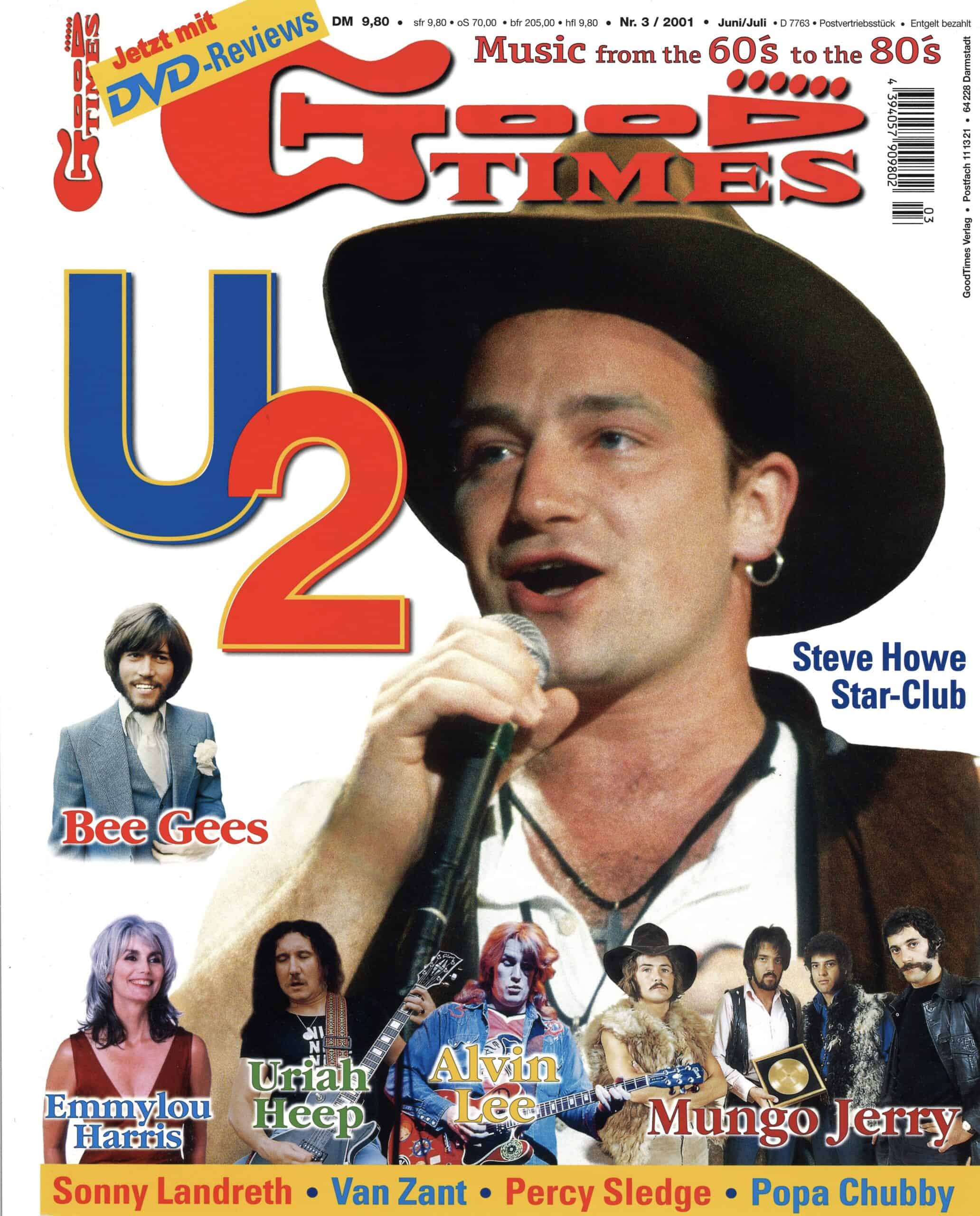
Good Times magazine, Germany – June/July 2001
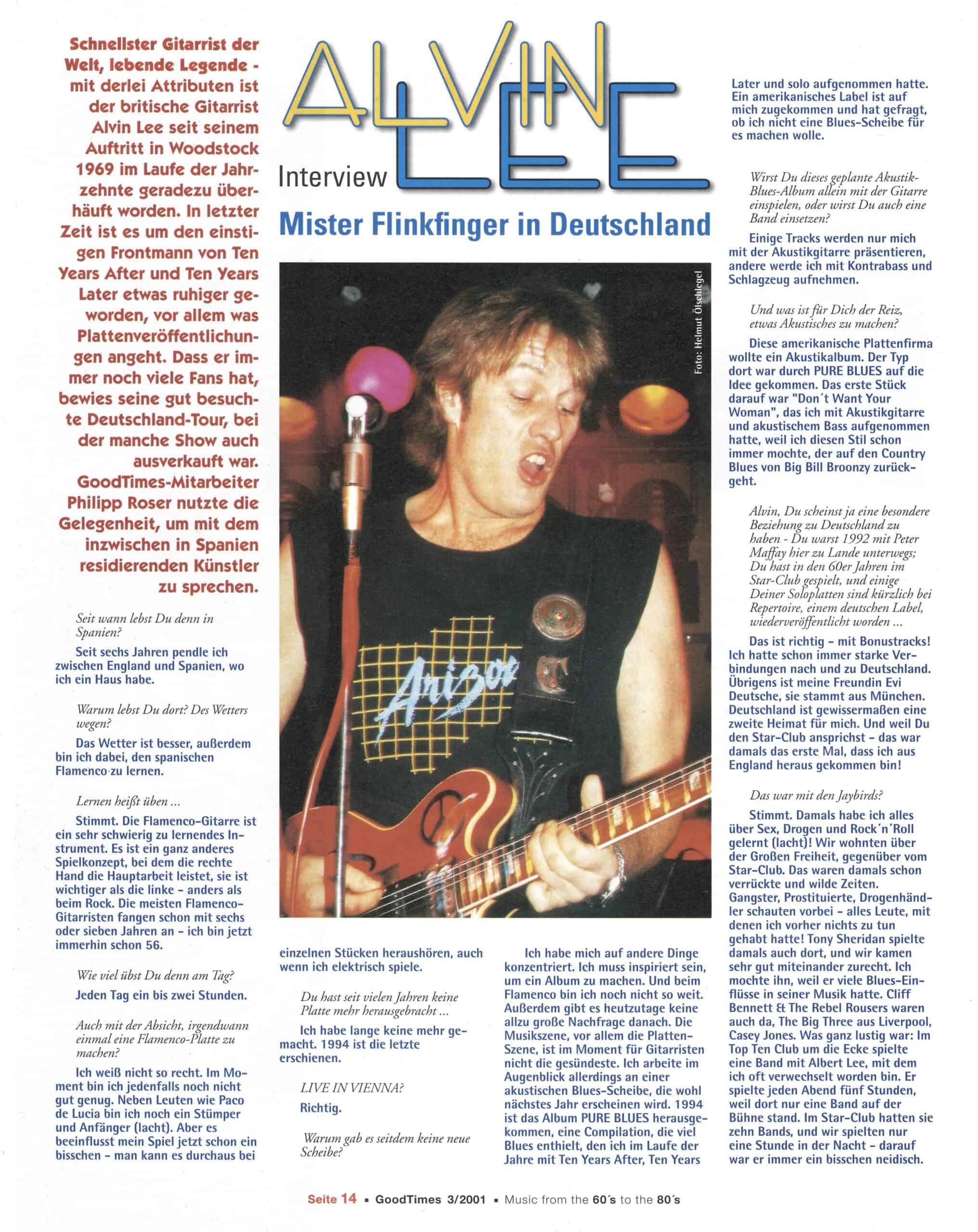
TYA album release “Live at the Fillmore East 1970”

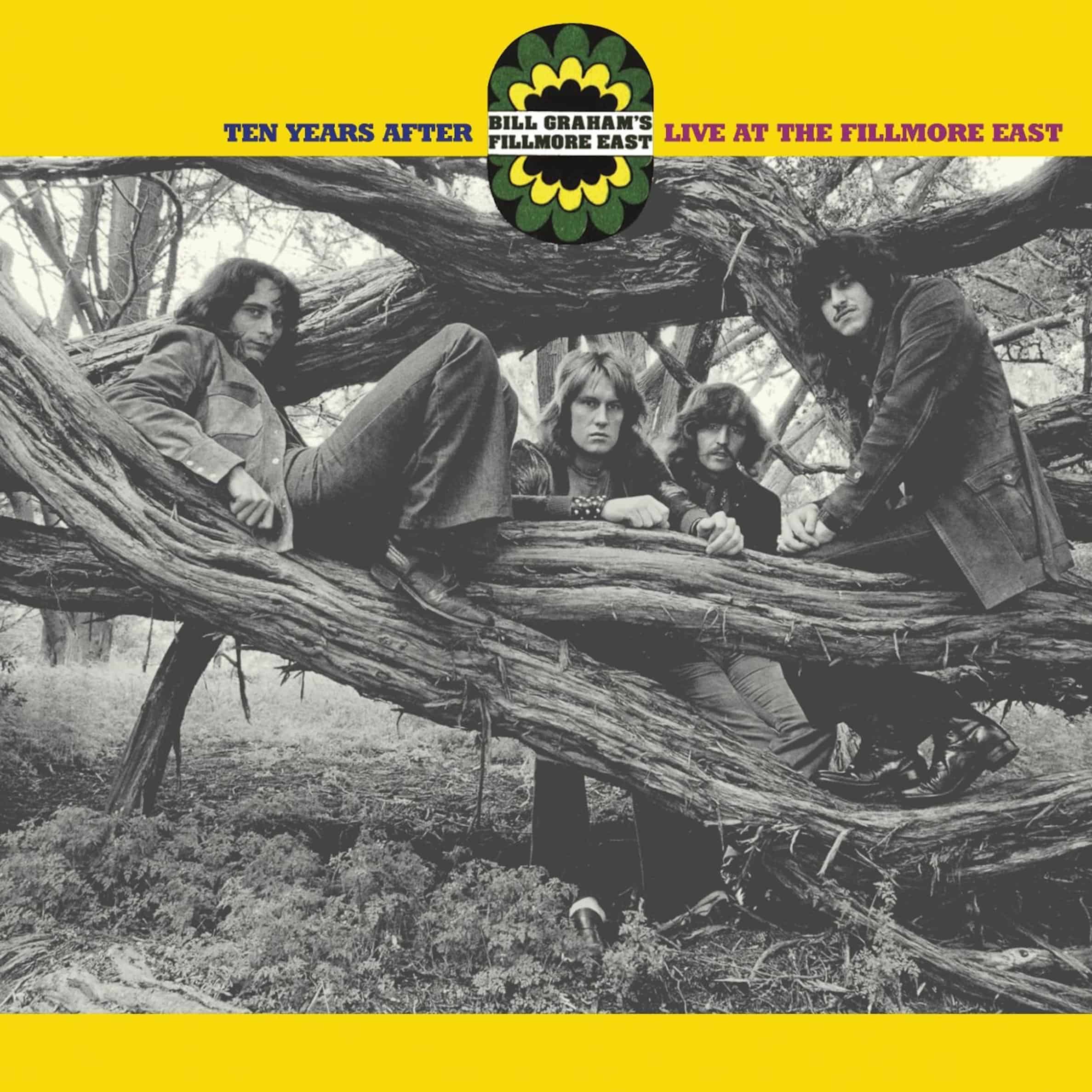
Ric Lee reminisces in 2001:
Ten Years After Fillmore East – February 26, 27 and 28, 1970.
The Fillmore East opened after the phenomenal success of the Fillmore West in San Francisco, California, owned and operated by concert promoter Bill Graham. The Fillmore East was located on 2nd Avenue and 6th Street, Manhattan, New York, USA.
It officially opened on March 8, 1968 and closed forever on June 27, 1971.
Ten Years Afters first performance at the Fillmore East was on August 2 and 3, 1968. This was during our very first tour of America. We opened for Big Brother and the Holding Company which featured their female singer Janis Joplin and The Staple Singers. The Staple Singers were magnificent, but the awesome Janis Joplin completely blew the audience away.
Our next appearance there was on September 27 and 28, 1968. This was sandwiched in between Country Joe and the Fish and the openers Procol Harum, who were friends of ours with the same management.
February 28 and March 1, 1969 saw our first headline gig, supported by John Mayall and Slim Harpo. It was at this gig that I got into trouble with our managers for going on stage in the first set to jam with John Mayall and Mick Taylor, the guitarist that replaced Peter Green in John’s and who would leave again very soon in order to join The Rolling Stones.
Although this was in a time of spontaneous jamming between members of different bands at assorted venues, I was told in no uncertain terms, that on this occasion, that it was not appropriate for a member of the headlining act to jam with the support bands. This in spite of the fact that the entire audience went crazy when I did that, and my actions didn’t jeopardise our status later in the evening in any way. There were other jam sessions at the Fillmore too.
After hours, Bill would supply some food and drinks and the bands, along with some invited guest, would get together and jam until dawn, when everybody staggered out into the cold morning light, and hoping to be able to find the way back to their hotels without too much grief.
The English Invasion was next on April 9 and 10, 1969 with our mates (friends) The Nice and Family. Family and Ten Years After had enjoyed a friendly (and healthy) rivalry, since the early Marquee Club days in England, when both bands were booked by separate agents from the same office. A wager was taken as to which band would first receive a sixty pound fee for an engagement, at any club in the UK during the 1967 period. We won!
On the second day of this engagement at Bill Graham’s burgeoning venue, all of us were pleasantly surprised and flattered when Jimi Hendrix turned up to watch the show.
Alvin, Leo, Chick and I had met Jimi on a couple of previous occasions; the first of which happened when we played support to The Experience at Sussex University, in Brighton, England, early on in our careers, and later when Jimi, drummer Mitch Mitchell and guitarist Larry Coryell came to sit in with us during our residency at Steve Paul’s Scene Club, which was the first New York venue that we played back in 1968.
In 1970, we headlined on February 26 with John Hammond and Zephyr (featuring Tommy Bolin on guitar) and on 27 and 28 with John Hammond and Doug Kershaw. Luckily, the shows on these dates were recorded, and have been re-mastered in their entirety for this double CD set. None of the tracks here have been released before with the exception of: “Love Like A Man”, which was the B-Side of a vinyl 45 single that was released in April of 1970 on the Deram label, and gave us a Top Ten hit in the UK, in the summer of that same year.
The Fillmore East was a cosy theatre with a seating capacity of 3564, and unlike its brother venue, The Fillmore West in San Francisco, which was previously known as the Carousel Ballroom, it had very limited seating arrangements. Before the shows, the street outside would be teeming with hippies, stone freaks, groupies, fans and street people from the East Village. Sometimes, we entered the gig through the front door and were immediately bombarded by all of them, requesting “Spare Change” and “do you have any spare change?”
None of those demands were ever threatening to our safety in any way, and Leo’s initial response was, “Thanks, how much have you got?” – which later would become our stock answer to all panhandlers. Wisely, we never gave in to these constant request, and later on some of these same protagonist who were protesting poverty, would be seen in Chicago and Los Angeles making similar request outside of the gigs in those cities.
Shows at the Fillmore East were twice nightly at 8pm and 11.30pm. But, no matter which time you went on stage, with three other acts on each night, there was always a long wait until your second set. So in order to relieve the boredom of sitting in what were pretty basic and somewhat dismally (grim) dressing rooms, we would often go out front and watch the other acts perform for awhile, and then if it was going to be a long evening, we would venture next door to Ratners. Unlike its English namesake in later years, Ratners was not jewellery chain, but a superb Kosher dairy restaurant. Their nut cutlet was fabulous. This was a dish of mashed potatoes and mushrooms with an outer crust of bread-crumbs. It looked very similar to Chicken Kiev, but the taste was strikingly different and inimitable (indescribably delicious).
Backstage was spartan. The bands performed on staging built out over the old orchestra pit. The area behind the light show screen was stripped of wings, flies and backdrop to facilitate quick changes between acts. It was very stark (barren/empty) and even though the old theatre was very well heated, it always seemed cold on the main stage; surrounded only by three bare brick walls. Most likely if you drilled a hole in those walls, you would find the outside right behind those bricks. No insulation, and a never ending draft from one end of that stage to the other.
All of the heavy back-line gear; Drum Kit, Hammond Organ, Marshall Amp Stacks, and the like were set on low, mobile risers. When the first act finished, the light show screen was raised and the equipment was rapidly rolled in and out of position. Beneath the stage was a grim, mucky basement, but more about that situation later. The stalwart engineer of the tracks on this CD package was pucker Englishman Edwin H. Kramer, better known to us as Eddie.
He is perhaps, most famous for recording all of Jimi Hendrix’s hits, and is the master-mind behind the building of Jimi’s New York Recording Studio called “Electric Ladyland”.
For these Ten Years After recording sessions, poor Eddie was consigned to the grim mucky basement, with: “What was probably a rented, handmade, console and a Scully eight track tape machine, which I believe, I also used at Woodstock 1969 for recording the festival. The desk was probably made by Bill Hanley who supplied all the PA systems around that time. There I was in that dingy cellar, cans (my headphones) on, crouched over the desk, surrounded by enormous heating pipes and although I never actually saw one, I’m convinced that there were rats within spitting distance. As soon as the band on stage right above me leapt into action, I was showered with dust and had to dash to cover the sensitive recording gear with sheets, polythene and anything else directly at hand. Not the easiest (or the most ideal way) way to record.”
The atmosphere up top side, however, was electric. As Bill Graham introduced us individually and the minute you hit the stage, the hot air from the overhead lighting, the air thick with the smell of dope instantly warmed you and set you up for the show. The audience at once seemed like best friends, just wanting to share whatever we were going to give them with tremendous involvement and appreciation. In addition to the usual stage lights, was Joshua’s fabulous light show. Behind my low drum riser was an enormous screen which filled the whole of the proscenium arch, providing a kind of living backdrop / background to the band, which was projected, from a gallery at the back of the stage, the most amazing psychedelic images; forming, then disintegrating / then re-forming again and again in sympathetic (unison / synchronicity) with the music.

A quick note about some of the rare gems that are included here:
“Spoonful” – has been an intrical and principal part of our stage act in the early days and was incorporated in our very first studio album for that reason. By the time this Fillmore East concert came along, it had unfortunately been dropped from our set list, in favour of new tracks from the bands forthcoming; “Cricklewood Green” album. This studio album produced such powerful / memorable hits such as – “Love Like A Man” – “50,000 Miles Beneath My Brain” – and “Working On The Road”. This is most likely why it shows up here an encore.
“We seemed to be playing quite spur of the moment stuff in this period as witness, “Help Me Baby”, about which Alvin comments, “I might add, that’s the first time we’ve played that number for about nine months. Yeah, was a good trip, wan-nit?” (great / perfect)!
“Roll Over Beethoven” – the Chuck Berry classic, has to my knowledge, never before been released on any Ten Years After set, which makes this track extremely rare.”
“Hobbit” – my old chestnut, is included here as it was an integral part of our live sets all through our career and is different to a later version that was on “Recorded Live” 1973.
I was experimenting with different forms at this stage, in the live context. Similarly, many of Ten Years Afters classics gained development on stage, in front of our fans. I don’t mean we were getting paid for rehearsing. What we were doing was more akin to the way jazz players had developed their chops in the years before; taking a basic theme and then jamming it out.
This way, each performance would have something different, however small and the music was kept exciting for both the performers and the aficionados. A good example of this happens in, “I Woke Up This Morning”. There’s a “living on the edge” approach from the rhythm section during Alvin’s extended solo. In effect, we were all soloing and you’ll hear Leo and Chick and me all playing phrases across the beat in a jazz style to both complement and contrast with the guitar, which became one of the trade marks of a Ten Years After performance.
In my humble opinion, these tracks are among some of the best Ten Years After live recordings. When putting this collection together, we tried hard to recreate the excitement and ambience of the gigs when mixing and although the final selection is taken from different nights, we’ve tried to present the album as near to the running order of the show, so that you the listener can sit, get stoned or whatever, and either imagine being at the Fillmore, soaking up the atmosphere if you were never there, or relive it if you were, in what was one of rock’s most famed and revered venues.

Leo Lyons – 2001
Q: Leo, what are your three most memorable Ten Years After concerts?
A: “There are so many highlights from the years of touring that it’s difficult to pick out only three. If I have to, probably the Marquee Club, London the first time we headlined there, the Fillmore’s (East and West) and of course Woodstock (1969). I think these three gigs in their own way were pivotal points when the band broke through and made a connection with the audience. I remember so many enjoyable gigs and I’m sure everyone has their own favorite.”
2002
Goldmine Magazine – April 5, 2002
by Dave Thompson
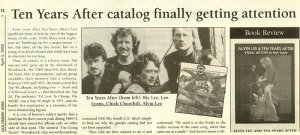
Four years after Ten Years After’s last significant burst of activity, one of the biggest bands of the early 1970’s blues – rock explosion are lumbering up for a major return – not, this time, on the live circuit, but via a string of archival releases that really have lain in obscurity far too long. That of course is a relative term. Ask anyone who grew up in the aftermath of Woodstock, the 1969 “Mud Fest” that thrust Ten Years After into prominence, and the group straddles their memory like a colossus. Between 1970 and 1973, the band scored five Top 40 albums, including two – Ssssh and Cricklewood Green – that breached the Top 20. The anthem-ic “I’d Love To Change The World” was a top 40 single in 1971, and the band’s live reputation is a creature of the most shimmering legend.
It is one of history’s oddest quirks that a band that hit their concert peak between 1969 and 1972 should have issued live albums only on either side of that span. The sainted “I’m Going Home” Woodstock clip nonwithstanding, evidence of the group at the height of its powers has been nowhere to be found. Until Now!
“Ten Years After Live At The Fillmore East” is a two CD set drawn from three of the four shows that the band played at that august venue over the last two days of February 1971.
Recorded by Eddie Kramer, the tapes were shelved only because the group’s next studio album, the aforementioned “Cricklewood Green”, was imminent. Unfortunately, the tapes were also forgotten.
Ric Lee, Ten Years After’s powerhouse drummer, picks up the story. He is the guiding force behind the reissue, having first contacted EMI (the band’s U.K. label) simply to find out why the group’s catalogue had not yet been upgraded. “They told me they wanted to do it and asked if I could help find some bonus material – unreleased tracks and things – to flesh out the original albums,” Lee told Goldmine in a recent phone interview. “I was looking around and suddenly I came across this, an entire album which we had completely forgotten about.”
It was an astonishing find. The band is in vicious form throughout – if one wants to criticize, a couple of the tracks, from the second set of the second night are a little ragged in the vocal department, but that’s about it. For the rest of the collection, Ten Years After are at their incendiary best. “The only track that’s ever been released from these tapes is “Love Like A Man”, Lee continued. “We used it as the B-Side to the studio version of the same song, when that came out as a single.” And therein hangs a tale. “Because the studio version was edited down for the single, we thought it’d be nice to give people the full song on the B-Side. So we used the live version, which is almost ten minutes long. The thing is, because it’s so long, it had to play at 33 1/3 RPM rather than 45 RPM. The A-Side was a regular 45 record speed, and the B-Side was 33 RPM. A few months later, we were in the south of France, in this little cafe and the single came on the jukebox.
Except it was the B-Side which came on, and we just groaned, because it was playing too fast. But nobody else seemed to notice! They all got up started dancing and when the record finished, they gave us a round of applause! “We went back to the hotel still laughing about it, but a couple of nights later, back at the cafe the same thing happened again. Nobody realized that wasn’t how it was meant to sound.” It’s a sobering thought but the French people’s subsequent love for mach-10 – punk rock might well have been born that night, from playing Ten Years After at 22 revolutions too fast.
The Fillmore album is the standard bearer of a full scale Ten Years After reissue program, as all the original albums prepare to re-emerge. In addition, a two CD anthology wrapping up album favourites and non – LP rarities is also set to surface, with the band’s Woodstock breakthrough naturally among the expected highlights. Ensuring that credit is given where credit’s due. Ric Lee admitted that his own performance on the Woodstock soundtrack’s “I’m Going Home” may not be all that it seems. “They didn’t mike up the whole drum kit,” he recalled, “and years later, (Mountain’s Drummer) Corky Laing told me that he went in and overdubbed the bass drum for the movie and LP versions.” Amazing – one of the best-loved moments of the entire event, and the guy who helped create it wasn’t even at the Woodstock Festival. No doubt that tale will be among those that Ric Lee will be recalling once again as he embarks upon a fascinating tour of his own. “It’s a two hour lecture, talking about Ten Years After, including a slide show and music, plus a question and answer session and at the end, a drum demonstration. I’m taking it around Britain first, but I hope to be in the States with it soon.”


Coinciding with the brand new Ten Years After CD of the Live Fillmore East – and the rebirth of “The Ten Years After Story” is Herb Staehr’s “Visual History”, the full story of the ultimate rock and roll warriors. Arranged in a day by day diary format. Visual History follows Alvin Lee, Chick Churchill, Ric Lee and Leo Lyons from their very first show ever, opening for the one and only John Lee Hooker at the Marquee in June of 1967 in London to the burst of activity surrounding the band’s 30th anniversary, the Third Reunion Tour in 1997 – 1998.
The books photos are in black and white but this in no way detracts from the thrill of discovery as you read page to page the bands long and exciting history. In fact, it makes it that much more authentic. All around, then the book is a worthy tome and a salutary lesson to all those modern pop stars who complain that they spend too long on the road. Ten Years After was hardly ever off the road. Ric Lee does remember one night when the pressure got to be too much, and Alvin Lee really couldn’t take any more. “He sat in the van, with his head in his hands, saying he didn’t think he could carry on any longer, and he wanted to leave the band. So my wife said, “Why don’t you just take a holiday, then see how you feel when you get back?” Alvin agreed. So, we cancelled the next night’s show and two days later, he was as right as rain again.”
By Dave Thompson
TYA – re-releases by EMI Records (2002)
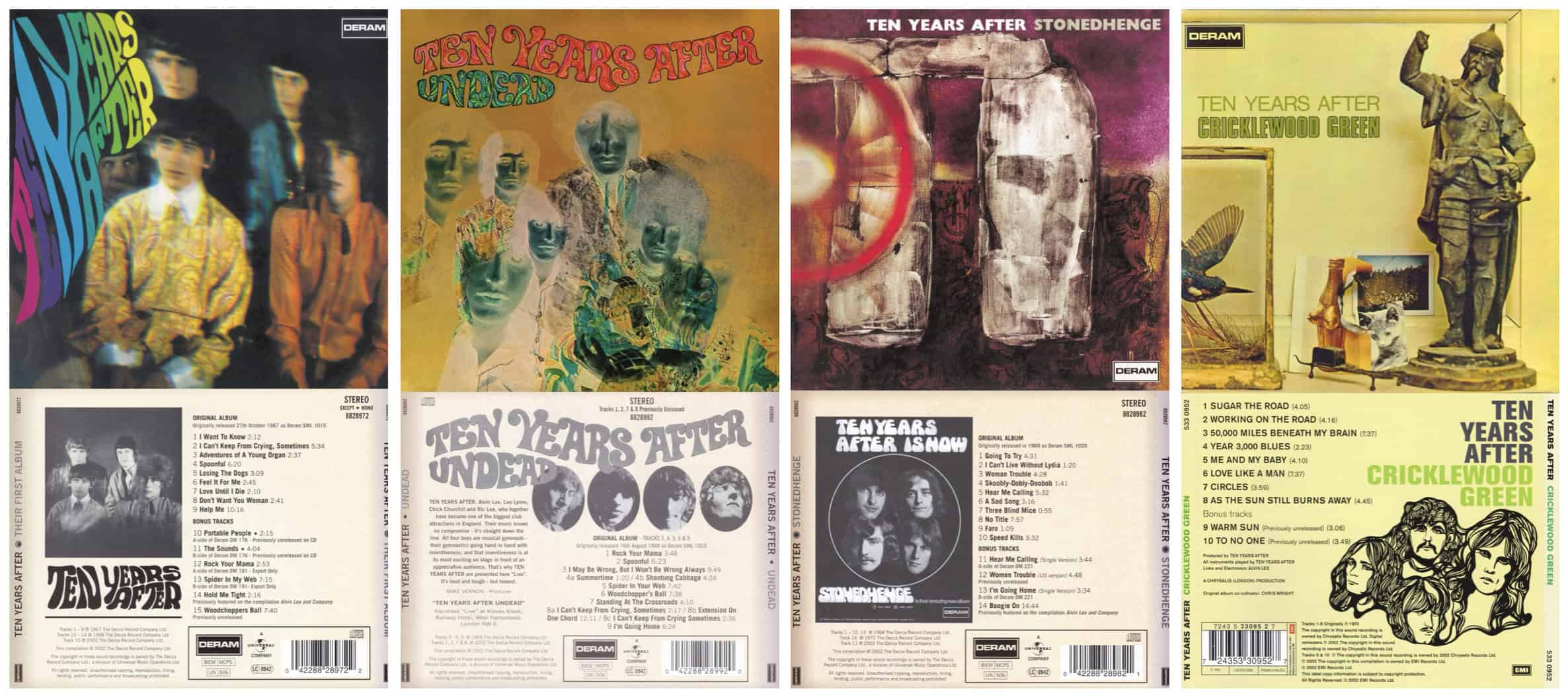
…with the addition of previously unreleased material.
Vintage Guitar Magazine – May 2002
by Glen Anderson
Ten Years After – Woodstock Music & Arts Festival, August, 1969
In the summer of 1968, America was starting to hear about a new blues movement exploding in England, primarily in the hipster clubs of London. Riding the wave of the worldwide success of the Rolling Stones, groups with raw sound and power such as The Yardbirds, The Animals, and Eric Clapton with John Mayall & The Bluesbreakers were avidly embraced. Savoy Brown became a college radio smash.
These Brits were applying variations of the blues form to contemporary culture, and creating vibrant, direct songs. The whole English scene was dynamic and exposed a generation to the music of American blues masters including Sonny Boy Williamson, Muddy Waters, and the entire group of legendary Chicago purists. These British Groups channeled the American blues into an exciting format that was both explosive and relevant to an entirely new audience in America.
Out of this kinetic setting, Ten Years After burst onto the scene, featuring one of the most dynamic, flash guitarists to ever emerge from of the British scene. Certainly, Terry Reed, Mick Abrahams, and Taste also had emerged as guitar powerhouses around the same time, but Alvin Lee was the complete package; a lead guitarist/lead singer with classic good looks; blazing guitar speed; and that rare, key component – taste. He could play cleaner and faster than any rock guitarist of his time, but he had the keen musical perception to insert strategically placed pauses just long enough to catch life and embrace the listener before blazing down the fingerboard.
In 1968 America was ripe and ready for British blues, hungry for the latest group with blue-based style echoing the early work of Eric Clapton and Jeff
Beck. Ten Years After hit the charts with its live album, Undead, recorded at the famous Klooks Kleek in London.
The album absolutely dripped with excitement, and college FM radio immediately embraced its sound. Lee was a gifted flash guitarist who had a real feel for the blues structure. His virtuoso guitar approach was dazzling, and he could immerse himself in the form so completely that his vocal howls echoed the backstreets of Chicago.
Ten Years After was composed of four gifted musicians – with Alvin Lee, Chick Churchill on the Hammond B-3, Leo Lyons on bass, and Ric Lee on drums. The group was tight, focused, and the ideal launching pad for Lee’s gifts. On Undead, they tear into “Woodchoppers Ball” with intense, spellbinding ferocity and determination. The band flies with such determination that the listener can feel the energy that must have radiated in the club on recording night.
Lee had absolute command as his fluid, slick guitar lines fly over the driving rhythm. No sappy sell-the-group pop songs here – this record is a testament to speed and artistry. The lyrical “Summertime” reflects the scope of Lee’s expressive range, as does the album’s version of the now legendary “I’m Goin’ Home.”
In August of ’69, I was 17 and living in upstate New York. We started hearing radio reports of a gathering down in Bethel, where a large rock festival was scheduled for later that week. We couldn’t know it at the time, but this was the start of the original Woodstock Festival at Yasgar’s Farm.
As Friday approached and the reports of freeway closures became more frequent, it was clear that this was going to be a once-in-a-lifetime event. My parents also made it clear to me that I was not to even think about going! Without a pause over that small detail, I managed to convince an older member of the band I was playing with at the time to drive us to the concert – and we were off before my parents realized where we were heading.
We arrived Saturday morning and had to park on a side road cluttered with “abandoned” cars. We soon joined the river of 500,000 people ambling into the woods and meadow near the main stage. Striding up the dirt walkway, we stepped over the perimeter fence, which had been trampled when the crowd declared the event a “free” concert (as a result, I still have my ticket!).
Making my way to a tower on stage right, I saw all the groups that afternoon, including The Incredible String Band, Santana, and Joe Cocker. Everyone was high and happy to be there; I remember someone singing Bob Dylan’s “Ballad of a Thin Man.”
As darkness fell, the announcer called, “Ladies and Gentleman… Ten Years After!” And I was swept up in a classic rock and roll moment.
In the cool, dark evening, the band blazed! Lee mesmerized everyone; he didn’t have to do anything but focus those blues the way he wanted to. No smashing of amps, no running around. He had the power, and he used it. In the huge Woodstock setting, Ten Years After transported us all to a place where only music lived – everything else was blurred and irrelevant.
After all their work in small clubs, Ten Years After was able to create music with tremendous inward power. With the Hammond pounding out the chords, and the rhythm section locked in the groove, the charismatic Lee had the skill to draw everyone in, and share their magic circle of sound.
With that performance, Ten Years After had arrived. For me, the highlight of the festival came when Lee blazed into the intro of “I’m Goin Home”, before the entire band drove the song to the heavens.
What made the band’s performance so powerful was its complete command of the blues, and the sincerity in its presentation. These weren’t “posers” cashing in on the latest fad. They were a dedicated group whose love of the blues was evident in every note they played. They locked into a song and it moved! Lee rode the train in total control of his instrument, playing faster and cleaner than ever, then at just the right moment, he’d slow down and insert a slight pause, leaving the audience gasping at the push/pull! This contrast made “I’m Goin Home” the band’s most powerful showpiece. As Lee’s guitar fireworks and voice blared into the surrounding hills.
Looking back, I don’t know if it was the simplicity of their style or their intensity, but Ten Years After succeeded in becoming a highlight of that wonderful moment that was Woodstock. Their live, raw power connected the audience. The combination of the expressive Hammond B-3 under the searing guitar lines has since become a blues standard.
But on this night, Alvin Lee’s slashing stop-and-go phrasing was magical. He kept his eyes closed tightly as he soloed, and you could imagine that he was transfixed, floating somewhere between the Woodstock stage and the smoky blues stages in London. Time and space failed to exist as his music dragged us all into that special place where only the most gifted musicians and artists can go. And in the darkness, half a million people went along for the ride.
This article originally appeared in VG May 2002 issue. Reproduced with kind permission of vintage guitar magazine
All copyrights are by the author and Vintage Guitar magazine. Unauthorized replication or use is strictly prohibited.
July 13, 2002 — Interview with Alvin Lee
FROM NOTTINGHAM TO WOODSTOCK TO CHAMPNEYS
ALVIN LEE ENDS UP IN A DRUG REHABILITATION PROGRAM FROM ALCOHOL AND COCAINE ABUSE. WHILE DOING HIS LAST GRAM OF COKE AT THE GATE, HE CHECKS HIMSELF INTO CHAMPNEYS HEALTH FARM FOR A COMPLETE DETOXIFICATION, AND THUS TRADES IN HIS WHITE CLOGS FOR….

The story starts as a helicopter drifts over a sea of faces and heads towards the stage. 500,000 people, some naked, some on drugs, mostly hippies, were there to see some of the biggest names in rock and to celebrate peace and love. Man.

Many shielded their eyes as they looked into the bright August sun towards the helicopter, as they wondered who might be inside.
The helicopters had been ferrying the artists in and out all weekend long, as it was the only way. The two lane highway that led to this cow pasture in upstate New York was totally blocked for seventeen miles. Groups of youngsters had driven halfway across the country in their flower-daubed VW’s in order to get there. But the fact remains, that less than half of them actually paid for tickets.
Police stood helplessly by as the crowd, who were expected to reach 60,000 swelled, tore down fences, smoked pot, took acid, danced naked and listened to some of the best music on the planet.
Some who had already been and gone on the Friday and Saturday included The Grateful Dead, Janis Joplin, Sly and the Family Stone, The Who and Jefferson Airplane. Now it was Sunday August 18, 1969 the final day of this amazing, unique event, and the guests would include Jimi Hendrix, Joe Cocker, The Band, and Crosby, Stills, Nash and Young.
As the helicopter in question touched down in the backstage area, out trooped four lads from Nottingham, England called Ten Years After.
Says singer, songwriter, and guitarist Alvin Lee, “We were only there about five hours in all, and three of those waiting around because it had been raining, the stage was soaked, and electricity was sparking. It didn’t look likely that anyone would be going on stage for an hour or two so I went for a walk through the crowd and around the lake. It was the best decision I could have made, I saw the festival from the other side. Backstage was utter confusion, bands and managers were vying for who goes on next, and during this, the whole backstage area had run out of cigarettes so I volunteered to go and find some. It was a different world out there, the people were fantastic. No one knew who I was but people were offering me food, drinks, joints, anything they had. They were happy to share. I remember near the stage entrance area there was a police car with nowhere to go. It was totally wedged in by people so the two cops were sitting on the grass smoking a joint with some of the crowd. “If you can’t beat’em join’em”, a grinning cop said to me. I asked if he had any cigarettes. He said no and handed me a couple of joints. I walked off around the lake area there were lots of naked people swimming, and it all seemed serenely natural in this setting. It reminded me of a native Indian scene with camp fires, and barbecues, and circles of people passing round pipes, and stuff. I asked for cigarettes, and they handed me a couple of joints too. When I eventually arrived backstage after my adventures, it was still chaos. “Have you got any cigarettes?” they asked. “No, but I’ve got 18 joints.” Alvin’s walk seems to have done the trick.
TYA’s 90 minute set on that Sunday would change their lives forever. In fact, before Led Zeppelin came along, Ten Years After were Britain’s biggest selling rock band. It was a nine minute version of their encore number called “I’m Going Home” that became a festival highlight, when the `Woodstock’ movie was released the following year. The reason was Lee’s guitar wizardry. “I have watched it a few times since, and it’s still pretty good,” he admits today. “Of course you see the mistakes, but that was all part of it.”
Ten Years After is: Alvin Lee on guitar and vocals; Ric Lee on drums; Chick Churchill on keyboards; and Leo Lyons on bass guitar. The band would sell millions of records, tour the United States more than any other band in the world, and rub shoulders with rock legends such as Jimi Hendrix, Janis Joplin, and George Harrison.
There came the country mansions, the fleet of cars, and inevitably, the sex, and the drugs, along with their rock and roll. It was a long way from Wollaton Park where Alvin grew up, with his two older sisters, Janice and Irma.
By trade his father Sam was a builder, while his mother Doris ran a hair-dressing salon. They both played guitar. They used to do odd gigs as a cowboy trio; my mum, my dad, and my sister Janice. My dad collected ethnic blues records, prison work songs, and stuff like that. Big Bill Broonzy, and Lonnie Johnson. “I grew up listening to that, and that’s where my blues came from.”
Along with his parents musical influence, Alvin was swept up into the American culture of the late 1950’s including James Dean, Bill Haley, and of course Elvis Presley. Alvin says, “It was all very romantic, and a contrast to my environment in Nottingham where you were brought up to work at Raleigh or Players.” As it turned out, he would only have one “proper” job after leaving school.
Leaving Margaret Glen-Bott School, where he says he was a bit of a rebel and was regularly sent back home, for wearing “inappropriate clothing”, it was at Weller Gauge, a light engineering company that he worked for about two months. Alvin says, “I cut my fingers one day on some metal work and my Mum said, `you can’t stay there-you have your fingers to think about.’ So they let me pack it in and concentrate on my guitar playing.”
Alvin’s very first gig had been at the age of thirteen at the Palace Cinema in Sandiacre, which was located by the railway bridge, and has long since been demolished. At that time he was playing with Alan Upton and The Jailbreakers, right before the screening of a Brigitte Bardot movie, in which the advertisement announced, `Alan Upton featuring Alvin Lee, and his amazing talking guitar’. His Mum still has got the cutting.
He joined his next band called Vince Marshall and the Square Caps, by way of another advert in the Evening Post. Alvin says, “we rehearsed for three months, played one gig at `All Souls Church’ in Radford, then broke up.”
Next in line, was Ivan Jay and the Jaycats, and Alvin says, “Ivan Jay is living in San Diego now. He’s a car racer and one of my heroes. He was a bit older than us, and we all looked up to him. He had bright blond hair, and my Mum dyed his hair pink and blue on the sides, and he had to go home on the 39 bus.”
By the early sixties, Ivan had left, and Alvin had taken over the vocal duties, and the name was changed to the `Jaybirds’, playing in Nottingham at such clubs as The Dancing Slipper, The Carousel, The Cocked Hat, and The Regal located in Ripley. They followed the Beatles trail to Hamburg, and to the famous Star Club, located in the heart of the red light district, the Reeperbahn. Alvin says, “That’s where I learned everything about sex, drugs, and rock’n roll.”
The Beatles had been there and gone by the time the Jaybirds arrived, but other artists including Tony Sheridan, Cliff Bennett and the Rebel Rousers, and The Big Thre were there performing.
Alvin says, “I’d seen nothing like it before. The Star Club was run by gangsters. When you were playing there you got a little badge with a star on it. I’ve still got mine. It could get you in anywhere in the Reeperbahn. I was glad to get away from there alive, it was a bit hairy at times. “All these kind of gangster things were going on. Hookers used to come down to the gig at two in the morning, and pick on the young boys for a bit of fun”. Like you Alvin? “Yeah, a lot of fun actually,” he laughs, “I was there a month, but it felt like two years.” Find below the lyrics to “Little Boy”.
The story behind Alvin’s song LITTLE BOY which he wrote as a little autobiography about a period of weeks that occurred in his teenage years. He talks about his discovery of sex, drugs and rock `n’ roll in Hamburg, Germany. It seems that just for fun, the hookers would come down to the Hamburg club in the small hours of the morning and have a little fun with the cute young teenage boys, who were there. Alvin just happened to be one of the LITTLE BOYS who attracted the attention of these whores. As I have yet to find anyone who transcribed the lyrics correctly, this version is the way I heard Alvin sing it, but we’re always open to making corrections.
The song starts:
“I’m gonna tell the story now”, he says, “give me bass drum. When I was a little boy, I didn’t know right from wrong, I was young and innocent, but it didn’t last too long. I went out to Germany, reeperbahn and all that, I aged five years in thirty days, now there ain’t no turning back.
(Choirs) ….
Ooh, it ain’t a bad world, it ain’t bad all the time, No one gives, gives you no guarantee that you’re gonna like what you find.
You can’t forget the things you learn, you can’t go back in time. I live my life to gain experience, I’ve laid it on the line.
I don’t claim I’ve seen everything, but I’ve had my share. I don’t understand everything, but I know what’s fair.
(Choirs) ….
Ooh, it ain’t a bad world, it ain’t bad all the time, No one gives, gives you no guarantee that you’re gonna like what you find.
While backing American singers on tour in the UK, like The Drifters and The Ivy League, and with ex-roadie Chick Churchill, who was from Ilkeston, joining on his Hammond as organ/keyboard player, the band also took on a new name and now became Ten Years After.
It was in 1966, and blues rock was an emerging force in Britain, and Ten Years After were signed to `Decca Records’ where Jonathan King chose Love Like A Man to be released as a single. It became their only hit in Britain, but like Led Zeppelin, who came later, Ten Years After were really an album band, particularly in the USA, where Lee’s speed guitar playing earned him hero worship on a par with Jimmy Page and Jimi Hendrix. Alvin’s trademark `Red Gibson ES-335′ along with his long blond hair, white clogs and loons epitomized a definite kind of hippie cool.
So that by the year 1968, Decca were pushing the band in the direction of America. It was during these early tours that the members of Ten Years After would be rubbing elbows and shoulders with the likes of Jimi Hendrix and a hurricane-voiced blues singer named Janis Joplin, who more than held up her end when it came to drugs, drinking and living her life in the world of rock `n’ roll excess. As Alvin tells it, “Most guitarists…Jeff Beck, Jimmy Page and the like, I figured we all had about the same influences, and I knew where they were coming from, but Jimi Hendrix… from outer space, he was a force on his own.”
Alvin, like most others during the 1960’s was into sampling the new drug called `LSD’ in great quantities. Alvin recalls, “I became cosmically conscious. It did me a lot of good. As a lad, I was a bit of a tearaway. With the Jaybirds, we had shotguns in the van and would go around shooting poor old rabbits and crows, but it all changed, I wouldn’t kill an ant after I had LSD.”
So by the mid 1970’s Ten Years After were feted in the USA and were selling millions of copies of record albums. Alvin bought himself a 16th-Century-Country Mansion, located in Berkshire called Hook End Manor, which included twenty rooms and was set on fifty acres of land. It was to become the band’s headquarters, their studio and their workshop. Alvin reflects, “I built a large studio in the old barn there which was called Space Studios. It had no windows, and no clocks so it was impossible to know what time of day or night it was. They were crazy times. We often used to spend all night in the studio, and when we came out it was already light outside, so we’d go back in for another ten hours until it got dark again.”
“The craziness went on for several years, but then it started to get too crazy. At first we just used to smoke lots of hashish, but later came the cocaine, which was totally unproductive, and a big waste of money. We would be in the studio for three days at a time, non-stop, and I don’t think we recorded anything worth keeping during the whole two years. Fortunately, I saw the light in time, I looked in the mirror one day, and said `Who the hell is that?’ I immediately went and checked in to Champneys health farm for a complete detox.”
After finishing off his last gram of cocaine at the front gates, Alvin submitted to a check-up. A doctor took his blood pressure, and informed the guitarist: “It looks like you’ve got here just in time.”
In retrospect Alvin laments, “Since then I am glad to say I have swapped my clogs for trainers (sneakers), and I have my own gym and studio at home.” Alvin concludes, “The drugs are just a purple haze.”
As for Ten Years After, they would get back together in 1989 to make an album entitled `About Time’, along with a tour, but the fact remains, that since the mid-seventies, Alvin has concentrated more on his solo work and with the Alvin Lee Band than devoting any time at all to his fellow band mates or with his old band, Ten Years After.
Alvin now lives in Malaga Spain. He says, “It’s a lovely view from my studio, I can look out and see the ocean.”
What does he do everyday? Well – lets ask Alvin: “I’m still writing songs, and touring, though I haven’t played in Nottingham for a long time, but I’d like to play `Rock City’, I have a music publishing company with offices still in Nottingham.” Although he has never been married, he does have one daughter named Jasmin, who is now in her twenties, and is also working in the music business as a band manager.
Although Alvin left Nottingham at the young age of eighteen, he is now fifty seven (as of this article), and he still carries the prominent accent, and keeps in touch with his Mum Doris, who is still living in Wollaton Park. As Alvin states, “She was always really proud of me. To be honest, I don’t often do interviews these days. I’m not really bothered about the history books, but my mum said `oh I’m so proud of you, go on, do it’.”
Alvin continues his conversation and talks about, George Harrison, Janis Joplin and Jimi Hendrix:
Looking back, it was at Steve Paul’s Scene Club, that one Jimi Hendrix stood by and watched Ten Years After perform, as Alvin reflects, “We were doing `I Can’t Keep From Crying, which had a twenty minute guitar solo, and I went into it with jazz octaves, and stuff like that, he came up to me (Jimi Hendrix) and said `wow I’ve been thinking of doing something like that, but you beat me to it.’ So there was a bit of mutual respect there.”
When they met up once again, it was at The Speakeasy in London. Alvin continues, “He (Jimi) asked Leo Lyons if he could get up and jam, and Leo said `no’. I knew who he was, but I don’t think Leo did, which was a bit embarrassing. He (Jimi) did have some terrible gigs though, because he would treat his guitar in such a way, it would go dreadfully out of tune. He would come off stage and he would throw his guitars at the roadies, going raving mad. Apart from that, he was a very nice guy, very quiet. Quiet and mad, hot and cold, like all larger-than-life people.”
Alvin and George Harrison became close friends and neighbours after Alvin moved in to Hook End Manor, as Alvin says, “George lived just down the road at Friar Park in Henley, and we used to jam together, and play on each others albums all the time. I remember one time he came over with Eric Clapton and Carl Radle, and I was rehearsing with my new band Ten Years Later. We had a jam session and recorded `Too Many Lead Guitarists Blues’. At the end I shouted `everybody take it’ and it turned into the loudest cacophony you’ve ever heard. George would later come over and play slide guitar on my albums. He played on `Real Life Blues’, `Talk Don’t Bother Me and `The Bluest Blues’. George also played on my version of the Beatles’ I Want You-She’s So Heavy. He was a wonderful man, and I miss him greatly. He always used to send my mum a food hamper or flowers on her birthday.”
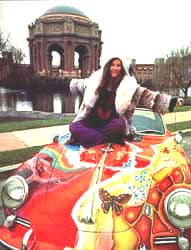
It’s no surprise that Alvin’s friendship with Janis Joplin was far less relaxed, as Alvin remembers it, “I think she had a thing for me, she called me baby-cakes, but I didn’t know what it meant, my ass I think…hang on my mum’s reading this.” Alvin goes on, “One night when I saw her play, the audience were handing bottles up on stage to her, and she tweaked my ass, and gave me a bottle of Southern Comfort. I didn’t realise it was a strong whisky, and I drank most of it. Next thing, I woke up at five in the morning, backstage at the Fillmore East in New York City, and there was no one but a guy sweeping up.”
So had Janis got what she was after from Alvin?
Alvin’s firm reply, “No, she scared me, she was one of the boys, and far too dangerous for me at that time.”
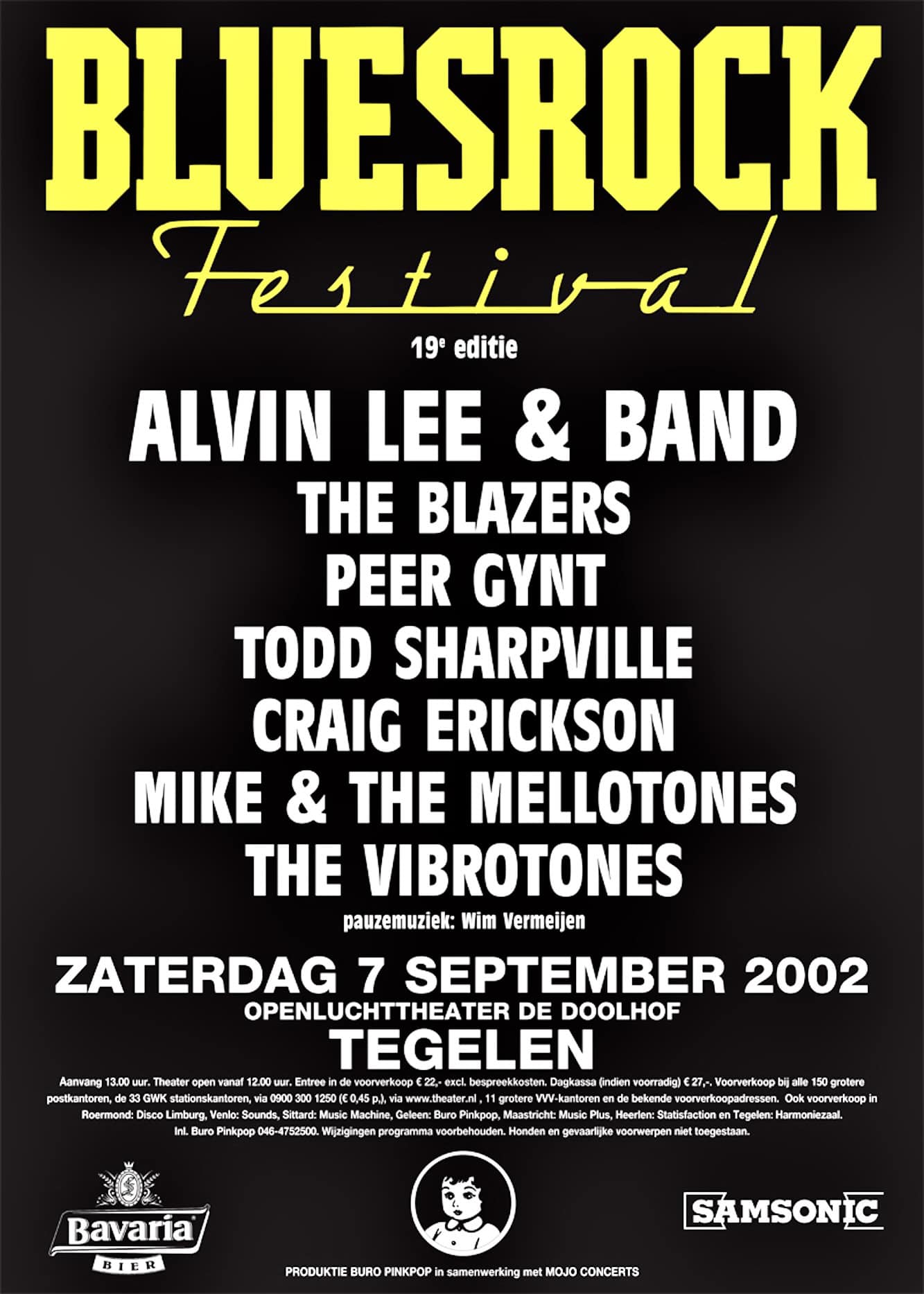
September 7, 2002 – Bluesrock Festival Tegelen, Holland
An association of TYA
Gus Dudgeon
From Decca’s tea boy to famous record producer
Top producer of the year with Elton John
A sad ending:
On Sunday July 21, 2002 while driving home from a party with his wife Sheila, (whom he married in 1959) Gus Dudgeon fell asleep at the wheel and drove off the M4 between Reading and Maidenhead. The car plunged down a steep embankment at a high rate of speed. The couple crashed into a drainage ditch, their Jaguar convertible landed upside down, where they both drowned. Gus was 59, they had no children.
Elton John was deeply saddened by their death and called Gus the greatest producer of his generation.
Gus was born on September 30, 1942 in Surrey England and educated at Hailey Bury:
He began work at Olympic Studios off Baker Street in London as a tea-boy, but eventually he was promoted to the position of sound engineer and moved to Decca Recording Studio in West Hempstead. He worked with The Artwoods, Bruce Channel, Davy Graham, The Small Faces and Shirley Collins. His early pop successes included The Zombies hit song “She’s Not There” which went to number two in the top ten music charts in 1964, he produced everything by the Zombies thereafter. Then he did the famous John Mayall Blues Breakers album featuring Eric Clapton in 1966. He helped with the auditions of Tom Jones, Lulu and The Rolling Stones. His very first co-production credit came in 1967 with the debut album named after the progressive blues band “Ten Years After”. He also did Eddie Boyd and His Blues Band album (in 1967). This was followed by his production of The Bonzo Dog Band albums that included: The Doughnut in Granny’s Greenhouse (1968) and Tadpoles (1969). Gus also produced two highly successful albums for Elkie Brooks: Pearls and Pearls Two. He went on to produce the then unknown David Bowie’s hit single “Space Oddity” with exceptional acoustic guitar accompaniment by Keith Christmas. Gus liked to point out that three of his biggest hit singles all had surreal space travel themes. David Bowie’s – “Space Oddity”, The Bonzo Band’s – “I’m The Urban Spaceman” (it says ‘produced by Paul McCartney’ 1969) and Elton John’s famous hit “Rocket Man”.
Goodbye Decca – Hello Yellow Brick Road
Gus became independent in 1968 and left Decca Records, founded his own company, and his first big production project was for EMI, doing Zoot Money’s Big Roll Band.
Then in 1970 he began working with Elton John. The very first song that they worked on together was ironically called “Your Song”, on which Gus elaborated on the simple piano tune and added an orchestral arrangement by Paul Buckmaster. The song reached into the top ten in the United States, thus becoming Elton’s first substantial certified hit. Gus continued working with Elton on his next several albums.
Although Gus, at times, could be very critical of Elton’s work. Case in point was Elton’s 1974 album titled “Caribou”, which Gus says – “It’s a piece of crap, the sound is the worst and the songs are nowhere, the record sleeve came out wrong and the lyrics weren’t that good, the singing wasn’t all there, the playing wasn’t great and the production is just plain lousy.”
Gus Dudgeon along with Elton John, Bernie Taupin and Steve Brown founded “Rocket Records” in 1972. Gus also became the founder of “The Music Producers Guild” and in 1995 he re-mastered much of Elton’s music catalogue. It also says that Gus was the first person to use sampling in 1971 – using a tape loop of African tribal drumming…but I just watched a dvd where Sir Paul McCartney predated Gus by four years on the Beatles Sergeant Pepper Album. Paul brought in a plastic baggie full of tape loops, for George Martin to use on the sessions.
Ten Years After, Elton John, Chris Rea, Jennifer Rush, Elkie Brookes, XTC, Fairport Convention, The Beach Boys, Joan Armatrading and The Hollies were among the main leading artists who benefited from their association with Gus Dudgeon, who was one of Britain’s most respected and prolific record producers. While he spent many years in a branch of the music business that’s notorious for hard-nosed, cynical attitudes, Gus was much liked for his breezy blend of good humour and enthusiasm. He put the artists at ease in the stressful confines of a recording studio, yet he maintained a straight-talking, bustling style that commanded respect. If ever there was ever a person who would willingly give his time to help a struggling artist or recording engineer – it was Gus Dudgeon!
Elton John had tremendous respect for the talent of his producer, and thus gave Gus complete freedom to craft the finished tracks as he pleased. Gus, for example, did the songs: Saturday’s Alright For Fighting, Rocket Man, Crocodile Rock, Daniel, Goodbye Yellow Brick Road, Don’t Go Breaking My Heart (with Kiki Dee) and Nikita.
From Gus Himself:
“I was terrified of ever getting on the console, but the thing I loved about it was, just the volume and actually hearing the real low end! It was like “Bloody Hell” !!!
“That’s bloody marvellous” !!! I just loved the power of the big speaker system. I never heard anything like it.”
About Gus Dudgeon:
He was an exceptionally charming and funny man. He was a flamboyant dresser, favouring wide striped suits, winkie-pickers, tight Levis, brooches and colored sunglasses. And while his hard work earned him a considerable fortune, a crooked accountant relived him of much of his wealth. But Gus never rested on his laurels, he was always visiting clubs on the lookout for new bands and artists that he could produce. In his early days, he was raised in the post Goons and Monty Python era, which meant that he could relate to the things that made his artists laugh. This while his career paralleled the vast explosion in rock music and the expansion of the recording studio technology and audio advancements in general. When he began his work in the mid 1960’s he was limited / confined to using a four track recorder and had to endure the strictures of the pre-electronic era. Just as George Martin had done with the Beatles. At Decca there was a daily roster of bands and artists to deal with, and Gus had to work with top session men during intense three hour sessions. The music had to be sight-read and recorded “live” in the studio, with as few takes as possible.
“There was no room for perfection” replied Gus.
David Bowie’s “Space Oddity” reached number 5 in the U.K. charts in 1969 and then reached number 1 when it was re-issued in 1975. Gus later said that he was only paid 250 pounds in advance for his work on the hit and claimed that he was owed in excess of a million pounds in unpaid royalties!!!
Among others he worked with were: Marianne Faithfull, The Strawbs, The Rolling Stones and on a project with George Harrison and Ringo Starr. Again, let it be pointed out, that Gus Dudgeon was one of Britain’s most successful record producers.
In His Free Time:
Gus was happy to spend more of his free time gardening around his 16th Centaury Surrey home. Just as he maintained his love of live music, and went to see three “Unknown” bands per week. He kept his sense of humour too, listing among his other hobbies, in the true Bonzo Dog Band style of collecting rhinos.
Some of the text on this page by Chris Welch.
At The Funeral:
The funeral service was held in Cobham, Surrey, where Gus and Sheila lived.
“We have not only lost a couple who treated a very naive country boy with great courtesy in his younger days, but also an extraordinary talent without those our early records would never have taken on the legendary status they have been so fortunate to attain. I love Gus and his loving wife, and I thank him for all that he had done for me over these many years. I would now like to offer this lost couple a song called, “High Flying Bird”. In thanks for the glorious times, and may you be in heaven together forever, Love Elton…..We’ve been missing you.”
Foundation In His Name:
The Gus Dudgeon Foundation for the Recording Arts, was formed to preserve and promote the techniques of recording and production exemplified from his outstanding career and to give students from all walks of life the opportunity to learn and pass on these skills for future generations. The studio will provide a world class recording facility that will be available to students, academic institutions and commercial clients.
The Music Producers Guild – United Kingdom
Conceived and supported by producers and engineers who are passionate about all aspects of creating and creating music, it provides a community for us to share our collective experiences and collaborate with other like minded people.
The Gus Dudgeon Suite:
Is now the home of Gus’s MCI mixing console and his legendary 24 track, along with other studio equipment and valuable memorabilia, including some of his many prestigious awards that represent his long and distinguished career, contributed by the Gus Dudgeon Foundation and The Music Producers Guild.
2003
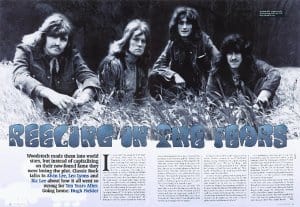
Classic Rock Magazine, August 2003 issue
Ten Years After — Reeling in the Years
WOODSTOCK made them into world stars, but instead of capitalising on their new-found fame they were losing the plot. Classic Rock talks to Alvin Lee, Leo Lyons and Ric Lee about how it all went so wrong for Ten Years After.
Written by Hugh Fielder
It was getting dark by the time Ten Years After took the stage at Woodstock back in 1969. The rain had come bucketing down mid-way through the afternoon, just as they’d been about to go on, drenching the stage and turning the site into a quagmire. The audience variously estimated at between 350,000 and 500,000 was wet, chilled and bedraggled; many of them were the worse for wear after three days in the open.
The band weren’t in much better shape, having travelled overnight from St. Louis, making the last leg by helicopter and then being cooped up on-site in the back of a trailer, waiting for the rain to stop.
In the movie of Woodstock, the camera picks out the skinny frame of Ten Years After’s Alvin Lee, his boyish face ringed by shoulder-length hair. “This is a thing called “I’m Going Home” by helicopter!” he announces, and for a dozen seconds he rattles out notes on his trademark Gibson guitar that sound like a sustained burst of machine-gun fire. The band then kick into a breakneck boogie and the song takes off; Alvin spits out the vocals, filling in the spaces with more guitar salvos. The camera remains fixed on him; there are just occasional glimpses of keyboard player Chick Churchill, drummer Ric Lee (no relation to Alvin) and bassist Leo Lyons, who is head-banging furiously. Alvin leads the song high and low, never letting the pace flag, until nine minutes later he builds to a final warp-speed cacophony. The crowd, their central heating now restored, erupts.
When the Woodstock movie came out in late 1970 (more than a year after the actual festival) it did for Ten Years After what Live Aid did for Queen and U2; it transformed them into superstars. Suddenly Ten Years After were the new heroes of British Blues Rock.
Or, as Alvin puts it: “That’s when fourteen year old girls started showing up to our gigs with ice creams.”
Ten Years After had been in the vanguard of the second (and much heavier) invasion of the US by British groups, touring relentlessly and rapidly reaching top of the bill status. “We had this thing – and looking back I’m a bit ashamed of it now – that we had to sting any band that went on after us,” Alvin recalls. “We used to go out of our way to blow them off and make them look bad, it wasn’t so much playing well as going down well; we’d learnt that from our years on the club circuit, and there were a lot of bands in America who wouldn’t go on after us. At Woodstock Country Joe McDonald whipped his equipment on before us because he’d played after us at the Fillmore East and died a death. We used to wear the audience out. It really was a heads-down-let’s–go-for-it attitude.” (Alvin and Leo called it “Their Blow’em Off Policy”).
“Leo used to shake his head off, that was fine on stage, but he’d do it in the studio too, we used to have to gaffer-tape his headphones to his head.” Leo’s head-banging style even got him an offer from Frank Zappa to appear in a movie he was planning called “The Choreographers Of Rock “n” Roll. Leo reveals the secret behind Ten Years After vigorous and intense live shows: “Ric and I egged each other on when we flagged (slowed down a bit, and needed that edge back) I’d yell “Hit them you bastard!” and he’d shout back: “Fuck Off.” Leo would also spur Ric on by spitting at him – anticipating the punk movement by a decade – but the drummer never minded as Ric says “because he always missed”.
Riding the crest of this high-energy wave, Alvin would sneer and pout outrageously as he tore through solo after solo. Even on the slower songs his burst of notes seemed faster than mere human fingers could manage. No wonder the American media dubbed him “Captain Speed-fingers”.
But behind the bravado that had propelled Ten Years After into the premier league was another, more insecure, Alvin Lee who just couldn’t handle the superstar status that the Woodstock movie had bestowed on the group: “We’d been playing for the heads, the growing underground audience”, he recounts, “ But then it got bigger and people had to come to ice hockey arenas and stadiums to see the band, and because of this, we lost the personal connection with our audience. You had police with guns and cotton wool sticking out of their ears, sneering up at the band and looking for half a chance to beat up some unfortunate and unsuspecting audience member. It was awful, and at this point I realized that it had all gone wrong and I found myself thinking, “what the fuck am I doing here?””
And the song that made Ten Years After famous was becoming an albatross (a ball and chain): “You’d walk on stage and people would be shouting for “I’m Going Home”, which was the last song in our set. I often wonder what the rest of our career would have been like if the Woodstock movie had used another song. As it was, everything became focused on the last song, which also happened to be our most high energy number and show topper.”
To make matters worse, Alvin was also becoming estranged from the rest of the band members: “I think they began to resent me because I started to back off then,” he admits. “I couldn’t help it, I hated it, I just hated all of it, I used to go on stage and go; “dong” (as he mimes a big chord) and the audience would go “YeaHHH!” You could do anything, it was just crazy, it was horrible. My problem was that I couldn’t communicate it to anybody, as my band mates thought I was looney, as I went into sulks and things like that, maybe I should have tried to talk more with them, but it didn’t work for some reason, they started to get jealous because they thought I was being singled out to do all the interviews and the photo sessions. I wasn’t getting singled out, I was the songwriter, singer and lead guitarist, after all, so obviously I was the one they all wanted to talk to.”
There was indeed resentment from the rest of the band, but it was born out of frustration rather than jealousy. Around the time of Woodstock, Ten Years After’s management had decided to focus all the attention on Alvin, which is fair enough you might think, as it was Alvin who was the front man, the guitar hero and the pin up poster image. But Leo Lyons and Ric Lee believe differently, to them (and they should know better than anyone else) ‘Alvin was temperamentally unsuited to assume the role’. “I felt it would be too much pressure for Alvin, and told our manager, Chris Wright, that he was creating a monster he couldn’t control,” Leo says.
Their misgivings were well-founded, because at the very moment that Ten Years After should have been seizing the initiative, Alvin retreated behind a wall of dope smoke. Whenever Ric and Leo, angry at being marginalised, managed to provoke a reaction out of Alvin it was invariably the wrong one. It created a rift, and the recriminations continuing to this day.
What added to the bitterness was how close the group members had been up to then. Ric describes Alvin and Leo’s relationship as “a well-oiled marriage”. It dates back to 1960 when Leo started playing with Alvin, already a precocious guitarist, in a local Nottingham band called “The Jaybirds”. They even went through the classic 1960’s rock group apprenticeship together, playing a five week stint at Hamburg’s Star Club in 1962 – just a week after the Beatles played there. According to Ric Lee, “We stayed in a two-room apartment above a mud-wrestling / sex club,” Ric remembers. “The rooms were filled with bunks and there were probably ten or twelve people living there. I was eighteen, Alvin was seventeen, and we were exposed to prostitutes, pep pills and music twenty-four hours a day.” Alvin confirms that the Hamburg experience was “a real rite of passage, as one day I went into the bathroom and there was one bloke sitting on the toilet, a guy in the bath and another guy washing his socks in the bath water, when all of the sudden another bloke runs in a fires off a gas gun into the room – it was total madness. There was also a scary side to it with the gangsters. One guy had this big welding glove and when you used to see him going out with it you’d think: Uh-oh, trouble.”
When the band returned to England Alvin bought his first Gibson ES335 – which would become his trademark guitar. Ric, who came from nearby Mansfield, replaced the previous drummer (Dave Quickmire) in 1965 (as it was Quickmire who personally recommended that Ric take his place in the band) and soon afterwards they brought in Chick Churchill on keyboards. The following year they started tapping into the burgeoning blues market in Britain that John Mayall had opened up. “I threw myself headlong into that,” says Alvin who had grown up listening to his dad’s collection of pre-war bluesmen such as Big Bill Broonzy, Lonnie Johnson and Josh White, but it was the jazzier influences in the group that meant they were always, as Ric says, “a bit sideways-on to the blues”.
That paid off when Chick Churchill got them an audition for London’s then legendary Marquee Club early in 1967 and equally legendary club manager John Gee who was very impressed by their version of Woody Herman’s “Woodchoppers Ball”. To celebrate, they changed their name from the now outdated Jaybirds to Ten Years After – which Leo found while flicking / leafing through the pages of the Radio Times Magazine.
Via the Marquee, Ten Years After landed a spot on the 1967 Windsor Jazz and Blues Festival (which later became known as the Reading Festival), where they got a standing ovation from 20,000 people in attendance. Among them was noted blues producer Mike Vernon, who was there checking out one of his charges, Fleetwood Mac. It was Vernon who later signed Ten Years After to Decca’s new Deram label (which ironically, the band had just recently failed their audition for Decca).
In keeping with the times, Ten Years After slapped down their very first record album in just five days, and “Mike could see that we were a bit radical as far as his kind of blues was concerned,” Alvin recalls, “but he basically gave us the freedom and said get on with it.”
The album caught Ten Years After’s raw, jazzy approach to the blues, which could be high-velocity, as on the opening song “I Want To Know”, or the slow, extended and mood building, closing number called “Help Me”.
The record was rough and ready, but it attracted the attention of famed American concert promoter Bill Graham, who was looking for new bands to play at his Fillmore venues in San Francisco and New York and figured there must be more where Cream and Hendrix had come from.
In June of 1968 Ten Years After started a seven-week US tour at the Fillmore West: “That first tour was great”, Alvin recalls, “We had such a good time out there, and we lost around $35,000, but we got asked back so we knew we were on our way. The strange thing was that we had gone to what I considered to be the home of the blues, but they’d never heard of most of them, and I couldn’t believe it – “Big Bill who?” We were recycling American music and they were calling it the English sound, while all the American bands were using Fender equipment, which sounded really tinny when compared with the juicy sound that you get from Marshalls.”
Then, of course, there were the psychedelic delights of the West Coast, and Ten Years After had already been a part of the London underground scene during 1967’s “Summer Of Love”; they had even made a whimsical trippy single in early 1968 called “Portable People”, and played at the very hip Middle Earth.
Publicity shots of the time reveal Ten Years After’s garish fashion sense: “Ah, Paisley shirts!” Alvin laughs, “That was my girlfriend Loraine, she was the wild one, as she had me wearing my mother’s curtains for trousers, with those lampshade frills around the bottom.”
“I loved the underground,” he says. “It was so experimental, everything opened up, and you could try anything (and it all was accepted) and by now the drugs were taking effect, and that was all part of it – the opening up of consciousness.”
In America, you had to be careful not to find your consciousness being expanded unwittingly.
“There was one gig at the Fillmore West,” he remembers, “where somebody gave me this joint as we were going on stage, and me being Mr. Bravado, I had to have a toke – and it turned out to be angel dust, and by the time I got to the stage, my left leg felt a mile long.
I hit the first note on my guitar and it struck the back of the hall and I saw it bounce back hitting the heads of the audience and ricochet up into the roof, and I was just standing there going: “Wow”. I don’t know how I managed to play, but I noticed at one point the band were looking at me strangely. After we finished the song I said: “What’s wrong?” and they replied: “We just did the same song twice!”, but it didn’t matter as the audience were in the same state, it didn’t seem to matter.”
Needing a new album to promote the band, Ten Years After hastily recorded a live album at a club called Klook’s Kleek in London. “Undead” caught the sweaty, small-club vibe / atmosphere and the band’s free-form approach to the blues with the jazzy, flashy “I May Be Wrong But I Won’t Be Wrong Always” and “Woodchoppers Ball”, the intense emotional blues of “Spider In Your Web” and a very early yet potent version of “I’m Going Home”.
“Basically, that album put it in a nutshell,” Alvin reckons, “I was so happy with it, when I first heard it I thought, what are we going to do next? After that my attitude was, “Let’s go into the studio and experiment, because we’ve already made the ultimate album.”
The result of that initial experimentation was the not-so-subtly titled “Stonedhenge” (with all due credit being given to Alvin for the very apt title) as it was Ten Years After’s “Psychedelic Blues Album” Alvin’s recollection is “Pipes and stuff like that all over the place” and it was very experimental in places. I was into my musique concrete phase. There’s quite a lot of (avant-garde industrial composer) Todd Dockstader in there. It was still very underground at that point, and we were making music for that audience / for ourselves really because we were that audience too.”
”Stonedhenge” could fairly claim to be Ten Years After’s most innovative album, as it’s light and trippy (their “Flower Power” album, reflecting the time period or the insistent “Going To Try” and the ever bouncy / catchy and addictive hook of “Hear Me Calling”, or the positively spooky lyrics / tone of “A Sad Song”. Despite, the apparent substances involved behind the scenes, and in common use during this period – the band itself were tight, strong and confident.
Stonedhenge was released in February of 1969, the record set up Ten Years After for a momentous year. In fact Woodstock was just one of half a dozen festivals they played that summer, which also included Texas, Seattle, and the prestigious Newport Jazz Festival, which also proved to be the only year that rock bands were allowed to participate.
At Flushing Meadow in New York they played alongside of Vanilla Fudge and Jeff Beck. While Led Zeppelin also turned up to check out the competition. In Richard Cole’s notorious “Stairway To Heaven” a kiss and tell all book, the former tour manager relates how Jimmy Page was awestruck by Alvin’s super-sonic playing, much to the annoyance of an inebriated John Bonham, who suddenly lurched forward and threw a glass of orange juice all over Alvin’s guitar, in order to slow up his (Alvin’s) finger work as the strings and fret-board got stickier.
When asked about this incident, Alvin doesn’t remember anything having been thrown, although Ric Lee confirms the story. He also remembers a more amusing incident at the end of the show when he and Bonzo joined Jeff Beck for the encore: “There was Robert Plant, Rod Stewart, Jimmy Page, Jeff Beck and three bassists I think Bonzo was beating out a riff on the drum kit, so I grabbed a floor tom and started thrumming hell out of it. The crowd were going ape-shit as we banged out a blues standard and Bonham, who was already stripped to the waist, took off his trousers and underpants. He was sitting there naked, playing away, when the police saw him, I then saw Peter Grant and Richard Cole spotting the police as the number fizzled out, all I saw was Peter and Richard running on stage, each grabbing one of Bonzo’s arms, and his bare arse disappearing as they carried him off.”
Alvin tended not to get involved in the rock n´ roll high jinks, however: “ The reason I didn’t mix with bands like Led Zeppelin and The Who too much and go in for all that hotel wrecking was that I was a doper; I was always carrying hashish around, and in those days you could get twelve years if you got caught with a joint in somewhere like Texas.”
Even legal drugs such as alcohol could also be hazardous for Alvin, particularly if they were being brandished by someone like Janis Joplin: “She used to chase me around a bit,” he chuckles,” but I wouldn’t have it. She was just too dangerous. There was a show we did with them at the Fillmore East and they were handing her bottles of Southern Comfort on stage and she was drinking them, I thought it must be something like sweet wine. She came off stage and grabbed my ass and gave me a bottle, so I promptly collapsed and passed out in a quiet corner. When I woke up it was about five in the morning and there was just some guy sweeping up, and I didn’t even know which hotel we were staying at.”
In fact, on the Richter scale of rock groups behaving badly, Ten Years After barely registered (“I tried to start a food fight one night, and everyone went behave yourself.” Ric admits). So it’s something of a surprise to find them appearing in the grossly overrated movie “Groupie”.
In a scene that attempts to prove guilt by insinuation, Leo is seen with a young lady in a hotel coffee shop, ordering tea, while the soundtrack plays Ten Years After’s “Good Morning Little Schoolgirl”. “Oh boy, was my friend Iris pissed off when she saw the movie,” Leo laughs, “ Someone sent me a copy recently, and I watched it while hiding behind the sofa with one eye closed, but it’s pretty tame stuff now. The musical segments are worth watching, but Spinal Tap would be a better buy for the backstage antics.”
It was Ten Years After’s SSSSH album, recorded just before they embarked on their US summer tour in 1969 – that included Woodstock and the other festivals – that opened up the rift in the band. The album itself wasn’t a problem, after the laid back trip of “Stonedhenge”, Alvin was up and flying again; his blistering solo on “I Woke Up This Morning” was a corker / cooker, as was the reworked riff that anchors “Good Morning Little School Girl” was tougher than the rest. The problem was the album sleeve, which in Ric’s words, “stuck it to everyone, as we’d done a photo session together and then suddenly we were presented with this album cover with just Alvin on the front, and we went: “What The FUCK Is This?”
“This” was the new management strategy of putting the focus on Alvin, and Alvin admits the pressure got to him almost immediately: “There’s the story about how I nearly didn’t play Woodstock because I had a bad back, it wasn’t a bad back, it was a bad head. I couldn’t face the tour, I looked at the thirteen week list of dates and thought, “I’m not going to get through this.“ I pretty much had a nervous breakdown at the beginning of the tour, I’d done five days of interviews before it started, I’d left my girlfriend back in England, and I really wasn’t feeling very capable and I just collapsed. It was our American manager, Dee Anthony (who went on to manage Peter Frampton), who got me through it. He used to give me all these pep talks – “Stay on the bus, it’s your music, forget all the bull-shit, that one and a half hours on stage is all that counts”, but I was still getting upset, and I was still going on stage saying: this is horrible.”
Nevertheless, the relentless schedule continued and successfully too. The twenty-eight US tours they notched up between 1968 and 1974 were unequalled by any other British band, and the album sales were also getting bigger.
“CRICKLEWOOD GREEN” may not sound as exotic as “ACAPULCO GOLD” or “LEBANESE BLACK” admittedly, but then the grass always seems greener on the other side, doesn’t it?
Cricklewood Green, (the record) was released in 1970 cracked the American top twenty and was Ten Years After’s biggest selling UK album, helped by the hit single “Love Like A Man” which Alvin remembers writing most of the songs in a taxi on the way to the studio.
“WATT” was released at the end of the year, but failed to make any substantial impact, but Alvin got what he wanted, time off in which to write songs for the next album, called “A Space In Time” and he came up with the band’s biggest hit, the deceptively simple, catchy but out of left-field “I’d Love To Change The World”. It became the crucial opportunity for the band, “but by then I was too confused to take it,” Alvin says, “I’d Love To Change The World” was a hit and I hated it because it was a hit, by then I was rebelling and I never played it live, to me it was a pop song,” Even worse, Alvin vetoed the record companies choice for the follow-up single, which annoyed the head of their US label, the redoubtable Clive Davis, who had earlier told the band: “Give me the tools and I’ll do the job”, promptly made “I’d Love To Change The World” a Top Ten Hit.
Ric remembers being invited to a Columbia Records meeting chaired by Davis, with all the radio promotions people saying that “Tomorrow I’ll Be Out Of Town” was a perfect radio cut. When Ric said the band didn’t want that as a single, Davis growled: “So why is that track on the album? If you want me to do the job, don’t give me the tools and then take them away from me.” “He’d been on our side up until then,” Ric says, “But after that the albums never sold as well and we never had another hit. If the artists didn’t co-operate, then the record company would simply move on to one that did; they weren’t going to wait around for us to get our act together, and this was a stark lesson in reality,”
Not that even Clive Davis could have done much with “Rock and Roll Music to the World” which was recorded and sold pretty much on auto pilot, and while “Recorded Live” fared much better, it also highlighted the fact that the core of the set list had remained unchanged since Woodstock four years earlier. “What’s the point?” was Alvin’s response. He didn’t have the inclination, he was miserable and communication within the band was generally reduced to “shouting and screaming matches”.
Leo contends that Alvin in turn made the band’s lives a misery: “It stressed me out so much that I stopped trying to reconcile things, I still enjoyed playing live shows, provided there were no tantrums. If there were confrontations, I stupidly rose to the bait every time.”
Amid such an atmosphere, the management kept their distance, and eventually Ten Years After took a six-month break for the second half of 1973.
Alvin recorded a solo album with gospel singer Mylon Lefevre (who’s band “Holy Smoke” had supported them on tour) at his newly furnished home studio. “Mylon was great, he arrived and said: “Where do all the musicians hang out?” I told him the Speakeasy. He went straight off and returned about six hours later and said: “I got us a band”, and in walked George Harrison, Steve Winwood and Jim Capaldi! Mylon really had a silver tongue, he captivated everyone.” Harrison even goaded Alvin into putting on his own gig. Alvin: “He said: I’ll bet you couldn’t,” and I did, I rang up and got a booking at the Rainbow Theatre. I had twenty-four songs that hadn’t worked with Ten Years After, and I rehearsed them with a band that included Boz Burrell, Tim Hinkley and Mel Collins.”
The titles of the Mylon Lefevre album – “On the Road to Freedom” and Alvin Lee & Company live “In Flight” both seemed to offer broad hints about Alvin’s intentions, but surprisingly, there was a new Ten Years After album due out in 1974, called ironically “Positive Vibrations”. Except that it wasn’t.
Alvin didn’t seem to know what he wanted: “I did an American tour with Alvin Lee & Co. and it was all new material; I didn’t play “I’m Going Home” or any of that. We were playing little theatres, getting good reviews, but to tell you the truth, I did miss the oomph of the audience, I’d gotten used to that. I mean they enjoyed it and clapped and stuff, but there wasn’t the oomph there, then I did a Ten Years After tour and got the oomph back.”
Not for long though. Another petulant spat resulted in a threat to put the band on wages. They limped through one more US tour before it all disintegrated. Alvin then embarked on a solo career as Alvin Lee & Co. – The Alvin Lee Band – Alvin Lee and Ten Years Later and even just plain old Alvin Lee.
Meanwhile, the others got on with music-related careers, playing, sessions, producing, managing.
In 1983, Ric Lee got a call from the Marquee presuming that Ten Years After would be playing at the club’s 25th anniversary celebrations. “I rang around the others and said: “I think we should do this”. Alvin felt, “It showed us we could do it, and it was fun actually, we had one rehearsal in the afternoon and then we plugged in and played and it was Ten Years After. That amazed me, and we thought that from that gig there would be a reunion, but it didn’t happen, as it was a funny time in music, we weren’t respected legends, we were old farts.”
Ten Years After petered out when the bickering started up again. It also hampered subsequent reunions at the end of the 1980’s and late 1990’s which included a nostalgic appearance at the Woodstock 29th anniversary festival, which was billed as “A Day In The Garden”. Their reactions to that are revealing:
Alvin Lee: “It was a big disappointment, there I was, standing in a field that they tell me is exactly where it happened, but the people weren’t there, the vibe wasn’t there, it had nothing to do with it.”
Leo Lyons: “It turned out to be a series of flashbacks for me, we were booked into what used to be the Holiday Inn, Liberty – Tranquillity Base in 1969. I didn’t realise until I walked into the hotel bar, it stopped me in my tracks, I swear I could see and hear Jimi, Janis, Jerry Garcia, Bob Hite, all of them gone now. We were together in that room twenty nine years ago.”
Ric Lee: “Disappointing, really. We hadn’t played for awhile, I was certainly rusty, the original thing was funky, this was all very clinical, it was like an MOR concert. Still, at least we had dressing rooms, which we never had the first time….”
For Ten Years After, it all came to a head at the last series of European Festival shows in 1999, when a vicious spat between Leo and Alvin buried any chance of a reunion, under a mound of perceived grievances on all sides. Alvin went back to his own band, while the others remained together, occasionally playing and recording with various American guitarists.