Pop Culture Classics magazine, USA — 2004
Alvin Lee: Years after, his riffs still reverberate
Interview by Paul Freeman
His fingers funneled lightning onto the frets. Alvin Lee played with soul and imagination, as well as sensational speed.
The guitarist-singer-songwriter was born in Nottingham, England in 1944. In 1960, the teen formed the British blues-rock band Ten Years After. They released 10 albums, earning widespread acclaim. They had a 1971 hit with Lee’s more pop-oriented “I’d Love to Change The World.” “Hear Me Calling” and “Love Like a Man” were also in-demand tracks.
Touring enhanced their reputation. Like Lee’s scorching string work, crowd responses to live shows could be frenzied. He didn’t just entertain. He dazzled.
The band’s performance at the 1969 Woodstock festival, particularly on the number “I’m Going Home,” became legendary. Lee’s electrifying riffs influenced generations of guitarists.
Lee went solo in 1973, seeking new musical directions. Over the years, his albums encompassed diverse styles.
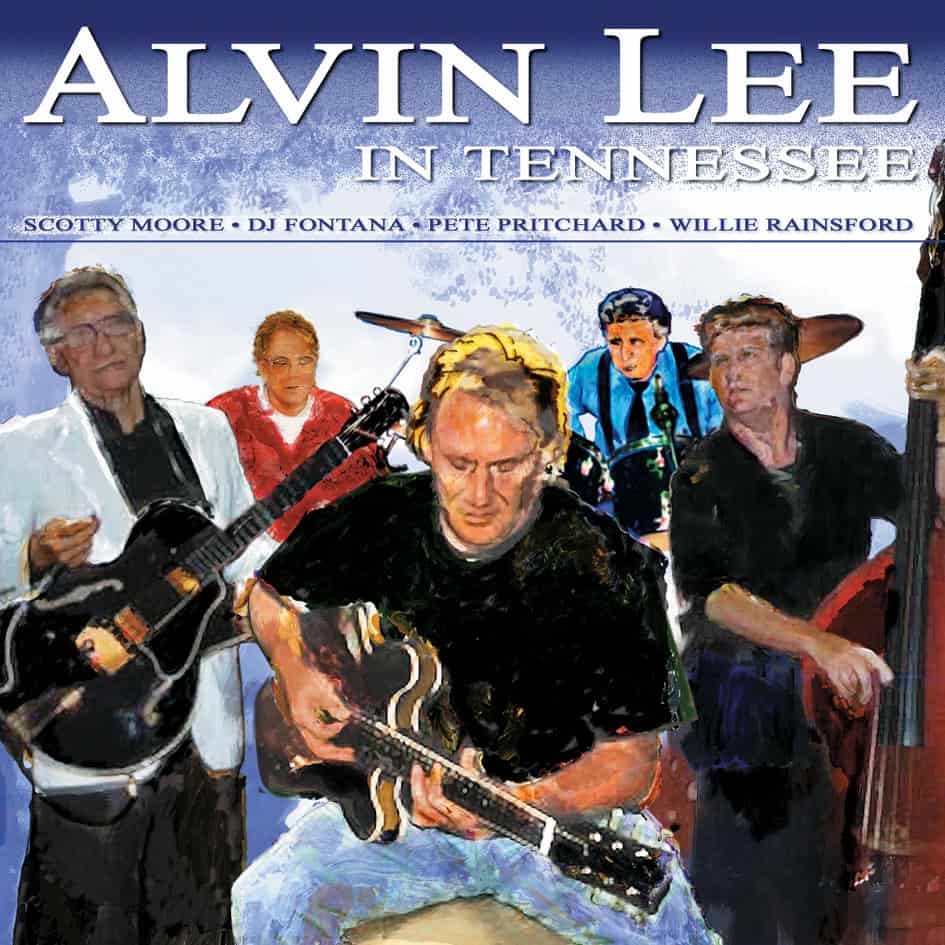
We interviewed Lee after the release of his 2004 album “In Tennessee,” which teamed him with Elvis Presley’s original Sun label bandmates Scotty Moore (guitar) and D.J. Fontana (drums).
POP CULTURE CLASSICS: The “In Tennessee” album has an amazing energy to it. Did it surprise you at all, the process of recording with Scotty and D.J.?
ALVIN LEE: Well, it was a surprise as much as I didn’t really know what to expect. I knew I’d get something good out of it. I didn’t know what it would be. And it’s funny, because I was really nervous. I thought those guys may kind of treat me like a young upstart or something. In fact, they gave me the greatest compliment they could give me — they treated me like one of the boys.
PCC: You had met Scotty at a ceremony in London, when they introduced the signature guitar [the ES-295]?
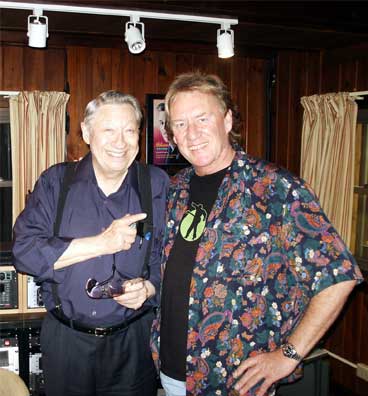
ALVIN LEE: That’s right, yeah. Actually, I first met Scotty as a fan in 1985. I went over to Nashville and I got his autograph and had my photo taken with him [laughs].
PCC: Had you called to tell him you’d like to meet him?
ALVIN LEE: A friend of mine knew where his studio was and I just went around and introduced myself. And then at the beginning of ’99, George Harrison called and said, “Scotty Moore and D.J. are coming over. Do you want to join in?” And we had a good evening at George’s, playing guitars and stuff. And it was after that he invited me to come and play at this Air Studios [Sir George Martin’s studio] Scotty Moore guitar presentation, which is when I really tasted what it was all about.
PCC: So you got to jam on some of the rock ‘n roll numbers ?
ALVIN LEE: That’s right, I did. I did an Elvis medley. I did ‘Rip It Up’. It’s funny, because Rip It Up’ starts with a cymbal beat. I said, ‘Let’s do ‘Rip It Up’. You all know that one. I tuned to D.J. and he wasn’t doing anything, so I did the ‘ch-ch-ch-ch’ (making the cymbal sound). He said, ‘Oh, yeah, I forgot about that. I haven’t done that tune for about 30 years’. (Laughs). It’s just the one I happened to pick. No, but it was great, though. I did ‘Mean Woman Blues’, ‘Hound Dog’, I think. ‘Blue Shued Shoes’. And I’ve been a fan of Scotty’s since I was 13 years old. And D.J. too. All those early Sun recordings. But it was a just a mind-blower for me to be up there, playing with those guys. I said, ‘Is there any chance of getting you guys in the studio?’ And they said, ‘Yes, sure, any time’.
PCC: Was that earlier get-together what sparked the idea for doing this album? Or was it an idea you had been toying with for some time?
ALVIN LEE: No, that was definitely it. It was actually D.J.’s drums that did it for me. I left London. I was driving out of London and these drum sounds that I’d just been playing with were still in my head. And I thought, ‘Wow, that’s like playing with those old Sun recordings!’ I got really excited about that. So I started writing new songs in that vein that would work with those guys. Because what I didn’t want to do is kind of go over there and record lots of old Elvis songs, because that’s kind of ‘Elvis for the Day’. And I don’t think anybody can fill his blue suede shoes.
PCC: How difficult was it to write new material that seemed true to that style?
ALVIN LEE: Actually it seems easy to me. I kind of lean that way anyway. I was brought up with that kind of music. I don’t know if you know, but my dad used to collect old ethnic chain gang songs and blues records and all roots stuff. He had an amazing collection. So I was kind of brought up with that kind of music anyway. I was brought up listening to the music that probably Elvis and Scotty were listening to when they were 12 and 13 years old.
PCC: So the guitar became a way of life for you early on?
ALVIN LEE: Yes, it did. I actually started on the clarinet when I was 12 years old. I took a year’s lessons on the clarinet. I listened to Benny Goodman a lot. So when I listened to Benny Goodman, I heard Charlie Christian [the legendary jazz guitarist who played with Goodman’s band]. And I had a leaning towards the guitar. I wanted to play more like Charlie Christian than Benny Goodman.
And of course, as soon as the rock ‘n’ roll came in, then I wanted to sing as well. And you can’t sing and play the clarinet [laughs]. So that was a pretty easy decision. And when I first heard Scotty, Bill Haley, Chuck Berry, Jerry Lee Lewis, to me, that was like hearing all the old blues I’d been brought up with, but with more energy and also attitude. Because there was that kind of rock ‘n’ roll rebellion thing going on, wasn’t there?
I mean, Elvis was pretty outrageous in the 50s. Stems from that James Dean kind of era. Remember the “Rebel Without a Clue”? [Laughs] And all of that. Rock ‘n’ roll was a way of life. An attitude. Most of the older generation thought it was terrible. It was typical teenage music, wasn’t it?
PCC: And you actually joined the Elvis fan club to get some photos?
ALVIN LEE: That’s right. I did — the English one. The reason was, I saw an advert in a magazine and it had pictures of Elvis. And it had pictures of Scotty, as well, Scotty with his guitar. So I actually went for the pictures of Scotty and his guitar. I wrote to this girl, Jeanne Saword [who co-founded the Official Elvis Presley Fan Club of Great Britain and the Commonwealth]. I didn’t actually tell anybody, because I was a bit embarrassed [laughs] about being in the fan club.
PCC: But it did serve as inspiration?
ALVIN LEE: It did, yeah. Those were really keen days. Just to get a picture of a guitar. I mean, I used to go see concerts, because I heard the band had Fender guitars of something. Because in England, there were lots of cheap copies of guitars. There was the Futurama, which looked like a Fender. Sounded like an orange box. And if anybody actually said, “Well, this band’s got a real American Fender,” you’d travel 50 miles just to go and see the guitar.
PCC: Did you try to track down a guitar like Scotty’s, when you were a kid?
ALVIN LEE: That was very difficult. Those [Gibson] Switchmasters, they’re kind of hand-carved. They’re pretty expensive. In those days, that sort of guitar wasn’t really a consideration [laughs]. It wasn’t in the budget.
PCC: So that wasn’t something you could land until later in life?
ALVIN LEE: That’s right, yeah. I finally got a Gibson in about 1962.
PCC: What is it about Scotty’s playing that makes him so unique and that makes him stand out, even after all these years?
ALVIN LEE: The fact that he is unique. The fact that no one else plays quite like that. He put solos together which are tunes in their own right. Incredible solos. Just the art of being able to play a guitar solo. Especially when you remember, at my session pretty much, but even more so in the 50s, they would be recording straight to the master.
And Elvis would be in the same room as the bass, drums and guitar and the piano. And all the mics bleed onto each other. It’s all taken in one take. You’ve got the adrenaline of going for the one take. And then, when the solo comes up, that’s a pressure situation. You’ve got to deliver a good solo like that. And if Elvis does a perfect vocal and the guitar’s made a mistake, they’re going to take Elvis’ good vocal every day. So it’s a big pressure situation to come up with a unique solo. He just seemed to do it so easily.
PCC: Is he a laid-back guy?
ALVIN LEE: He’s a very laid-back guy. It’s funny, one of the first things, they were at George’s, the reason we got on so well together, was because everybody was being kind of over-cool and respectful. And as soon as I got there, I said, “Hey, Scotty, grab this guitar, show me how to do that on ‘That’s All Right Mama.’ [Laughs] And everybody else was like, “Yeah, yeah!’ They were worried that he might not want to. But actually, he was quite happy to do that. And we swapped guitar licks for a couple of hours. And I think that’s where we got off together, because we’re both mad on guitar. He still is mad on the guitar.
PCC: Was he very familiar with your work?
ALVIN LEE: I don’t think so. He’d heard of Ten Years After. But I don’t think he knew much about it. In one interview recently, Scotty said, “That Alvin, he plays faster than I can listen.” [Laughs] And he said to me one time, we did that tune “Going Home,” and he said, “Why would anybody want to play that fast?” I said, “Well, you did, on “Big Hunk of Love.” “Oh, well, that was a long time ago.” [Laughs] He used to play fast, too.
PCC: What about D.J.? Hearing him on your own songs, that must have been a treat.
ALVIN LEE: Oh, that was fantastic, playing along with him. It’s a bit like playing with the maestro. He’s so cool. He just listens to a song, makes a few notes, and then he’s got it. It’s in his head. And he never wavers. He’s as solid as a rock. And he’s just great to play with. He doesn’t waste energy on unnecessary drum fills. He puts in very little, but what he does, he really makes it sound cool. To me, he’s the ideal drummer. I just love to play with him. I mean, actually, I was really nervous. When we started and D.J. counted it in, I thought, “Whoa, I’m playing with D.J., I’d better not screw up.” [Laughs] But those guys made me feel very at home, very welcome.
PCC: It must have been a great atmosphere.
ALVIN LEE: It was a great atmosphere. A lot of fun. And of course, it was quite new to them to do extended solos.They’re used to one guitar solo, maybe two one-verse guitar solos in a song. And I was doing like 80 guitar solos [laughs]. They were going, “I thought that song was never going to end!” I said, “Well, I’d be happy if it never did end” [laughs]. The beauty of CDs these days… In the old days, with vinyl, you’d have to cut everything down, to get all these songs on the album. And a lot of times, the best bits, which were the jams at the end of the songs, they got left off. But there’s no need for that these days.
PCC: Do you feel that going back to the roots actually can help to move music forward?
ALVIN LEE: Yes. I was brought up on early rock ‘n’ roll music and I had my own take on it. In those days, English bands, we used to play all those rock songs, but we used to play them much more desperately. A lot more energy. Less roll. And when I listen back to those records, in my memory, you kind of tend to think, something like “Whole Lotta Shaking,” you think, “Oh, yeah, that’s really hard rock ‘n’ roll and really fast and ravey.” And it’s not.
“When I listen to it now, it swings like hell. It’s got more roll than rock. It’s got swing. It’s got pace. It’s got lots of subtlety, which, when I was a teenager, I hadn’t really noticed. Then it was rock ‘n’ roll and how I heard it was really loud and brash. Little Richard’s stuff swings like hell. It’s not mad, crazy, bashing rock ‘n’ roll at all.
So it’s a matter of getting back to that and doing it like should have been, properly, in the first place. To me, it’s a gap in education, which had to be filled. And the only way to do that was to play with those guys. I could play songs all day in England for a year and I’d never get that sound that those guys can get. For them, it’s just natural. They’ve got the roll. I went back to visit it to find out what it’s all about. And it’s still there. It moved me. And I loved it. I’m really proud of that album. I’m so glad that I did that.
PCC: And you can take what you’ve learned from that experience forward into your future projects?
ALVIN LEE: Oh, for sure. I actually made the effort to underplay on this album. I made the effort to leave spaces. I made the effort to get the feeling of not filling everything up, which was my natural way to play, when I was young. And I still play that way. I’m still doing some mad, crazy guitar, as well. I haven’t changed my style. But I like visiting these different styles. I think that’s how you learn. I always have learned that way.
I did a kind of country-inclined album, my first solo album, called, “On the Road to Freedom” with Mylon Lefevre. And I did an album called “Pump Iron,” which was kind of leaning to the funky side. And I’ve done melodic, tuneful albums. I’ve done hard rock albums. I like to experiment, to lean to another direction and see where it takes me and where I can take it.
PCC: You have performed on stage with many other great guitarists. Is that all part of the learning curve? Why are you drawn to events like “Night of the Guitars”?
ALVIN LEE: Well, that, Miles Copeland phoned me up and said, “I’m organizing this tour with one rhythm section and 10 lead guitarists all traveling on one bus.” I said, “You’re mad. I’ll do it.” [Laughs] I thought, “That’s got to be wild.” It was quite healthy, actually. Everybody was quite well behaved, which surprised everybody else. And we had a good time. Mind you, I only did the English leg of that tour, which was two or three weeks long. It did go on to Europe and I heard that there were scuffles and differences later on. But I was lucky. I didn’t see any of that.
PCC: And you actually have a chance to play with Hendrix.
ALVIN LEE: I did, yeah. A couple of times. He got up and jammed at the Scene club in New York, Steve Paul’s Scene club. That would have been about 1967, the first or second trip to America. So he came up and said, “Can I jam?” And I offered him a guitar, but he couldn’t play a right-handed guitar left-handed. So he took the bass and turned it upside-down and proceeded to jam with the bass. And he ended up doing this amazing solo and we all actually stopped playing, so we could listen to what he was doing on the stage [laughs].
He was amazing. And he liked some of the stuff I did. I was doing a 20-minute version of “I Can’t Keep From Crying Sometimes” and I was using octaves a la Wes Montgomery, one of the old jazz players. And he was hip to that music. He said, “Oh, yeah, I like that Wes Montgomery thing. I’m doing something along those lines.” And I said, “Well, I beat you to it.” Cheeky. I was a cheeky boy back then. He was an amazing character, a larger than life personality. I mean, you didn’t think you were talking to Joe Schmo down the road, when you were talking to Hendrix. You knew that was something special.
PCC: And when you have those sorts of interactions, does it seem to invigorate you? Or is it a competitive kind of thing, trying to top one another?
ALVIN LEE: It’s both, really. Talking-wise, it’s great, with someone like Jimi Hendrix, or anybody who says, “Oh, I like when you do that.” And they take interest in your playing. And they comment on it. That’s very complimentary. And it gives you a boost.
Playing sometimes, it’s strange. Sometimes it does that. But sometimes it makes you kind of go shy. I know first time I played with Scotty, I had that thing. I didn’t play any lead licks, because I didn’t want to get in his way. You know what I mean? [Laughs] I didn’t know what to expect from the man. So I just played rhythm and second line stuff. I kept out of his way and gave him all the solos.
Often happens, when there’s a lot of respect, people may tend to back off and underplay. And then you get those terrible occasions where there’s three or four lead guitarists on the stage and they’re all trying to out-blow each other. And it turns into a cacophony. A racket.
In fact, there’s a funny story, actually. George Harrison came round to my house, because we used to live about three miles apart. George came round with Eric Clapton… and Carl Radle [bassist from Joe Cocker’s Mad Dogs and Englishmen tour] was with him. And [laughs] his first comment was “Have you got anything to smoke?” I said, “Oh, George, you only come around here to get free drugs, don’t you?” And Eric said, “I didn’t realize you two knew each other so well.” [Laughs].
But we went into the studio to have a jam. I had been doing rehearsals and the drums and everything were set up. So I played guitar. George played guitar. Eric played guitar. My bass player played guitar. So there were four guitarists, bass and drums. And we did this funniest jam that we called “The Two Many Lead Guitarists Blues.” It says, “I’ve got two many lead guitarists and I just don’t know what to do.”
It ended up with me shouting, “Everybody — take it!” And it was a send-up, really, but there was this racket at the end, this biggest cacophony, you’ve ever heard. Four guitar solos all happening at once. And we were all rolling on the floor, holding our sides. Terrible noise. if you were to hear it on the radio and not know what it was, you’d think, “What on Earth is that? What a terrible racket!”
PCC: Getting back into the roots on this project with Scotty, do you think rock has truly progressed over the years? Or have we lost something along the way?
ALVIN LEE: Well, it’s evolved, as all music does. And it evolves in circles, too, I always find. In a way, it’s two steps forward, one step back. There’s always a need for the retro, to go back to the roots. I mean, there was a big rockabilly craze about 10 years ago with Stray Cats and all of that, which is pretty much 50s rock ‘n’ roll yet again. Not really changed that much.
I don’t know. To me, the roll was drifting out a bit. That’s why I wanted to do this album myself. I consider the stuff on that album the real thing. Some people might argue that it wasn’t actually recorded in 1956. But it’s the closest you can get these days. It sounds like that era. And yet it’s all done on new equipment. The only difference is the equipment. We thought about that. Scotty used his old mics. So he uses a 1956 RCA microphone and stuff like that. If you go through those mics and go onto digital equipment, it’s still got that basic old sound.
PCC: What about the decision to include “I’m Going Home”?
ALVIN LEE: Well, that wasn’t in the original plan. That was Pete Pritchard [the bass player]. He said, “I’ve always loved that song. I’ve always wanted to play it. Can we do it?” And I said, “Well, okay. I always do requests.” He was just very keen to play it. And I could see why, because he just burned it down to the ground. He had obviously listened to it a lot himself.
And D.J. was great on it, too. It’s a song that doesn’t have a fixed arrangement. And D.J. and the keyboard player had a bit of trouble at first, so I said, “We’ll just jam this one.” If I lift my head, we’ll stop. And if I keep nodding my head, we’ll keep playing. And we got it down real quick. I was worried. D.J.’s in his 70s and that’s a pretty heavy number. And he really whacks those drums. He doesn’t play lightly. He really thumps them. But he was great. He didn’t bat an eyelid and said, “Okay, next.”
PCC: Are you surprised at the way that song has become kind of a fixture in pop culture, because of Woodstock?
ALVIN LEE: I often wonder how the situation would have panned out had the Woodstock movie featured a different song, if it had featured “I Can’t Keep From Crying Sometimes” or a slow blues or something. I mean, “I’m Going Home” is a great ending number. But it’s not so much a song. I sometimes joke, people say to me, “Did you write ‘I’m Going Home'”? I say, “Yeah, I wrote all the words myself.” It’s “I’m goin’ home, to see my baby. I’m goin’ home, to see my baby.” That’s about it, really.
It’s a jam. But it’s a vehicle. That’s what’s so great about it. It’s a vehicle to go off and boogie and play solos and it’s a great tempo. And there’s rock ‘n’ roll medleys within it and stuff like that. I mean, I’ve recorded it like 20 times and it’s always been different. And that’s what’s good about it, I think.
PCC: The whole Woodstock experience, do you have vivid memories of that?
ALVIN LEE: I do, actually. Most people say, “If you remember Woodstock, you weren’t there.” I remember it well. When we first heard about it, it was just another name on the date sheet. Nobody expected anything. It was just another festival. And I’d done a lot of festivals that year. I did the Atlanta Pop Festival. I did the Texas International Pop Festival. And at the time, I actually thought they were better than Woodstock, because they were better organized. But the day we arrived, they said, “You can’t get in by road. We’re going to have to take you in by helicopter.” It was obvious then, from that minute, that this was going to be a very special date. And it was.
Had we just come in, gone on stage, played and left again, maybe it wouldn’t have been so memorable. But the storm happened before we were going to play, so we had to wait about three hours for the stage to dry out. There was all that electricity to be concerned about. I actually wanted to play. I said, “Let’s just go out there and play. If we get electrocuted, think how many records we’ll sell.” [Laughs] But they said we had to wait until it was all dried up.
So I went for a walk out into the audience. I went around the lake. They’d run out of cigarettes backstage. So I said, “I’ll go out and I’ll score some cigarettes.” I was gone for about two hours. I came back with about 20 joints and no cigarettes [laughs]. There were no cigarettes out there, but lots of other stuff. I remember there was a cop car there, the police were guarding the area, making sure nobody went backstage. And these two cops were smoking joints. They said, “Hey, if you can’t beat ’em, join ’em.” [Laughs]
I don’t think anybody knew I was in a band or anything, as I walked around. I was just another freak. But there were people offering me food. Anything they had, people were sharing, their food, their drinks… and their girlfriends. It was a wonderful attitude. That whole peace movement was very magical, from ’67 onwards. When I was first in Haight-Ashbury, I got into it there. I really believed in it. I really gave it every chance. And Woodstock was kind of the epitome of it.
The trouble is, when the movie came out, it made the peace movement kind of a fashion. It made the peace sign a fashion. And like all fashions, fashions come and go. And I think by the early 70s, to say “I love you” and give the peace sign wasn’t cool anymore, which I thought was a bit sad. I often think the peace generation came together for Woodstock and then went they went home again and dissipated… But I hope that sort of idealism will return.
http://www.popcultureclassics.com/alvin_lee.html
Blues Matters! magazine (England), issue April – June 2004
Dave “The Bishop” Scott interviews Alvin Lee
BM: This won’t be an easy interview because it is easy to get tongue-tied when you meet your hero; however, there is no need for you to go shy on me or to be nervous! I am interested in your early life in Nottingham and your schooldays, especially your time at Margaret Glen-Bott where the headteacher Miss Lovett famously told you to “Smarten up and get rid of that guitar as you will never make a living out of it.” Have you forgiven her yet?
Alvin: I was a rebel at school and I suffered the consequences; I was a James Dean fan and the bad guy who got blamed for everything. Miss Lovett said that I would never make any good out of anything. If anything ever went wrong at that school, I was called up to explain what I had been doing. I got the blame unless I could prove otherwise which made me even worse. Mine was a new school and the other schools around were pretty nasty so they weren’t going to let that happen in Wollaton so anyone slightly out of the ordinary was watched very closely. One day, a new teacher came into the school and called me by name to stand up; he said, “Right, I will remember you” which is not very cool when you think about it. It might have been a chance to make a good impression but he had already done me in. My reaction was, OK I will give you something to remember me by.
The schooling I had was memorising dates in history; I didn’t care what the dates were, although I still remember 1066, the Battle of Hastings. It’s the only one I ever knew and I never use it unless during Trivial Pursuit. I don’t know the names of all the countries in the world but I have been to most of them and experienced being there. Anywhere you go in the world is what you make of it, not what you read in books. My teachers at my school were concentrated on making us behave and toe the line rather than bringing the best out of people. Actually, there was a woman science teacher and I actually became first in the class because I found her interesting and responded to her teaching. The headteacher thought I was cheating because I came top and so she switched teachers to this idiot who started writing down chemical formulas which I wasn’t interested in, so I suddenly came last again. Teachers are more intelligent now and are more likely to see the sparks in their pupils and draw out their talents. I was in a secondary stream which was a dead loss. I mean I like music and the music teacher’s idea of a music lesson was to write down the words of hymns. My class behaved so badly he made us write this hymn out 10 times, so cheating by using carbon copy paper I made it into a little book and said that owing to a shortage of good hymns this year we had decide to publish the same one ten times. He actually thought that was quite funny and kept the book. I went to see the careers officer and told him I wanted to be a musician and he said, “Oh dear, all we can offer you is the army” which is not what I had in mind.
BM: How supportive was your family at this time?
Alvin: They were great. There is a big age gap between my sisters Janice and Irma and myself so I didn’t know them that well when I was younger although they have been very supportive in later life. One sister played guitar and sang and the other was into acting. It was a bit of an arty family; my mom and dad had a little group, The Singing Range Family and they did cowboy songs and stuff. By trade my dad, Sam, was a builder and Dot ran a hairdressing salon. I had an enormous amount of confidence that I would land on my feet no matter what I did. Strangely enough, through all those school years I decided at 13 or 14 I was going to be a musician and so school was just something to get out of the way, a waste of time and not to bother with it. Not a very good role model; hey kids ignore school and get out as quickly as you can.
BM: That is particularly self-deprecating and somewhat ironic as Nottingham council is keen to use you as an example of Nottingham’s second famous citizen (pipped by Robin Hood) in an advertising campaign aimed at encouraging newly qualified teachers to teach in the city.
Alvin: I just couldn’t take school seriously: I had this guitar neck with four frets which I kept hidden under the desk. It had strings on it so I would practice my chord shapes under the desk and that’s about all I did at school. My parents knew that I was going to become a musician and after I left school I got a job for a few weeks in a light engineering factory and I cut my fingers on some lathe turnings and my mum said I shouldn’t go back there.
BM: Is it true that you have been surfing the Friends Reunited website?
Alvin: Oh yeah, and this guy wrote and said he used to know me. There was one time and we were in this wood, a spinney which we used as a short cut to the school. Apparently this guy and his friends had bows and arrows, real ones and I came up and challenged them to shoot me; they tried very hard and I was dodging between the trees. He remembers that at one point they shot this arrow and I stopped running and it was going straight to my chest; they thought it was going to kill me but I brought my school satchel up at the last second and the arrow glanced off it. This of course was in my teenage years when we were all invulnerable.
BM: Can you tell us about your formative blues influences which led to songs like I Woke Up This Morning.
Alvin: My dad was always a blues fan and he had loads of 78s by Big Bill Broonzy, Lonnie Johnson and Jimmy Reed, and tons of ethnic stuff, artists I haven’t heard of since. I listened to John Lee Hooker, Muddy Waters, Tampa Red, T. Bone Walker, all the Kings, BB, Freddie and Albert and many others. All those guys had the feel and were a great influence, but for me Big Bill and Lonnie Johnson were the best. They not only had the feel, they also had the dexterity and finesse which truly made them stand out as great guitarists.
Freddie King was a big influence when it came to string bending, he was the master of that and Chuck Berry was also a great influence particularly when it came to playing solos using two and three strings at once instead of picking single notes. There was also the jazz players Barney Kessel, George Benson, Wes Montgomery and of course Django plus the country pickers Chet Atkins and Merle Travis. They were all great influences but I would never copy what they did, I would just emulate the sound but play my own licks in their style.
I was brought up with that music and I always played it but in those early days you couldn’t make a living out of it. I used to do some danceable stuff, but mostly R&B and early Rock & Roll, but I would get complaints from the dance hall managers that people couldn’t dance to the band. But come the third set at 1 am with about ten people left in the club you could start playing blues and there would always be a heavy interest in it from a few people and that was enough to develop a pretty good blues set.
We travelled 3000 miles a week in The Jaybirds van around Nottingham and up to Blyth and Selby, Leeds, Doncaster even as far as Scotland, London and the south coast. Blues was a minority interest back then but after John Mayall, well he made it all possible and suddenly there was a chance for me to do all these blues songs I knew and I thought that this is the way to go. Of course, my angle on it was that it was a bit heavier than that and I always figured that if you were going to play blues you would play it how you feel rather than how those guys feel because you can’t copy them anyway.
Big Bill Broonzy is too good and who wants to hear a white guy from Nottingham trying to sound like him. I did it my own way and my take on it was that it was a cross between rock and roll, blues and even a bit of heavy metal thrown in. To me blues music has always been the truth and that is what I have always tried to put over in my music. I do not like the show business bullshit like smiling and looking like you are having a good time even if you are not. When I am in a good mood everybody knows it and I share it and put everybody else in a good mood but if I am not in a good mood like if the bass is too loud and out of tune I don’t try to hide the fact that I am not happy. I let people know. Some may say this is not professional but it’s the truth and it’s the way I am. As an artist I am a mirror of my environment and what goes on around me. If I can’t do that honestly then playing on stage just becomes bullshit and I will not allow that to happen.
After a while your hits become your cross to bear and at one time I revolted against mine because I would walk out on stage and someone would shout out, “I’m going home” and I would say, “Go on then.” It is kind of annoying because it is such a good song in its place at the end of the set, but if people want to hear it as the first song, give me a break. That’s when I did that In Flight album with a whole different band; I wanted to change the feel, I did not want to get stuck in that bag of being a heavy rock and blues player and it was very good for me. It was very fortunate for me too because through doing that I got it out of my system and I came back to the rock and roll.
Ian Wallace and Mel Collins were fine musicians in the band who could play anything but we played no TYA songs at all in the set and one night Ian said, “Come on, let’s play I’m Going Home” and I replied OK then so we did it and it was great. I realised that the audience loved it and that I couldn’t avoid it.
I remember Hendrix hated Hey Joe for the same reasons but I thought it was a great song. I still play it in my set from time to time and people love it. Jimi told me one time that he really regretted doing the “playing with his teeth bit” because people expected it and were disappointed if he didn’t do it and it became a trap. I saw one of the last gigs he ever played in Copenhagen and he did none of the histrionics he just kept his head down and played great. I told him after the show that I thought that was the best I had ever heard him play and he agreed but he was still not happy because he had not got the same reaction from the audience as when he did all the show stuff.
No matter how much of a muso you are you have to compromise and give a paying audience some of what it wants; you’re obliged to in a way and you’re a meano if you don’t. It’s like when I went to see Jerry Lee Lewis in Birmingham, he did all country and western songs and he didn’t do Whole Lotta Shakin’ and Great Balls Of Fire and I walked out really upset and I realised then if people come and see me they will probably feel like this if I don’t do Love Like a Man.
As long as you can change your stuff around; I always change the playing within the songs so I might do the same song but the solos are never the same. Some guitarists complain that it is not the same as the record and my response is, “Thank God.” If it was, that means I have been playing the same thing for 30 years. Going back to your original question, I prefer the decadent version of I Woke Up This Morning which is I Woke Up This Afternoon!
BM: What were the early days in London like?
Alvin: I used to hang around Denmark Street in Tin Pan Alley where all the music shops and studios were in London and someone’s head would pop up from Southern Studios downstairs at the Giaconda coffee bar and ask, “Are there any guitarists in here?” You could jump in and grab a session and make fifteen quid if you were lucky which would pay the rent. On one occasion, this guy said to me, “You can sing as well so you can do this song and I will pay you and put it out as a single and it might be a hit.” I refused in case it became a horribly embarrassing pop hit; it could have happened but fortunately I had a better plan.
When you record you sometimes do a funny little song and the record company might think it would make a nice little single. I did a solo album with Chris Kimsey, who recorded A Space In Time, and I remember doing Sea of Heartbreak, the old Don Gibson song. It was really good and sounded like a hit but I thought hang on a minute if this is a hit I might have to go on TV to sing this and that isn’t what I do, so I stopped the release.
When Love Like a Man got into the charts I wouldn’t go on Top Of The Pops so they had to play the record and use a film. The rest of the band moaned about the fact that I wouldn’t go on the telly. The record company called me “unco-operative” but it was because my heroes were blues singers and that’s what I wanted to be. Look what happened to John Baldry; he was a good blues player and he did, That’s When The Heartbreak Begins and turned into Engelbert Humperdink for the afternoon and it killed his career. And Cream’s Wrapping Paper shows that everyone makes mistakes.
BM: You have been an admirer of music journalist Chris Welch for a long time, haven’t you?
Alvin: Yes, he always starts with a story which seems irrelevant, like a train journey which ends at the studio. We had this long phone call about the sleevenotes for the Anthology album and the quote I liked the best I had forgotten about until I read it later. Talking about the sixties I said we all thought we were changing the world; we did change the world, I went on to explain, the only trouble is that it changed back again while we weren’t looking.
BM: Let us talk about the post TYA era and the start of your solo career with successful 70s albums such as In Flight and Pump Iron, moving on to the 80s era and Rocket Fuel.
Alvin: I have always been a solo performer to be honest, even with TYA. In the 80s there was this punk thing and I put a blues/rock band together with Tim Hinkley on Keyboards, Andy Pyle on bass and Bryson Graham on drums. It was a great band and before we started touring we did some gigs up north to try things out, billing ourselves as “surprise guest artists.”
Because Johnny Rotten and the Sex Pistols had been banned from nearly every venue that is how they billed themselves too, and when I looked out at the audience there was all the safety pins in their noses and it was quite funny. So I went out and took a swig of beer and spat it all over them because I heard that is what they do; quite sad really. They were shocked and horrified because they are just young kids dressing up really, they weren’t real punks. That was a bad time because it was going back to bad punk music and suddenly the “legendary rockers” like us were regarded as old farts, so I just sat that out; you can only push a boulder up a hill so far as it gets harder and harder and you have to let it rest for a while because all things change.
As George Harrison said, “All things must pass” and all things go round in circles, particularly in music. Led Zeppelin are still strong and what has happened to Johnny Rotten? At one time Led Zeppelin were the old farts
and the punk bands were the new wave; I used to say that I was the permanent wave!
BM: Who do you appreciate most on the contemporary music scene?
Alvin: I listen to all of it and learn from all of it but I tend to still like the old stuff that got me started in the first place. It’s my birthday tomorrow and I shall wake up playing Whole Lotta Shaking as I do on every birthday as that song just gets me going. To me that is music because it has the feel, it has the vibe, it’s got the energy and it’s got the words which means a lot to me, “Come on over baby, there’s a whole lot of shakin’ going on.” This is poetry to me, you can keep your Bob Dylan, I prefer Jerry Lee Lewis any day.
BM: A lot of people reading this interview will want to know about your relationships with other members of TYA and how you feel about them using the name for their recent tours and recordings.
Alvin: I think it is very sad that they are using the name so they can get work, I don’t begrudge them trying to make a living playing my music but they should change the name. They are not TYA and they are confusing and upsetting a lot of the original fans many of whom are turning up to concerts expecting to see me playing. When I found out about it I asked the band to change the name slightly to let people know it was not the original TYA but they refused. Very sad. I know I was always referred to as the dominant member of the band which is very ironic really because I didn’t even want to be the front man, I just wanted to play the guitar. When The Jaybirds first went to Hamburg the singer had left the night before we went so I got the job as I was the only one who could sing.
My ideal was to be a blues player and to stand at the back of the stage playing my solos with my pint on the amplifier. When things took off with TYA, by being the front man I got bad vibes from the rest of the band which was a shame because in the early days we were very close. The reality is that I never wanted to be singled out but when you are the lead guitarist and the singer you get the spotlight whether you want it or not. Woodstock didn’t help when the movie came out and I was on all three screens. After Woodstock I wasn’t enamoured by the kind of gigs we were playing because we started off as a kind of underground band and I loved the whole vibe of that; it was blues and R&B with very little compromise to being commercial but after the Woodstock movie came out in 1970 we crossed over into the teeny-bopper scene and I remember doing these ice hockey arenas and baseball stadiums, with little girls running to the front of the stage and screaming and dropping their ice-creams. I thought, what am I doing here, this is not part of my plan. I wanted to de-escalate this and get back to some real playing which is why I started the solo ventures. Management wanted me to keep the name TYA and change the band members the same as Ian Anderson had done with Jethro Tull but I did not think that was an honourable thing to do so I tried to keep the original band together. I valued the early days but it all got lost in egos and jealousy as it does. Eventually it got so painful and miserable I had to let it go and move on. My next touring band was so much better, they appreciated the opportunity and we just had a great time on and off stage. It was like a breath of fresh air and renewed my faith and enthusiasm for making music.
BM: Turning to your current lifestyle, how do you spend your time in this beautiful location overlooking the sea?
Alvin: Mainly being creative, which is the legacy from the sixties. When I get bored I pick up a pen and draw something or write something or paint or make music; I can’t imagine a world without music. Art wise, I won’t be doing any shows but I am a big Salvador Dali fan and I went to his museum and got inspired and tried to paint like him. I will never be able to but I enjoy trying; I have some great ideas it’s just that I don’t have the technique. I use my imagination, the ideas in my head; I might stand on the balcony overlooking the sea and paint mountains that aren’t there; people ask me what I am looking at! I am serious about the creative process but not the paintings themselves: I don’t call myself a painter but I love the involvement and the process.
BM: It is perhaps premature to talk about epitaphs but what might yours be. Chris Farlowe wants, “Finally, out of time.”
Alvin: I like Spike Milligan’s “I told them I was ill.” I have got nothing to say when I am dead and to boil it all down to one little phrase to put on a stone when you’re dead is a tough one. I think I will settle for “Bollocks.” Seriously, I have always been On The Road To Freedom and I have been searching for it all of my life and when I think I have found it, I find that I haven’t and the road continues and that is what it is all about. I tell my friends, put me in the dustbin when I die because it’s all over. I am not interested about what the history books say; I live for the present. Enjoy life while you have it as it’s a very precious thing to have, waking up in your own body. I just hope nobody does my life story and does something terribly embarrassing like these movies such as The Beach Boys life story where Hollywood does a new cheesy version.
BM: Tell us something about the forthcoming album with ex-Jordanaires Scotty Moore and DJ Fontana entitled, Alvin Lee in Tennessee.
Alvin: It started, oh I’m terrible with dates, 1999 I think, when I was asked to go to a gig Scotty was doing at Air Studios in London with DJ. I had met Scotty in Nashville in about 1995 just as a fan and I had asked him about a certain guitar solo in Hound Dog which was one of those classic guitar solos from Elvis’s band. I told him that everyone had been trying to get that off for years and he said, “Well, so have I, I just grabbed a handful!” He did some great guitar solos on those early Elvis tracks and they’re all singable solos which is a great thing about them although they are also clever and dexterous. My solos aren’t really singable, I kind of jam and blast around and play from the hip as you probably know, and not many people could sing that kind of thing.
Anyway, Gibson guitars were putting out a Scotty Moore guitar and it was a little gig at Air Studios to announce that so I went along there. I saw Gary Moore on the way in and Jeff Beck and Jimmy Page were there. When it came to jam session time I was first up; I don’t often jam but this was different because of Scotty and DJ. Scotty said “What are we going to play?” and I replied, “Oh a lot of tunes you know well.” We started with Rip It Up and I turned round to DJ and sounded out the drum rhythm and he said, “Oh yeah, I had forgotten.” We did a medley that also included Mean Woman Blues, Blue Suede Shoes and Hound Dog. It was great and also a real buzz; it was one of those events that was over before it started and you don’t really think about it.
As I was driving back afterwards I was still hearing all those great drum fills in my head and all those great riffs were bouncing around in my memory. DJ doesn’t do a lot of fills but when he does them he makes them count. It occurred to me how great it was because it was all the kind of stuff I had been brought up on. It literally hadn’t hit me until that moment how cool it was that I had actually been playing with those guys as I had always been just a fan. So that is where the idea came from; I thought if I can get these guys together to cut some tracks I will start writing some songs that I figured would be in that vein.
It took a couple of years of writing before I felt I was ready and I phoned up Scotty and asked if there was any chance of getting him and DJ in the studio. He replied, “Oh yeah, sure.” I asked if he could recommend a studio he knew in Nashville but he offered us the use of his place, his own house. “Great!” I exclaimed immediately as I just couldn’t believe it. I went there and sat with Scotty, DJ and the double bass player, Pete Pritchard, a lovely guy who had flown in from England as he does all Scotty’s stuff. Pete has been a Bill Black fan for years and he can play all that kind of material on the double bass.
DJ is fantastic; he is the only drummer I know, apart from Simon Kirke, who will play through a turn-around at the end of a verse; most English drummers, come the end of a verse when you want to do a guitar lick, will do a drum fill and suddenly everyone is jamming in at the same time which is not how it works with these guys. The other member of Scotty’s band was Willie, the pianist who is a good old boy.
I played all of my demos and asked them if there was any that they didn’t like but they liked all 28 songs I had taken out, from around 100 which I had written. I also had a host of Elvis songs up my sleeve just in case mine didn’t work but fortunately they did. I had a pretty good idea which were going to work with those guys so we cut it down to 12 tracks.
Then we had a jam session and me and Scotty sat down, Pete was there too, and I started asking him about all these solos; it was schoolboy time as I asked how he played the solo in Shake, Rattle and Roll. He showed me and the solos aren’t that impossible to play its just that you have got to know whereabouts they’re starting, what position and what shapes they are working. Scotty plays standard almost jazz style with jazz scales so his first finger is always below the root note which I don’t do.
Blues players usually play their first finger on the root note and bluff it from there. Scotty plays the proper way. Once I had sussed that, a lot of his solos started falling together and we had this great session which included Lawdy Miss Clawdy; Scotty practically told me off for playing it too fast, “Everybody does that, you’ve got to hit the pocket.” Sadly, this bit of the session wasn’t recorded but in a way that was probably for the best. The one that got away.
The next day was the recording session and DJ had his drums set up; he plays surprisingly loud actually. Scotty’s studio is just a house, what was his living room is the studio and he extended his front porch which is where DJ and Pete were, so they could watch and hear each other and keep it tight. I was kind of through the window looking at them and able to see the control room through another window.
I played my first demo and the guys made notes and then we just played it, not perfectly but great. We never did more than three takes and usually it was my fault if it ever went wrong. They were so professional; I never had to ask them to move it up or to give it a bit of life as it was there straight away and we got 11 tracks down in just two days. The twelfth track got forgotten in all the excitement, another one that got away.
There was a funny incident with Willie. I had this piano part, as some of the songs I write on a computer piano, so I do a boogie-woogie riff with two bars then loop it and that is my basis of the song. Willie couldn’t actually play the riff and play right hand as well but he explained as he looked over his shoulder that he could play that on his left hand and overdub the right hand but Scotty didn’t like overdubs because he prefers it to be all done at once. That really is the best way and its fine if you have Elvis as a singer of course but I am not that good and I would prefer to overdub my vocals, so I told him I would talk Scotty into it.
I concentrate on my guitar when I put the track down and do a rough vocal so that everyone knows where we are and then usually I get a better vocal later on, although some of the tracks are live. I did some of the vocal overdubs in Dan Penn’s studio. Tim Hinkley, one of the best English keyboard players and now living in Nashville had introduced me to Dan. The studio is called the Memphis Rooms and it is done up like a 1950s Chevrolet; all of the interior is leather with buttons and for the recording light he has the tail light of a chevy which makes it very atmospheric.
He has a microphone that Elvis had used, a 1956 RCA mike, which I said we definitely had to use because it was one of those big chrome things about the size of your head which was brilliant. I did all the vocals in an afternoon. I had figured that it was something to be going on with but in fact I didn’t get them any better.
To complete the recordings, I used the El Cortijo studio in Spain which belongs to Trevor Morais, ex Peddlers, and which attracts such divas as Mariah Carey and Kylie. Anyway, that is how it all panned out; I didn’t have a grand plan but it all went superbly. The main horrors were getting the tapes transferred and brought over to England as I had to have safety copies all over the place, some were sent by post, others by courier, the rest in my suitcase. Whatever happened I knew that I would get something back safely.
BM: Talk us through some of the tracks on the CD
Alvin: It’s all pretty straightforward, based on the boogie, called “Shake it baby” music by Scotty’s girlfriend, Gail. It was Gail who got all the old guitars out and she knew all about them. She is Scotty’s right hand man and if it wasn’t for her I don’t think the session would have ever come together. She helped organise the whole thing and also treated us to some Great Southern cooking. I borrowed a Gibson 335 out there which was a bit risky but I figured that taking a guitar to Nashville was a bit like taking coals to Newcastle and I know this guy out there called Mickey Butler who runs this great shop called Valley Arts Guitars with over 600 guitars to choose from and he told me just to help myself.
Lets Boogie is a straight boogie; Rock and Roll Girls is a good one because that is about all the girls like Dizzy Miss Lizzie, Peggy Sue and Lucille and how I love them. I was listening to Jerry Lee Lewis this morning and I still love that stuff as you just can’t beat it. Take my Time is an interesting track; Scotty has this ear problem in that he is deaf in one ear which is a terrible thing to happen to a guitarist because you lose more than half of your hearing, you lose about three-quarters of it. On some tracks he asked to do his guitar later but he played on that one and boy was it good; we did some swapping of licks.
I’m Gonna Make It is one of my favourites, really grooving and one of the live ones on the album, just as it was recorded; it felt so good I didn’t want to stop so I just carried on soloing which you can do with CDs as it doesn’t matter how long it goes on for. It’s a Jerry Lee Lewis and Chuck Berry type of number which is perfect for a double bass played in front of a mike which gives such an organic sound. In fact, this is the first time I have recorded with double bass and it is brilliant because the drums don’t play solid bass drum. DJ uses a very light bass drum and he uses the hard bass drum as a push thing like a cymbal crash and then he’ll bash the bass drum but a lot of the time he is just back-pedaling because the bass is providing a lot of the percussion through the clicking and slapping sound they get. I’m Going To Make It was a pivotal track because I must have done about 11 solos and that inspired the other musicians from then on in as they liked that vibe. Normally, they have songs of a set length of about 3 minutes or less with clearly defined starts and endings but I said if it sounds good we just keep playing. I don’t think Dolly Parton would like to have a lot of solos on the end of her single but I do!
Something’s Gonna Get You is a slinky kind of song, very different with a weird bass line and hardly any drums at all, it’s got a shaker and other percussion such as maracas that DJ played. Why Did You Do It is straight ahead rock and roll. Getting Nowhere Fast is a nice little song I recorded on acoustic guitar with bass and drums and I put another acoustic on it and other gadgets and echoes but then I decided that it was best left organic as it was originally recorded. The themes like Take My Time are very Nashville in that there is not too much rushing around. We could have got a double CD out of the songs I took there but I intend to go back and record more of a blues/rock album next time. I play much more tasty these days.
I mean you have got guitarists like Eddie Van Halen and Steve Vai who are high-speed technical guitarists and even I am starting to say these guys are too fast and it’s daft because you can’t tell what they are doing and after five minutes you have heard it all and there is too much sameness. The more you learn, the more you play and the more you learn to leave out and so the spaces become more important; you become more simplistic and go for the essence because once you have the technique anyone can fly up and down the fretboard. Although I use speed in my arsenal, it is best if you can do the light and shade, something mellow followed by a Tommy gun type burst has much more effect than playing flat out all the time. The best Jazz musicians are good at playing it simple and saving the clever bits and chucking them in sparingly here and there.
Tell Me Why is another basic rocker and Lets Get It On is another track with Scotty on, a mellow one on which we swap solos. The last track is the national anthem I’m Going Home which I wasn’t going to do but Pete the bass player insisted that we did it as it was one of his favourites. I played them a version of it and they started making notes so I explained there was no point because I never play it the same ever.
Scotty observed, “Why would anyone want to play that fast?” and I said that he would and in fact did so on Shake, Rattle and Roll. His response was, “Well that was a long time ago.” You get an adrenaline rush, you want to impress people and that is how you end up playing fast and it still happens to me even though I tell everyone I am playing cooler these days. The bass playing on Going Home is brilliant and so is DJ. We did about three takes because I kept changing the arrangement; I never had it fixed and couldn’t remember it if it was, and it is quite long anyway so I was worried that it might wear them out, but no way! Those guys can rock!
The album should be out by March on the Repertoire label in Europe and Rainman in the USA/rest of the world. Strangely, the cover photograph shows me sitting down, as it was taken when we were jamming, whereas in fact I never sit down when I am recording. I am thinking of putting a disclaimer on the CD cover. “Alvin Lee wishes it known that at no time during the recording of this album did he sit down to play the guitar.”
Notes by Dave “The Bishop” Scott
I had spent the best part of two years tracking down Alvin for a rare face- to-face interview which he granted me at his home. It is well known that Alvin is a very private person who shuns publicity; he is also a man of great integrity in a business not renowned for that quality. Compared to contemporaries such as Ozzie Osbourne and Eric Clapton, Alvin is a reclusive legend although his forthcoming CD, Alvin Lee in Tennessee is so good that it will inevitably thrust him back into the limelight.
My admiration of Alvin as a musician started when I bought the SSSSH album in the late 60s; at that time I was a drummer with Seamus Beg in Nottingham, a band which rehearsed at The Jaybirds’ old haunt, The Milton’s Head. Chris Welch wrote in Melody Maker, “Notts fans rave over Seamus Beg,” but only because we persuaded hundreds of our fellow students to write in to him! Such is the fine dividing line between success and failure which is why I am writing for Blues Matters! and Alvin is a superstar. Alvin’s career has been well documented from the formation of Ten Years After to
the zenith of that band’s achievements, notably Woodstock and that 11- minute version of I’m Going Home played at 100 mph which stole the entire show.
For this interview, I was less interested in the “What was it like in the 60s?” and “Did you or didn’t you?” in relation to Janis Joplin, than I was in Alvin Lee the man, his music, artistry, life and hopes for the future. We spoke for nearly two hours about his early life, his views on the state of the world, contemporary music, Ten Years After and his long road to musical freedom. So is Alvin still on the road to freedom and love? In 1971, Alvin wrote: “The road I walk along is time, it’s measured out in hours: And now I need not rush along, I stop to smell the flowers.” I wanted to know where Alvin was Thirty-two Years After.
June 25, 2004 – Piazza Blues Festival, Bellinzona, Switzerland


photos by Dragan Tasic
20th Centrury Guitar Magazine – August 2004
That’s All Right – 50 years of Rock ‘n’ Roll with Alvin Lee and Scotty Moore
Interview by Robert Silverstein
It was fifty years ago-on July 4, 1954 in Memphis, Tennessee to be exact-that guitarist Scotty Moore met a budding singer named Elvis Presley. The very next day, on July 5th 1954, Scotty and Elvis-with Bill Black on bass and Sun Records founder Sam Phillips in attendance-recorded “That’s All Right” and the rest is rock ‘n’ roll history.
Celebrating 50 years since the first Sun Sessions and the birth of rock ‘n’ roll, RCA Records has released Elvis At Sun-a nineteen track 2004 CD containing some of the great tracks Elvis made with Scotty Moore and Bill Black at Sun including “That’s All Right”. Coinciding with Elvis At Sun, RCA has also released Memphis Celebrates 50 Years Of Rock ‘N’ Roll, a 21 track CD combining a range of early Sun classics from Elvis, Scotty & Bill, Carl Perkins, Johnny Cash, Roy Orbison, Jerry Lee Lewis.
Flash forward 50 years, from 1954 to 2004, and the release of a new recording celebrating the glory days of ‘50s rock ‘n’ roll. Released on Rainman Records, Alvin Lee In Tennessee features British blues-rock guitar icon Alvin Lee joined in a musical reunion with original Elvis band members Scotty Moore and drummer D.J. Fontana. Showcasing Alvin’s songs and vocals—with key contributions from Scotty and D.J.—Alvin Lee In Tennessee merges the finest elements of ‘50s rockabilly with the blues-rock power Lee successfully brought to bear with his ‘60s band Ten Years After.
Honoring the 50th anniversary of rock ‘n’ roll and the 2004 release of Alvin Lee In Tennessee, 20th Century Guitar and mwe3.com music editor Robert Silverstein spoke to both Scotty Moore and Alvin Lee in early June 2004 on a range of topics. Scotty spoke about recording with Elvis at Sun Records, Alvin’s CD and the 2004 DVD reissue of the Elvis ‘68 Comeback Special. One of the original architects of ‘60s British blues-rock, Alvin Lee was eager to point out how influential Scotty and D.J. Fontana were during the making of Alvin Lee In Tennessee while also sharing musical memories of Ten Years After, the ’69 Woodstock festival and much more.
RS: Hi Alvin, how are you doing?
AL: I’m doing fine, thank you!
RS: You’re living in Spain?
AL: That’s right.
RS: Do you still spend time back in England anymore?
AL: Oh yeah, I just did a huge tour in England. Well, huge for me anyway. (laughter)
RS: Spain has a rich guitar tradition.
AL: I know, the flamenco guitar is fantastic.
RS: I heard you were supposed to come over to the States for some shows this June but they got canceled because of work visa problems?
AL: Yeah that’s right. I went to the American embassy for me work visa and it didn’t pan out. My name wasn’t on the list. It’s getting tough these days.
RS: I spoke to Arnie Goodman and he said it’s a sign of the times.
AL: Oh, yeah. I like Arnie. How’s he doin’? I haven’t spoke to Arnie Goodman for years!
RS: He’s Mr. Blues Expert.
AL: Well, he always has been, yeah. (laughter)
RS: He’s a nice guy…
AL: He’s great, yeah…
RS: You’re going on to tour in Italy and Sweden next summer?
AL: That’s right, yeah. I did this seven week tour of the United Kingdom with Edgar Winter and Tony McPhee, which was great. I haven’t done it in while and it’s actually got me back into playing regularly again which is great.
RS: You finished the UK tour with Edgar Winter on May 27 at the Royal Albert Hall? That’s an amazing place…must have been a great show.
AL: That was a great night actually. It was a great end to the tour. We had a good time. We had a good party afterwards too! (laughter)
RS: Starting off asking some questions about the 2004 release of Alvin Lee In Tennessee, can you reflect back to when you were 14 and you joined the Elvis Presley fan club in order to get pictures of Scotty Moore and his guitars.
AL: That’s right, yeah. I don’t know what it was. I was just starting to pick up the guitar and fool around with it and I’d taken a few chords lessons. I’d been brought up on blues. My father was an avid blues collector and he had a 78 collection of some very ethnic chain gang songs and Big Bill Broonzy and the like so I was brought up on that music. I started off playing a clarinet when I was 12. And I heard Charlie Christian playing with Benny Goodman and thought, ‘that’s more what I’d like to do’, so I swapped the clarinet for a guitar.
And till I heard Chuck Berry I was kind of pretty much into jazz chords and things. I used to listen to Barney Kessel and Django Reinhardt and early George Benson. But I first heard Chuck Berry and I thought, ‘this is the blues all rolled into rock and roll as well.’ I loved the way Chuck Berry played two notes at a time when he solos.
And of course, the other great guitarist was Scotty Moore. The “Heartbreak Hotel” solo was the first one I ever heard. And the second “Hound Dog” solo, which is a classic till this day. And just his talent and his style and the way he made things work. And I was just inspired by that. I never actually copied these guys. I used to copy their style but not their notes. You know what I mean? So I would play in their style…it’s what kicked me off. D.J. Fontana too…who I think, still is one of the greatest drummers in the world.
RS: Can you recall the first time you met Scotty Moore and how that evolved into the making of Alvin Lee In Tennessee?
AL: I first met Scott, I was in Nashville as a fan in 1995. And somebody took me round to meet him. I got my photograph taken with him and got his autograph. All the fan stuff, y’know? Asked him all the fan questions and we kind of struck up there but it wasn’t until four years later, 1999 it was that Scotty was launching his guitar for Gibson, the Scotty Moore model. And it was a jam on stage at the AIR studios in London. They invited me down and I got up and did a medley of Elvis songs with Scotty and D.J. I just loved it. I mean it was great. It was magic and I thought, ‘I’ve got to take this further.’ So I asked Scotty, ‘Any chance getting you guys in the studio sometime?’, and he said ‘sure thing.’ So the idea was born there and then.
RS: It’s interesting that some of those early Elvis sides like “That’s All Right” didn’t even have drums on it!
AL: No drums. The very early first sessions had no drums at all, yeah.
RS: What was it about Scotty Moore’s early rock and roll guitar style with Elvis that intrigued you most?
AL: It was a mixture of…he played melodies for solos rather than kind of noodling. I play from the hip generally. I play kind of stuff all over the place. But I’ve always admired guitarists, people like George Harrison too, they can construct a solo which is singable. But Scotty would do that too whilst exploring interesting runs and he had a little bit of jazz stuff going there, which is quite unique really.
RS: What did you think of Elvis as a guitarist?
AL: Didn’t think of him as a guitar player. A damn good singer. (laughter) One thing I thought when I went to play with Scotty at that jam, I said, ‘well look, I don’t want to be up there as Elvis for the night, y’know? ‘Cause that’s a tough act to follow and I can’t fill his blue suede shoes.’ He said, ‘oh, no…just get up and have a bit of fun.’ And that was basically what it was about. But for the recording, I wanted to record original songs. I went over to Nashville. I had, I think twenty seven songs and I even had a stash of about fifteen songs…all Elvis like “Shake, Rattle & Roll”, in case my songs didn’t work. But fortunately I didn’t have to use those. I went over to record for three weeks and in two days we got down eleven tracks. So, I had a lot of time to spare. Those guys are very good and know what they’re doing in the studio. They go for the feel and the groove in the pocket. It was beautiful.
RS: You’ve called D.J. Fontana the best drummer in the world. How cool is that to have two key Elvis band members backing you up on the Alvin Lee In Tennessee album?
AL: (laughter) I know. It was great. I was still like a fan when I got there. You know what I mean? In Scotty’s studio, he’s got pictures of him with Elvis, trophies and gold guitars…stuff all around. I mean, like a school boys dream. It took me back to being a school boy. I felt like a young kid, but they made me feel like one of the boys, which is a great compliment. They could have kind of treated me like an upstart but they made feel really at home and like one of the boys, which was great.
RS: Interestingly, you’ve said about making the Alvin Lee In Tennessee that ‘it was time to put the roll back in rock and roll’.
AL: That’s right! It’s been missing for a long time. The English style of rock music came from rock ‘n’ roll but it was always kind of done with kind of more aggression and more adrenaline. And of course the English rock music turned into the stadium rock, which became louder and even turned into heavy metal. So the ‘roll’ in rock ‘n’ roll, which D.J. Fontana is the master of, kind of got lost somewhere.
And I thought it was possibly the best bit, ‘cause it’s the swing, it’s the groove, it’s the finesse. And when you hear those old Elvis records, which you think are really loud and raucous…they’re not so loud and raucous. In fact, they’re steady. They’ve just got that swing groove which makes them rock…and roll.
RS: Scotty only played guitar on a couple tracks, but you’ve said he kind of masterminded the sessions.
AL: Oh yeah. Well he put the band together to start with. He got Willie Rainsford on the keyboards. I didn’t know Willie before then and he was perfect for the job. And the bass player, he brought in Pete Pritchard. He’s
actually from London. And I just used him on my last tour. He’s great. He plays double bass and he plays electric bass as well. And Scotty brought him in from England so I figured he must be good, ‘cause (laughter) there’s a hundred bass players in Nashville! But this guy, he’s kind of brought up on Bill Black. And he know all Bill Black licks and he can slap the bass just like that. He’s great too. He’s a great character. We put about four tracks down in the studio and Pete turned to D.J. and said, ‘hey D.J., you’re pretty good at this, have you ever thought of taking it up for a living!’ (laughter)
RS: Pete at one time played with Chuck Berry and even Bill Haley.
AL: That’s right. He’s an English stand up bass player and he knows every American rock and roll star who’s come over here. He used to get the gig.
RS: You’ve said that nothing comes close to your ‘Big Red’ Gibson 335. Did you mostly use the 335 on the Alvin Lee In Tennessee CD?
AL: No, I didn’t use that one. Actually (laughter), I borrowed a guitar in Nashville. (laughter) I figured taking a guitar to Nashville is like taking, what we say, coals to Newcastle. I suppose you’d say, taking sand to the desert. Also, I got fed up with carrying guitars on airplanes these days. It’s great if you can pick up a guitar and play it. I mean, it’s a bit risky really. When I do my touring and stuff I take my own guitar but it’s great when you can pick up one. And in Nashville, the guy at Valley Arts Guitars…he’s got about six hundred Gibsons and just said, ‘help yourself’.
RS: So which guitars did you use on the album?
AL: It was a 335 type of guitar. It was a sunburst version. It was a prototype of a different pick-up situation, but it was pretty much a 335. I’m playing it on the album cover, you can see it so…the brown version.
RS: So you still have your original 335?
AL: Yeah, unfortunately that’s got so valuable, I can’t play it anymore, which is very sad. I mean the last thing I ever wanted was to have a guitar stuck in a vault somewhere. Some guy offered half a million dollars for it last year, which kind of makes me want to not take it on an airplane and not leave it in the back of a van. You know what I mean? I turned it down because I wrote this song once called, “There Once Was A Time”…an old Ten Year After song (with) ‘I’d never sell my guitar because that would be a sin’. It’s not the money, I mean it’s a great guitar. The sad thing is, I’m not playing it. I just don’t take it on the road. If it got broken or stolen I’d be…devastated.
RS: Are there any other vintage electrics or archtops you’re using on the CD?
AL: I always use a 335 when I’m getting serious. I’ve got a nice Strat that I fool around with. I’ve got a Steinberger which I use for sessions. I’m jamming alot. We have these jam afternoons over in Morbello. Boz Burrell lives out here, Bad Company bass player. And Trevor Marais, he’s got a studio here, which is where I actually mixed the album. He used to play with a band called The Peddlers in England and he went on to run professional studios all his life. He’s a drummer, he’s a great drummer so we have these jam sessions over there. In fact, I take this Steinberger and I take this tiny little box, called Pandora’s Box and plug it straight into the desk and it’s great, it’s great for jams. It’s a toy but it’s great. You can get damn close to…it’s like having about fifty amplifiers with you. So I enjoy mucking around with that.
I’m doing another project with Trevor ‘cause I think I can see Africa from where I am here. So we go over to Africa and we’re recording with a load of African drums. So it’s going to be like heavy rock guitar, full distorted rock guitar with stacks of Marshalls and stacks of African drummers. It’s going to be a jungle-rock fusion. (laughter) It sounded very good. We’ve done a few runs, a few tests on it. It sounded great. ‘Cause it lets me get back to my mad guitar style. ‘Cause the style I play with Scotty on the In Tennessee, I’m kinda playing…when you play with D.J. Fontana and Scotty Moore, you play tidy, you know what I mean? And of course with the jungle drum project, then I just go mad. Just attack the guitar with fervor. I think I need to do that. That’s the next thing I want to do. (laughter)
RS: So that style you’re playing with Scotty you call ‘keeping it in the pocket’… can you expound on the definition of that musicians term?
AL: That’s right and I’ve adopted it for this album. I’m not going to follow that style from here on in. That’s what I’ve pretty much always done on most of the albums that I’ve recorded. I play in the kind of the style of the year as it were. My own style is between blues and rock. Early on, I suppose I was a blues player with heavy metal leanings. I’ve always been trying to push the boundaries a bit and kind of get out of being ordinary and average. Not that there’s anything wrong with that. B.B. King is good enough or Freddie King is good enough, so who needs two of them. I figure I should do something which comes from within me.
RS: Early Ten Years After albums like Ssssh! and Cricklewood Green were ahead of their time.
AL: I thought so too! (laughter) They were great days. It was the time for breaking barriers in those days. I mean, if you made an album without breaking a few barriers then it was passe, wasn’t it? I’ve got this anthology album out, it’s called Alvin Lee Anthology and I did this interview which the guy used for the liner notes. I don’t know if you heard that one ‘cause it’s a good mixture of all the stuff I’ve done over thirty years. It might only be out in Europe at the moment. I think it’s due to be released in America this year, come to think of it. In the interview I said, ‘those were the days when we thought we were changing the world’, and I went on to say, and I’d forgotten I said this and when I read it I cracked up. I went on to say, ‘in fact we did change the world back in those days, the only thing is, it changed back again while no one was looking.’ And it’s kinda true, y’know?
It’s like…all that, the underground, which was so great, I loved being part of the underground. We used to play Electric Factory and The Boston Tea Party and The Fillmores. Those kind of gigs with light shows and kind of very stoned audiences. And it was called music for heads in those days and it was called underground. And the early days of underground you know you’d do a show with a rock band, a poet and a string quartet or something. And it was really kind of arty. That was a great involvement. It was very bohemian and I really enjoyed being part of that. And that kind of evolved into what later became the peace generation I suppose.
RS: Before the ‘70s malaise? Sort of before punk and soon after MTV.
AL: It all kind of went inwards rather, didn’t it? That was the thing.
RS: But some of the music you were making with Ten Years After back then…I call it baroque blues or something.
AL: That’s an interesting description, yeah.
RS: The lead off track on the In Tennessee album, “Let’s Boogie” kicks off the CD in style with it’s Berry meets Elvis bounce. It sort of sets a solid tone for the album.
AL: Yeah, I like that one, yeah. That was the obvious direction because, I mean to me, that jump-jive stuff is where rock ‘n’ roll comes from. And I think that’s what D.J. and Scotty were listening to when they were learning. This is what’s great about music, ‘cause every time you find an innovator of music, you find out what he was listening to. And rock ‘n’ roll goes back to the early 40’s, or even earlier but if you go to the jump-jive bands in Harlem in the ‘40s? They’re playing rock ‘n’ roll. With a lot of swing.
RS: The song “Tell Me Why” has a cool kind of Ten Years After feel.
AL: It does have a little bit, doesn’t it? It’s interesting you should notice that.
RS: Scotty played on only a couple of songs….
AL: He only played on the two…he had this ear problem. He actually went totally deaf in one ear, which was quite devastating and he was very worried if he was going to mess things up so he sat out on the others. But his input was phenomenal though. I mean, just him being there…he’s a lovely man, a wonderful guy. He’s been there and done everything I can think of.
RS: Another highlight on the new album featuring Scotty, “Let’s Get It On” was reminiscent of the spirit of some of your work with George Harrison. Is that a valid comparison?
AL: I wouldn’t have actually thought of that myself. George didn’t do much boogie-woogie stuff. He was more of a chord man and a melodic man. When you get that anthology album, there’s “The Bluest Blues” on there, which is one of George’s best guitar solos ever. He plays this slide guitar solo, which just sends shivers down your spine. And he’s great for that. He’s just got the feel and the touch and the sensitivity. And he keeps me in line too, ‘cause if I start to overplay, and then George comes in and he plays in such sweet, pure tones. And he brings me back down again to being melodic. That’s one of my favorite tracks of all time, “The Bluest Blues”.
RS: Can you remember the first time you met George?
AL: I met him through Mylon LeFevre. Mylon came over to record my first solo album in ‘72, which was On The Road To Freedom. Mylon came over, in fact Mylon came on a Ten Years After tour. We used to hang out together and write songs after the gigs and things and became kind of rock and roll buddies on the road. Then he came over to England and we wrote some more.
And then I built my first studio, Space Studios, in England and Mylon said, ‘I’m going to go out and get us a band now!’, ‘cause the studio was finished. He said, ‘where do all the musicians hang out?’ And I said, ‘at the Speakeasy in London I think.’ And Mylon went off. (laughter) And he came back about four hours later with George Harrison, Stevie Winwood, Jim Capaldi, Ronnie Wood… (laughter) He said, ‘man, I’ve got us a band!’ (laughter)
RS: Not a bad start!
AL: No, it was pretty good, yeah. Mylon was good at that. He was hustling everbody. He said, ‘man, I just love your music.’ He hustled George into… George had this song…Mylon said, ‘any of your songs we could do George, on this album?’ And George said, ‘there’s a lot of good songs on the albums, why don’t you do one of those?’ Mylon said, ‘George, you do them so good, I would never try and follow you. We need a song you haven’t recorded yet.’ (laughter) So George said, ‘there’s this song called “So Sad”, which I’ve been working on and I think it could be a hit actually.’ Mylon said, ‘I’ll take it!’ (laughter) It was all down to Mylon actually. He kind of got me in touch with George originally. Having a guy from Atlanta, Georgia in the Oxfordshire countryside was quite a trip. You take him round anywhere and as soon as he started talking, people just fell in love with his accent.
RS: You recorded a remake of the Lennon-composed Beatles song “I Want You” (She’s So Heavy)
AL: That’s right.
RS: And George played on it. How cool is that?
AL: That was very cool. Yeah. He played slide on that. And he told me, I didn’t realize it, he played that with his fingers when he started on the original Beatles version by bending the notes, which sounds like a slide guitar. That was great yeah. That one and “Yer Blues” I think are two of the Beatles tracks which really rock.
RS: “Yer Blues” almost sounds like it could be a Ten Years After song.
AL: Yeah, it’s kind of more my style. That’s the kind of Beatles that I like. Strange enough, when The Beatles came out I wasn’t a big fan, I’ll tell you why. ‘Cause I was going around doing Eddie Cochran and Chuck Berry songs in the early ‘60s and then when The Beatles came out people said, ‘oh, I like that “Roll Over Beethoven, that Beatles song you did.’ (laughter) I just said, ‘that’s not a Beatles song!’ I suppose to my mind in the early days, The Beatles were considered a bit of a hype-y pop band, suits and haircuts and everything else. I was more into the blues and being a musician.
RS: The Beatles turned me on to Chuck Berry who was a few years before my time.
AL: That’s right. First time I went to America…I told you my father brought me up on Muddy Waters and Big Bill Broonzy, so when I first went to America I assumed that everybody in America would be aware of Muddy Waters and Big Bill Broonzy and I was amazed to find they weren’t. It was like their own musical heritage. They were into Jefferson Airplane and Woody Guthrie but the blues seemed to get left behind somewhere. So in fact, The Beatles did do a big favor, and The Rolling Stones for that matter of bringing awareness back to those guys.
RS: Especially in the early days. It was great hearing George singing “Roll Over Beethoven”
AL: (laughter) He had his own little version of that, didn’t he?
RS: It’s the 35th anniversary this summer of Woodstock.
AL: Is it?
RS: 35 years ago, the Summer of ‘69 was a huge turning point for you and Ten Years After. The band released Ssssh!, which next to Cricklewood
Green is my favorite TYA album. In 1969 TYA played Woodstock. How’s your memory of the ‘69 Woodstock festival?
AL: It’s pretty….I’ve pieced it back together! (laughter) It was a very special event but at the time nobody really was sure about that. The first realization of it being anything other than another date on the list was when we were told we couldn’t drive into the festival site ‘cause the roads were all blocked and it had been declared a national disaster on the radio and we had to take a helicopter in. And to me, I thought ‘well, this is going to be interesting.’ (laughter) And it certainly was.
Flying over the audience, a very strong smell of marijuana wafting through the roter-blades, was a good way to start the day! And had it been running to plan, which is wasn’t, we’d have probably just flown in and played and gone again and been none the wiser but as it happened we got there and had to wait a long time and then the rain came down just as we were about to play. So, nobody could go on stage ‘cause there were electric sparks jumping around and they wouldn’t let anyone play so I said, ‘C’mon, let’s play! If we get struck by lightning, think how many records we’ll sell.’ At that age, who cared? (laughter).
We couldn’t play so I went out into the audience. I went out for a walk around the whole site. Went round the lake and I kind of joined in with the audience as it were. Nobody knew I was anybody in particular. I looked like just another freak. They were inviting me to have food with them and smoke drugs with them and everything. Anything that was going, was shared. It was a great vibe. So I got into the actual other side of it. ‘Cause backstage, although it was supposed to be three days of peace and love, there was quite a bit of jostling and managers there saying, ‘I want my band on next’, all this stuff.
And in fact, when I came back, (laughter) from my trek, Country Joe had set up his gear and had rushed on stage before me, so that they didn’t have to go after Ten Years After, which was kind of funny. So it was even a longer delay. I actually went out into the audience to get some cigarettes. Backstage had run out of cigarettes. So I thought, ‘I’ll go and blag some.’ I walked around there for two hours, came back with about sixteen joints but no cigarettes. In fact, they had to drop cigarettes in by helicopter. The only thing to smoke was grass. (laughter) It was funny, dropping food, blankets and cigarettes.
RS: Ten Years After played Woodstock on that final Sunday with Hendrix, The Band and CSNY on the bill too…
AL: I didn’t say that, and I’m not sure what day we played. What day it was, I couldn’t tell you. It’s in a book somewhere. (laughter)
RS: Did you get to see Hendrix play there?
AL: No, he didn’t play till like six in the morning. So had it been the same day, it would have been twelve hours later. I got to see Country Joe…who else did I get to see? I can’t remember. There was a lot of purple haze there. Difficult to see through the purple haze. But I do remember my walk out. I don’t remember much about playing but I obviously had a good time. (laughter)
RS: It’s interesting to note that the same summer of ‘69, before Woodstock, TYA became one of the first rock bands to ever play the Newport Jazz Festival.
AL: Yeah, that’s right. I think were the first band to play rock music at the jazz festival. I met Miles Davis there. He was a weirdo. I liked him.
RS: That confirms my belief that Ten Years After were one of the first bands to combine jazz influences.
AL: I think so…the Undead album was very jazzy all the way through actually and that was the first live album of Ten Years After. And when I’d recorded that I thought, ‘well what on earth can we do now?’ ‘cause that’s what the band does, that’s what it’s good at. That says it all. So that’s why I decided to go into the kind of experimental mode of Cricklewood Green. Well, Stonehenge I think was the next one which was quiet psychedelic and experimental and possibly drug influenced. (laughter) It was all cool then, wasn’t it?… wait…I’ve been given a piece of paper here. We played Woodstock on Sunday, the 17th of August.
RS: Newport and Woodstock, how would you compare the two?
AL: There were tons of festivals around that year. I remember I did the Texas Pop Festival, the Atlanta Peace Festival…and to be honest, I thought they were actually better than Woodstock as far as an organized gig went. I mean Woodstock…having played Woodstock and moved on…the helicopter flight and the fact that it was the largest number of people was kind of cool but to be honest, you don’t notice, you don’t count the people when you’re there. Any crowd over fifty thousand is big. If it’s a hundred thousand, two hundred, three hundred…you don’t really see that much difference. It’s just that the sea of heads goes back a bit further. You know what I mean? When you’re on stage, you tend to relate to the people who you can see around you. At least the faces. And the rest is like a mass that goes off in the distance. So, it wasn’t that different. It was very unorganized. It didn’t feel that big.
And when we went on to play, we carried on playing the same kind of underground gigs for a year. It wasn’t until the movie came out that it made all the difference. And the movie was the kind of hype and that’s what caught people’s attention and band crossed over to the other lot. (laughter) Woodstock/Newport I was keen to be kind of the rebel. There’s enough jazz there already. It’s funny, I’ve always found this about jazz festivals…if you go on late in the evening, when they’ve been listening to jazz all day. Boy, are the ready for some blues and rock ‘n’ roll. ‘Cause sometimes the jazz gets a bit too much. Jazz is good, jazz is interesting but often, it doesn’t have that flow. The flow of a good blues, so I think that audiences have been listening to jazz for three or four hours are wide open for some blues and rock. So, that’s what I did. Still works today.
RS: In 1988 you recorded a track called “No Limit” for the Guitar Speak label headed up by Miles Copeland.
AL: Oh, that’s right, yeah. It was my first trip into kind of electric drums and computerized rhythm sections. That was the forerunner of what was going to be an instrumental album. It just never came together because I
ended up in the studio working with computers and to be honest after about three months of that I kind of disappeared up my own rear end! (laughter) It was fun but to me, it’s not like playing live with a rhythm section. It’s kind of interesting. I did similar stuff with the synth player from The Art Of Noise, J J. Jeczalik. That was around the same time, doing lots of instrumentals. It’s sitting around in the vaults of Space Studios actually, I just never got around to finishing it.
RS: Does the new Alvin Lee Anthology feature Ten Years After stuff?
AL: No, no it’s all my own personal stuff away from Ten Years After.
RS: Any other huge guitar or jazz influences?
AL: I could mention George Benson, Barney Kessel, Wes Montgomery and of course, Django Reinhardt ‘cause I originally learned to play rhythm, Django Reinhardt style. That was when I was thirteen years old. ‘Cause that’s what I love. I even used to think of my original band, the Jaybirds, which was the forerunner of Ten Years After. And we used to do like swing, Count Basie swing stuff and stuff like that for a three piece band. And that was very intricate but it actually works but alot of it is that vamping guitar which George Benson does so well, and Charlie Christian. It’s a little art to itself and it kind of disappeared after 1958. Vamping disappeared.
A lot of guitarists today, and there’s some great, young guitarists around but they don’t put the time in on the chords and the rhythm. And I think rhythm is very, very important. I mean I enjoy playing rhythm guitar, or like chop rhythms, as much as playing lead guitar. That’s where it all comes from and you’ve got to hear that before you can hear what notes you want to put in. Once you’ve got the dynamics of those rhythms, then your solo work just takes off in a world of it’s own. And I think the rhythm is very important.
I see a lot of guitarists today, they play Eddie Van Halen lick and then I say play the chord of F! (laughter) and they sometimes struggle. A lot of motivation these days is to become a rock star, which I’ve always found a bit sad because…I was looking at some adverts in one of the guitar mags and it said, ‘well, you’ve got the looks and you’ve got the right guitar and the right clothes and now you need the right sound’, which is totally wrong, I mean you need the sound first. (laughter) That’s the way to go.
I think the motivation to be a musician is much wiser because it lasts much longer. I’ve been a professional musician now for, must be thirty five years now. And rock stars might last two or three or four years and if you’re a serious musician you can make a career of it. And it’s more rewarding.
Actually the stuff I’m going on to play now to me, this thing with Scotty, the African drums…it’s much more rewarding musically. I’m actually getting control of what I’m doing these days. I’m actually really enjoying what I’m doing and enjoying trying these projects and I have to make it a special project to keep me interested. Obviously after how many albums…I don’t know, twenty five albums? You get a bit jaded.
I’m not going to go into the studio and record another straight rock and roll album. It’s got to have an angle for me. It’s got to have an interest. It’s got to be a project which has interest. And that’s what Scotty and D.J. did for me. ‘Cause they took me right back to my roots and made what was originally exciting to me to listen to, exciting to me to play. And it’s a kind of a full circle. And I feel very honored and I thank Scotty and D.J. for doing that.
RS: Too bad you didn’t film the In Tennessee sessions.
AL: Not officially, no. Maybe a home movie of it, which is great fun. But nothing official.
RS: Any archival CD DVD releases planned?
AL: Alot of the old stuff comes out, but to be honest I find that it’s fine for the fans and collectors but a lot of it is not that good. A lot of it is taken from old video tapes. They remaster it on DVD and to my mind, I don’t know…I don’t think it’s really worth it myself, some of those old things. Some of ‘em are good, some of ‘em are not. It seems to me there’s no quality control on it. People get hold on…old TV shows I did in the ‘70s suddenly start turning up on DVD. They’ve got no contracts to release that stuff on DVD. (laughter) It gets done anyway. They do it and say, ‘okay, well sue us.’ And there’s no quality at all. No matter how bad it is, they’ll put it out. So I’m not that keen. The DVD market to me is…everybody’s cashing in on a wave at the moment and there’s a lot of crap coming out.
I could have recorded the Albert Hall live for DVD, but to be honest, when I do a gig to me, what’s special about a gig is the notes I play, the songs I do, the feels I have…they’re there for the moment and they’re gone and that’s special y’know? And once I’m aware that something’s being taped or recorded, it’s a whole different ball game. You’re playing something that you’re going to have to listen back to again and again. And so you play more safe and you play with a different attitude. I don’t like that to get between me and the audience. I like to play to the audience. So I chose not to do that at the Albert Hall.
It’s kind of a shame we didn’t get that gig on, ‘cause it was really good, but I’m kind of a purist when it comes to gigs. I just want the gig for the gig’s sake. I don’t want the audience to have to sit there watching these guys with cameras squabbling around, the little guy following him holding the cable. That, to me is a bit of an insult to the audience. Also, when I play, as I say, I want to play live and it’s there for the moment. And I hate these bootlegs. You go and do a show and you think, ‘that was great’ and then a bootleg of it turns up and it’s not meant to listen to. It’s a show, an experience that you actually are at. It’s the audio of it only. It doesn’t usually work as well.
RS: So Arnie says you’re planning to come back to the East Coast?
AL: Oh yeah, I intend to move all over the States, when I get there.
RS: Who’s in your band right now?
AL: Well, I’ve got this band I work with, which is Richard Newman on drums, which Tony Newman’s son. He’s a drummer in Nashville now but originally was with Sounds Incorporated in England. And of course Pete Pritchard on the bass, who was on the Scotty album. But I was going to play with The Blasters when I came to L.A. but that was just for these three club dates, just a little kind of adventure rather than a tour. I like The Blasters, they’re a good band.
RS: Yeah, I can’t wait to speak with Scotty about the album.
AL: It’d be nice to tie in Scotty’s comments with mine about the album. Because I’m really proud of this album. To me, it’s a rhythm section thing and I just love it as it is. It’s natural, it’s pure it’s kind of minimalism and
that’s what I wanted to do.
RS: And it couldn’t have come at a better time, with the 50th Anniversary of rock and roll.
AL: (laughter) I hadn’t even thought about that! It just took me that long to get it together! (laughter) It’s full circle for me, ‘cause I’m back to my roots and kiss the ground I started on. And as I say, I really loved every minute of it.
RS: Scotty is one of the unsung heroes of rock and roll.
AL: Absolutely. Personally I think the Elvis Presley fans base should give him a million quid for every guitar solo he ever recorded. I think those guitar solos were as important as the songs. More important, some of them. Everybody’s done “Rip It Up” and everybody’s done “Shake, Rattle & Roll” but nobody’d done solos like that in them except Scotty. And if he never does anything else, that’s good enough for me! (laughter)
RS: I guess the main thing is to keep it varied because you’ve done so many great things over the years.
AL: It’s a matter of getting yourself motivated and excited. If somebody says, ‘let’s go make an album. I’ve got a few songs’, I think ‘no, not really’ (laughter) but if somebody says, let’s go to Peru and put a band together,
I’ll go ‘Now, you’re talking!’ It’s kind of getting yourself motivated. Getting to put my flamenco guitar down and go and do some real work!
RS: The flamenco thing still sounds interesting.
AL: There’s alot of that happening here actually. It’s strange enough that flamenco players can’t play…I mean, I saw a flamenco band try and play blues the other night and it was pitiful! It’s weird, they can’t do it. It’s strange, isn’t it? They’ve got all that passion and all that feeling in their fingers for flamenco but when they put their acoustic guitars down and picked up the electrics (laughter) they played this dreadful blues. Sounded like a pop band.
RS: Actually I just wrote liner notes for a new DVD that’s coming out from The Moody Blues.
AL: Oh, yeah. I remember, I used to do lots of gigs with The Moodies, around the ‘70s, yeah…
RS: ‘Cause you guys were on the same label, Deram.
AL: That’s right Deram, yeah.
RS: I was always interested in how Ten Years After got signed to Deram.
AL: It was just our very first record deal. I think it was actually Decca we were talking to. Decca had London Records, Deram Records…just kind of names within the Decca label. It was the first major record company that offered us a contract. It was very early days in those days. Those days, your first record deal, they said, ‘you want to sign a record contract?’ we said, ‘Yes!’ They said, ‘wait a minute, we haven’t told you what the deal is
yet’, we said, ‘it doesn’t matter!’ (laughter) ‘It’ doesn’t matter, we just wanna get our record out.’ I think we were getting about six percent of the take on the earliest thing, but it got a bit better later on. The Stones and John Mayall were on London Records, weren’t they? In America. But then again, so was Engelbert Humperdinck, Tom Jones and…Mantovani! (laughter)
RS: And also David Bowie was on Deram in the early days.
AL: That’s right, yeah.
RS: And also Cat Stevens…
AL: It’s funny, at Decca…and Deram Records…they kept having Mantovani months and things like that. And all the guys that worked at the record company, they were all in an older age bracket. We were like these young, rebellious, upstarts coming in making strange records and they didn’t know quite what to make of us…till they started to move a few units, then they liked it. (laughter)
For Scotty’s interview with Robert Silverstein please visit Scotty’s website
Country Standardtime magazine — September 2004
Alvin Lee finds his groove
Ken Burke interviews Alvin Lee
“Well, I had to go to the masters to get that,” says Alvin Lee of the strong rockabilly groove exhibited on his new album “In Tennessee.” “I could have tried forever to do that in England or anywhere else in the world. But, you have to go where it is done best.”
Best known as the primal force behind Ten Years After, Lee enlisted the aid of Elvis Presley’s original ’50s band mates, Scotty Moore and DJ Fontana. Speaking from his home in Spain, the ’60 and ’70s guitar god envisioned working with the duo from the moment they first met at an all-star gathering.
“Yeah, it was from meeting Scotty, first in 1995,” explains Lee. “I met him as a fan. I had a camera, and I got his autograph. I asked him how he played the second guitar solo in ‘Hound Dog.’ Then, I met him again in 1999 with (documentary film-maker) Dan Griffin and DJ over at George Harrison’s house. George had invited them down, and I think they had done a radio interview with my friend (pioneer English rocker) Joe Brown in England. So, we basically all went down to pay homage to Scotty and DJ, and we had dinner and then went up to the studio.”
“Then, rather uncoolly but what the hell, I grabbed a guitar and thrust it at Scotty and said, ‘Show me how you play the intro to ‘That’s All Right Mama.” That turned out to be the icebreaker because everybody suddenly gathered around, and guitars came out, and we had a session with the master.”
“I then was invited to this jam session in London, and it was in aid of the Scotty Moore guitar being put out by Gibson. He was there with his band and Pete Pritchard on bass, and I got up and jammed with them. Jeff Beck was there. Jimmy Page was there. Jack Bruce was there and a lot of people paying homage to the maestro. That was just a blast. I enjoyed it so much. I just said, ‘Any chance I can get you guys in the studio?'”
Lee’s admiration of Moore’s work with Presley is just part of his stockpile of influences. Like many British stars, the 59-year-old Lee is incredibly knowledgeable about American roots music. When asked how he became exposed to these sounds, the native of Nottingham, England responded cheerily.
“Well, through my dad’s record collection. I was brought up listening to chain gang songs, Muddy Waters and Big Bill Broonzy. That was always kind of just playing around the house. So, basically I thought that was what music was all about. That’s why I got very excited in the mid-60’s when John Mayall made progress with a blues band. I said, ‘Aha, now here is way to play all that stuff that I really love and play what I want within the music.’ So, in a way, John Mayall, who is the father of British blues, kind of started that for me, but I had already been turned onto the real thing.”
Surprisingly, Lee did not begin his musical life as a guitar player. “I did a year on the clarinet when I was 12,” he admits with a chuckle. “I listened to Benny Goodman and became more aware of (pioneer electric guitarist) Charlie Christian than Benny Goodman. So a part of me started moving to the guitar from the clarinet. That, and you couldn’t be a rock star playing the clarinet.”
During the mid-60s, he and Leo Lyons transformed their group, Britain’s Largest Sounding Trio, into the seminal blues-rock group Ten Years After. Employing remarkable speed and shading on his instrument, Lee earned a reputation as “The Fastest Guitar Alive.”
With his fame rapidly spreading, Ten Years After began to tour overseas. However, Lee’s hopes of finding the pulsating rural blues and folk music of his dad’s record collection in their land of origin, were quickly dashed.
“When I first got to America in 1968, I thought everybody in America would be aware of those guys and hardly anybody was. About 10 percent of people I met had even heard of Big Bill Broonzy. I was saying, ‘Man, this is your whole heritage.'”
However, whether working with Ten Years after (1967-1974), or on his own, the superstar guitarist reveled in that heritage. “I have tended to play a lot of styles through the years. I did that solo album with Mylon LeFevre (1973) which was really quite country,” he admits before adding, “I did actually play with the Earl Scruggs Revue in 1976 on an album and did a live gig with them. That was great too. There was old Earl picking his banjo, and the band was cooking, and the audience was raging. It was like a Rolling Stone’s audience. They were jumping, screaming and shouting. Young girls were there. It was great.”
How did Scruggs’ traditional bluegrass audience react to the long-haired English rocker? “They were kind,” Lee laughs, “but you have to go in and fill your space carefully.”
Lee was part of a more famous roots tribute when he along with a whole galaxy of English super pickers guested on rock pioneer/country comeback king Jerry Lee Lewis’ 1973 double album “London Sessions,” which has recently been reissued on CD.
“I remember it vividly,” Lee recalls with pride. “When I got there, the whole band was playing without Jerry Lee. They had Chas Hodges on piano, who does a pretty mean Jerry Lee impersonation. He’s an English guy, and it was rocking then. Then Jerry Lee came in, and the producer came up to us and said, ‘Now remember, Jerry Lee really appreciates you doing all this, but he’s a country boy, and we want to get as much done as soon as we can.'”
“We all read into that what was probably going down there, because when he arrived he took a whiskey bottle out of his coat and put it on the piano. He said, ‘Y’all know my tunes. When I stamp my feet, you play. When I lift my head you stop.’ And, he was off. When we finished the first song, he said, ‘That sounded good to me, let’s go and listen to it.’ and, he was off into the control room. I was sitting there with Albert Lee, and we both looked at each other and went, ‘Wow…that’s rock ‘n’ roll.’
That sort of play-it-off-the-floor-in-one-take feel is what Lee hoped to rediscover when he went down to Scotty Moore’s Blueberry Hill Studios.
“Absolutely! It’s the only way to go,” exclaims Lee. “The studio is Scotty’s house basically. It’s a kitchen, a bedroom and an adjoining studio – which is great. I called him up and said, ‘Where’s the best place to record, Scotty? Any engineers you would prefer to use?’ He said, ‘Well, let’s do it at my place.’ That was like a dream come true to me – icing on the cake.”
According to Lee, another big asset was the musicianship of former Presley drummer and Nashville session ace, DJ Fontana. “To me, it’s like getting on a $10 million horse or something,” the guitarist reasons. “You have to give that horse a lot of respect. DJ gets a lot of respect from me, so when I play with him I’m on my best behavior.”
Lee was amazed by the 73-year-old Fontana’s work on the drums. “He whacks them too. It surprised me, I thought maybe he played them quite lightly. He knows where the groove is – he knows where the roll in rock ‘n’ roll is. That’s why I did this album. I like the ‘ roll more than the rock. The roll is what gives it the magic, to me.”
Although Moore plays on only 3 of the disc’s 11 tunes – “Let’s Get It On,” “Something’s Gonna Get You” and “Take My Time” – his no nonsense production style proved quite rewarding. “I booked three weeks to record in Nashville, and it took two days, and we were done,” reports Lee. “That’s how good those guys are.”
Further, in addition to choosing double bass slapper Pete Pritchard and country boogie pianist Willie Rainsford for the sessions, the ’50s rockabilly legend also reigned in some of Lee’s hard rock instincts.
“He told me to take to the funny, distorted sound off of my guitar and not play so fast,” laughs Lee. “He said, ‘Alvin, you always play faster than I can listen.’ I said, ‘What about that solo you did on ‘Shake, Rattle, and Roll?’ He just grinned and said, ‘Oh – that was a long time ago.’ But he told me off and said ‘you’ve got to find the pocket.'”
From the start, Lee recognized that Moore respected his abilities. “Scotty, working with me, I think he gave me a bit more reign had he done if it were his own session,” he explains.
Moore also displayed sense enough to let Alvin Lee be Alvin Lee, and allowed some extended jams that showed off the English guitarist’s trademark musical energy and invention.
“That ‘I’m Gonna Make It’ track has 11 solo sections on the end,” Lee adds. “It was just going on because it felt so good, and everybody was blowing so well. I wasn’t going to demand an end it.” Further, Lee’s song lyrics reveal a certain New Age aesthetic. “One of the sound engineers on the tour, a very scholarly guy, he came up to me and said just that. He said, ‘I think you’re the first person to record a rockabilly song and use the words entropy and infinity.’ I said, ‘Thanks very much for noticing.'”
Another remarkable outpouring comes via the Ten Years After concert staple, “I’m Going Home.” Did Lee include that for longtime fans? “No, actually, it never occurred to me to include that. Pete Pritchard requested that. He said it was one of his favorite songs, and he always wanted to play it and wanted me to hear it on double bass. So, what could I say?”
Lee had never used a stand up bass before and was mightily impressed. Subsequently, he hired Pritchard – who normally tours with Moore and Fontana when they play abroad – for his own band. “Live, it works out fantastic,” he says of Pritchard’s bass. “It’s a unique sound which I am actually getting off on at the moment.”
Still one of the hardest, balls out concert players of any generation, Lee feels he has grown as a musician. “The passion is there but it takes different forms,” he modestly explains. “I used to kind of give 150-percent adrenaline and possibly lacked a bit of taste in my younger days. So, the difference now is that I’m probably more controlled, a little more in the groove.”
As a result, Lee’s in-studio efforts earned a rare compliment from the man whose guitar work lit up Elvis Presley’s best early recordings.
“You know what Scotty said,” asks Lee with glowing pride. “He said, ‘If you play this album for someone and they don’t tap their feet – you’d better bury them because they’re dead.'”
Tim Hinkley reminisces
I was playing in a band called The Bo Street Runners. It was around 1965 and we had a gig at a place called The Dungeon, in Nottingham, England. Our singer Mike Patto had grown up in Norfolk not far from Nottingham. During our break Mike introduced me to a guitarist who had a band called Jaybirds.
Later that year we all ended up living at the Madison Hotel just off Bayswater Road, London. The hotel was full of musicians, we were four to a room and below us Alvin was sharing a room with his drummer, Ric Lee and bass player Leo Lyons. The Jaybirds were backing up a vocal harmony group called the Ivy League and also working with some visiting US acts which was something we all did in those days.
Finally Alvin told us he had reformed the Jaybirds and changed the name to Ten Years After in honor of the ten years since Elvis’ first hit record in 1956, it then it being 1966. They got a record deal with Chrysalis records and went to the US and did a gig in upstate New York at a place called Woodstock. The rest is history.
I lost touch with Alvin for a few years but when we finally met up again in the early 1970’s Alvin was about to record an album with gospel artist, Mylon Le Fevre. We recorded the album in Alvin’s new studio which was still unfinished. I remember helping put up the sound absorbing panels before the recording sessions started.
That album, “On The Road To Freedom” was Alvin’s first venture away from TYA and I played on most of the tracks. After tthose sessions played music together a lot, forming a close musical relationship and it has never stopped. I’ve played on nearly all of his solo albums including the live recording of the Rainbow concerts, “In Flight” which I consider to be one of the best examples of Alvin’s enormous talent.
Alvin is steeped in the blues and jazz. His wonderful Dad, Sam who I had the pleasure of meeting a number of times was an avid music fan and introduced Alvin to blues and jazz at an early age. Alvin has a great knowledge of music and we have become close friends over the years. We will continue to play music together for the rest of our lives.
Now resident in southern Spain, Alvin continues to make great music. His latest recording on which I played B3 organ, was recorded here in Nashville with his hero, Scotty Moore, the architect and guitarist of the early Elvis recordings. “Alvin Lee In Tennessee” is a superb example of Alvin’s great talent for playing Rock ‘n Roll.
Whilst I was working with George Harrison he once said to me in that Liverpool drawl, “ya know, Alvin plays Chuck Berry bedder than Chuck
Berry”. Maybe he’ll do a “Chuck” album next !
© 2004 Tim Hinkley
Jukebox (French magazine) — September 2004
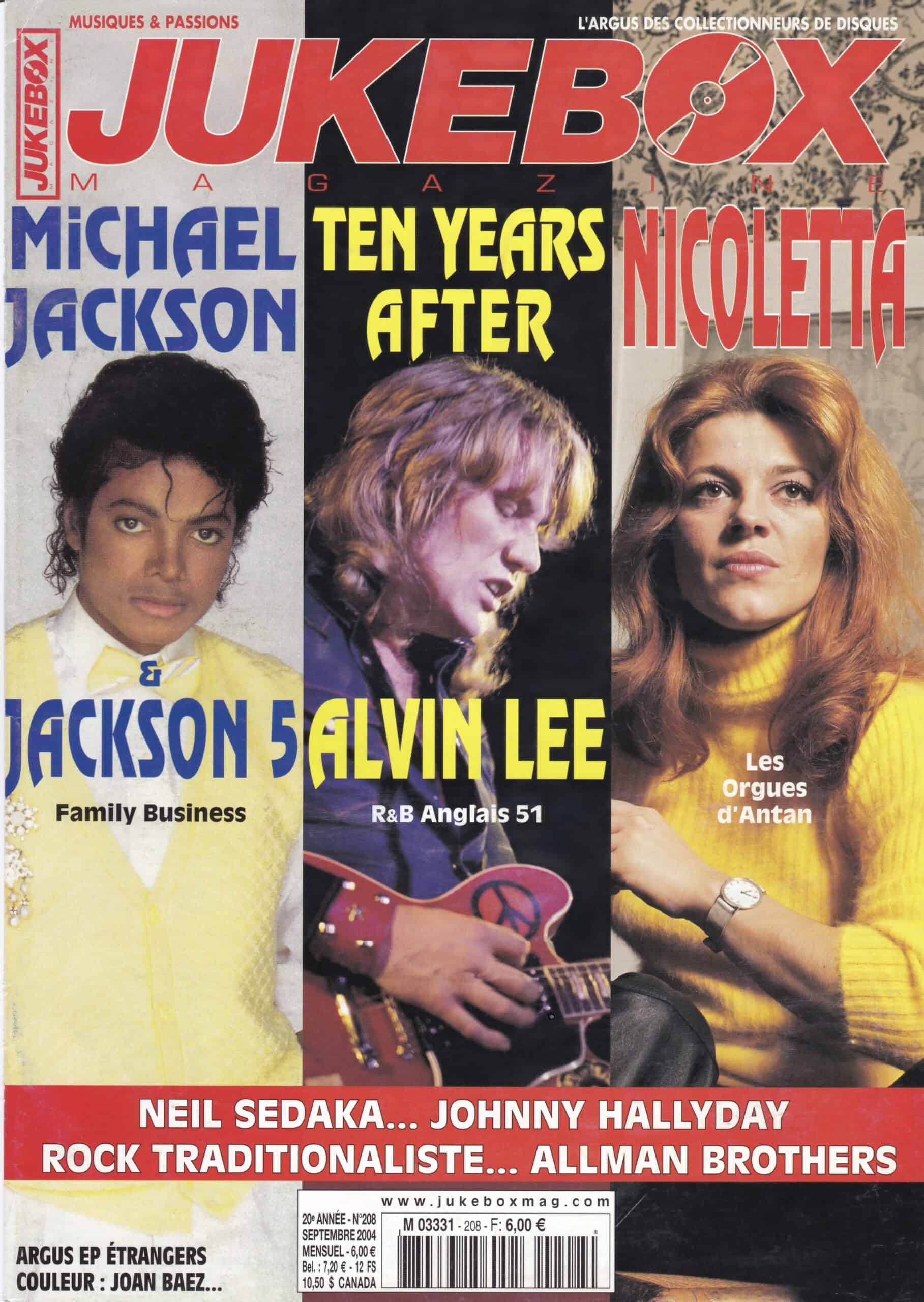
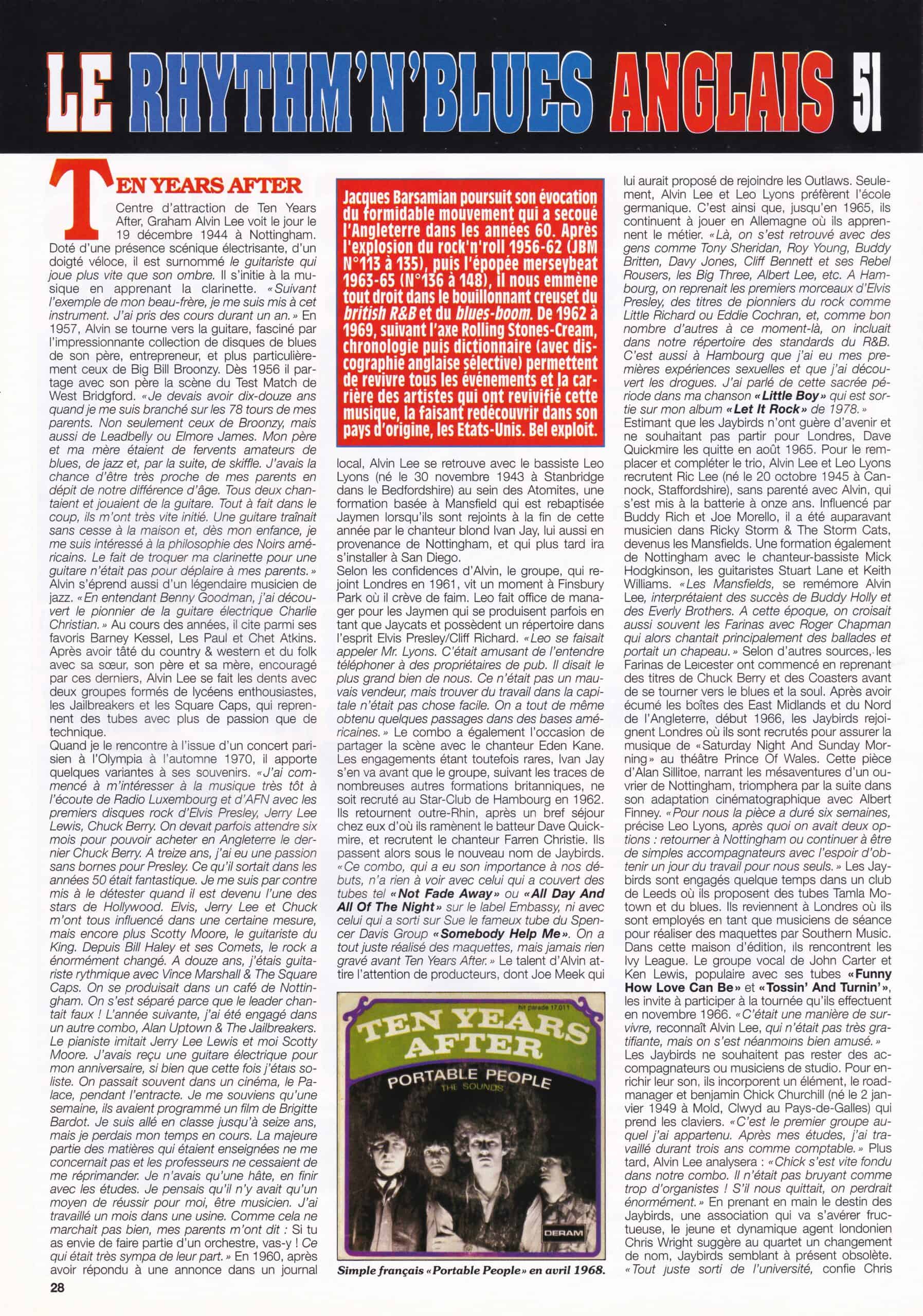
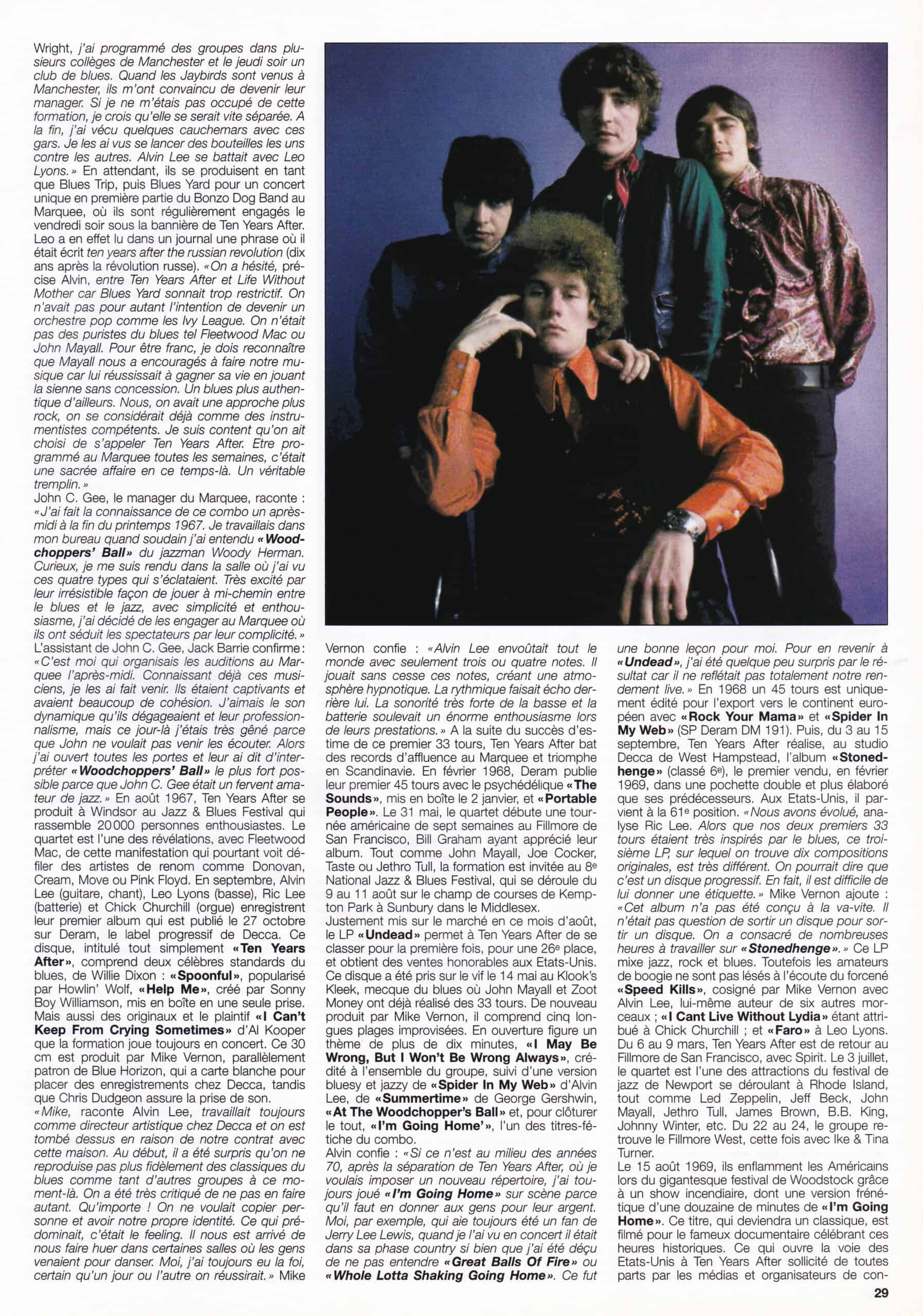
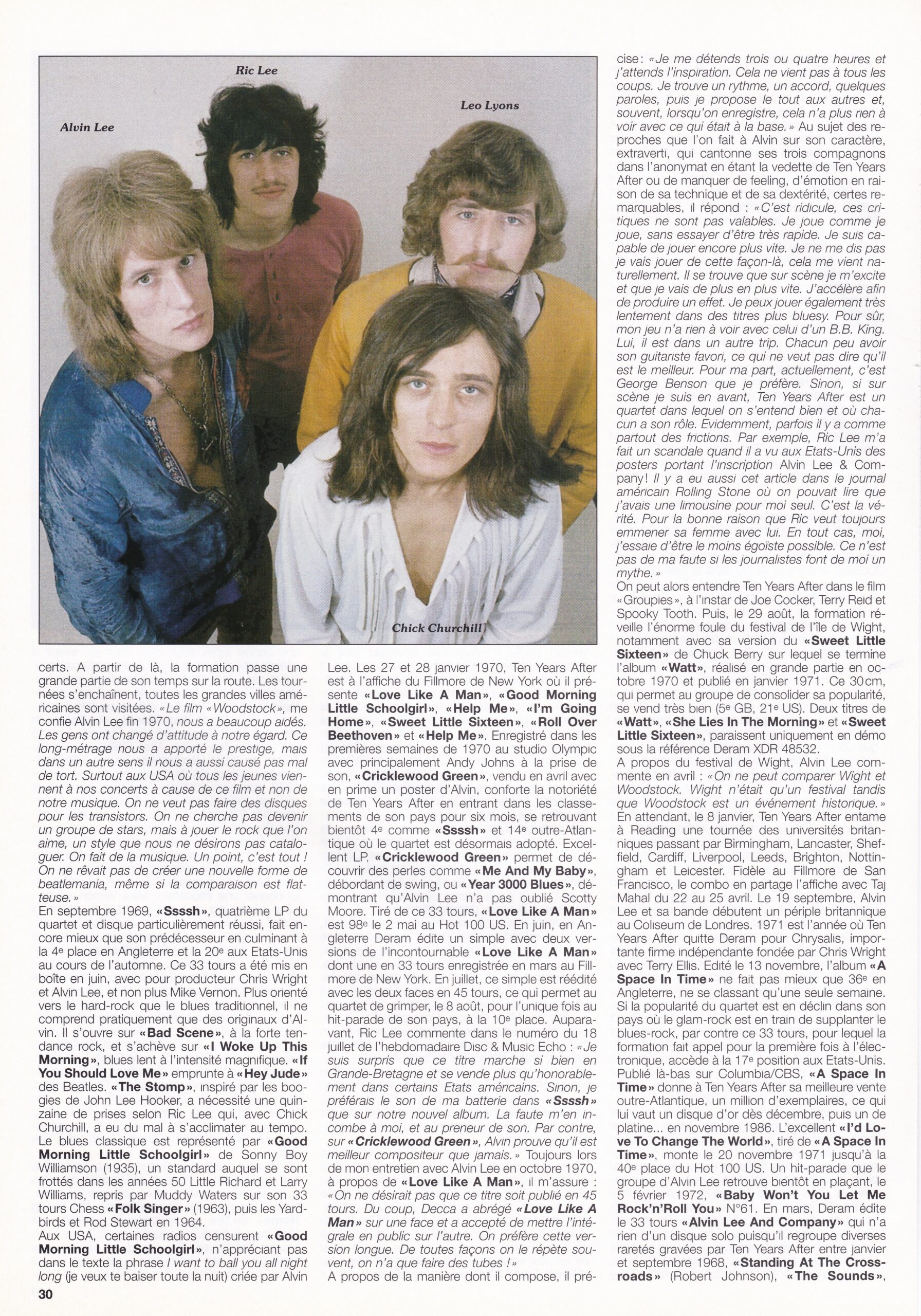
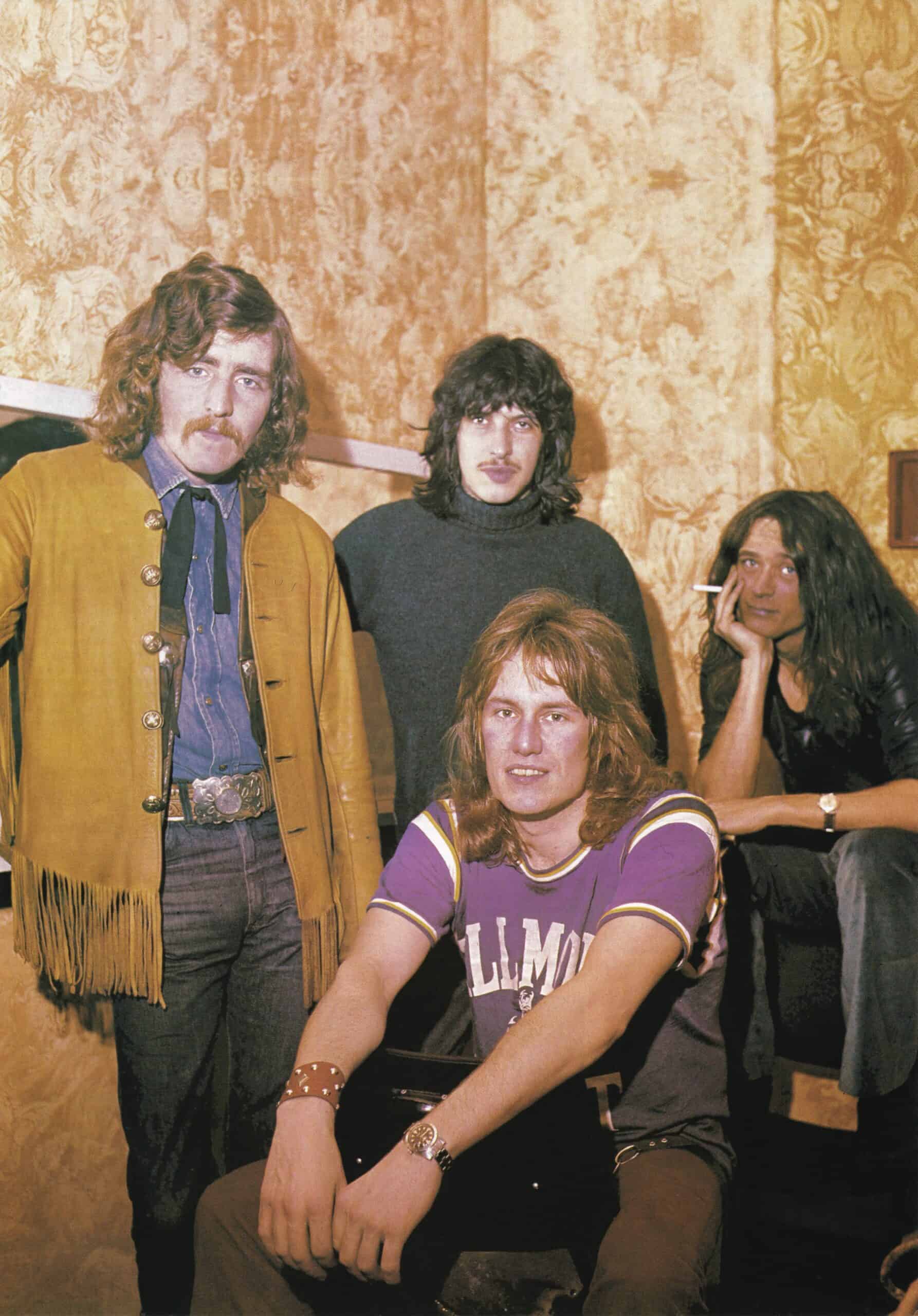
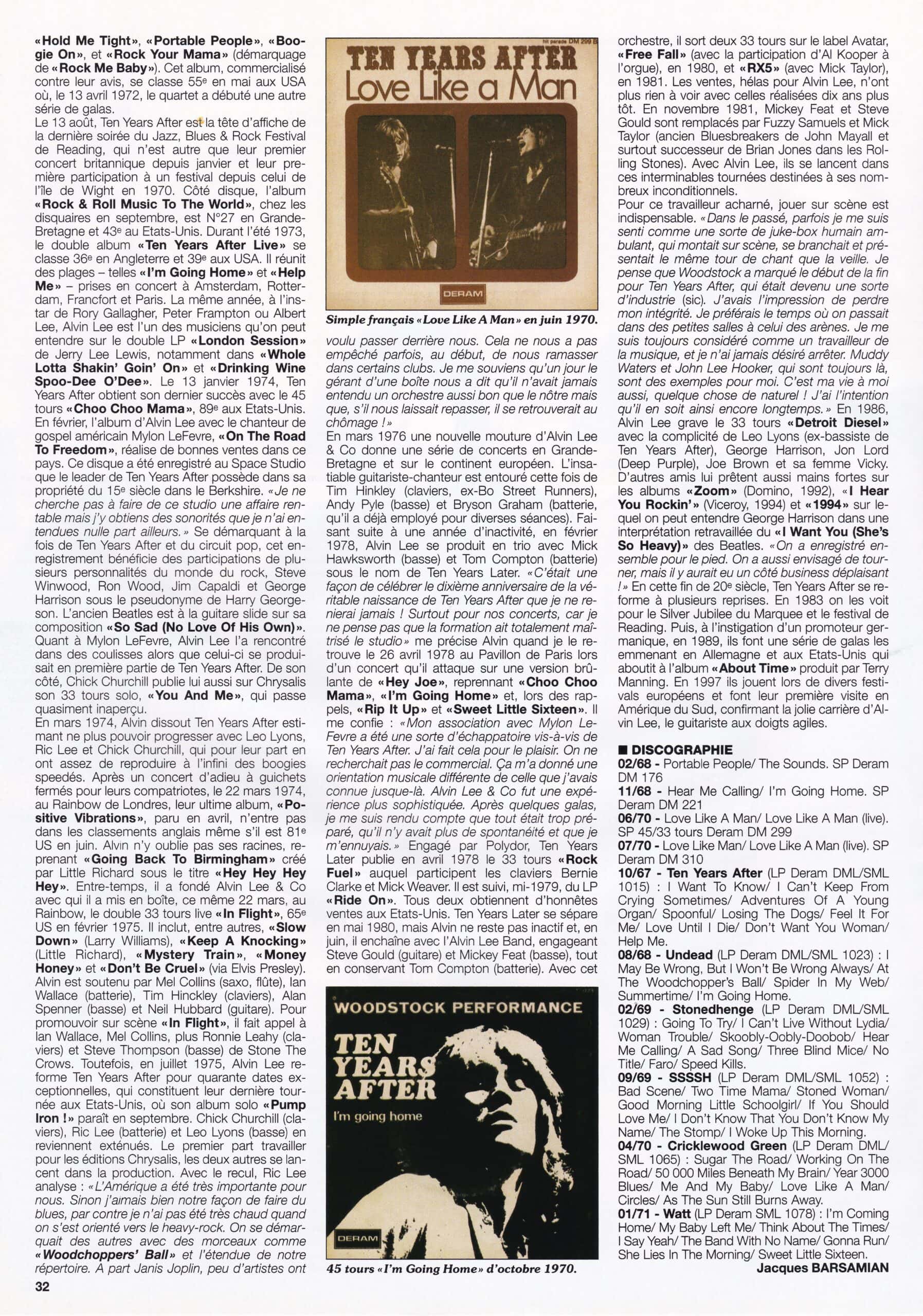
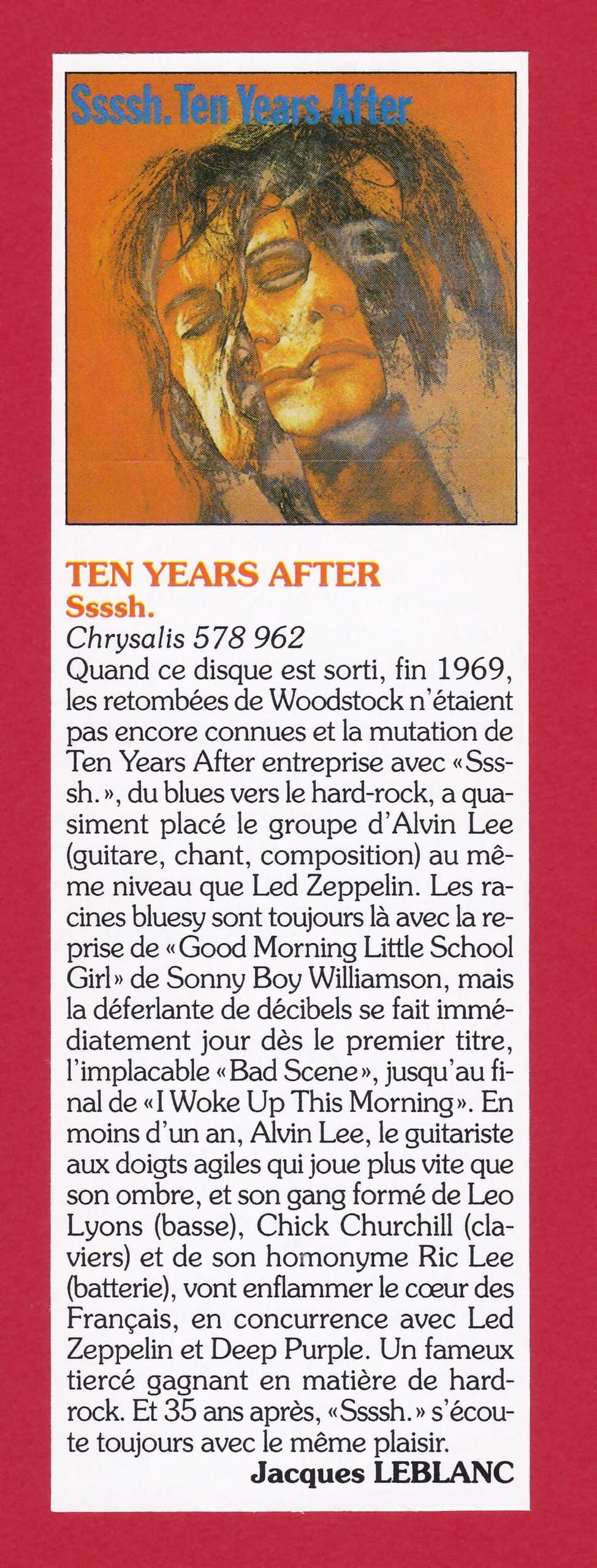
Guitar Techniques magazine, December 2004
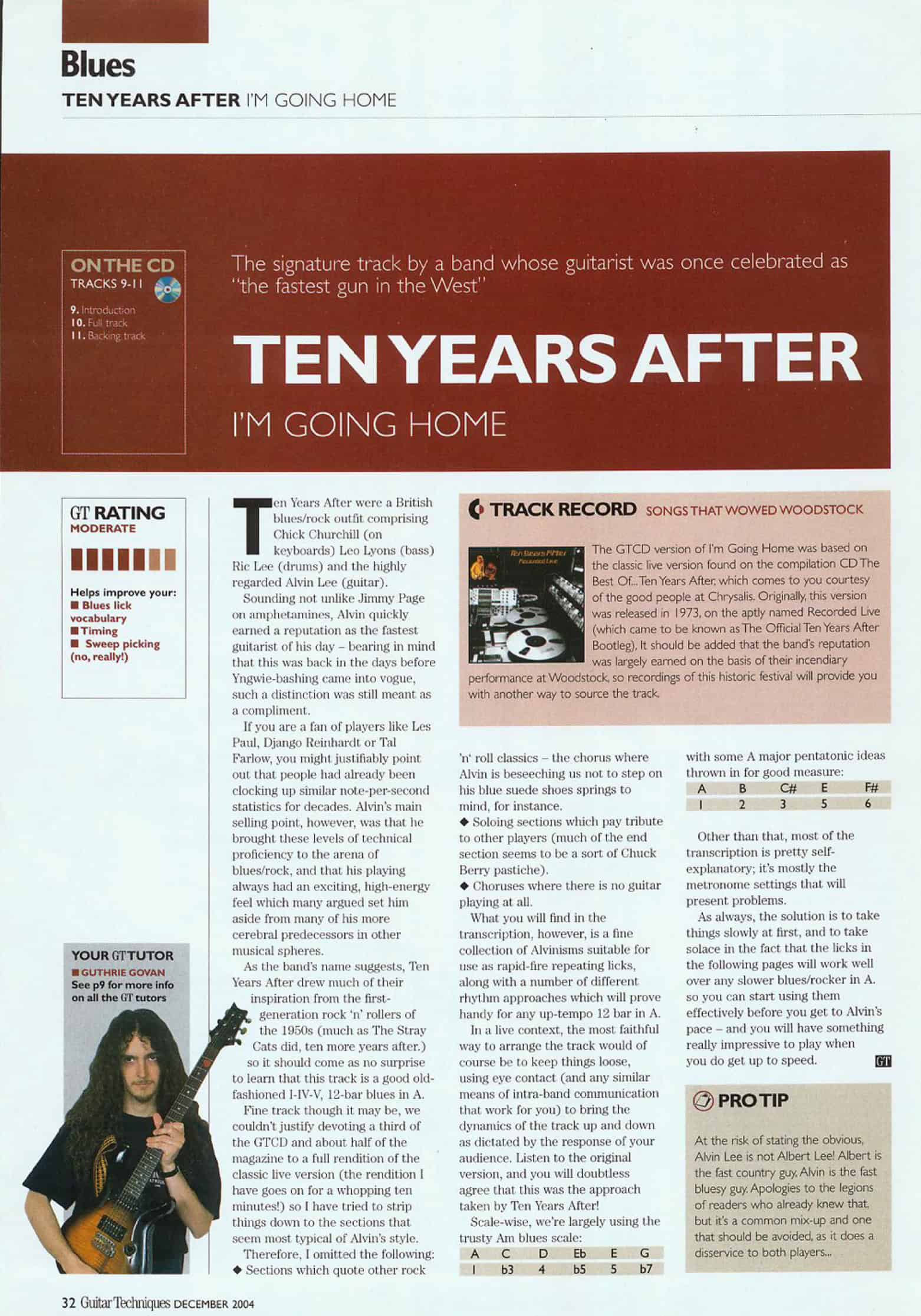
Rock-A-Billy
It has been said that guitar wizard Alvin Lee of Ten Years After fame, was paying homage to “Sun Records” in his searing rendition of “I’m Going Home” which the band performed live at the Woodstock Festival in 1969. While there is no way to substantiate this claim, the dynamics and style of this number certainly are reminiscent of the reckless abandon that was on display during the early rockabilly years. What is verifiable is the direction that Alvin Lee has taken in recent years, with his recording of “Alvin Lee In Tennessee” that was released in 2004. It was recorded in Memphis, together with his childhood hero and living guitar legend Scotty Moore, who is known for his excellent guitar work on the early Elvis Presley recordings, done at Sam Phillip’s studio, at Sun Records.