1995
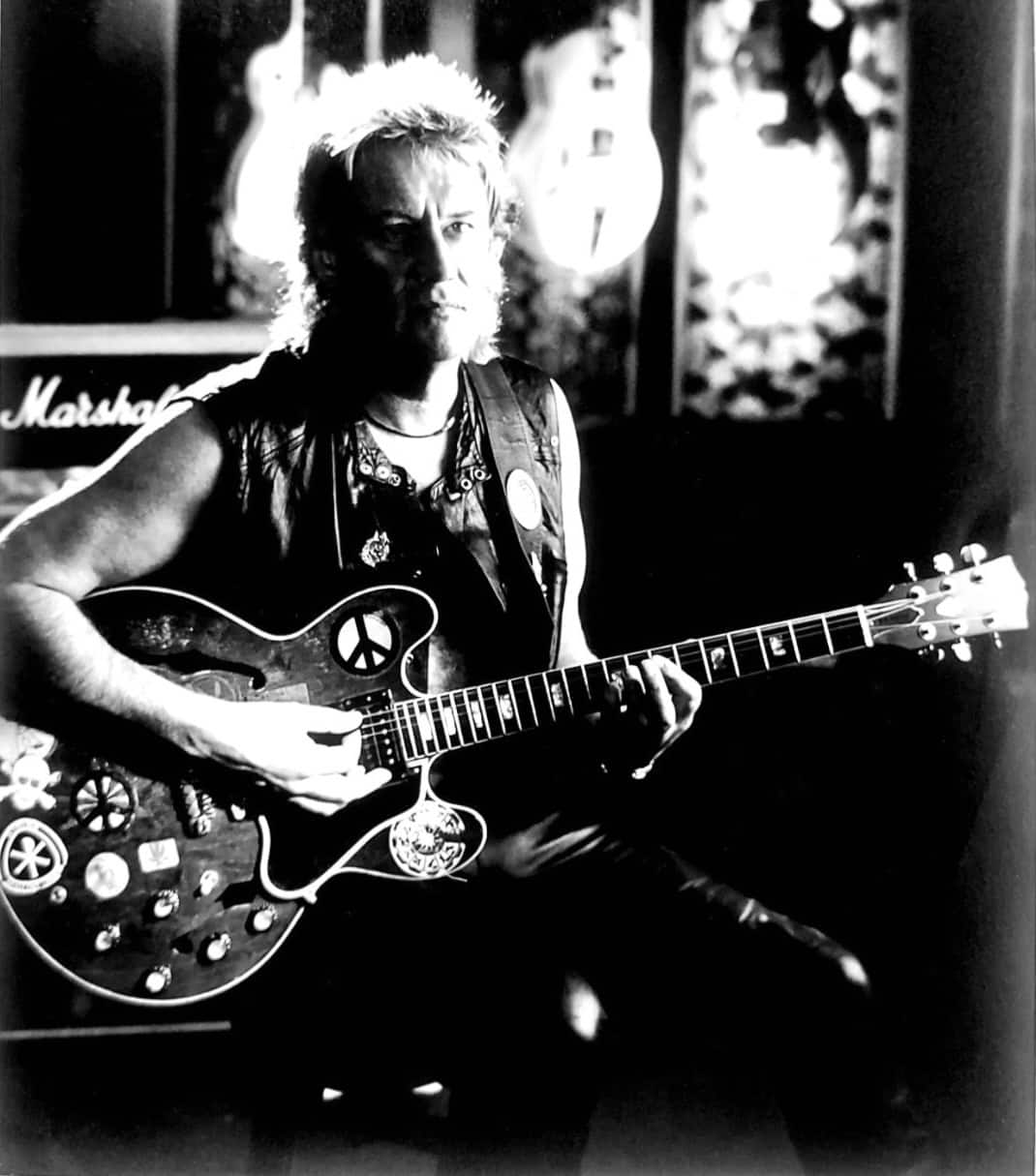
photo by Richard K. Butland
February 11, 1995 – Athens, Greece

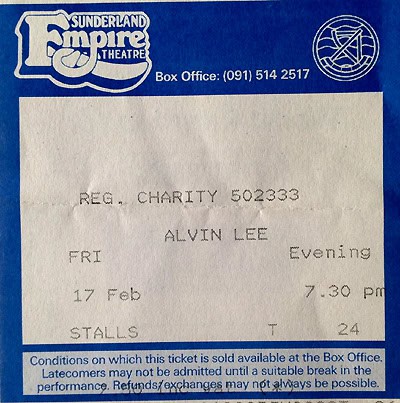
February 17, 1995 – Empire Theatre, Sunderland, England
Alvin Lee Band
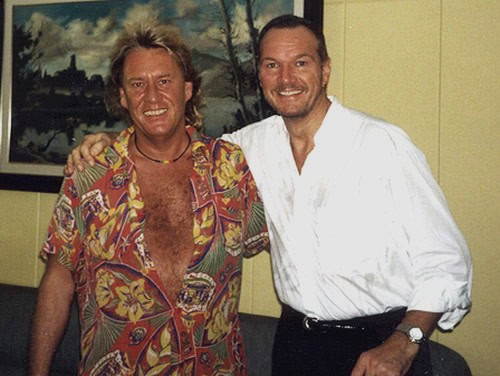
Alvin Lee and Ian Wallace in Spain, 1995
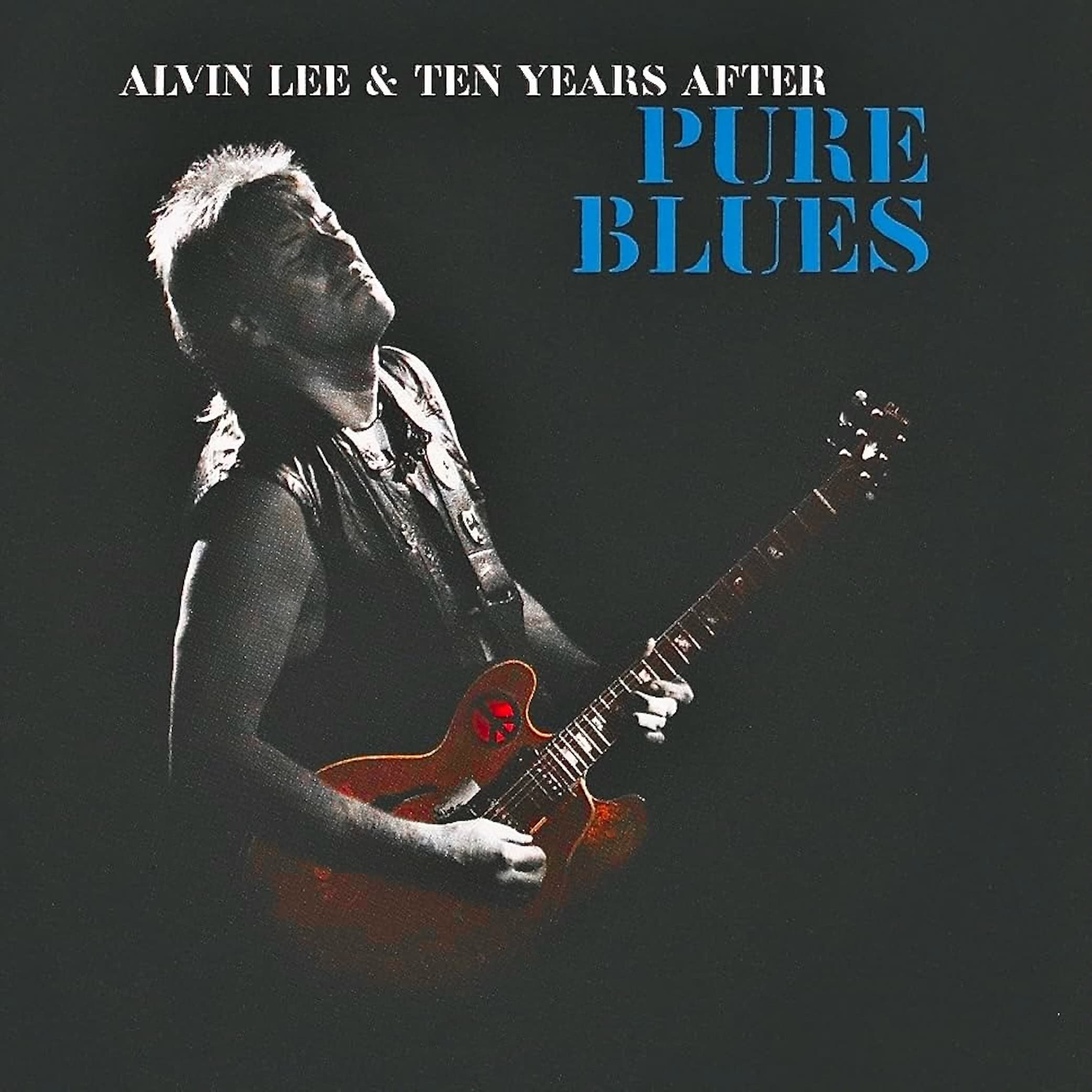
Pure Blues – CD Review
*Pure Blues*, released in 1995, is a compilation that serves as an accessible entry point into the blues-oriented work of the guitarist Alvin Lee, with and without Ten Years After. The album brings together a selection of Alvin’s blues material as representative cross-section rather than a comprehensive overview of his full catalogue.
The compilation highlights both the collective musicianship of Ten Years After and Alvin Lee’s distinctive guitar style. Across the track list, Lee’s playing is given ample space to develop, demonstrating his versatility and expressive approach within the blues tradition. The band’s tight arrangements and cohesive performances underscore their reputation as a skilled and hardworking ensemble.
While *Pure Blues* does not capture the entirety of Alvin’s blues output, it effectively illustrates his contribution to the genre. The album emphasizes energy, emotional delivery, and musical precision, qualities that have long been associated with Alvin’s sound.
March 24 & 25, 1995 – Moscow, Russia
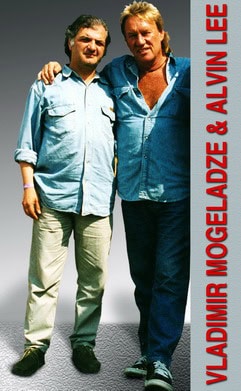
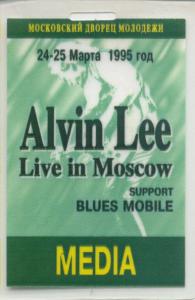
Alvin Lee was performing in Moscow, Russia in 1995. There were two gigs played at the Moscow Youth Dome. One was on March 24th and the other on March 25th. Both shows were superb, unfortunately it was not the best time in our country. It was rather unstable after Gorbachev’s perestroika. The advertising for the concert was very poor, the tickets were rather expensive and the Dome was only one third full I’m sorry to report. I’ve chanced to be present at that great event, and was greatly impressed.
Alvin Lee – Guitar and Vocals
Steve Gould – Bass Guitar and Vocals
Steve Grant – Keyboards
Alan Young – Drums
April 22, 1995 – Meyenheim, France
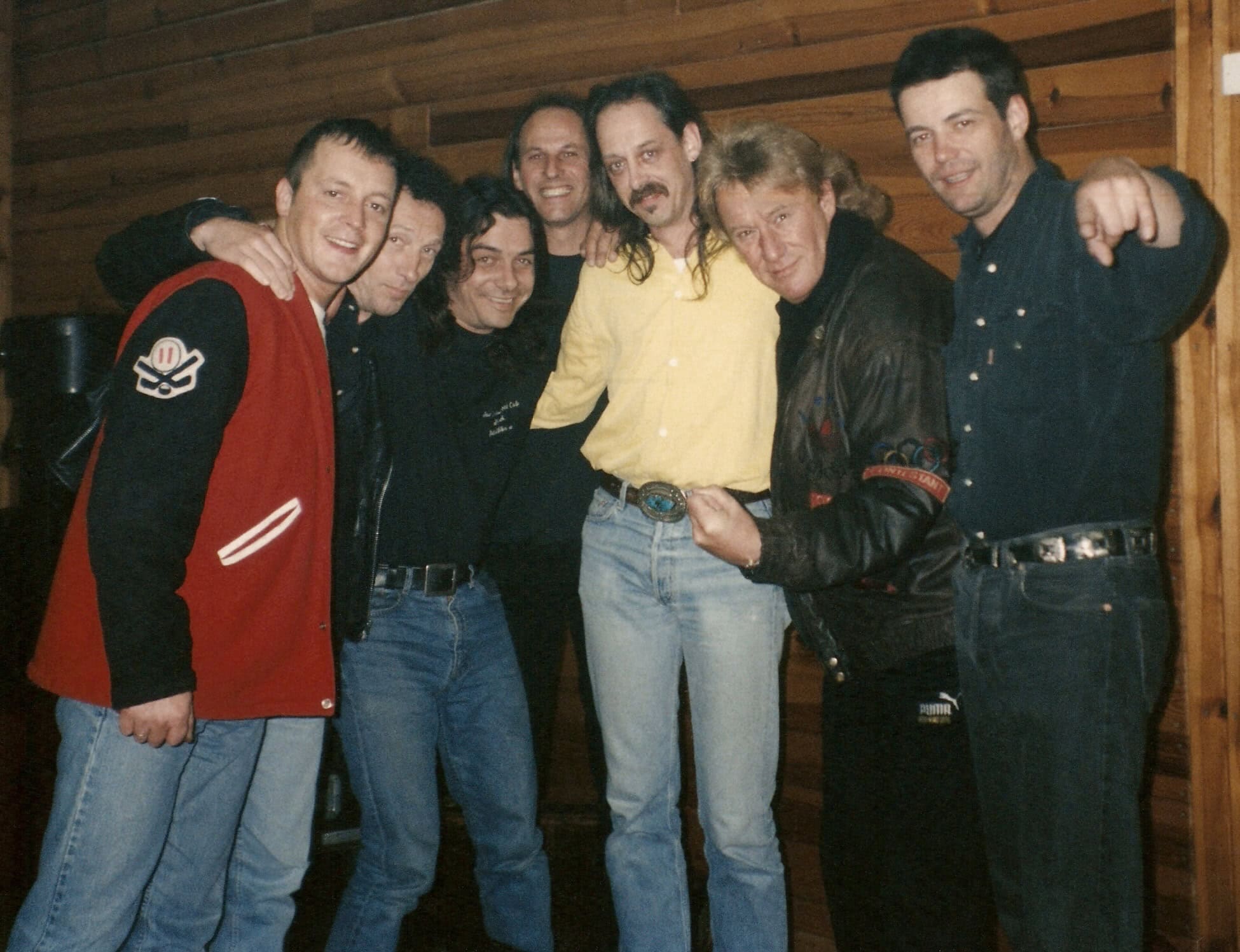
Backstage with the Jimi Hendrix tribute band “More Experience” from Switzerland
left to right: Alan Young – Steve Gould – Marco “Caco” Brander (Drums) – Henry Imboden (Bass) – Marcel “Jimi” Aeby (Guitar & Vocals) – Alvin Lee – Dave Muscheidt (Sound Engineer)
May 11, 1995 – VIII Festival Internacional “Blues de Cerdanoya”, Spain
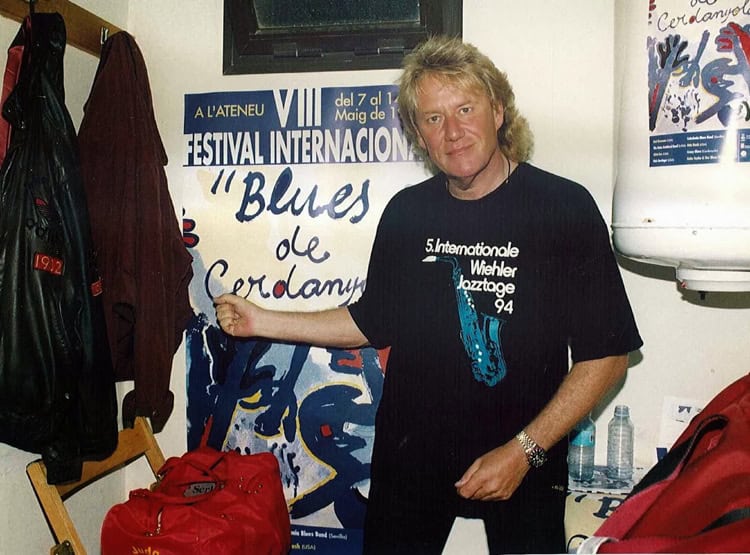
Alvin Lee Backstage

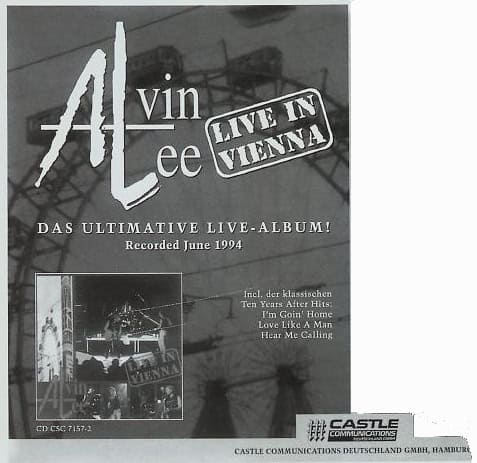
Recorded in 1994 / Released in 1995
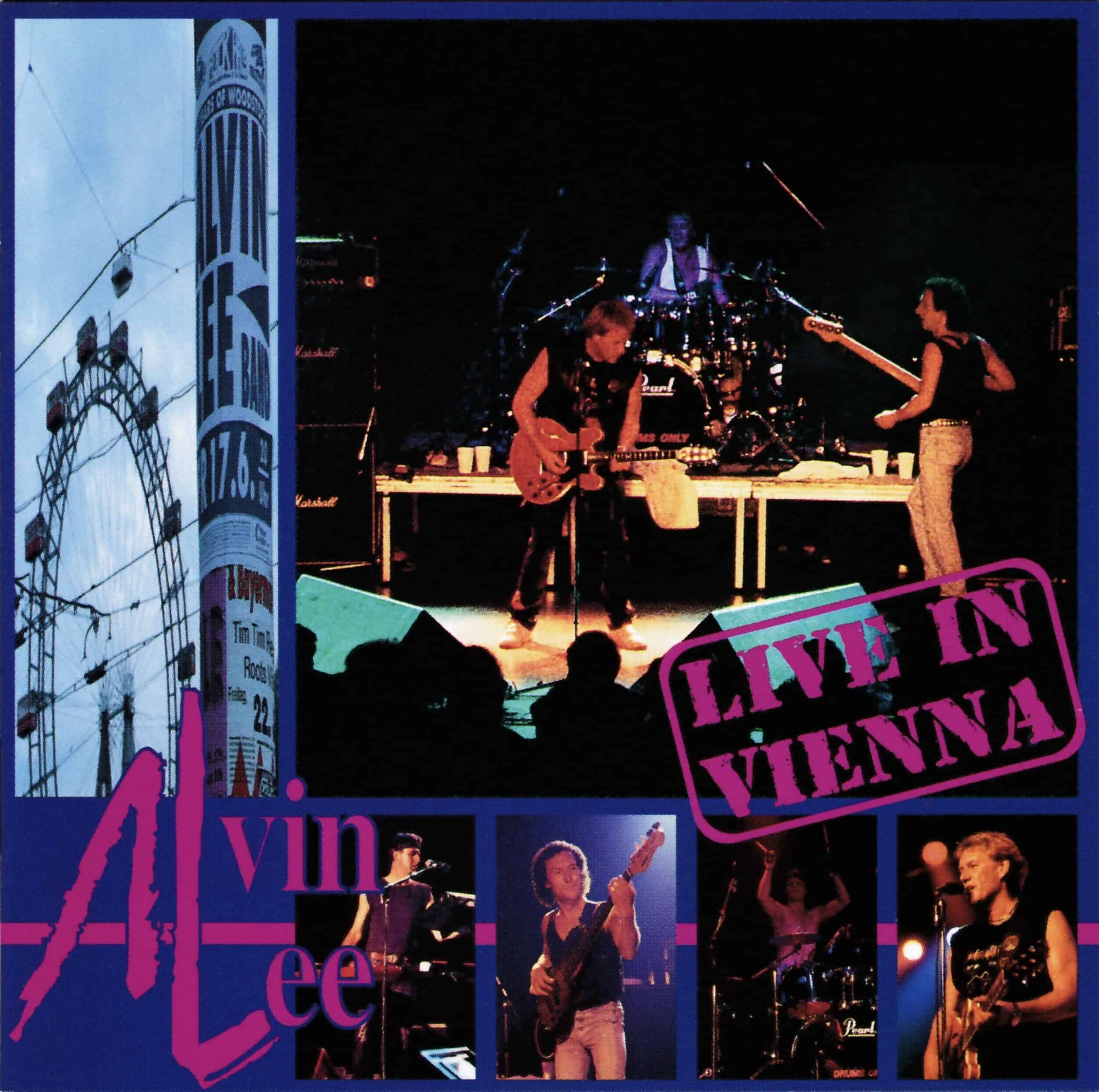


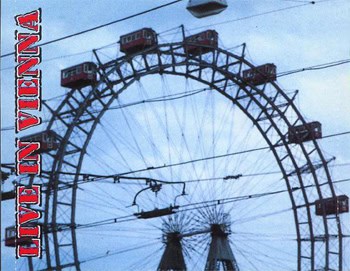
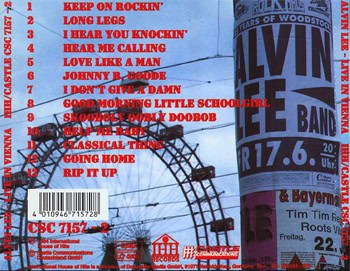
Alvin Lee Band – Live In Vienna
*Live in Vienna* is a strong reminder of just how compelling Alvin Lee was on stage. From the opening moments, his guitar tone is sharp, fluid, and full of character, carrying the performance with confidence and ease. This is Alvin doing what he did best: playing with speed when needed, but always with feel and intention.
The live setting suits the material well. Songs are allowed to stretch and breathe, and the guitar solos feel spontaneous rather than rehearsed. The band supports him solidly throughout, keeping everything grounded while still giving the music plenty of energy.
What stands out most is the sense of enjoyment in the playing. There’s no sense of going through the motions—this feels like a genuine live performance, captured at the right moment. *Live in Vienna* is a rewarding listen for fans of Alvin Lee and anyone who appreciates blues-rock played with passion and authenticity.
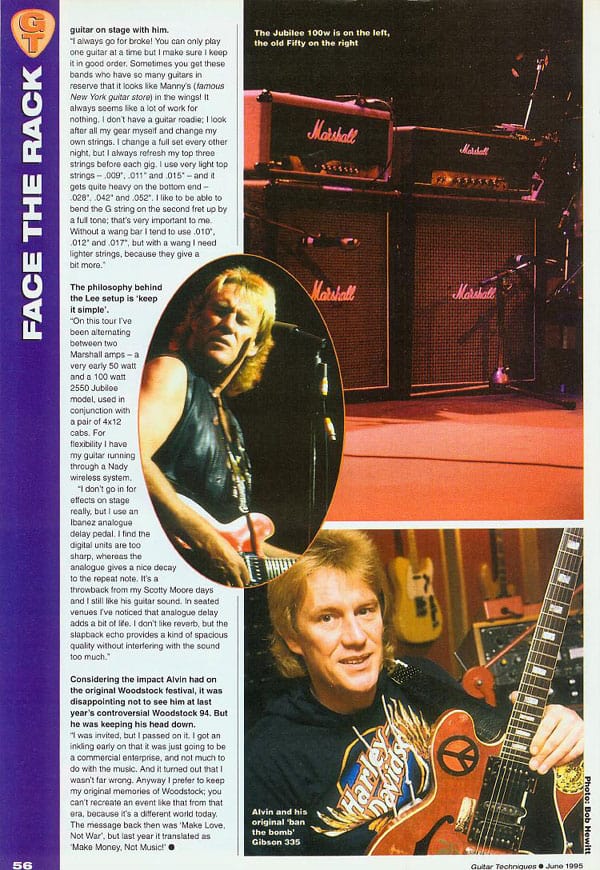
Guitar Techniques Magazine
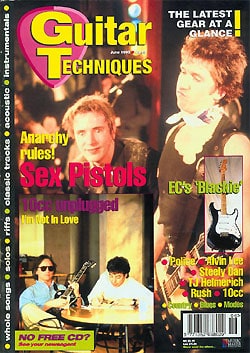
June 1995 – Alvin Lee
Face The Rack “Alvin Lee; Still Going Home”
More than a quarter of a century has passed since Ten Years After took Woodstock by storm..
But, as Mark Cunningham discovers, Alvin Lee is back on the road, proving there’s more life than ever in those lightning fingers.
“I Hear You Knocking” (similar to Dave Edmunds version) and The Beatles “I Want You” (she’s so heavy); the latter featuring a guest appearance from Alvin’s long-time mucker, George Harrison.
Alvin, 50, says: “My career has turned full circle now, and like a lot of my contemporaries, I’ve gone back to my musical roots. It’s where I feel most comfortable. We even recorded “Nineteen-ninety-four like the old days – all in one room. With very few overdubs, to keep the whole thing sounding natural and raw”.
As a guitarist, Alvin’s influences are as diverse as they come:
“Very much so” he agrees. “In my early days I listened to a lot of jazz because my parents were real jazz and blues fans. There was a great guitar player called Charlie Christian who worked with Benny Goodman, and a lot of those guys like Count Basie and Louis Jordan had a huge influence on the swing aspects of early rock ‘n roll. Then there’s Chuck Berry, “Sun period” Elvis, Jerry Lee Lewis, Little Richard and the blues guys like Big Bill Broonzy, Muddy Waters and John Lee Hooker. Every time I hear those old records I smile.”
“But there are other not so obvious influences at work in my guitar playing. I’d like to think I’ve learned a lot from listening to country man Merle Travis, Segovia’s classical work and the great flamenco guitarist Juan Serrano. I’ve certainly heard a lot more of that style since I moved to live in Barcelona, and I’m sure it’s rubbing off on me, albeit subtly. Unfortunately, it’s hard to transpose those flavours to the stage style of rock `n` roll , although I’m investigating flamenco as a hobby”.
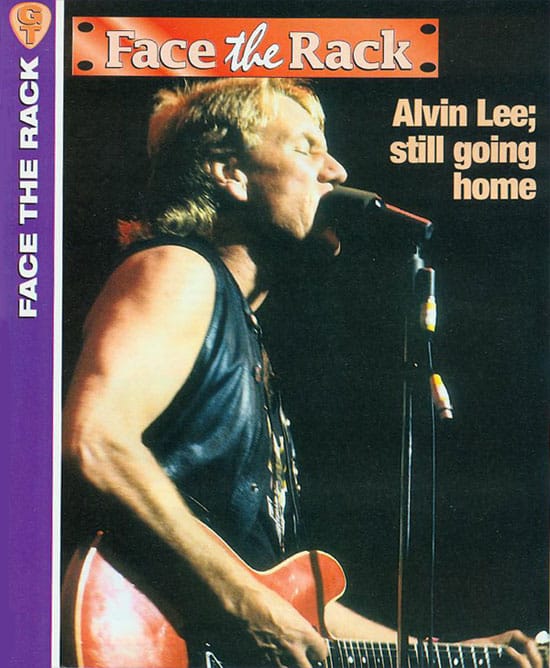
In the UK, Alvin on stage has become a rare sight over recent years:
“To be honest,” he says, “The Ten Years After experience burned me out. We began as a great club act, playing at the Marquee and places where the sweat was literally dripping down the walls. That’s what live music was about for me, but then after Woodstock things got out of control and we got catapulted into the American arena scene, where that interactive relationship with the audience just dissolved. It all became very false and I think we lost touch with the reality that playing in Britain gives you. The situation has turned around now because, due to a longstanding problem with the Internal Revenue Service (IRS) I don’t feel inclined to tour the States. But this year will see me playing my first ever dates in Russia and Poland, which will be interesting, although very cold. I know that people want to hear me play things like “Love Like A Man” and “I’m Going Home” and although I used to revolt against the idea, I don’t have a problem with it now. I remember going to see Jerry Lee Lewis during his country period where he didn’t even touch my favourites like “Great Balls Of Fire”. I was sick as a pig, so I know not to neglect some of the more well known Ten Years After material”.
Surprisingly, Alvin’s classic 1958 “Ban The Bomb” (Peace Sticker) Gibson ES-335 – is absent on his latest live trek:
“It’s still my favourite guitar but it’s become too valuable for me to risk taking it on the road, although I used it on quite a few of the tracks on “Nineteen-Ninety-Four”. If anything happened to that it would be a disaster. These days I’m playing a red Heritage Alvin Lee 335 type model with a Kahler wang bar. In fact, an airline broke the neck a few months ago and they put a new one on, so now it’s as good as new. But you couldn’t risk that with my Gibson.
It wouldn’t feel the same. Between the humbuckers on the Heritage there are extra Stratocaster pickups with their own volume control. It was effectively built for me by the same people who made my famous 1958 Gibson 335. When Gibson left Kalamazoo and renamed the company Heritage.”
Alvin obviously has great faith in his strings; he insists on taking only one guitar on stage with him:
“I always go for broke! You can only play one guitar at a time, but I make sure I keep it in good order. Sometimes you get these bands who have so many guitars in reserve, that it looks like Manny’s (Famous New York City Guitar Store) in the wings! It always seems like a lot of work for nothing. I don’t have a guitar roadie; I look after all my gear myself, and change my own strings. I change a full set every other night, but I always refresh my top three strings before each gig. I use very light top strings: .009, .011 and .015 and it gets quite heavy on the bottom end: .028 .042 .052. I like to be able to bend the G string on the second fret, up by a full tone; that’s very important to me. Without a wang bar I tend to use: .010 .012 and .017, but with a wang I need lighter strings, because they give a bit more”.
The philosophy behind the Lee set-up is – “Keep It Simple”.
“On this tour I’ve been altering between two Marshall amps, a very early 50 watt and a 100 watt 2550 Jubilee model, used in conjunction with a pair of 4 x 12 cabinets. For flexibility, I have my guitar running through a Nady wireless system. I don’t go in for effects on stage really, but I use an Ibanez analogue delay pedal. I find the digital units are too sharp, where as the analogue gives a nice delay to the repeat note. It’s a throwback from my Scotty Moore days and I still like his guitar sound. In seated venues I’ve noticed that analogue delay adds a bit of life. I don’t like reverb, but the slap-back echo provides a kind of spacious quality without interfering with the sound too much”.
Considering the impact Alvin had on the Original Woodstock Festival. It was disappointing not to see him at last year’s controversial Woodstock 1994.
But He Was Keeping His Head Down:
“I was invited, but I passed on it. I got an inkling early on that it was just going to be a commercial enterprise, and not much to do with the music. And it turned out that I wasn’t far wrong. Anyway I prefer to keep my original memories of Woodstock; you can’t recreate an event like that era, because it’s a different world today. The message back then was “Make Love, Not War”, but at Woodstock 1994 it translated into “Make Money, Not Music” !
“The Best of British Blues Tour 1996”
May 29, 1996 – Rochester, NY
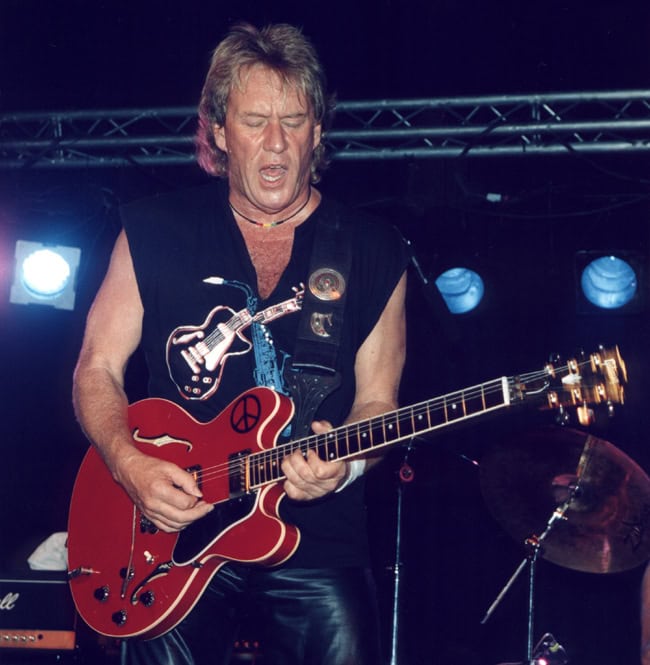
Photo Henry Kiecman
Ray Shasho Review

Those wild backstage party days of yesteryear are over. Classic Rockers are laid back and very approachable. After all, most of them are grand-parents now. I struck up a conversation with an older man outside a smaller venue in Washington D.C. It so happened that the man was Alvin Lee’s tour manager. With that same Fender Guitar in my hand, this reporter ended up hanging out backstage with legends Alvin Lee, Eric Burdon and Aynsley Dunbar.
This was when a band of veteran musicians got together for a short lived tour entitled, “Best of the British Blues” in 1996. Alvin even played my 1973 Fender backstage. I drove to the show in a white limousine and nearly gave Mr. Lee a ride to his hotel, if it weren’t for his girlfriend wanting to eat on the tour bus.
by Ray Shasho – far right in the photo
June 22, 1996 – Linz, Austria

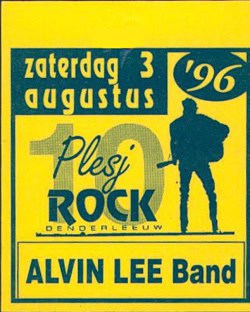
August 3, 1996 – Denderleeuw, Holland
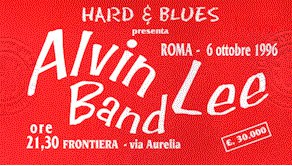
October 6, 1996 – Rome, Italy
SECONDS Magazine, No. 38 – September 1996


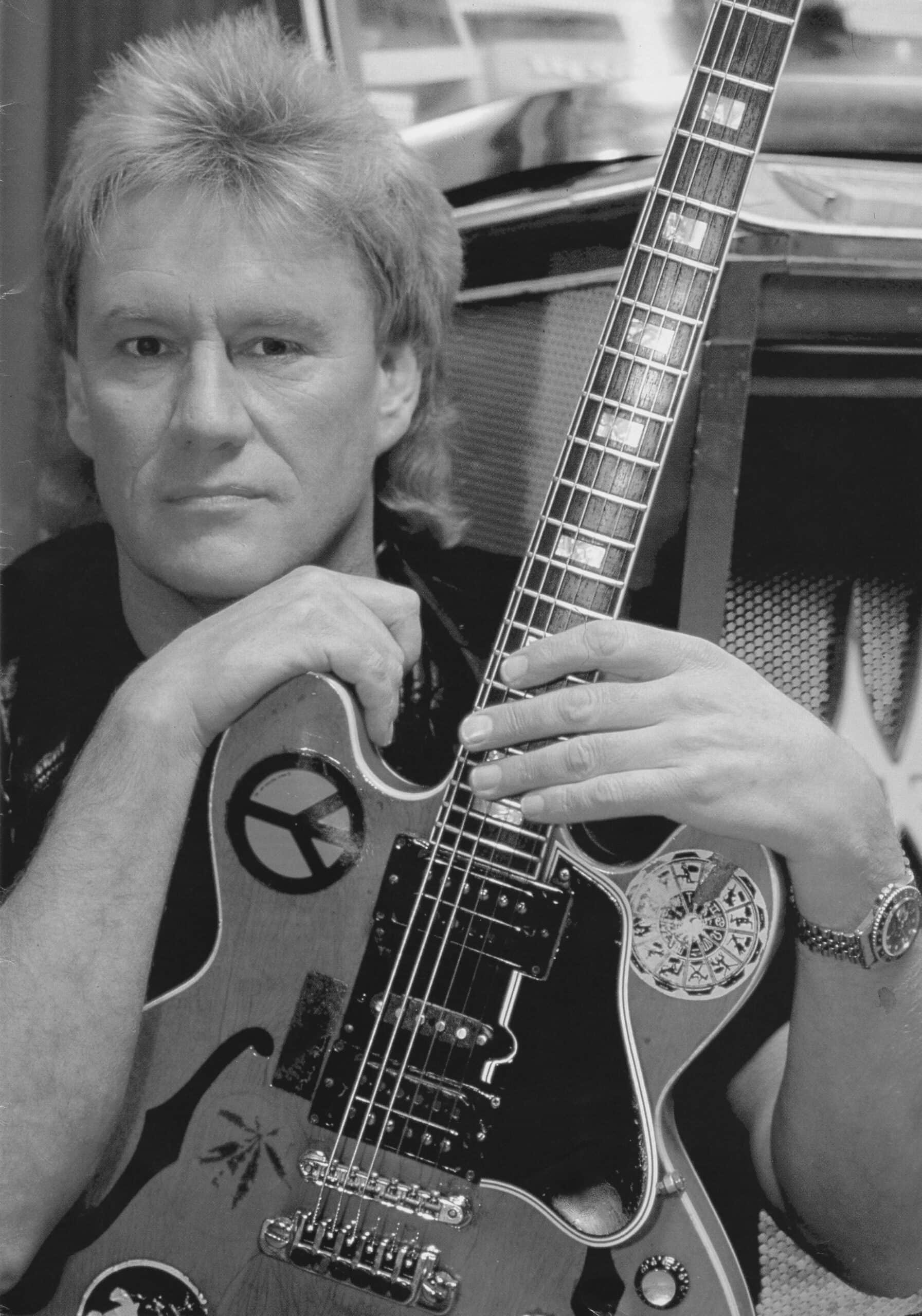
Interview Alvin Lee with George Petros, published in Seconds, No. 38, September 1996
The magazine Seconds was published from 1986 to 2000 by Steven Blush & George Petros, New York City
Seconds: What aspect of your work do you recognize in music today?
Alvin: Licks and tricks, really. There’s certain licks I play that I know I’ve developed that not many other people play. I never used to copy players. I was a big fan of Chuck Berry, but I never copied his solos. I’d emulate his style. Sometimes I hear my actual licks copied. I realize there are some young guys out there listening to me, like I listened to Chuck Berry. That’s an on-going thing.
Seconds: You are particularly noted for playing fast.
Alvin: The original “Captain Speed-Fingers” yeah. That was something that just happened, actually. I never tried to play fast. If anything, I tried to slow it down a bit. With the adrenaline of live gigs, it just used to come out that way. I never acknowledged that “Fastest Guitarist In The West” and all that because it just isn’t true. Django Reinhart was before us all and played much faster than anybody I’ve ever heard. A lot of Jazz players like Barney Kessel and John McLaughlin play much faster than me. I’l play light and shade, I’l play things slowly and then hit you with some rocket riffs. It’s nothing I set out to do – it’s quite the opposite; I always tried to hold it back a bit.
Seconds: What other qualities of your guitar playing would you like to be remembered for?
Alvin: I just play by feel, “from the hip”, as they say these days. I’m not musically trained. I’ve been asked to really know what I’m playing. I’ve developed a style where my fingers will do what my brain says, but I don’t get in the middle of that. It’s one of those things where I grit my teeth, dig in, and just play it. It’s an automatic thing. It doesn’t work slow; I forget where I’m going. I don’t play scales or anything like that — in my mind, scales are a waste of time. You learn to play a major scale but you can’t use it! It doesn’t sound nice. What’s the point of learning to play something that doesn’t sound nice? So I make my own scales up. I make scales that I want to hear. It sounds better and I can use it. I don’t think about my playing too much. I don’t sit down and practice this lick or that lick, I just play.

Seconds: What’s the center of gravity, the thing you come back to the most?
Alvin: The center of gravity is the guitar and me.
Seconds: I hear the word Rockabilly in connection with you …
Alvin: Yeah, I was a big fan of Scotty Moore. I met Scotty in Nashville. I had to say to him, “that second solo in Hound Dog – how did you play that?” He said, “I just grabbed a handful. I’ll tell you about another time I fucked up…”. It was a mistake. That’s what I like about Blues and Rock & Roll – sometimes the mistakes are the great bits. You make a mistake and it sounds good. That often happens when I’m playing live. I told Scotty a lot of us guitarist were trying to work out how he played this second solo to Hound Dog, and it’s a complete mystery, even to him.
Seconds: You don’t like your music to be too polished.
Alvin: I’m kind of an amateur engineer. I’ve got my own twenty-four track studio and I’ve always fooled around and made demos. Over the last ten years, I’ve got more and more involved with drum computers and synthesizers and sequences. It’s a lot of fun, but it led me astray a little bit. On the Zoom album, there’s a song called Jenny Jenny. It pleased me because it sounds like a Rock & Roll tune, but it was actually cut with a drum computer. On I Hear You Rockin’ I listened to some old Ten Years After songs and said, “How did we record then? How did the songs come about?” I remember sitting with the band in one room and playing tunes, so that’s what I did on this last album. It’s simple, but I clouded by technology. When I first started touring after I made the album, I did something I’ve always wanted to do. I went onstage and said, “I’ve just made a new album and now I’d like to play it for you”. I played the whole album from start to finish and it was great. Now, I’m playing a mixture of old favourites because I think the audience would like to hear the classic cuts, as well as the new stuff.

Seconds: What do you regard as your classic stuff?
Alvin: I’m Going Home – Love Like A Man – Good Morning Little Schoolgirl – Slow Blues In C – I’ve just started doing I Hear You Calling again.
Seconds: How was Ten Years After different from other Blues Rock bands of that time?
Alvin: Ten Years After was never a very happy band. It was a constant war, which made the style what it was. I was playing rocket riffs, the bass player was playing rocket riffs, the drummer was playing a constant drum solo, and a lot of the time it was very frustrating. I wanted to hear a bit of backbeat, but the band was so busy – everytime l’d take a solo, everyone else would take a solo at the same time.
Seconds: But you had the final word, right?
Alvin: Yeah, to a point. I never told a musician what to play. It’s far too corporate. If you want a happy musician, if you want a contribution from the guy, he’s got to be playing what he likes.
Seconds: Yet you were together a long time …
Alvin: It was enjoyable, but I started to move toward solo projects because I wanted to move on and try other things. The first solo album I did was On The Road To Freedom – which was a little statement in itself, and it was strongly influenced by Country Music. It was a whole different feeling. I had Ian Wallace playing simple drums and Boz Burrell (from King Crimson and Bad Company), who was one of my favourite bass players. After playing with Ten Years After, where everything was a racket and solos, suddenly I was playing with Wallace and Burrell. I’d start a Rock & Roll song, and instead of them coming crashing like I was used to, they’d come in with a neat half-time feel. To me, that was great. I’ve always liked to do different things; I don’t like to get stuck in a rut too much. I’ve always experimented with music. I hate the kind of person who sits down and says, “what’s popular? What the people want to hear, I’ll play that.” That’s too contrived. I always like the music I play. I’ve gone astray a few times, I must admit. Record companies say they want you to record something that’s popular so it can get played on the radio – I tried it a few times and it never worked. The radio stations say, “this isn’t Alvin Lee’s stuff. We want the real Alvin Lee.” I’ll stick to my guns and play what I like and it’s more rewarding. If you do have some success and it’s come from your heart, it’s much more rewarding.
Seconds: Ten Years After albums were very referential to Psychedelia, but they were also Blues albums.
Alvin: That was all part of that Sixties feel. On the second album Ten Years After did, the live album called Undead, we just played in a club and recorded it. I heard it back a couple of days later and thought, “this is great, this is the band playing the best they’ve played. Where do we go from here?” I was quite worried, I thought I’d peaked. I didn’t know what else to do. The way my mind went then was, “I’ve done that, so let’s experiment in other regions”. I suppose the Psychedelic era was on us and I was playing around with mind expansion as much as anyone else, and I guess it just came out in the music. I was always trying to not get tied down by any particular bag.
Seconds: Was the drug scene an integral part of the music?
Alvin: Not integral, but inspirational in a way.
Seconds: Did that all change?
Alvin: It has now for me – but not that recently! I’ve been a heavy user for a long time. I only cleaned up my act quite recently.
Seconds: An intoxication ritual is a great motivator for music.
Alvin: It is and it isn’t. Inspiration is hard to get, and anywhere you can get it, you get it. I’ve never been into heavy drugs at all. I was a pot smoker, I took LSD, and I found LSD to be quite inspirational.
Seconds: Did you do it when playing live?
Alvin: I have, in the bad old days. Once at the Fillmore West, as I walked on stage, the chemicals took over. I hit a test note on my guitar and I heard it hit the back of the wall and hit everybody’s head on the way back and bounce up. Most of what I remember about this gig is what people told me afterwards. I know I played Slow Blues In C and then said “Now I’d like to do Slow Blues In C” and played it again. All the fans were giving me very strange looks. There was one point where I was playing this solo, finished the solo and thought, “what song is this?” I came back playing another song. I got away with it, nobody wanted their money back. Things like that tended to happen at the Fillmore West.
Seconds: Did drugs take a toll on your contemporaries?
Alvin: When people started to die, that was not funny. I’ve always been very against heavy drugs. I’ve never been in the same room as Heroin. If anybody ever started to strap their arm up, I’d make it known that I disapprove and walk out. I’ve seen too many go that way. But smoking pot is harmless. Acid’s probably a bit risky, but you can’t be too safe in this world, can you ? I was quite a late starter in drugs. I never wanted to be reliant on anything. I liked the way I was going and didn’t want to change anything. The first time somebody gave me some Speed Pills, I was so worried that I made myself sick and spewed them out.
Seconds: Do you consider Cocaine one of the heavy drugs?
Alvin: I don’t consider it heavy, I consider it a waste of time and money.
Seconds: Did you see its effect on people around you?
Alvin: Yeah, I was a late starter on that too. I used to say, “how stupid putting white powder up your nose”. Eventually, I started doing it myself, as well. That led to three day jam sessions, out of which nothing came except a lot of rubbish. There was a time where I thought, “I don’t see the way out of this”, and suddenly I got fed up with the stupid lifestyle and just stopped. I’m healthy, happy, and I’ve got something in the bank now, which I never did when I was into that stuff.
Seconds: Your sound became more complex with albums like Watt and Cricklewood Green.
Alvin: I think an important part of music is evolving, and the band evolved, not necessarily for the good, but I think it’s best that a band does evolve, rather than stand still. We could have played that same style and become a cardboard cut-out band and made enough money to live fine, but I wanted more than that. I wanted personal creative rewards; I wanted to feel I was doing something more important than making a living.
Seconds: And the offer to play Woodstock …
Alvin: That just came about in the middle of a tour. I didn’t recognize it as anything different until I got there.
Seconds: It was a real demarcation point in your career.
Alvin: In retrospect, yes, but it was the movie that did that. The band was playing the Fillmore West, Fillmore East, Kinetic Playground, Boston Tea Party … the underground. We’d play to 1,000 to 2,000 people at the most. They’d be right up front, sweat dripping down the walls. Some of the best gigs I’ve ever done were those kind of gigs. We played the Woodstock Festival – great experience – but for a year we carried on playing club gigs. It wasn’t till the movie came out – that silver screen, larger than life feeling, and suddenly I found we were playing basketball stadiums and ice hockey arenas. You’d think playing to 20,000 people in arenas is making it, but it was horrible, I hated it. Having played clubs all my life, I suddenly found myself in ice hockey arenas where you’d finish the number and the sound continued on for another thirty seconds – huge barriers, so you couldn’t see the audience – and in those days, they didn’t have security guys; they had real cops with guns and cotton wool in their ears. I was playing to the back of coppers heads and thinking, “what am I doing this for?” People were shouting for Going Home through every number, and I got very disenchanted with that.
Seconds: If you didn’t enjoy playing the arenas, who was making you do it? Management and Record Companies?
Alvin: Pretty much. I wanted to do it at first. You think that’s what you want; you have to actually get it to find out it isn’t what you want. I used to walk onstage with everybody screaming and shouting – it didn’t seem like I had to do anything. With everything I did, they weren’t really listening to it. Nobody was picking on it. I’d play a rotten show, everybody would come back afterwards and say it was great. I’d play a good show, and everybody would say it was great. I don’t think anybody really knew. Generally I wasn’t getting any feedback. It’s a very unreal situation. My hero’s are Blues Musicians and I was becoming a Pop Star, which I didn’t want. A lot of people will say Woodstock made Ten Years After, but in fact it was the beginning of the end. At that point, disenchantment went on. To me, it was a big trap. I was constantly plagued by media obligations; it was ridiculous. I was doing twenty interviews a day and by the time it came time for the gig, I didn’t know where I was. I actually made the decision to de-escalate that thing. I stopped it. The managers, the record companies the agents, they all said, “Alvin, you can make millions of dollars”. I said, “what’s the point of having millions of dollars if I’m crazy?” I didn’t want what was happening to me. I stepped out of it and there’s no regrets. I’m playing a club tonight and that’s what I love doing. I’m glad I’m not playing Madison Square Garden tonight.

Seconds: Tell us about A Space In Time.
Alvin: A Space In Time was me making a break. After the Woodstock Movie, I had no time to write songs. I was writing songs in the taxi on the way to the studio. The band would say, “what have you got” and I’d make a song up right there. It worked; it was natural. I still write songs like that nowadays, but at the time I thought it ought to be harder than that. I wanted to struggle, I wanted to sit up all night writing. So I said, “I want six months off to write songs”. That was the first time I heard, “but Alvin, you could make a million dollars in the next six months”. Nobody could understand I didn’t want that.
Seconds: How was the band politics concerning money?
Alvin: Everybody was a bit burned out with these auditoriums, to be honest. I wasn’t the only one. The other guys quite liked making lots of money, whereas I thought it was distasteful, I didn’t think I deserved it. With A Space In Time, I said I was taking six months off. I wanted to be proud of the music I made. I’d Love To Change The World was one of the songs on that album I was really happy with.
Seconds: On The Road To Freedom with Mylon LeFevre was a real departure from the Ten Years After sound.
Alvin: I was trying to get back to some sanity and get away from Rock & Roll. When I did that, I realized that wasn’t what I wanted either and I came back to Rock & Roll. I went to see Jerry Lee Lewis and he was playing Country & Western. He didn’t play Whole Lotta Shakin’ or Great Balls Of Fire and I was really disappointed. I came out of that gig and I thought, “if people come to see me and I didn’t play I’m Going Home, they’re going to come out of the gig feeling like I feel”. It’s ok being an artist and playing what you want, but if people are paying money to come and see you, then you’ve got to give them something of what they want. That night, I went back to my band with Ian Wallace and Boz Burrell and said, “we’re doing I’m Going Home tonight”. I finally came full circle and came back to Rock & Roll and found it’s what I did best.
Seconds: It seems you’ve managed both your fame and your money pretty well.
Alvin: Yeah, by the skin of my teeth.
Seconds: You’ve probably had former millionaires looking to borrow ten bucks from you.
Alvin: It happens, sure. If you want security, there’s no security in the world. If you’ve got a million pounds, somebody can steal it from you. The only security I’ve ever found as a musician is that I can sing for my supper. I can do a gig and make money to live.
Seconds: Did you have contemporaries that lost their resources and looked to you with resentment?
Alvin: Most of those guys didn’t care. They were so out on a limb, they didn’t realize what they had and when they lost it, they didn’t realize it either. You make the best of what you’ve got, don’t you ? It’s not so much the guys that made millions and lost millions, it’s the guys that made millions and never got it. There’s lots of that, guys that had hit records and never saw a penny because of their crooked manager. I was lucky, I had a manager who used to say he was ninety percent straight, so I figured I got ninety percent of the money coming to me.
Seconds: How about your subsequent band, Ten Years Later?
Alvin: The name in itself was an anniversary, it was ten years after Ten Years After. There was a time around 1973 when I didn’t have any interest in the band anymore and the manager said, “You could have any musicians you want, Just call it Ten Years After. Keep the trade name”. To me that was very distasteful. I wanted to leave that and start again.
Seconds: I get the idea that you just considered yourself a guitar player in a group called Ten Years After, and were bothered by the fact that people fixated on you.
Alvin: It was never intended to be that way. It was a communal group, but obviously the singer and lead guitarist will be in the spotlight ninety percent of the time. I was getting bad vibes from the rest of the band. They were a bit miffed, that I was becoming the front man. That really started the rift within the band; they wanted to do interviews, too. So the manager would say, “Chick Churchill’s going to do the interview instead of Alvin Lee”, and the people would say, “we don’t want him, we want Alvin”, and the resentment built.
Seconds: In your current music, what do you look for?
Alvin: The feel. If it feels right, it’s good.
Seconds: If you experience a huge resurgence of popularity and someone calls you up saying, “Alvin, we want you to play Madison Square Garden”, what will you say ?
Alvin: I’d probably do it. I’ve learned a lot of lessons. Now I’ve got control, I know what I’m doing. In those days, I didn’t know what I was doing. I was pretty lost and the drug haze didn’t help. When you get to my age, you learn to make things easier for yourself. When you’re twenty three, you seem to be intent on making things hard for yourself – “how many drugs can I take and still play?” I’d give playing Madison Square Garden a whirl, I’d try and put over my music the way I want it to be. But I don’t think there’s too much danger of that happening.
George Petros about Alvin Lee
His music ought to be playing in the lobby of the Rock & Roll Hall Of Fame. And someday to be enshrined.
Ten Years After came as close to being “Underground” as a band could get in the late Sixties. They were raw and scruffily flower-powered. Despite their down-the-road sound, they aspired to virtuosity and speedy delivery. It was a time when albums were becoming more important than specific songs (thanks to the FM radio revolution) and there was zero nostalgia in music marketing, the Blues being something new to the White market. Ten Years After, who cranked out unfolding jams for hours on end and mixed genres with ease, were perfect for the emerging expansion of styles and attention spans. They enjoyed substantial recognition due to the sophistication and curiosity of the day’s audience. Lee’s unique guitar frenzies demanded that often he was mentioned along with contemporaries Eric Clapton, Jeff Beck, Jimmy Page, Peter Green and others.
You’ve heard Lee do his thing as Ten Years After’s big hit I’d Love To Change The World echoes Muzak-like over the drone of our planet, where no clatter can drown out his soaring post-Psychedelic guitar riffs that served as prototypes for many later mainstream Metal stylings. And you’ve heard Ten Years After’s Woodstock workout of I’m Going Home, in which Alvin Lee lays down some of the fastest Blues in history. But, what else do you know?
Long Before Ten Years After’s Woodstock Showcase, Alvin was a teenage Blues Wizard in early Sixties England, even playing with John Lee Hooker in London. In 1960 Alvin paired up with bassist Leo Lyons for gigging in an array of groups such as The Atomites, The Jaycats and The Jaybirds. Drummer Ric Lee joined Alvin and Leo in 1965, after which they pursued a sound with an emphasis on Hard Blues. 1966 keyboardist Chick Churchill joined The Jaybirds, they changed their name to Bluesyard and in 1967 the assemblage had released a self-titled album as Ten Years After on Deram Records. Subsequent recordings in 1968 and 1969 like Undead, Stonedhenge and Ssssh. were highly regarded discs that established Ten Years After in the burgeoning Rock underground.

In the year prior to Woodstock, they wowed audiences at the Fillmore West and New York’s Scene Club with a Hyper-Blues, that was equally kaleidoscopic and pyrotechnic. Growing out of the underground, post-Woodstock Ten Years After became a marketable commodity and jumped from Deram Records to Columbia. After 1971’s A Space In Time and 1972’s Rock And Roll Music To The World, Alvin and crew had moved up to headlining status in America’s biggest venues. But Alvin was reluctant to assume “Rock Star Stature”.
He instead built a studio in his home and together with American Mylon LeFevre recorded an album entitled On The Road To Freedom (1973 – on which superstars such as Steve Winwood, George Harrison, Ron Wood and Mick Fleetwood guest-stared on).
By 1974, Alvin Lee had obviously enjoyed his time away from the Rock & Roll ruckus of Ten Years After – so much that he put together a nine piece band around Mel Collins and Ian Wallace (both of King Crimson) Alan Spenner and Neil Hubbard (both of Joe Cocker’s Grease Band) and keyboardist Tim Hinkley. They recorded a Live Album of non Ten Years After material, and called themselves ‘Alvin Lee and Company’ and the album In Flight.
However, while Alvin’s solo adventures were taking place Ten Years After recorded one final album called Positive Vibrations. After a “farewell tour” in the US in summer of 1975, Alvin started anew; the next years saw Alvin Lee release albums such as: Pump Iron, Let It Rock, Rocket Fuel, Ride On, Free Fall and RX5.
The Seventies turned into the Eighties and you know that story; Punk Rock, New Wave, Electro Pop, Rap and all the rest – but Alvin continued to boogie right through it all. During that period, playing in Alvin Lee’s group was one of the best gigs an old-school rocker could have. Down on their luck musicians like ex-John Mayall and Rolling Stones guitarist Mick Taylor and ex-Stephen Stills Manassas bassist Fuzzy Samuels found gainful employment with Alvin.
After 1981’s RX5 album, Alvin was not ready to make the move into hi-tech AOR pabulum like so many of his English contemporaries – he did tour and write songs and doing recordings with different musicians like George Harrison, Jon Lord, Joe Brown, Boz Burrell, Tim Hinkley, Steve Gould. Finally released the sturdy album Detroit Diesel in 1986.
After playing four concerts in 1983, one for the 25th anniversary of the Marquee Club in London (at which Ten Years After had a weekly resident gig in 1967) and one at the Reading Festival (at which Ten Years After played last time in 1972), end of 1988 marked the return of the original Ten Years After with a new album About Time in 1989, their first recordings in the US, in Memphis at Ardent Studios, and subsequent Ten Years After tour which went on till December 1991.
It was a pleasant affair for those involved, but there was an apparent oldie-but-goodie “Remember Us?” look to it all. Not looking to go the eight shows at the amusement park route, Alvin detached himself from the Rock Conglomerates and joined up with the New York based label Viceroy, releasing the albums Zoom in 1992 and I Hear You Rockin’ in 1993. Today you’ll find Alvin touring the world in smaller clubs, plays music to an audience who are there to see Alvin Lee and his guitar roam the plains of the great American Blues and Rock & Roll.
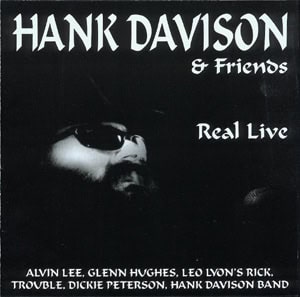
Hank Davison & Friends – Real Live – 1996

1. Get Your Kicks On Route 66 – Trouble – 3:12
2. Feel Good About It – Leo Lyons Kick – 6:07
3. Living It Up – Leo Lyons Kick – 4:21
4. Intro (B.T.B.W.) – 2:06 – Hank Davison Band
5. Panhead `49 (Born To Be Free) – 4:01 – Hank Davidson Band
6. Come On and Say Yeah – 5:03 – Hank Davison Band
7. Nutbush City Limits – 4:25 – Hank Davison Band
8. Prisoner Blues – 3:27 – Hank Davison Band
9. Slow Blues In C – 6:53 – Alvin Lee & Hank Davison Band
10. Summertime Blues – 4:49 – Dickie Peterson & Hank Davison Band
11. Hoochie Coochie Man – 7:46 – Dickie Peterson & Hank Davison Band
12. The Liar – 4:36 – Glenn Hughes & Hank Davison Band
13. Highway Star – 6:01 – Glenn Hughes & Hank Davison Band
14. She’s Gone – 5:47 – Trouble
Produced by Hank Davison – Recorded live at the Biker Union Annual Meeting in Schleiz / Germany – Recorded by Signon Sound Engineering – Live Mix by Thomas Schafer – Engineered and mixed by Mike “Spike” Streefkerk at Park Studios, Munich, Germany – Mastered by Manfred Melchior at M.M. – Sound, Gütersloh, Germany.
The Bands:
Trouble
Ralf Scherer – Blues Harp / Vocals
Klaus Wittor – Guitar
Rolf Bredtschneider – Bass Guitar
Rudiger Gniesmer – Drums
Leo Lyons’ Kick
Leo Lyons – Bass Guitar / Vocals
Tony Crooks – Guitar / Vocals
Jon Willoughby – Guitar / Vocals
Mark Price – Drums
The Hank Davison Band
Hank Davison – Vocals
Wolfgang Schludi – Guitar
Patrick Wieland – Guitar
Lewis Glover – Blues Harp
Goth Krumbach – Keyboards
Eberhard “Erbse” Heinrich – Bass Guitar
Markus Becker – Drums
Special Guests with the Hank Davison Band:
Alvin Lee – Guitar / Vocals (Ten Years After)
Glenn Hughes – Vocals (Deep Purple)
Richard “Dickie” Peterson – Bass / Vocals – Founding Member of “Blue Cheer”.
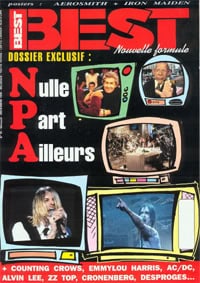
December 1996 – BEST Magazine

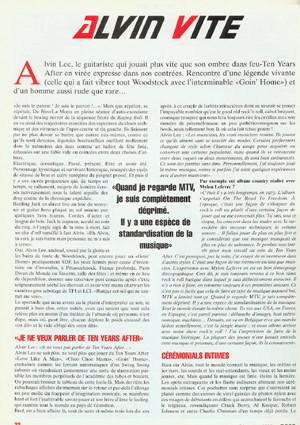
click to enlarge
Translation:
ALVIN VITE
Alvin Lee, the guitarist who played faster than his shadow in the late Ten Years After on an express tour through our lands. A meeting with a living legend (the one who made all of Woodstock vibrate with the interminable “Goin’ Home”) and with a man as rough as he is rare…
“I’m the boss! I’m the boss!…” Words repeated over and over by De Niro/La Motta during a self-exorcism session in front of the boxing mirror in the final scene of Raging Bull. Thus go those muscular trajectories superimposed on a chaos of technical virtuosity and uppercuts and left hooks. They end up no longer having to fight against themselves, against what they have become—bloated legends oscillating softly in the memory of ages like a party balloon finally deflated onto a weak video or wedged between two referee chairs.
Electric, acoustic. Past, present. To be and to have been. A hysterical character and a historical survivor, rescued from excesses of speed in the arms and another regime of the pressed wrist. And then there are those sacred projectors which, from time to time, light up again—cigarette butts of light nervously crushed under the sharp talent of the chronicler on duty.
Battling Jack live, driven by memory, and guitar hero planted in A minor by a few transfixed fans. Steel strings and blues language. Jack the jester, perched at the corner of the death blow, gives a knowing wink to fast Alvin. “Eh Alvin, you see, I fought but no one knocked me down.”
Yes, Alvin Lee, undead, stunned by glory and the Woodstock crowd baths, can still play a “Goin’ Home,” practically SDF (homeless), eyes closed for reasons of involuntary blindness or for sale, in Pétaouchnok. Deep France, Paris Divan du Monde or Taverne, function room; and even in this place of perdition, give a post-concert interview after carefully drying his hair and having just vigorously shaken up the cameras—gross sabotage of TF1 and LCI. “Put that lens away, it can’t see me!”
The show we had the pleasure of attending that evening took place behind closed doors, among initiates, those who know that all this is more or less theatre of the absurd where no one is fooled but where, perhaps, everyone deplores the excessive weight of “what is said” and the empty obligation of “what is not said.”
“I DON’T WANT TO TALK ABOUT TEN YEARS AFTER”
Alvin Lee: “I don’t want to talk about Ten Years After…”
Alvin Lee no longer is, no longer wants to play in Ten Years After. “Love Like a Man,” “Choo Choo Mama,” “Goin’ Home,” strung together like the automatic forces of a Swinging cabaret where people would come to consume a kind of peaceful damnation—perpetual members of the academy of hits and standards. One could paint the picture like that. But behind the bragging displayed by the trickster on the return trip and beyond a somewhat soft extension of musical imagination, manifests itself loudly and clearly the unalterable know-how and his soul brother the feeling, which brings everyone back to the land of emotion.
In short, we are indeed dealing here, right away and even three times over, with a couple of miraculous scamps without whom the imperturbable lumberjack that is good old rock ’n’ roll—noisy cabin boy, cosmic trooper—could not do without. He will once again make our ears smile with his slightly outdated rock-fan number on the edges, but so good where it hits hard!
Alvin Lee: “Real musicians remain. They play what they love without worrying about fashions. Some performers change style according to the mood of the times in order to acquire or maintain a certain popularity, but when they find themselves between two waves or two movements, they are very embarrassed. They are like fish out of water. Personally, I have always played the same music, even if I sometimes have done a few experiments with other musicians.”
For example, this country album made with Mylon LeFevre?
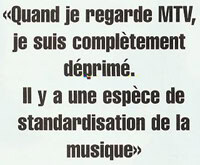
“It was a long time ago, in 1973. The album was called On The Road To Freedom. At the time, it was a way of moving away from rock ’n’ roll or at least from a certain way of playing that no longer suited me. You know, all that circus—the concerts in stadiums with overbidding technical means, the sound volume… You had to play louder and louder and I felt that my music lacked more and more substance. I was losing all interest in my work within Ten Years After. That’s why afterwards I tried to venture into other styles. It was a way of rediscovering myself as a musician. The experience with Mylon LeFevre is a good testimony in my discography. That said, I have always come back to that good old basic rock in which I finally found my roots. There’s nothing to be done—we always return to our first loves. It’s not as easy as that to make this kind of music today; MTV has damaged everything. When I watch MTV, I’m completely depressed. There’s a kind of standardization of music. Everyone listens to the same thing. You go to the USA, to France, to Spain—it’s the same everywhere: a flood of images, metronomic beat, machines… Tomorrow we’re going to Belgium and what’s working over there at the moment is jungle music; and we’ll arrive with our rock ’n’ roll show! I have the impression of making heretical music. Most young people have never heard this music and yet, in a certain way, they know it.”
INTIMATE CEREMONIALS
Of course Alvin, everyone knows music, the idiots and the stars, the deaf and the hard of hearing, the old and the young, etc. But when the music is over, turn off the light. The outrageous spots and indiscreet flashes do not appreciate intimate ceremonies. These sleeves without surprise that would open with pleasure like nyloned thighs with photos on vinyl, those faces of angry beginners who hung on to the wild and dark complexion, claiming Chuck Berry, Al Kooper, Robert Johnson and that other Charlie Christian from a time already gone.
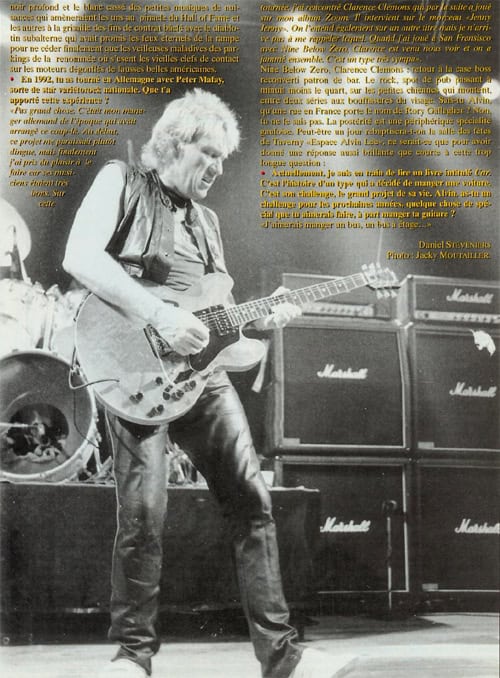
• In 1992, you toured Germany with Peter Maffay, a national rock star. What did that experience bring you?
“Not much. It was my manager at the time who arranged that deal. At first, the project seemed rather crazy to me, but in the end I enjoyed doing it because the musicians were very good. On that tour I met Clarence Clemons, who later played on my album Zoom. He appears on the track ‘Jenny Jenny.’ We can also hear him on another title but I can’t remember which one. When I played in San Francisco with Nine Below Zero, Clarence came to see us and we jammed together. He’s a very nice guy.”
Nine Below Zero, Clarence Clemons: back to square one, boss converted into bar owner. Rock, pub sport spending at quarter to midnight in small provincial bars that annoyingly get in between two series of face beatings. Do you know, Alvin, that one street in France bears the name of Rory Gallagher? “No, I don’t know.” Posterity is a specialized provincial periphery. Perhaps one day the Taverne function hall will be renamed “Espace Alvin Lee.” Wouldn’t that be enough to have given as brilliant as it is brief an answer to this overly long question?
• At the moment, I’m reading a book entitled Car. It’s the story of a guy who decided to eat his car. It’s his challenge, the big project of his life. Alvin, isn’t a challenge for the coming years something special you’d like to do—apart from eating the guitar?
“I’d like to eat a bus. A bus on stage…”
Daniel Stevens
Photo: Jacky Moutailler
(BEST, December 1996)
1997
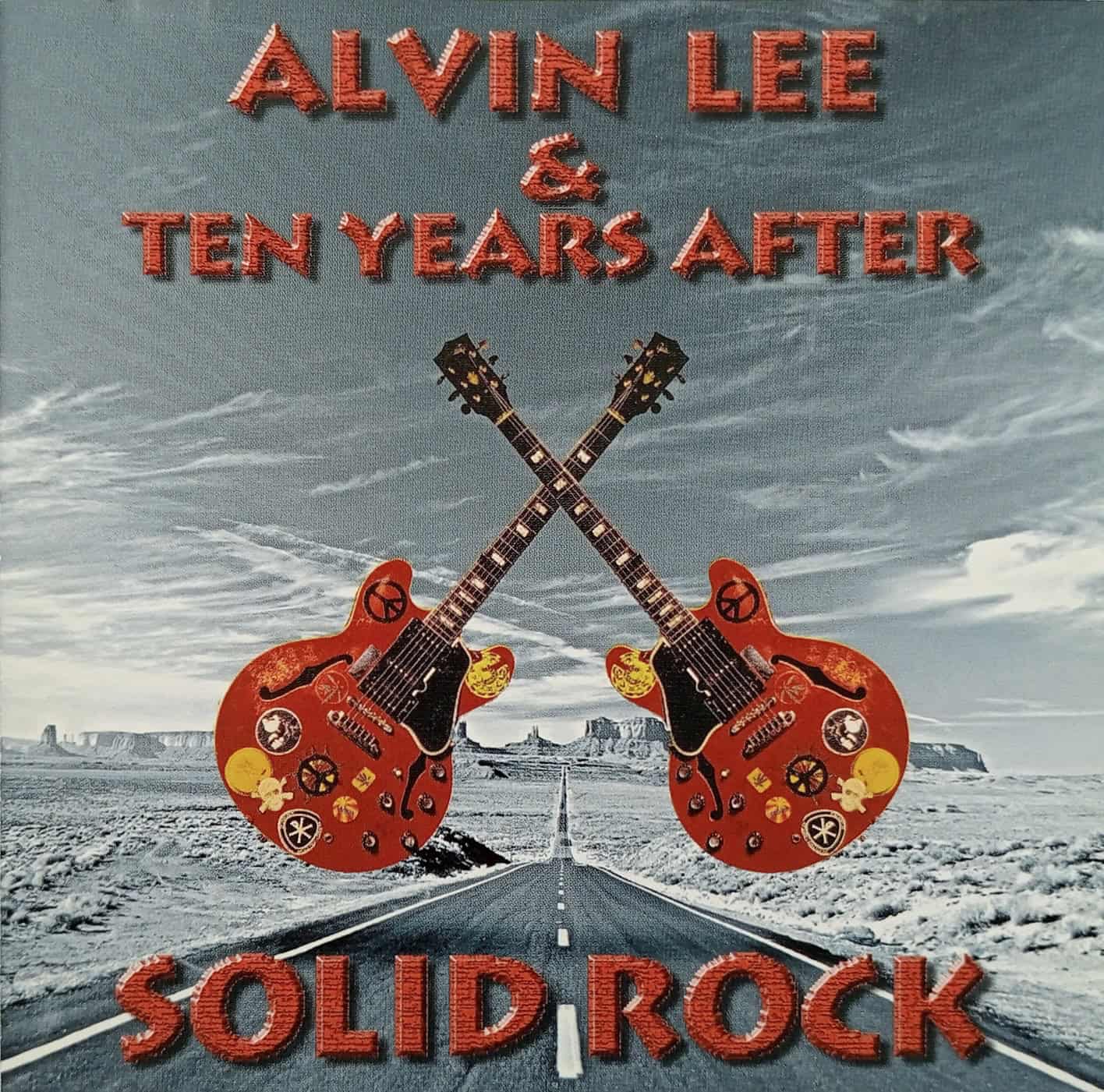
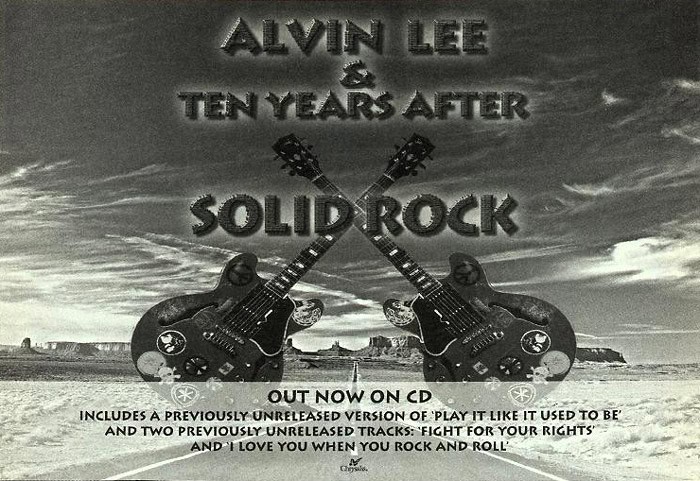
Album release “Solid Rock”
A “best of” collection
Mention the name Alvin Lee and most people will say what a wonderful blues guitarist the man is. Press it further, and the other half will respond with “I’m Going Home – Woodstock 1969 – Ten Years After – what fantastic rock and rollers they are”. This Solid Rock edition is a rocking greatest hits kind of jam release, a good introduction for the rank amateur, just discovering the band and the time, that they were in their classic prime. You’ll get to hear both sides of what the group was about. This includes Alvin with Ten Years After and also some tunes from Alvin Lee gone “solo”. It should be known, that Alvin himself hand picked the songs presented here. So, you can be sure that he’s giving you a little sneak peak as to what his personal taste consists of, and his most beloved rocking songs are.
When I first heard “I’d Love To Change The World”, my first impression of Ten Years After was “damn, who is that guy burning up the rosewood fret-board here?” During that time, the two guitarists who were grabbing up almost all of the accolades were, Jimi Hendrix and Eric Clapton. While Alvin Lee’s accomplishments greatly impressed me, and still do. Between the record companies, the music business and the sheer passage of time, all three have buried this guy in the forgotten pile. He’s truly one of the unsung heroes of rock and blues.
This collection also includes two bonus tracks, both never before released, “Fight For Your Rights” and “I Love You When You Rock and Roll”.
Martin Lake
TYA on Tour
In 1997, Ten Years After were lured back to the stage by the prospect of a major Scandinavian festival tour. All four original members signed on in earnest, eager to test the waters and rediscover whether the old chemistry still burned. The tour would also mark a significant milestone: their first-ever performances in South America.
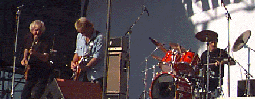
On Wednesday, May 21, 1997, the band delivered a rousing, triumphant concert to a sold-out crowd in São Paulo, Brazil. The high-energy set featured fan favourites including “Hear Me Calling”, “Good Morning Little Schoolgirl”, “Slow Blues in C”, and “Help Me”, along with a spirited audience singalong to “Johnny B. Goode”. No Ten Years After show would be complete without Alvin Lee’s tour-de-force performance of “I’m Going Home”. The band returned for encores of “Choo Choo Mama” and “Sweet Little Sixteen”, sending the ecstatic crowd home on a high.
Two days later, on Friday, May 23, the band took the stage in Porto Alegre. Reviews confirmed the same electrifying impact, praising both the performance and the band’s renewed rapport with their audience. Media interest was intense, with journalists keen to capture the spirit of the reunion. Though clearly energized by the experience, the members remained undecided about committing to a long-term future together.
Saturday, May 24, brought the third Brazilian concert—arguably the highlight of the run. Three thousand fans turned out in Belo Horizonte and refused to let the band leave the stage, calling them back for three extended encores in a powerful display of appreciation.
From Brazil, Ten Years After moved on to Europe, agreeing to headline four major music festivals.
On May 31, 1997, they appeared at the Esbjerg Rock Festival in Esbjerg, Denmark, sharing the bill with Peter Green, Bachman-Turner Overdrive, and Richie Blackmore’s Rainbow. Their expansive set list included “Rock and Roll Music to the World”, “Hear Me Calling”, “Help Me”, “Slow Blues in C”, “Good Morning Little Schoolgirl”, “Love Like a Man”, “Victim of Circumstance”, “Hobbit”, “Johnny B. Goode”, “Classical Thing”, “I’m Going Home”, “Choo Choo Mama”, “Sweet Little Sixteen” and “Rip It Up”.
On June 14, 1997, the band headlined the Rock Festival in Karlshamn, Sweden, on a bill that also featured Mick Taylor, Molly Hatchet, Simon Bolivar, and others. Approximately six thousand fans gathered to hear their favourite bands, with Ten Years After once again commanding the spotlight.
The momentum continued on June 28 in Helsinki, Finland, where the band performed before an audience of ten thousand – many seeing them live for the first time. It was described as their “best ever” concert by tour manager John Hembrow. The enthusiastic crowd rewarded them with the longest standing ovation ever witnessed at that venue.
The summer run concluded on August 15, 1997, in Claremont, France, where concert reviews were uniformly positive, affirming that Ten Years After’s return to the stage had been both triumphant and warmly received.
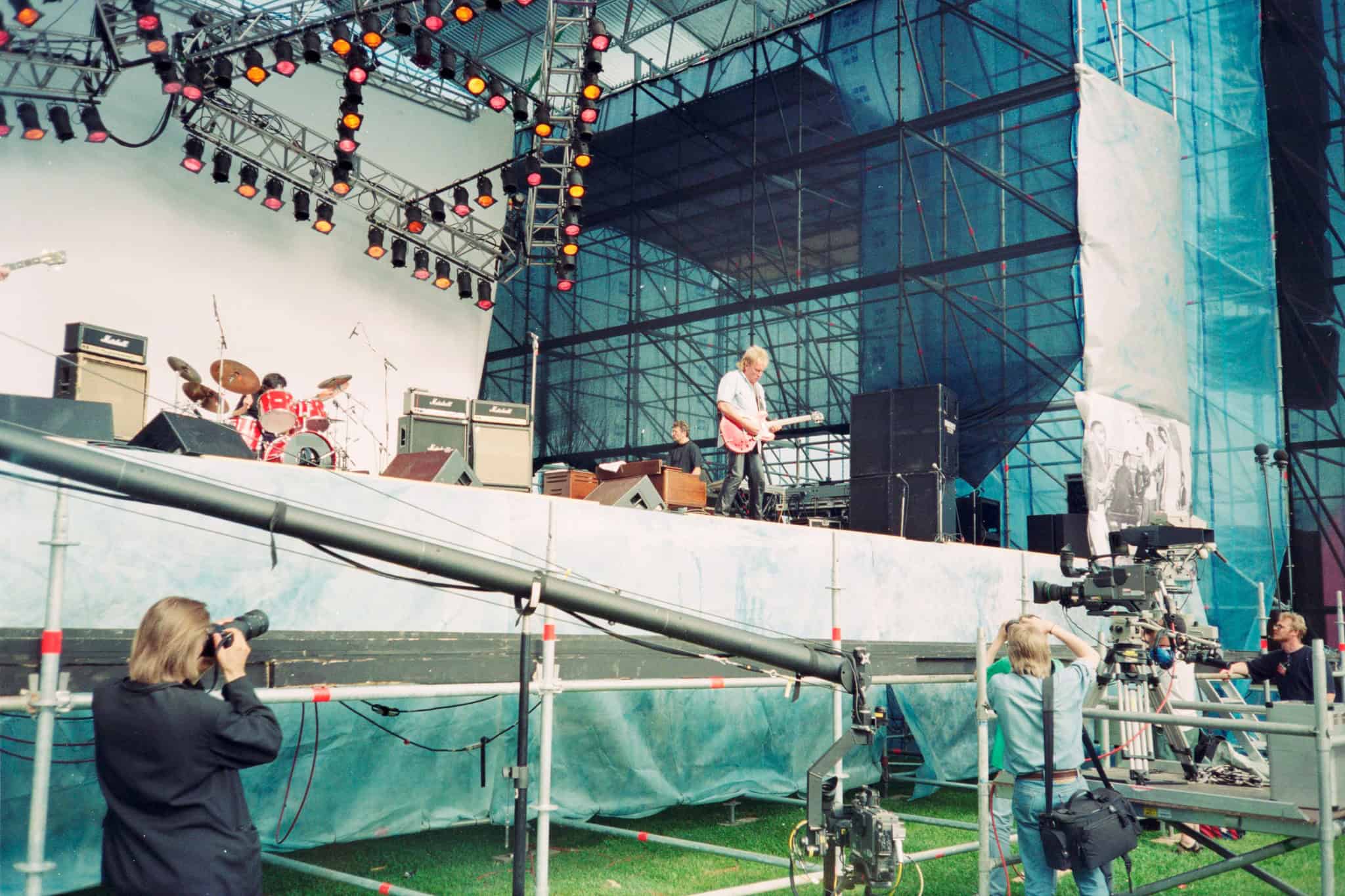
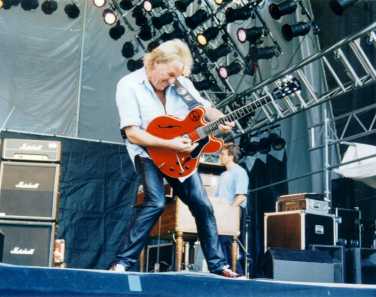
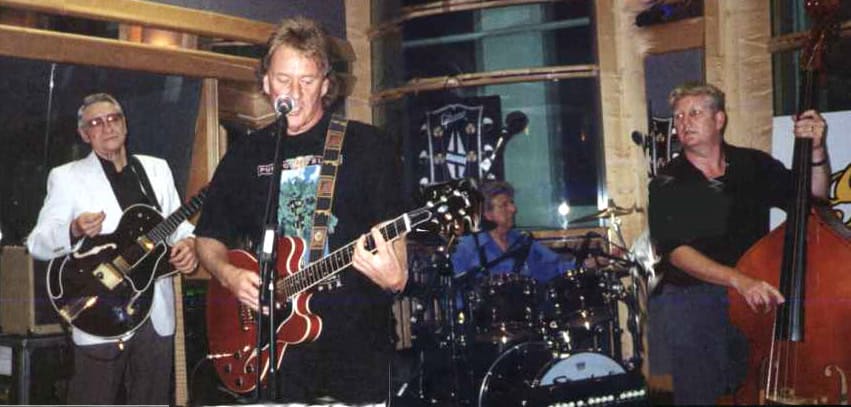
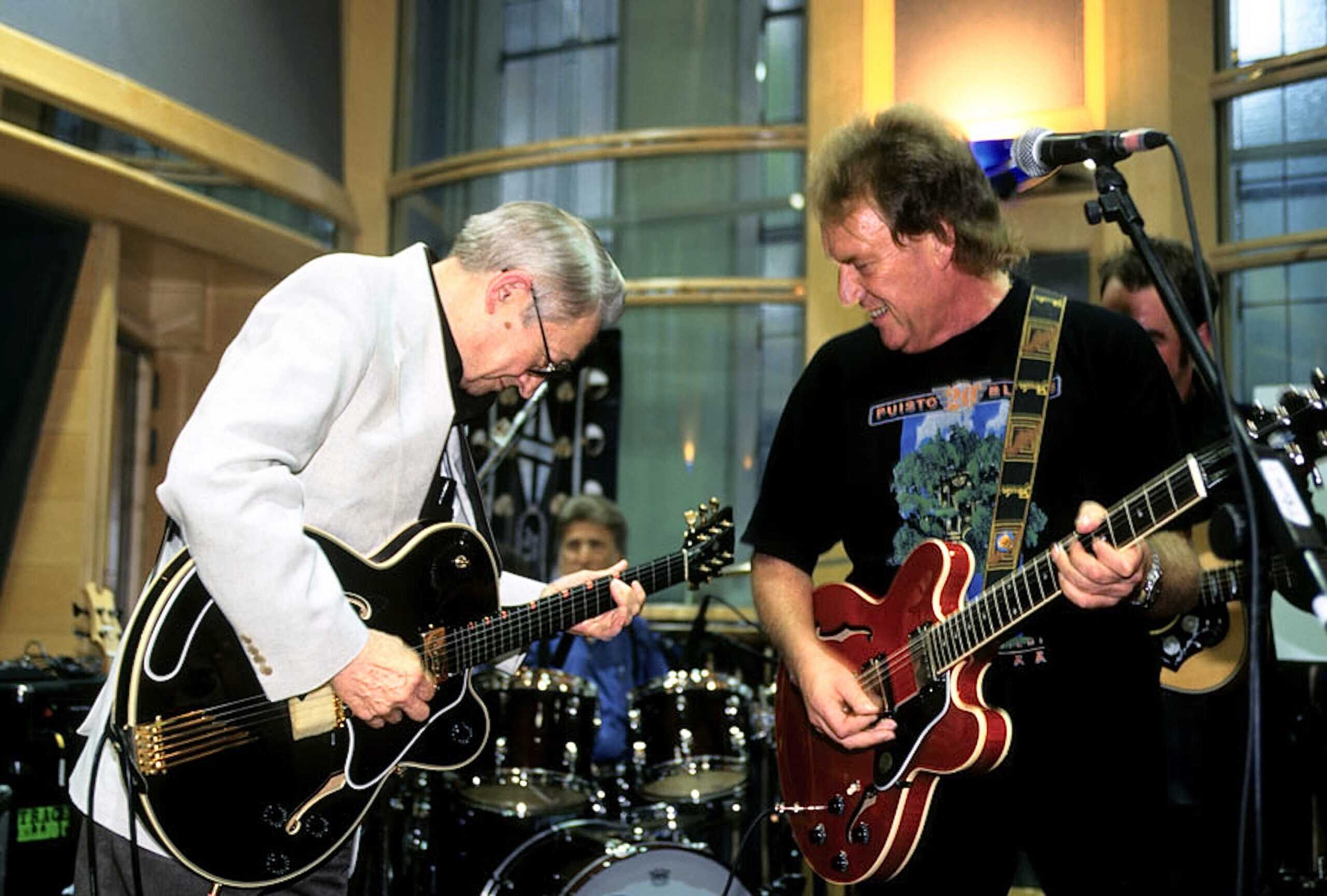
June 28, 1997 – Puistoblues Festival, Jarvenpaä, Finland
Album Reviews
The British rock press never quite forgave Alvin Lee for his guitar pyrotechnics in the Woodstock movie, although any solo that inspired awe and even a little envy in Jimi Hendrix was good enough for me. Both with and without Ten Years After, Lee has been cutting blues and rock albums for three decades, but his media profile in this country isn’t so much minimal as missing.
In Europe and South America, though, Lee is respected as one of British rock’s finest ambassadors from the 1960’s and rated alongside the likes of Eric Clapton, Jeff Beck and Peter Green as a guitar hero par excellence. “Stonedhenge”, the bands third album from 1969, was their real commercial breakthrough, besides debuting a Ten Years After standard in “Hear Me Calling”. Produced by Mike Vernon, it accentuated their blues roots but left plenty of space for Lee’s eye-blurring fretwork.
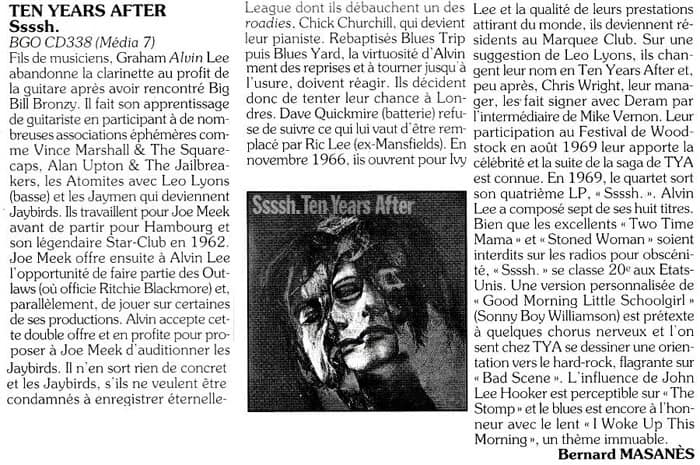
“Ssssh” may have featured a cover photograph by Graham Nash, but there was no sign of three part harmonies or odes to large sea mammals. Instead, Ten Years After kept up the diet of blues, slow in “I Woke Up This Morning” to the fast blues of “The Stomp”. But “Bad Scene” opened the album with a metallic rush that suggested another horizon for the band to conquer in the decade to come.
The “A Space In Time”, album number seven in the Ten Years After catalogue, released in 1971, certainly marked a change in direction, but not the way people might have expected.
With Del Newman’s strings on “Over The Hill” and some wary experiments with a Moog Synthesiser. Ten Years After baffled some of their British fans, but helped by their constant touring schedule, it became their biggest-ever seller in the States.
The touring eventually took its toll, with the effect that “Rock & Roll Music To The World” became their final erratic, studio album – at least until 1989. Thereafter, Alvin Lee set out on a long, rambling solo career, that has veered between some degree of success and complete commercial indifference and back again.
“Detroit Diesel” won more attention for its George Harrison guest appearance than anything else, thought it did also reunite Lee with Ten Years After veteran Leo Lyons. More tracks from the Harrison collaboration belatedly appeared on Lee’s 1994 release “I Hear You Rockin'” which ended with a faithful rendition of the Beatles – “I Want You (She’s so heavy)” – not with George, of course… “Live In Vienna” is the best hint of where Alvin is today – still playing “Hear Me Calling”, “Love Like A Man”, “Good Morning Little Schoolgirl” and, of course the obligatory “Going Home”.
Article by PD – 1997
Ssssh. Review – May 1997, Jukebox Magazine No. 116, France
1998
TYA play 3 festivals including ‘A Day in the Garden’, Bethel, NY
The Alvin Lee Band continues to tour


Ten Years After – Premium Gold Collection – released August 10, 1998
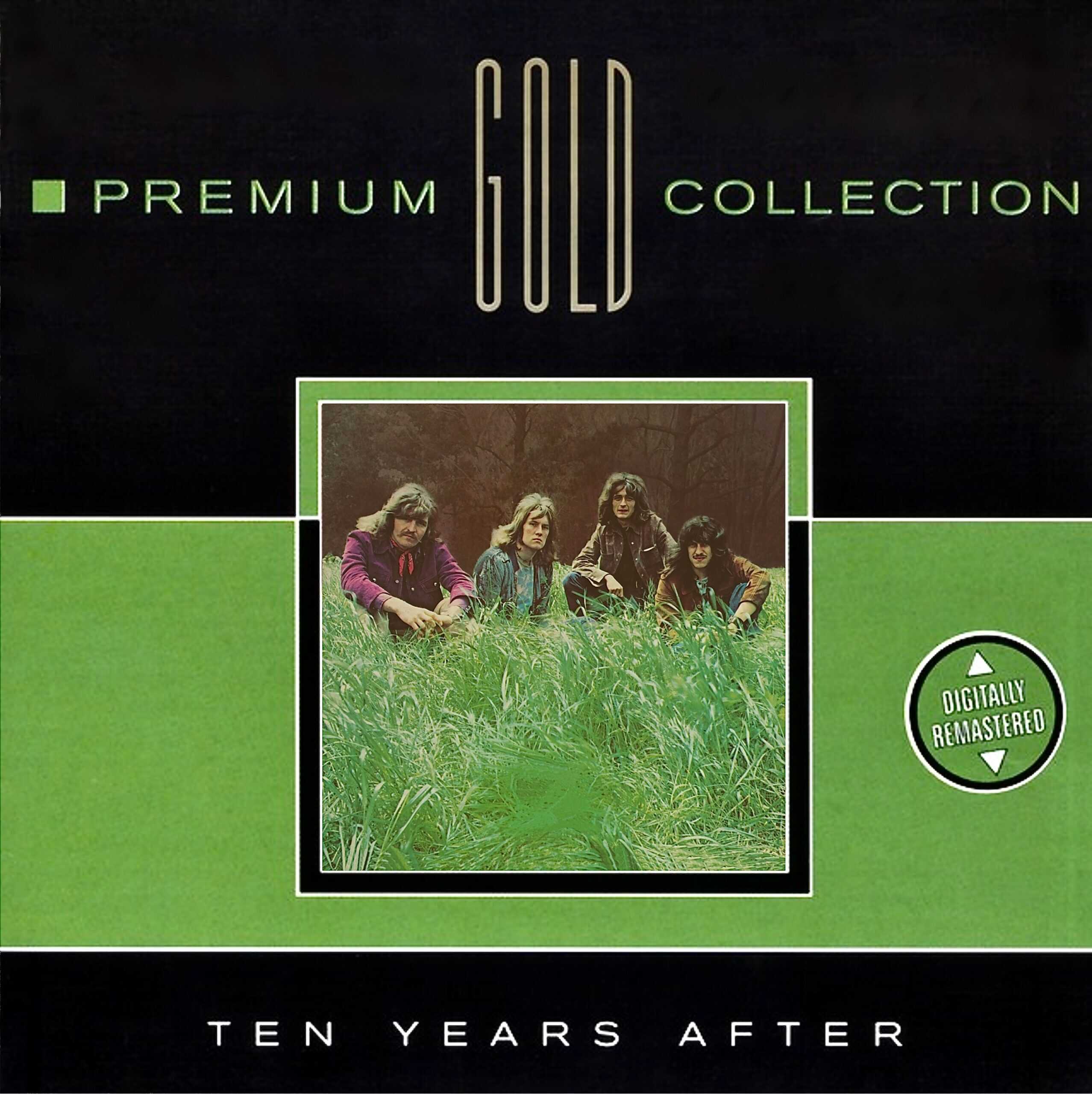
From Robert Brown:
I just purchased this disc online as a German Import. The sound quality is killer as it was recently re-mastered from the original source tapes. The song selection is excellent and I personally believe this is better than any other “Best Of” Ten Years After collection. The only problem with the song selection, in my opinion, is that the single edit of “Love Like A Man” is included, which omits Alvin Lee’s frenetic guitar solo. That said, check out his guitar work on “I’m Coming On” – this solo is guaranteed to send shivers down your spine.”If You Should Love Me” starts off as an acoustic blues tune, but builds up throughout with layers of guitars and Alvin screeching like Janis Joplin by the end of the song. Another great blues jam, entitled “I Woke Up This Morning” features yet another fantastic solo and a very cool psychedelic ending, that will leave your head spinning. However, as a Ten Years After enthusiast, who already owns all of their other albums, the best part for me is the inclusion of relatively obscure songs like: “Hard Monkeys” and “Nowhere To Run” which have some folk and soul influences respectively. These songs still sound fresh and energetic in this day of homogenized synthesizer music. This CD is very highly recommend for anyone who wants to know what real music is all about.
From Dan Jasper – Victoria, British Columbia Canada:
If you’re looking for good rock, blues and jazz fusion … this CD should be number one on your list. Ten Years After have since their first album back in 1967 cranked out the best music on this planet. This CD is a sampling of just what you will get on any of their issued CD’s. It’s nothing short of fantastic, in fact I’d say these four musicians are the most talented on Earth. Alvin Lee, Leo Lyons, Chick Churchill and Ric Lee – have honed their God given talents to a status of legendary. Listen to the quality of the music and see if you can resist buying other albums of theirs.
August 14, 1998 – ‘A Day in the Garden’, Bethel, NY
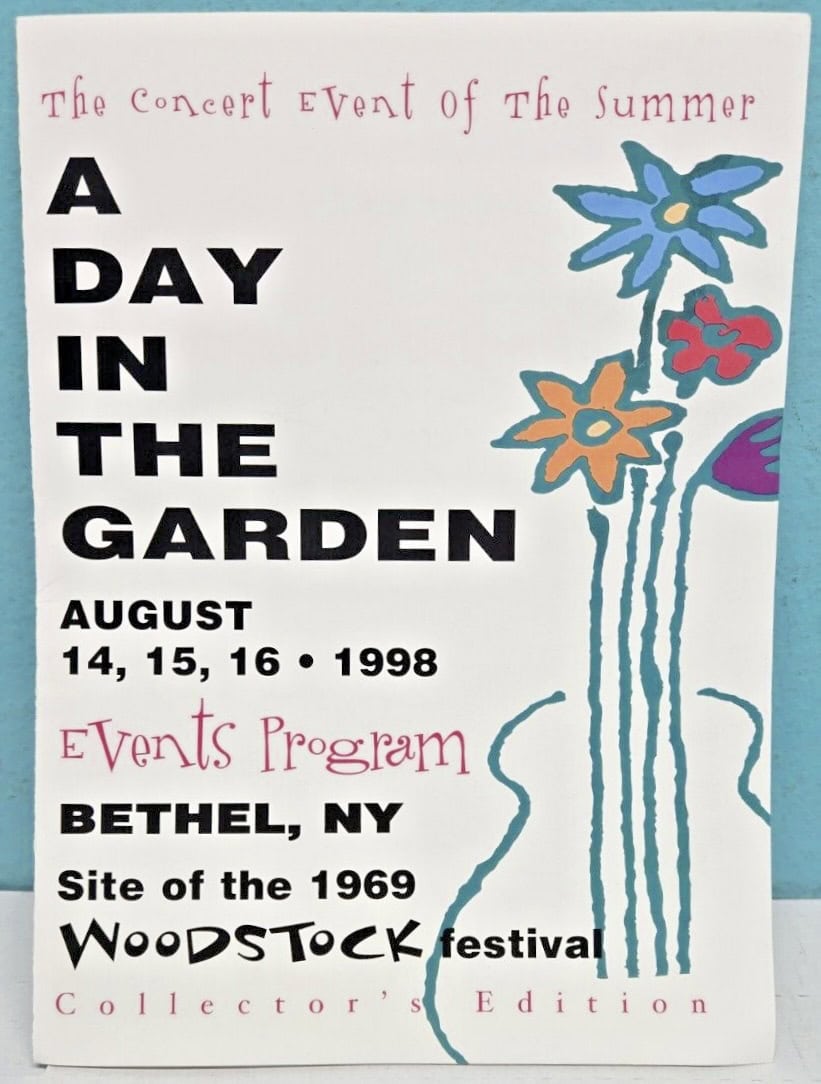
Get Back – Woodstock 98…NOT!
by Haven James
August 1998
Preview: A Day In the Garden Festival at Bethel
Day-tripper, yeah? Hard to imagine seeing Lou Reed in the sunshine, but stranger things have happened. Reed, Joni Mitchell, Pete Townsend and a bouquet of assorted veteran rock ‘n’ rollers will gather for A Day In The Garden at Bethel this weekend [8/14–8/16, 1998] on the original site of the 1969 Woodstock Music & Arts Fair.
Though the event marks the 29th anniversary of a generation’s four days of infamy on the late Max Yasgur’s fertile pastures, make no mistake – this is not Woodstock ’98.
Leave the tepee, cooler and camping tools home; just bring cash and credit cards, maybe a folding chair or blanket, an umbrella just because, and your reading glasses so you can study the rules, like no cameras or picnic baskets (there will be food and crafts booths to fill your needs).
The Gerry Foundation is now the owner of the Woodstock Festival site and Alan Gerry and his associates have set out to present this three-day daytime only event in a very designed manner. Mike DiTullo, one of the coordinators of the festival, offers the following perspective on the venue: “Our long-range plans are to develop a permanent international attraction that’s based on American performing arts and music.
This year, this is sort of like our maiden voyage; we thought we would have a day in the garden, [so] that’s what we’re calling the festival. [It’s] three separate days, it’s not a Woodstock reunion, it’s nothing like Woodstock. We’re limiting this to 30,000 persons a day.
There’s no overnight camping; we’re shooting for an older demographic, the baby-boomers between 25 and 50/55, [and] we’re looking to do just a nice two days of music and fun. The third day we’re targeting a younger demographic–it’s more modern, or alternative rock, you know, with the Goo Goo Dolls and Marcy Playground.
So what we’re trying to say is the first two days we’re recognizing, and maybe showing our respect for, the classic rock or the Hall of Famers, and then the third we’re saying that we’re also thinking about the future and there are some rookies out there that we also want to acknowledge and feature.”
So, from the production standpoint, this is not the same old ruse crew of likely suspects. It is a new, well-funded, and, at least on paper, highly organized unit with long-range plans, goals, and targets with pictures and arrows on 8×10 glossies.
No, Arlo won’t be there, but of course Richie Havens will, along with Ten Years After, Melanie, and Pete Townsend. That’s about it for returning veterans of ’69.
An enticing thing about the remainder of the big acts scheduled is that many of them are not often seen in this area. Friday brings Ziggy Marley and the Melody Makers (noon), Ten Years After (1:30), Don Henley (3), Stevie Nicks (5), and late addition Francis Dunnery. Saturday features Donovan (11 a.m.), Havens (noon), Lou Reed (1), Joni Mitchell (3), and Townsend (5).
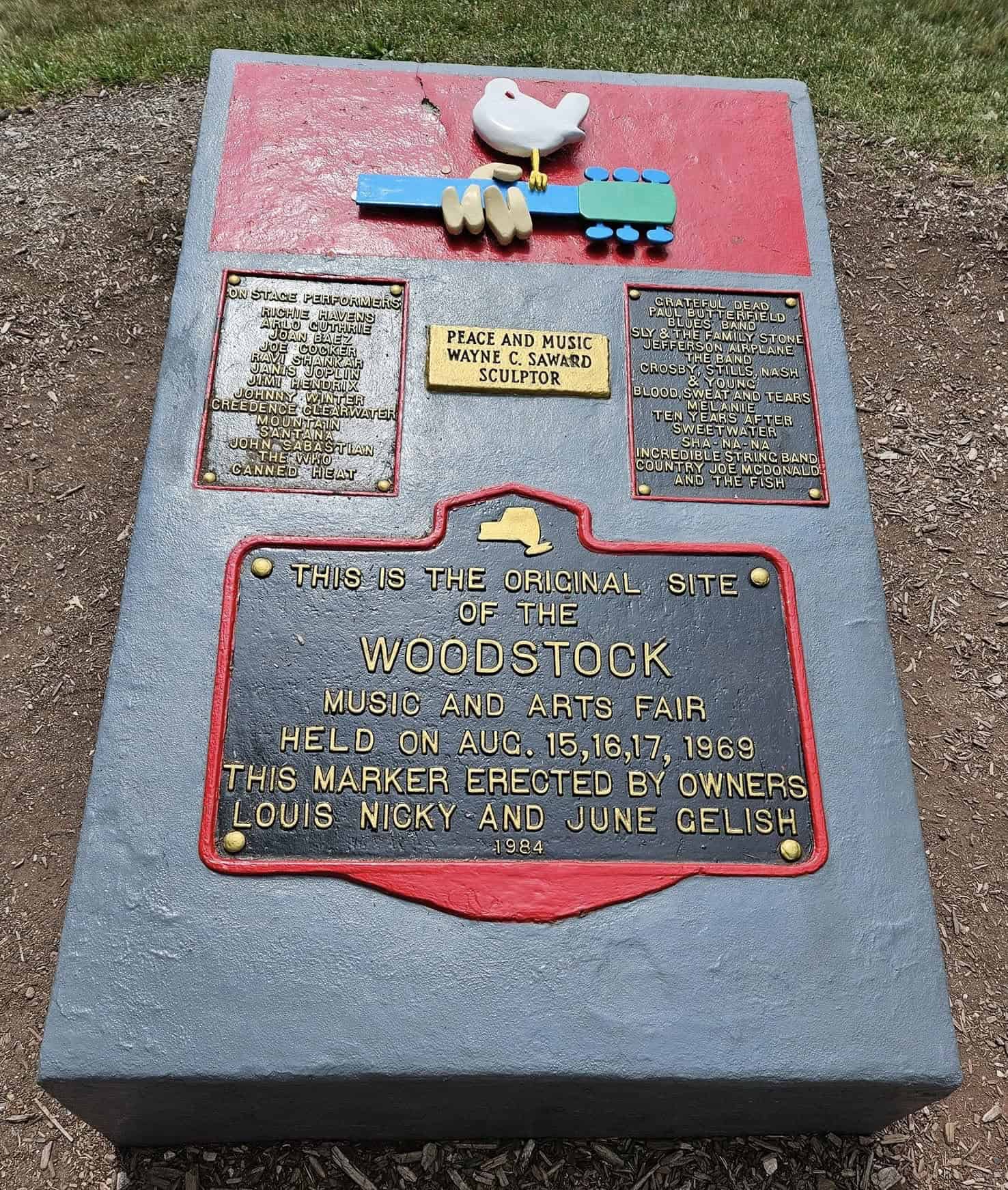
Even bigger news for some locals is the appearance of a bevy of area bands throughout the three-day affair. DiTullo and his assistant, Susan Leventoff, filled us in on these blossoming poppies. “We have hired around 15 to 20 local performers who will be playing throughout all three days.
There is a second stage so they’ll be playing before the headliners and then in between the headliners,” DiTullo says. Ulster’s own Perfect Thyroid will open the show Sunday morning on the Main Stage. They’ll be followed by Dishwalla, Joan Osborne, Marcy Playground, Goo Goo Dolls, and Third Eye Blind.
An almost-final list of the area bands booked for Stage Two follows: Starting Friday at 9 a.m. they are Afroblue, the Larry Hoppen Band, the Mountain Laurel Band, Pottersfield (who wrote the festival song, “Day In The Garden”), Ellen Avakian, Barclay Cameron, Micheal Kroll, and Whatch. Saturday brings Barbara Paras, Gavin DeGraw, New Frontier, Greg Press, Dan Sherwin, the Rausch Bros., the Don Lewis Band, and Blues 2000.
Sunday wraps with Borilis, The Works, The Flies, Wonderkind, Leslie Nuchow, Girlfriend, Jimsons Lyric, and Trinket. And there were still discussions in process about adding a few more Woodstock (the town) artists to the lineup, maybe Justin Love’s Big Red Rocket and the Dharma Bums. “That’s quite a lot of local talent we’re featuring, and we’re proud to do that,” DiTullo says. “This is a great opportunity for these acts to be playing with legendary performers.”
The report from Bethel is that the infrastructure is set and the site is ready to rock. Word is that it’s almost surreal there, and isn’t that the way a garden is supposed to be? Tickets are sort of surreal at this point, too. They are now two-for-one, approximately $70 per day (for a pair) Friday and Saturday and half that for Sunday. They can be purchased through TicketMaster by phone or ordered directly using the www TicketMaster or through the Day In The Garden website.
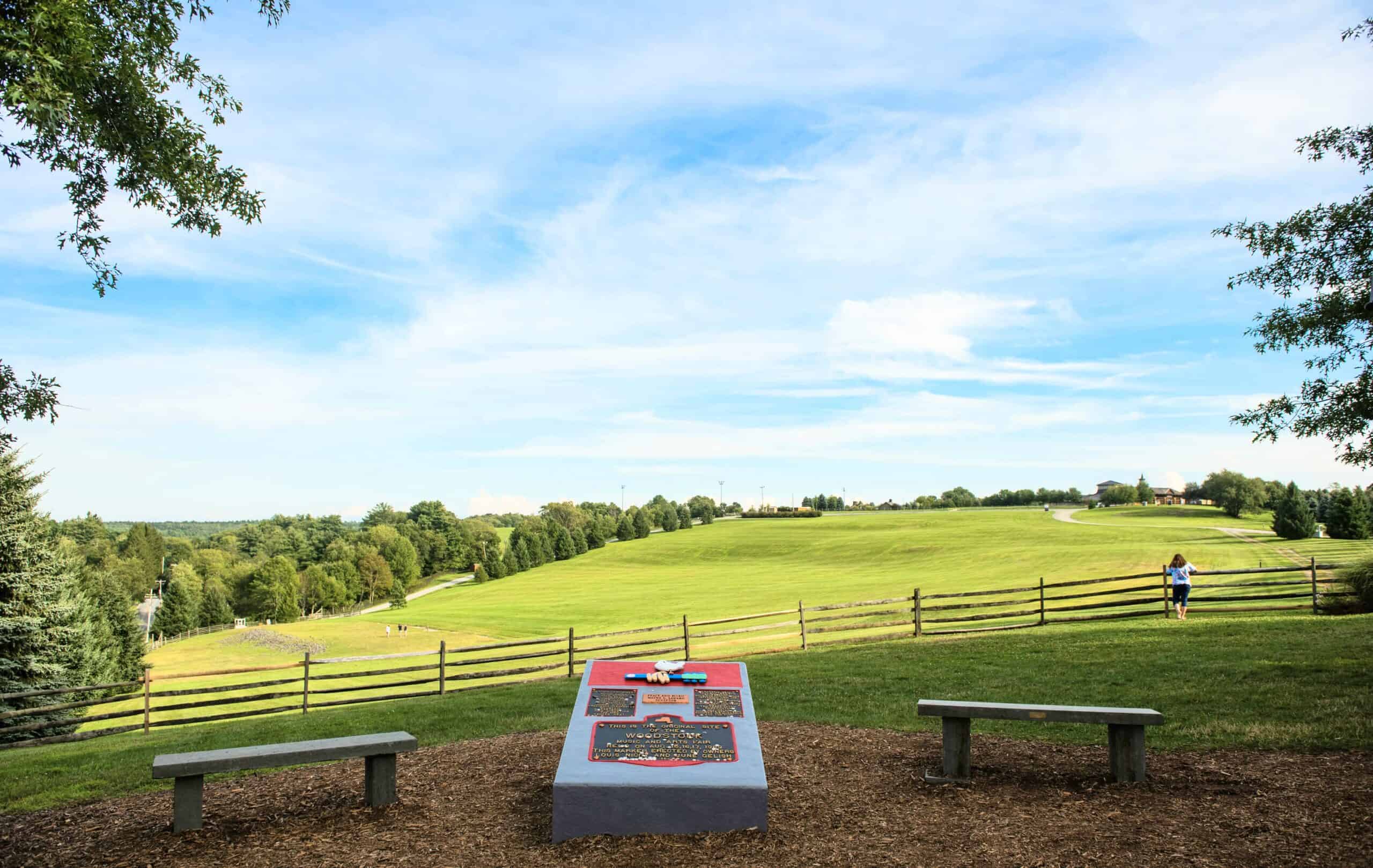
That was then, this is now, at Bethel.
Times Herald Record
August 14, 1998
By Jeremiah Horrigan
Staff Writer
Back then. Day One of the 1969 Woodstock Music and Art Fair
– The hordes arrive. Route 17B becomes the world’s longest two-lane parking lot.
– We’re not in Kansas, but it sure looks it.
– Richie Havens opens the show.
– Hot and sunny skies; weather looks perfect.
– First skinny-dipper sighted.
– One thousand photographers take note.
– Scalpers sell tickets to innocent high school kids.
– Kids save tickets, make collectible killing 29 years later.
– Richie Havens sings for three hours. Main stage construction nearly done.
– Showers at midnight.
Just now. Day One of the Day In The Garden.
– Route 17B never looked so empty.
– We’re still not in Kansas. Maybe Disneyland?
– Afroblue opens at 9 a.m. on tiny second stage. Plays half an hour.
– Cloudy skies look ominously familiar. First sprinkles fall on press tent, 10 a.m.
– Skinny dipping prohibited without official skinny dipping pass.
– One thousand apply for skinny-dipping review board.
– Scalpers sell bogus parking passes to innocent 48-year-olds.
– Innocent 48-year-olds embarrass their children with their Pete Townshend windmill-rocker moves.
– Alvin Lee of Ten Years After invites crowd to boogie. Crowd obliges.
– Illicit bottled water confiscated.
The Times Herald-Record Print Edition
Copyright August, 1998,
Orange County Publications, a division of Ottaway Newspapers
all rights reserved.
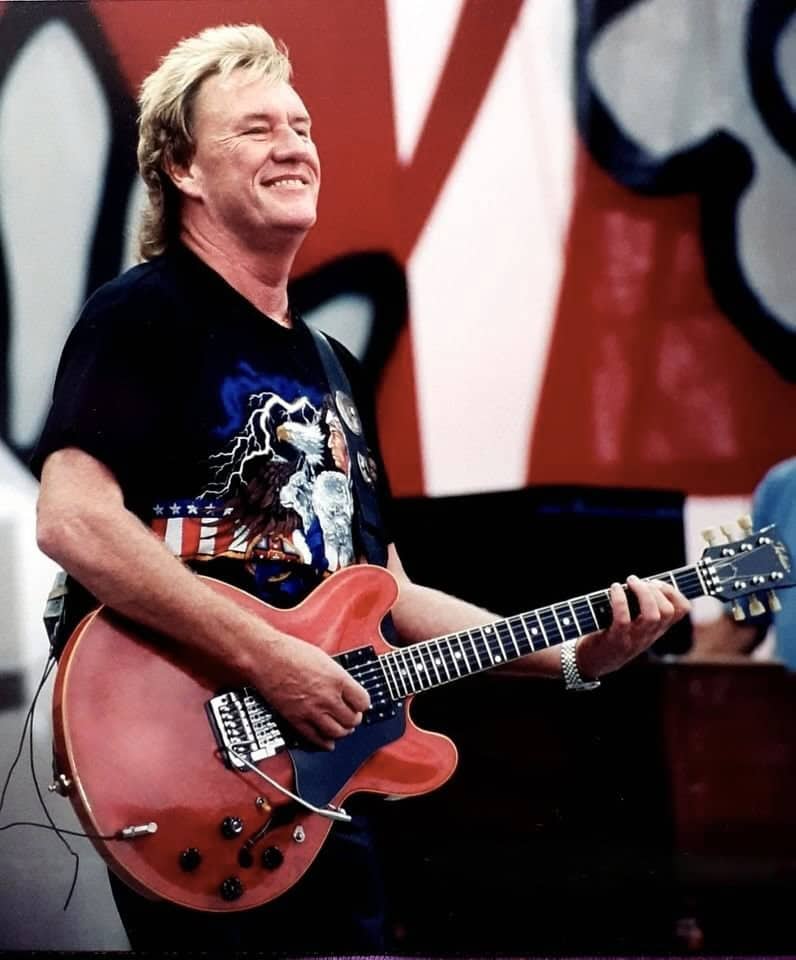
Chuck Levey – then and now
Back to the land: Woodstock cinematographer returns for a filmic look back…
Woodstock: Three Days of Peace and Music has been called the greatest documentary film ever made.
According to Warner Bros., it is the highest-grossing documentary of all time. Winner of the 1971 Academy Award for Best Feature Documentary, Woodstock brought spectacle and a grand scale to the documentary form. As a concert film, the collection of talent remains unequaled. And as historical chronicle, it quickly became emblematic of an era and a generation of Americans. In a review of the recent release of the director’s cut of the film, critic Roger Ebert said, “What other generation has so completely captured its youth on film, for better and worse, than the Woodstock Nation?”
Almost 30 years later, a smaller group of filmmakers set out to document a commemorative concert on the same site called A Day in the Garden, named for a line in the Joni Mitchell song Woodstock.
One filmmaker, Chuck Levey, was involved in both productions, giving him a unique perspective on the evolution of filmmaking technology in the intervening years.
1969…
Michael Wadleigh and his Paradigm Films partner John Binder had been exploring various high-impact film techniques while making civil rights films and diverse clips for Merv Griffin television specials. Early on, they were mixing rock and roll with the political, intercutting Ray Charles and James Brown with Dr. Martin Luther King, Jr. They knew they had something special on their hands. Many of the elements that would set Woodstock apart as a visual experience — multiple images on the screen, high quality audio, and freely moving, handheld cameras — were discovered and refined on these projects. According to Wadleigh, these earlier films were one key to his winning the Woodstock job. The other was his willingness to put up his life savings.
The filmmakers decided on 16mm blown up to 70mm. 35mm had been rejected as too expensive and bulky. Eclair NPR 16mm cameras, the state-of- the-art 16mm camera in 1969, gave them the portability to capture the spontaneity and energy of the event. “That portability would really impact content,” says Wadleigh. “The eventual dimensions of the film were obviously important to us, but in selecting 16mm, we chose the instrument that was appropriate to catch what was happening.”
The blowup would set Woodstock apart. “The other concert documentaries and music films out at that time had been flops financially,” Wadleigh recalls, pointing out Monterey Pop, Don’t Look Back and several Beatles films. “We had this idea that a big, World’s Fair-style enveloping experience was the proper approach. We wanted the audience to feel like they were taken there.”
A custom-built Technicolor lens would provide single-generation, liquid gate blowups, with opticals done simultaneously. The lens was simply aimed at various parts of the 65mm frame to produce the trademark multiple images now so familiar to anyone who has seen the film.
Careful editing was facilitated by the use of the first Kem editing machines in the United States and eight Graflex projectors, equipped with zoom lenses, which could be synced by plugging them into one junction box. Wadleigh and co-editor Thelma Schoonmaker, who would go on to become Martin Scorsese’s permanent editor, planned the opticals and laid out grids for the entire film, and then oversaw the lab work at Technicolor.
The 70mm projection prints afforded six channel stereo sound, as opposed to the more common optical soundtracks that limited previous concert films. The result was a stunning theatrical experience that had people dancing in the aisles at theaters across the country. “We knew we wanted the six track sound from the beginning,” says Wadleigh. “That was a huge advantage. You could just blow people out of the theater.”
Cameraman Chuck Levey, who had studied painting at Rhode Island School of Design, knew Wadleigh and had worked with him on several projects, including an Aretha Franklin concert filmed in Providence, Rhode Island. A self-described, 28-year-old hippie at the time, Levey was making a living in filmmaking “outside of the mainstream”, and he was already holding tickets when he got the call to help document the massive festival. Little did he know that 30 years later he would return to the site to direct and help photograph a sequel of sorts.
“There were a total of 12 cameras, with six or seven guys shooting at any given time”
The production itself was a Herculean undertaking. Eventually 120 miles (633,600 feet or 193,122 meters) of footage were exposed. “It was certainly much more of a struggle back then, to shoot on the run like that,” Levey recalls. “There were a total of 12 cameras, with six or seven guys shooting at any given time. We had AC-powered Eclair NPR cameras, plugged into 60 cycle AC. A 60 cycle tone was on one of the eight tracks of the music recording.
“To help in lining up picture and sound in post, I tried to get a shot of my watch at the head of each roll shot on stage. Needless to say, it rarely happened. As each camera roll went on the camera, the assistant wrote the time of day and the performer, as well as the cameraman’s name, roll number, etc., on the tape that was wrapped around the magazine (and eventually the film can).”
The plan was simple. Wadleigh had assigned the cameramen only rough zones in which to shoot. “That was his only direction,” says Levey. “‘Ride it out. Let it rip.'”
When the rains came and the performances were temporarily halted, Levey ventured out in the mass of humanity with his camera, now with a battery-powered motor. The motors in the cameras were interchangeable, with a synch generator built in and a synch cable connected to a Nagra. This footage of the revelers would be crucial to the success of the film as an historical document. “Being on the stage was a lot of fun,” he recalls. “But as a documentary cameraman, I was most comfortable ‘out there’.”
Most of the time, Levey and the other cinematographers loaded their cameras with Ektachrome Commercial 7255* film, rated at an EI of 25 in tungsten light. “During the day I had an 85 filter on most of the time,” Levey continues. “That left me with an ASA of 16. We were often pushing the film a stop already [at night] and, remember, this was destined for blowup to 70mm. But it was a pretty fine grain film, and even though it was blown up, with the multiple images on screen, one image is rarely filling the whole frame.”
Wadleigh agrees. “Without question, without Kodak, there wouldn’t be a Woodstock movie,” he says. “That ECO stock was the beginning, middle and end of it. If we hadn’t had that image on that material, we could never have done the 70mm blowup. Kodak was very honest with us at the time, and they were so helpful in working through the problems and selecting the proper print stock. They and Technicolor were invaluable.”
1998…
When Kodak’s Steve Garfinkel heard about a 1998 reprise of Three Days of Peace and Music, a new music festival on the old site in upstate New York to be called A Day in the Garden, he decided it was important. The concert was to be performed by newer pop acts as well as several original Woodstock performers, including Pete Townshend and Alvin Lee. Garfinkel contacted Peter Abel, President of Abel Cine Tech, a friend and fellow documentary aficionado. By coincidence, Garfinkel had recently met Levey. A trip to the festival site ensued, along with another coincidence: upon their arrival at Yasgur’s Farm they encountered the new festival’s organizers, who informed them that no arrangements had been made for the filming of the fast-approaching event.
“…the film would grow to include other subjects: the evolution of filmmaking technology as exemplified by the two productions”
Time went by, and the project began to snowball. Eventually the film would grow to include other subjects: the evolution of filmmaking technology as exemplified by the two productions, interview footage with participants and local characters, and the impact of the event and the generation it came to symbolize.
Levey would act as director/cameraman. More talent was drawn to the project, including line producer Richard Dooley, production coordinator Mary Cesar, and her assistant, Amy Baker. Award-winning cinematographer David Sperling and Baltimore-based filmmaker Peter Mullett joined up, along with sound recordist J.T. Tagaki. Garfinkel acted as producer and fourth cinematographer. Vicki Kasala would be still photographer, with additional stills being shot by the legendary Elliott Landy, the official Woodstock photographer in 1969, and Chester Whitlock, a freelance concert-shooter. Peter Abel and Abel CineTech would bring more than a million dollars worth of equipment to the production. According to Levey, there were similarities in the approaches to filming Woodstock and A Day in the Garden. But the newly-assembled crew worked with the benefit of 30 years of advances in production and postproduction technology.
“The difference between the reversal stocks that we had back in 1969 and the Vision films that we have today is more like a revolution,” says Levey. “The latitude, sharpness, fine grain, blacks that are black that you can still see into. We used both Vision 200T and Vision 250D, and I doubt that anyone could tell them apart.”
Some 75,000 feet (22,860 meters) were shot that week, with laboratory developing and selected roll printing done at Colorlab of Rockville, Maryland. Postproduction telecine and editing was done at SMA Video, in New York City.
“In 1969, we shot the performance material using AC power in order to stay in sync. It was clumsy. There were cables. The motors were heavy and became very hot. In the rain we kept getting shocked. And don’t forget our primitive ‘get a shot of your wristwatch’ attempts at time code.
“In 1998, with AatonCode, we could just turn on the camera and shoot,” says Levey. “Syncing is automatic with the Aaton InDaw system. And the 800-foot (244 meter) magazines are much more convenient. You didn’t have to think about running out of film. If you think of a song being five minutes long, you can get four of them on an 800-foot-roll. They are a few pounds heavier but they are balanced so well with the camera that the extra weight doesn’t matter.”
Each camera was synchronized by way of an Aaton ‘Origin C’ master clock. The same code was fed to the 48-track sound truck, stereo DAT recorder and the ‘smart-slates’ Each camera was synchronized by way of an Aaton “Origin C” master clock. The same code was fed to the 48-track sound truck, stereo DAT recorder and the “smart-slates”. The Aaton cameras “burn-in” man and machine-readable code along the perforation edge of the film, making syncing virtually automatic.
The final link in the film sound system is Aaton’s InDaw computer. The InDaw allowed the filmmakers to automatically post-sync audio instantly. Using a Jaz drive, Garfinkel fed the 21 hours of recorded concert material from DAT to Jaz cartridges, which are high-capacity removable hard drives. This rendered all the audio random-access instantly available.
With a laugh, Levey compares the new syncing technologies to those of the original film. “We were glad when it came to the footage of The Who, because Pete Townshend’s trademark windmill guitar technique made syncing that passage a little easier,” he recalls.
Epilogue:
Over the years Levey has garnered nine Emmy nominations and four Emmy Awards. He has remained loyal to the documentary form and to film. “I never fell in love with video like I did film,” he says. “Film is a completely different medium. I’ve shot plenty of videotape, and I feel that film is still the better way.
Clearly, in the long run, it lasts longer. If Woodstock had been shot on video — which was impossible at the time — we wouldn’t have it today. When things go widescreen, what form is the videotape going to take? On the other hand, with film, it doesn’t really matter. You’ll have the quality images no matter what.
“Technological advancements have made the cinematographer’s job a lot easier since the old days,” he says. “The job got done in 1969, but with much more difficulty. Having done it both ways, I’ll take easier.”
Eastman Ektachrome Commercial 7255 (EI25) process ECO-1 was introduced in 1958.
It was replaced in 1970 by Ektachrome Commercial 7252 which in turn was discontinued in 1986.
_____________________________________________________________
From Making Films In New York Magazine, October 1970 issue
It concerns Woodstock as “The Longest Optical” and explains in very clear detail how the Woodstock movie was filmed and why. “Ten Years After offered us a simple optical solution. We filmed only one number of this group, that everlasting encore, Goin’ Home. We began filming with three cameras. Mid-Way, one of the cameras ran out of film. When we saw the rushes together with the sound, we realized right away we had to show Alvin Lee, the lead performer in triple image. So at the point at which the third camera ran out of film, we simply took the continuing image from the right side, flipped it, and let it run on the left side to continue the triple image optical throughout. It is also a sequence that has very few cuts. When filmed, the sequence ran eleven minutes; in the final edited version, it runs nine.”
_____________________________________________________________
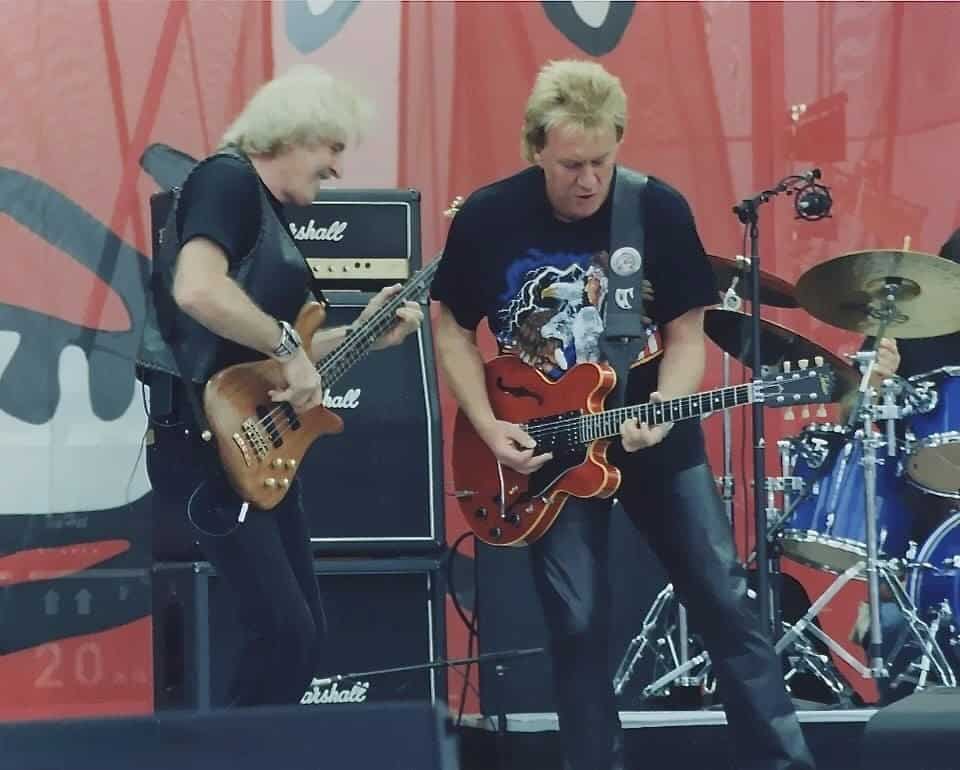
Different vibes at Woodstock ’98
29th anniversary concert draws a respectable orderly audience
The Associated Press
BETHEL, N.Y. For Mike Kowalik, there was one obvious difference between the original Woodstock and this weekend’s three-day anniversary concert at Max Yasgur’s old farm. “You know what’s good about this one?” he asked. “A lot of toilets.’ Kowalik, 55, said that while he relished the joyful chaos of the original concert, he appreciated the more organized ’98 version that kicked off Friday.
Dads and kids swayed to reggae, bottled-water drinkers outnumbered pot smokers and concert; staff gave parking directions to beige mini vans instead of warnings about brown acid.
“It’s a completely different scene,” said Mike Feinstein, who wore a tie-dyed Grateful Dead shirt and fiddled with a cell phone. “We’re grown up hippie’s now. We have responsibilities.”
Patrons were greeted with everything from an espresso kiosk to 400 port-a-potties. Security guards on horses and all-terrain vehicles prowled the festival’s perimeter to avoid a repeat of the mass gate crashings of 1969 At least one Woodstock tradition held true; evening rain fell on the crowd as headliner Stevie Nicks performed.
Promoters of “A Day in the Garden,” which continues this morning, estimated that about 12,000 or more of the 30,000 tickets available for Friday’s show were sold. Slow ticket sales had prompted a two-for-one ticket promotion.
Concert-goers; who spread their blankets on the massive sloping hillside Friday had elbow room as Don Henley and Stevie Nicks performed.
The concert attracted a fair share of people who showed up for the original concert 80 miles north of New York in 1969. They found a site transformed from scruffy to respectable — just like many of them.
“How can it be the same spirit? I’m 29 years older.” said Frank Vania, who showed up in Bethel with the same friend he brought in 1969.
The festival was scheduled to continue through today. Woodstock veterans Pete Townshend and Richie Havens performed yesterday, along with Joni Mitchell. Today is reserved for younger acts like Third Eye Blind and Goo Goo Dolls. Ten Years After was the only original Woodstock band on Friday’s bill.
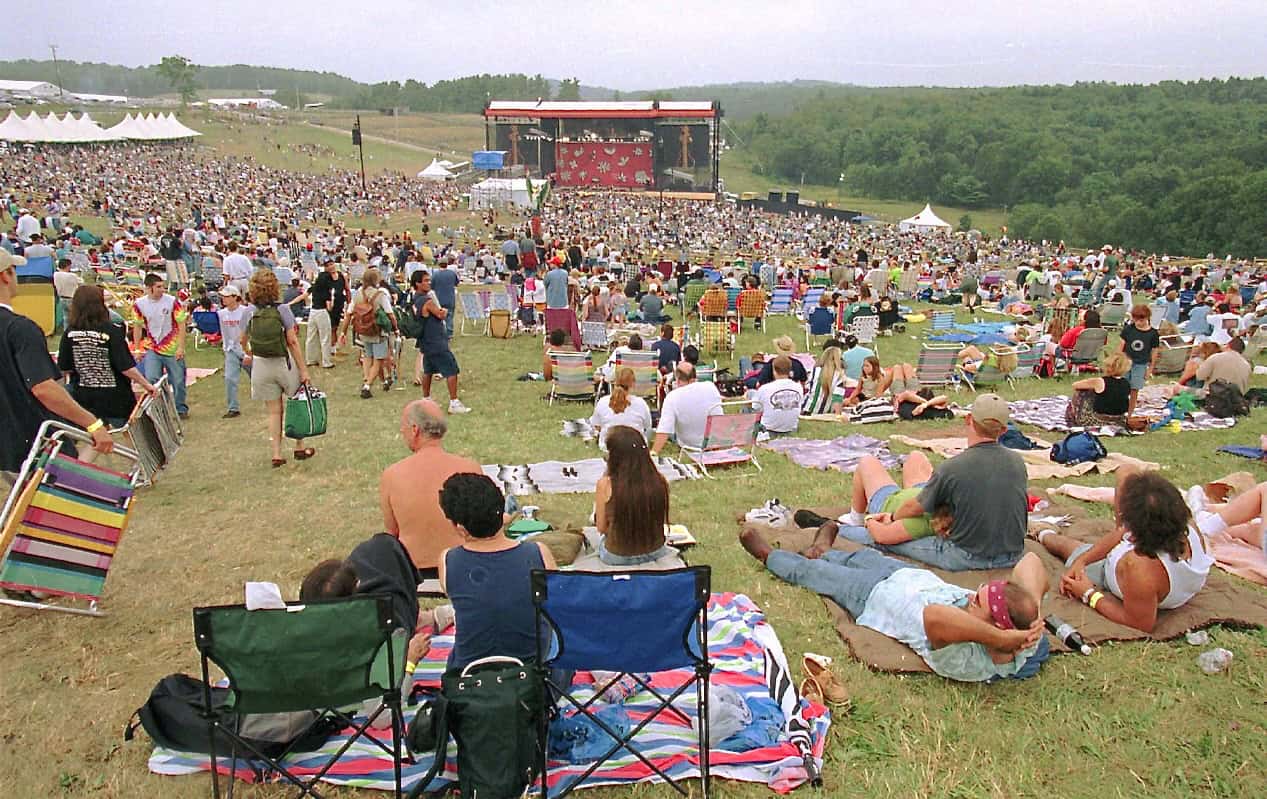
August 14,1998
Ten Years After return to the site of the original 1969 Woodstock Festival to perform before 14,000 people at the “Day In The Garden” Festival. Almost thirty years after their legendary performance on this farm-site, Ten Years After are introduced as:
“The Band Who Rocked The World!”
1. Rock and Roll Music To The World 3:45
2. Hear Me Calling 5:45
3. Love Like A Man 5:35
4. Good Morning Little School Girl 7:15
5. Hobbit 5:35
6. Slow Blues In C 8:15
7. Johnny B. Goode 1:55
8. I Can’t Keep From Crying Sometimes 14:55
9. I’m Going Home 12:15
10. Choo Choo Mama 4:25
11. Rip It Up 3:00
From a fan:
Wow!! I just finished watching the live internet broadcast of a Day In The Garden festival, and the band looked fantastic playing two encores, and a great version of I’m Going Home…Great Job!!!
April 28, 1999 – Friar Park, Henley: Alvin meets Scotty and DJ at George’s
George Harrison invites Scotty Moore and DJ Fontana to have dinner at his home at Friar Park. Alvin and Joe Brown also attend and are happy to meet their heroes! Full story as told by Dan Griffin, Scotty’s tour manager.
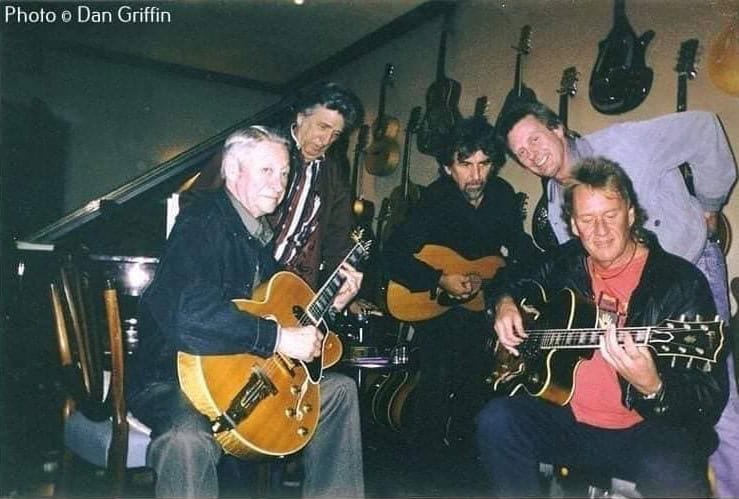
July 13, 1999 – Air Studios, London
Gibson hosted a special tribute event at Air Studios, London, honoring rock & roll pioneer Scotty Moore and marking the launch of his limited-edition ES-295 Signature model. The evening celebrated Moore’s groundbreaking guitar work with Elvis Presley and his lasting influence on generations of players. Joined by original Presley drummer D. J. Fontana, Scotty played to an appreciative audience as the evening evolved into a joyful, loose-spirited celebration of rock history and guitar heritage.
Alvin, whose fiery, blues-driven style paid fitting tribute to Moore’s early rockabilly sound, joined the onstage celebrations during an extended, informal jam session that brought together many of the attending musicians in a spontaneous and energetic performance. Among them were Jeff Beck, Jimmy Page, Gary Moore, Steve Howe and Jack Bruce. Bass player on the night was Pete Pritchard, who ultimately worked with Alvin touring and recording from 2003 onwards.
TYA play select venues in Germany and the US

September 20, 1999 – House Of Blues, Los Angeles

Photo: Neil Zlozower – published in Guitar World (2013) –