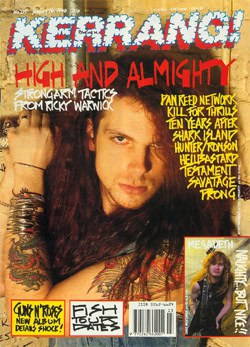
KERRANG Magazine – January 20, 1990
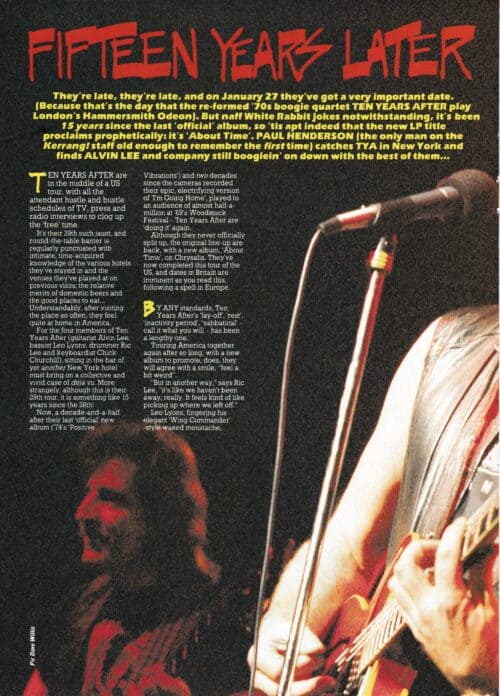
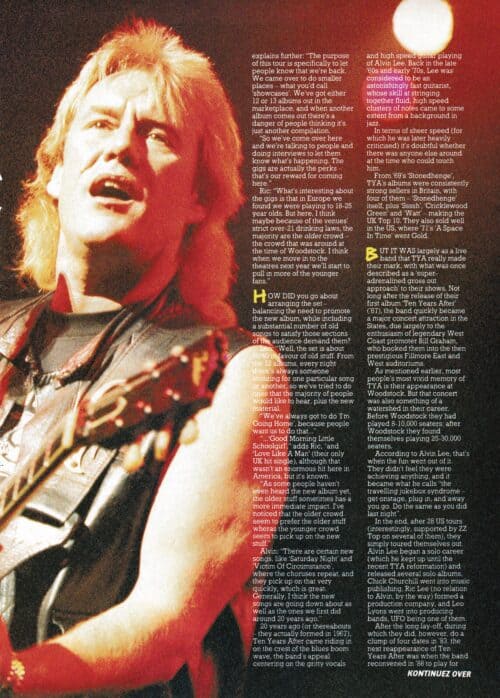
click to enlarge
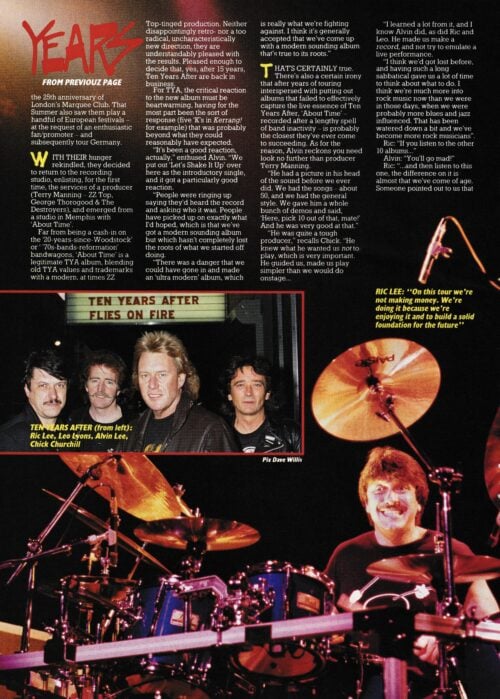
click to enlarge
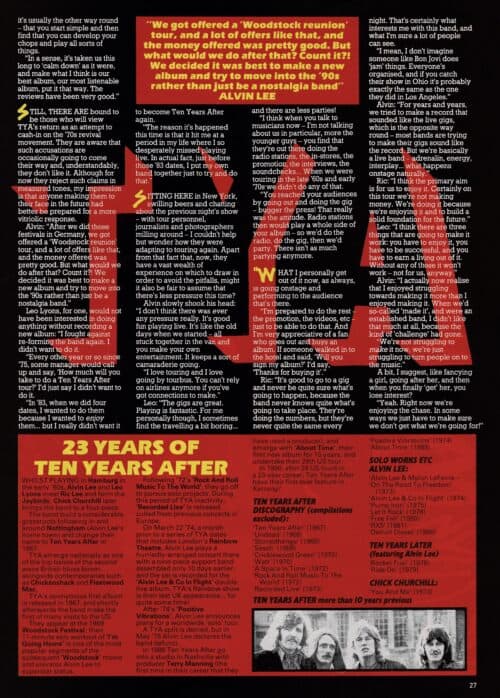
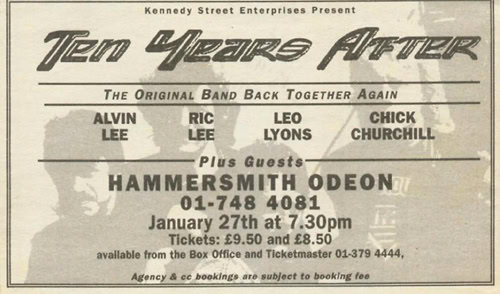
They’re late, they’re late, and on January 27 they’ve got a very important date.
(Because that’s the day that the re-formed ’70’s boogie quartet TEN YEARS AFTER play London’s Hammersmith Odeon).
But naff White Rabbit jokes notwithstanding, it’s been fifteen years since the last “official” album, so ’tis apt indeed that the new LP title proclaims prophetically: it’s “About Time”. PAUL HENDERSON (the only man on the Kerrang! staff old enough to remember the first time) catches TYA in New York and finds ALVIN LEE and company still boogiein’ on down with the best of them…
TEN YEARS AFTER are in the middle of a U.S.A. tour, with all the attendant hustle and bustle schedules of T.V. press and radio interviews to clog up the “free” time.
It’s their twenty-ninth such jaunt, and round-the-table banter is regularly punctuated with intimate, time acquired knowledge of the various hotels they’ve stayed in and the venues they’ve played at on previous visits; the relative merits of domestic beers and the good places to eat… Understandably, after visiting the place so often, they feel quite at home in America.
For the four members of Ten Years After (guitarist Alvin Lee, bassist Leo Lyons, drummer Ric Lee and keyboardist Chick Churchill), sitting in the bar of yet another New York hotel must bring on a collective and vivid case of deja vu. More strangely, although this is their 29th tour, it is something like 15 years since the 28th!
Now, a decade-and-a-half after their last “official” new album (74’s “Positive Vibrations”) and two decades since the cameras recorded their epic, electrifying version of “I’m Going Home”, played to an audience of almost half-a-million at 69’s Woodstock Festival – Ten Years After are “doing it” again.
Although they never officially split up, the original line-up are back, with a new album, “About Time”, on Chrysalis. They’ve now completed this tour of the U.S. and dates in Britain are imminent as you read this, following a spell in Europe.
By any standards, Ten Years After’s “lay-off”, “rest”, “inactivity period”, “sabbatical” – call it what you will – has been a lengthy one.
Touring America together again after so long, with a new album to promote, does, they will agree with a smile, “feel a bit weird”. “But in another way”, says Ric Lee “it’s like we haven’t been away, really. It feels kind of like picking up where we left off.”
Leo Lyons, fingering his elegant “Wing Commander” style waxed moustache, explains further: “The purpose of this tour is specifically to let people know that we’re back. We came over to do smaller places-what you’d call “showcases”. We’ve got either twelve or thirteen albums out in the marketplace, and when another album comes out there’s a danger of people thinking it’s just another compilation. So we’ve come over here and we’re talking to people and doing interviews to let them know what’s happening. The gigs are actually the perks that’s our reward for coming here.”
Ric Lee: “What’s interesting about the gigs is that in Europe we found we were playing to eighteen to twenty-five year olds, but here, I think maybe because of the venues strict over twenty-one drinking laws, the majority are the older crowd-the crowd that was around at the time of Woodstock. I think when we move into the theatres next near we’ll start to pull in more of the younger fans.”
How did you go about arranging the set-balancing the need to promote the new album, while including a substantial number of old songs to satisfy those sections of the audience demand them?
Leo: “Well, the set is about 60/40 in favour of old stuff, from the twelve albums, every night there’s always someone shouting for one particular song or another, so we’ve tried to do the ones that the majority of people would like to hear, plus the new material. We always got to do “I’m Going Home”, because people want us to do that…” “Good Morning Little School Girl”, adds Ric, “and “Love Like A Man” (their only U.K. hit single), although that wasn’t an enormous hit here in America, but it’s known. As some people haven’t even heard the new album yet, the older stuff sometimes has a more immediate impact. I’ve noticed that the older crowd seem to prefer the older stuff where as the younger crowd seem to pick up on the new stuff.”
Alvin Lee: “There are certain new songs, like “Saturday Night” and “Victim Of Circumstance” , where the choruses repeat, and they pick up on that very quickly, which is great. Generally, I think the new songs are going down about as well as the ones we first did around twenty years ago.”
Twenty years ago (or there-a-bouts as they actually formed in 1967). Ten Years After came riding in on the crest of the blues boom wave, the band’s appeal centering on the gritty vocals and high speed guitar playing of Alvin Lee. Back in the late 60’s and early 70’s, Lee was considered to be an astounding fast guitarist, who’s skill at stringing together fluid, high speed clusters of notes came to some extent from a background in jazz. In terms of sheer speed (for which he was later heavily criticised) it’s doubtful whether there was anyone else around at the time who could touch him. From 1969’s “Stonedhenge”, Ten Years After’s albums were consistently strong sellers in Britain, with four of them – “Stonedhenge” itself, plus “Ssssh”, “Cricklewood Green” and “Watt” all making the U.K. Top 10. They also sold well in the U.S. where their 1971 album “A Space In Time” went Gold. But it was largely as a live band that Ten Years After really made their mark, with what was once described as a “super-adrenalined gross out approach” to their shows. Not long after the release of their first album “Ten Years After” in 1967, the band quickly became a major concert attraction in the States, due largely to the enthusiasm of the legendary West Coast concert promoter Bill Graham, who booked them into the then prestigious Fillmore East and Fillmore West auditoriums. As mentioned earlier, most people’s most vivid memory of Ten Years After is their appearance at Woodstock, but that concert was also something of a watershed in their career, because before Woodstock they had been playing eight to ten thousand seat venues; after that they found themselves playing to audiences in the twenty five to thirty thousand range.
According to Alvin Lee, “that’s when the fun went out of it.” They didn’t feel they were achieving anything, and it became what he calls “the travelling jukebox syndrome, where you get on stage, plug in, and away you go, you do the same as you did last night”. In the end, after twenty eight U.S. tours (interestingly, supported by none other than ZZ TOP on several of them), they simply toured themselves out. Alvin Lee began a solo career (which he kept up until the recent Ten Years After reformation) and released several solo albums, Chick Churchill went into music publishing, Ric Lee (no relation to Alvin, by the way) formed a production company, and Leo Lyons went into producing bands, UFO being one of them. After the long lay-off, during which they did, however, do a clump of four tour dates in the Summer of 1983 which followed the 25th anniversary of London’s Marquee Club. The next reappearance of Ten Years After was when the band reconvened in 1988 to play some European rock festivals at the request of an enthusiastic fan / promoter, and subsequently did a tour of Germany. With their hunger rekindled, they decided to return to the recording studio, enlisting, for the first time, the services of an outside producer, (Terry Manning who produced ZZ Top and George Thorogood and the Destroyers), and emerged from a studio in Memphis with “About Time”. Far from being a cash-in on the 1970’s-bands reformation bandwagons, “About Time” is a legitimate Ten Years After album, blending old Ten Years After values and trademarks with a modern, and at times ZZ Top-tinged production, and neither of which are disappointingly retro, nor too radical, uncharacteristically new direction, they are understandably pleased with the results. In fact pleased enough to decide that yes, after fifteen years, Ten Years After is back in business once again. For Ten Years After, the critical reaction to the new album must be heartwarming, having for the most part been the sort of response (with a 5 K’s rating in Kerrang! for example) that was probably beyond what they could reasonably have expected.
“It’s been a good reaction, actually”, enthused Alvin said, “we put out “let’s Shake It Up” over here as the introductory single, and it got a particularly good reaction. People were ringing up saying they’d heard the record and asking who it was. People have picked up on exactly what I’d hoped, which is that we’ve got a modern sounding album but which hasn’t completely lost the roots of what we started off doing. There was a danger that we could have gone in and made an “ultra modern” album which is really what we’re fighting against. I think it’s generally accepted that we’ve come up with a modern sounding album that’s true to its roots.” That’s certainly true. There’s also a certain irony that after years of touring interspersed with putting out albums that failed to effectively capture the live essence of Ten Years After, “About Time” although recorded after a lengthy spell of band inactivity, is probably the closest they’ve ever come to succeeding. As for the reason, Alvin reckons you need look no further than producer Terry Manning. “He had a picture in his head of the sound before we ever did. We had the songs, about fifty of them, and we had the general style. We gave him a whole bunch of demos and said, “Here, pick ten out of that, mate!” And he was very good at that.”
“He was quite a tough producer,” recalls Chick Churchill, “He knew what he wanted us not to play, which is very important. He guided us, made us play simpler than we would do onstage… I learned a lot from it, and I know Alvin did, as did Ric and Leo. He made us make a record, and not try to emulate a live performance. I think we’d got lost before, and having such a long sabbatical gave us a lot of time to think about what to do. I think we’re much more into rock music now than we were in those days, when we were probably more blues and jazz influenced. That has been watered down a bit and we’ve become more rock musicians.”
Ric Lee says: “If you listen to the other Ten Years After albums…”
Alvin interrupts, “You’ll go mad!”
Ric continues: “…and then listen to this one, the difference on it is almost that we’ve come of age. Someone pointed out to us that it’s usually the other way around, meaning you start simple and then find that you can develop your chops and play all sorts of things. “In a sense, it’s taken us this long to “calm down” as it were, and make what I think is our best album, our most listenable album, put it that way. The reviews have been very good.”
Still there are bound to be those who will view Ten Years After’s return as an attempt to cash in on the 1970’s revival movement. They are aware that such accusations are occasionally going to come their way and, understandably, they don’t like it. Although for now they reject such claims in measured tones, my impression is that anyone making them to their face in the future had better be prepared for a more vitriolic response.
Alvin Lee: “After we did those festivals in Germany, we got offered a “Woodstock Reunion” tour, and a lot of offers like that, and the money offered was pretty good, but what would we do after that? Count it? We decided it was best to make a new album and try to move into the 1990’s rather than be a nostalgia band.”
Leo Lyons: “For one, I would not have been interested in doing anything without recording a new album: I fought against re-forming the band again. I didn’t want to do it. Every other year or so since 1975, some manager would call up and say, “How much will you take to do a Ten Years After tour?” I’d just say I didn’t want to do it. In 1983 when we did four dates, I wanted to do them because I wanted to enjoy them…but I really didn’t want it to become Ten Years After again. The reason it’s happened this time is that it hit me at a period in my life where I so desperately missed playing live. In actual fact, just before those 1983 dates, I put my own band together just to try and do that.”
Sitting here in New York, swilling beers and chatting about the previous night’s show-with tour personnel, journalists, and photographers milling around, I couldn’t help but wonder how they were adapting to touring again. Apart from the fact that, now they have a vast wealth of experience on which to draw in order to avoid the pitfalls, might it also be fair to assume that there’s less pressure this time?
Alvin Lee, slowly shook his head: “I don’t think there was ever any pressure really, it’s good fun playing live, it’s like the old days when we started – all stuck together in the van and you make your own entertainment, it keeps a sort of camaraderie going. I love touring and I love going by tour-bus, because you can’t rely on airlines anymore if you’ve got connections to make.”
Leo Lyons: “The gigs are great, playing is fantastic, for me personally though, I sometimes find the travelling a bit boring, and there are less parties! I think when you talk to musicians now – I’m not talking about us in particular, more the younger guys – you find that they’re out there doing the radio stations, the in-stores, the promotion, the interviews, the sound-checks…. When we were touring in the late 1960’s and early 1970’s we didn’t do any of that. You reached your audiences by going out and doing the gig – bugger the press! That really was the attitude. Radio stations then would play a whole side of your album – so we’d do the radio, do the gig, then we’d party. There isn’t as much partying anymore.” Leo continues: “What I personally get out of it now, as always, is going onstage and performing to the audience that’s there. I’m prepared to do the rest-the promotion. the videos, everything, just to be able to do that, and I’m very appreciative of a fan who goes out and buys an album. If someone walked into my hotel and said, “Will you sign my album?” I’d say, “Thanks for buying it.” ”
Ric Lee: “It’s good to go to a gig and never be quite sure what’s going to happen, because the band never knows quite what’s going to take place. They’re doing the numbers, but they’re never quite the same every night. That’s certainly what interest me with this band, and what I’m sure a lot of people can see. “I mean, I don’t imagine someone like Bon Jovi does “jam things”, everyone’s organised, and if you catch their show in Ohio it’s probably exactly the same as the one they did in Los Angeles.”
Alvin Lee: “For years and years, we tried to make a record that sounded like the live gigs, which is the opposite way around as most bands are trying to make their gigs sound like the record, but we’re basically a live band, with adrenalin, energy, interplay, is what happens onstage naturally.”
Ric Lee: “I think the primary aim is for us to enjoy it. Certainly on this tour we’re not making money. We’re doing it because we’re enjoying it and to build a solid foundation for the future.”
Leo Lyons: “I think there are three things that are going to make it work: you have to enjoy it, you have to be successful, and you have to earn a living out of it. Without any of those it won’t work, not for us anyway.”
Alvin Lee: “I actually now realize that I enjoyed struggling towards making it more than I enjoyed making it. When we’d so-called “made it” and were an established band, I didn’t like that much at all, because the kind of “challenge” had gone. We’re not struggling to make it now, we’re just struggling to turn people on to the music.” A bit, I suggest, like fancying a girl, going after her, and then when you finally “get” her, you lose interest? “Yeah, Right now we’re enjoying the chase. In some ways we just have to make sure we don’t get what we’re looking for!”
RAW Magazine – January 24, 1990
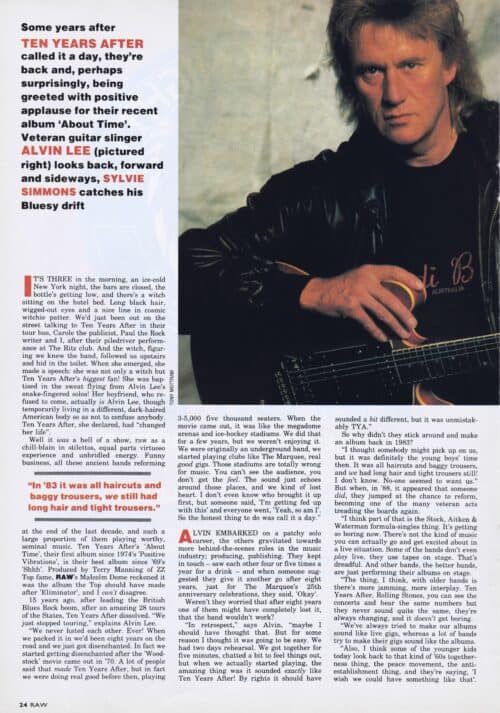
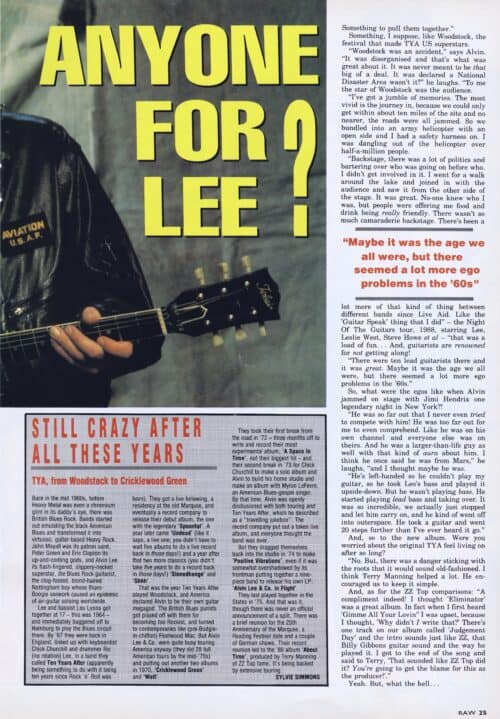
Photo by Tony Mottram – click to enlarge
Some years after Ten Years After called it a day, they’re back again and perhaps surprisingly, being
greeted with positive applause for their most recent record album called “About Time”. Veteran guitar slinger Alvin Lee looks back, forward and sideways with our Sylvie Simmons who catches his bluesy drift.
ANYONE FOR ALVIN LEE?
It’s three in the morning, an ice-cold New York night, the bars are closed, the bottle’s getting low, and there’s a witch sitting on the hotel bed. Long black hair, wigged-out eyes and a nice line in cosmic witchie patter. We’d just been out on the street talking to Ten Years After in their tour bus, Carole the publicist, Paul the Rock writer and I, after their pile driver performance at The Ritz club. And the witch, figuring we knew the band, followed us upstairs and hid in the toilet. When she emerged, she made a speech: she was not only a witch but Ten Years After’s biggest fan! She was baptised in the sweat flying from Alvin Lee’s snake-fingered solos! Her boyfriend, who refused to come, actually is Alvin Lee, though temporarily living in a different, dark-haired American body so as not to confuse anybody. Ten Years After, she declared, had “changed her life”.
Well it was a hell of a show, raw as a chill-blain in stilettos, equal parts virtuoso experience and unbridled energy. Funny business, all these ancient bands reforming at the end of the last decade, and such a large proportion of them playing worthy, seminal music. Ten Years After’s ‘About Time’, their first album since 1974’s ‘Positive Vibrations’, is their best album since ’69’s ‘Shhh’. Produced by Terry Manning of ZZ Top fame, RAW’s Malcolm Dome reckoned it was the album the Top should have made after ‘Eliminator’, and I can’t disagree.
15 years ago, after leading the British Blues Rock boom, after an amazing 28 tours of the States, Ten Years After dissolved. “We just stopped touring,” explains Alvin Lee. “We never hated each other. Ever! When we packed it in we’d been eight years on the road and we just got disenchanted. In fact we started getting disenchanted after the “Woodstock” movie came out in 1970. A lot of people said that made Ten Years After, but in fact we were doing really good before then, playing 3,000 to 5,000 five thousand seat venues. When the movie came out, it was like the mega dome arenas and ice hockey stadiums. We did that for a few years, but we weren’t enjoying it. We were originally an underground band, we started playing clubs like The Marquee, real good gigs. Those stadiums are totally wrong for music. You can’t see the audience, you don’t get the feel. The sound just echoes around those places, and we kind of lost heart. I don’t even know who brought it up first, but someone said, I’m getting fed up with this’ and everyone went, “Yeah, so am I”. So the honest thing to do was call it a day.”
Alvin, then embarked on a patchy solo career, the others gravitated towards more behind-the-scenes roles in the music industry; producing, publishing. They kept in touch saw each other four or five times a year for a drink and when someone suggested they give it another go after eight years, just for The Marquee’s 25th anniversary celebrations, they said, “Okay”. Weren’t they worried that after eight years one of them might have completely lost it, that the band wouldn’t work? “In retrospect,” says Alvin, “maybe I should have thought that. But for some reason I thought it was going to be easy. We had two days rehearsal. We got together for five minutes, chatted a bit to feel things out, but when we actually started playing, the amazing thing was it sounded exactly like Ten Years After! By rights it should have sounded a bit different, but it was unmistakably TYA.” So why didn’t they stick around and make an album back in 1983? “I thought somebody might pick up on us, but it was definitely the young boys’ time then. It was all haircuts and baggy trousers, and we had long hair and tight trousers still! I don’t know. No-one seemed to want us.”
But when, in ’88, it appeared that someone did, they jumped at the chance to reform, becoming one of the many veteran acts trotting the boards again. “I think part of that is the Stock, Aitken & Waterman formula-singles thing. It’s getting so boring now. There’s not the kind of music you can actually go and get excited about in a live situation. Some of the bands don’t even play live, they use tapes on stage. That’s dreadful. And other bands, the better bands, are just performing their albums on stage. The thing, I think, with older bands is there’s more jamming, more interplay. Ten Years After, Rolling Stones, you can see the concerts and hear the same numbers but they never sound quite the same, they’re always changing, and it doesn’t get boring. We’ve always tried to make our albums sound like live gigs, whereas a lot of bands try to make their gigs sound like the albums. Also, I think some of the younger kids today look back to that kind of 60’s togetherness thing, the peace movement, the anti-establishment thing, and they’re saying, ‘I wish we could have something like that’. Something to pull them all together.”
Something, I suppose, like Woodstock, the festival that made TYA US superstars. “Woodstock was an accident,” says Alvin. “It was disorganised and that’s what was great about it. It was never meant to be that big of a deal. It was declared a National Disaster Area wasn’t it?” he laughs. “To me the star of Woodstock was the audience. “I’ve got a jumble of memories. The most vivid is the journey in, because we could only get within about ten miles of the site and no nearer, the roads were all jammed. So we bundled into an army helicopter with an open side and I had a safety harness on. I was dangling out of the helicopter over half-a-million people. Backstage, there was a lot of politics and bartering over who was going on before who. I didn’t get involved in it. I went for a walk around the lake and joined in with the audience and saw it from the other side of the stage. It was great. No one knew who I was, but people were offering me food and drink being really friendly. There wasn’t so much camaraderie backstage. There’s been a lot more of that kind of thing between different bands since Live Aid. Like the “Guitar Speak” thing that I did, the “Night Of The Guitars” tour in 1988, starring Alvin Lee, Leslie West, Steve Howe and the rest, Alvin says, “that was a load of fun…and, guitarists are renowned for not getting along! There were ten lead guitarists on the bill, and it was great. Maybe it was the age we all were, but there seemed a lot more ego problems in the 1960’s.”
So, what were the egos like when Alvin jammed on stage with Jimi Hendrix one legendary night in New York?! “He was so far out that I never even tried to compete with him! He was too far out for me to even comprehend. Like he was on his own channel and everyone else was on theirs. And he was a larger than-life guy as well with that kind of aura about him. I think he once said he was from Mars,” he laughs, “and I thought maybe he was. “He’s left-handed so he couldn’t play my guitar, so he took Leo’s bass and played it upside-down. But he wasn’t playing bass. He started playing lead bass and taking over. It was so incredible, we actually just stopped and let him carry on, and he kind of went off into outer space. He took a guitar and went twenty steps further than I’ve ever heard it go.”
And, so to the new album. Were you worried about the original TYA feel living on after so long? “No. But, there was a danger sticking with the roots that it would sound old-fashioned. I think Terry Manning helped a lot. He encouraged us to keep it simple. And, as for the ZZ Top comparisons: a compliment indeed! I thought ‘Eliminator’ was a great album. In fact when I first heard “Gimme All Your Lovin” I was upset, because I thought, ‘Why didn’t I write that?” There’s one track on our album called “Judgement Day” and the intro sounds just like ZZ, that Billy Gibbons guitar sound and the way he played it. I got to the end of the song and said to Terry , “That sounded like ZZ Top did it? You’re going to get the blame for this as the producer!’.”
Yeah. But, what the hell…
by Sylvie Simmons


January 27, 1990 – Ten Years After “Storm Back”!
After playing shows in Germany, and described by the fans as “Sensational”, and the best they’ve been ever ! Ten Years After come storming back to play at the Odeon Hammersmith, London on January 27.
It will be the all-time classic boogie band’s first major UK appearance since 1974. The band features the original line up, of Alvin Lee (Guitar and Vocals) Leo Lyons (Bass Guitar) Chick Churchill (Keyboards) and Ric Lee (Drums).
They very recently released their critically acclaimed album “About Time” on Chrysalis, and have just completed a successful tour. The Hammersmith gig forms part of a full European Tour. Tickets are priced at 9.50 and 8.50
January 27, 1990 – Hammersmith Odeon
Article by Pippa Lang
Why oh why did Captain Speed Fingers never make it mega ?
Mention Alvin Lee’s name and most people still have to think a bit, before remembering the famous “Ban The Bomb” Fender Strat of Woodstock. (It was a Cherry Red Gibson ES-335).
The straight blonde hair, the long face, screwed up in exquisite concentration, squeezing out the sparks for that unrepeatable rendition of “Going Home”….that was a long time ago
(The Woodstock Movie) came out after the 1969 festival. But nothing changes, thank God!
We are witnessing a time warp situation; and putrid smell of Afghan mingling with the musky whiff of patchouli oil. Love and peace man!
I’m sitting in the balcony with a grand stand view of our Alvin Lee giving his inimitable treatment of “Good Morning Little Schoolgirl”, Leo Lyons bass, throbbing through the floor beneath my feet and setting up a rhythm for the hordes to stomp along to. “Going Home” is still a classic, after all these years and twenty years later, the Fender is still capable of extraordinary acrobatics. (It’s a Gibson ES-335 – not a Fender). The Ban the Bomb sticker is still there, a symbol of everlasting values. This is simply the best time that I’ve had in ages. Surrounded by hippies and heads, without a self conscious bone in their bodies, they are going ape-shit. Some are weeping. We’re going to do “Can’t Keep From Crying Sometimes” next.
Our hero smiles warmly and the hippettes are hysterical. Alvin’s guitar gently weeps.
“Choo-Choo-Mama” the legendary set-ender nearly demolishes the Hammy – Odeon !!!
There is a mass boogy-ing on the seats, a mad flurry of activity and an undulating sea of hair.
It’s been almost eighteen years since Alvin Lee, Leo Lyons, Chick Churchill and Ric Lee have played together in one unit. A few experimental outfits in between, never really made it. As it’s taken this long for the four of them to realise they can’t do without each other. And judging by the reaction tonight, there are a fair few thousand who can’t do without the band either. Let’s hope it doesn’t take another eighteen years before we get to hear “I’m Going Home” live again.
Ten Years After on tour
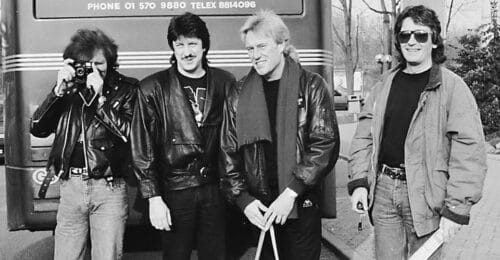
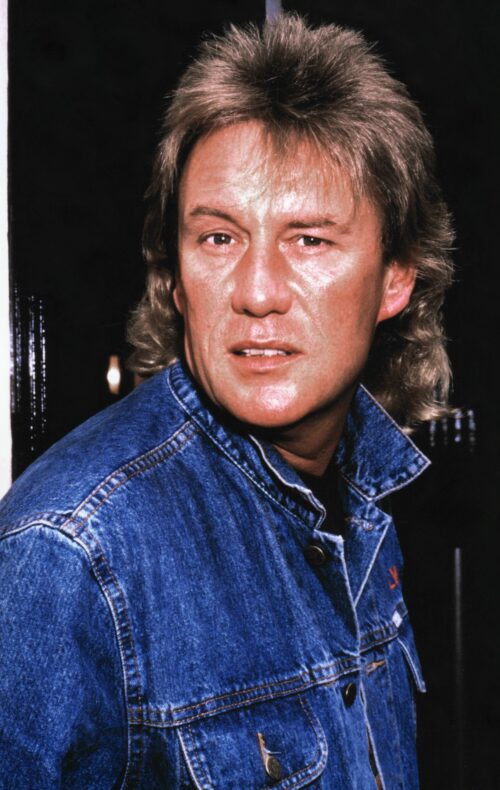
Photos by Jacky Moutaillier
Nottingham Evening Post – March 8, 1990
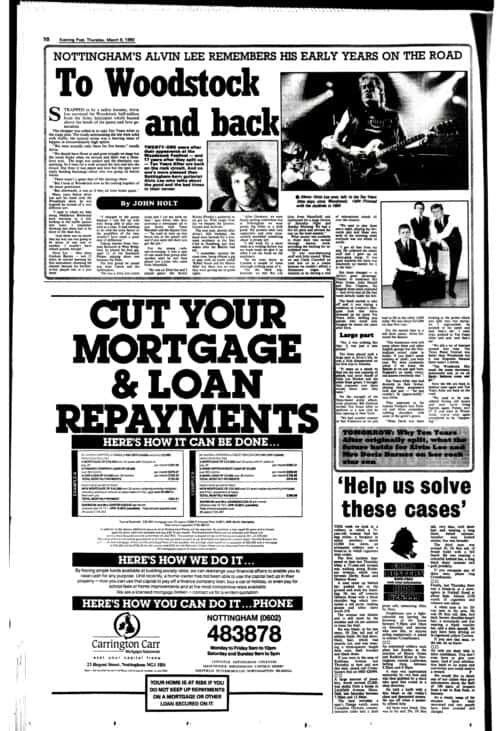
click to enlarge
Nottingham Evening Post – March 9, 1990
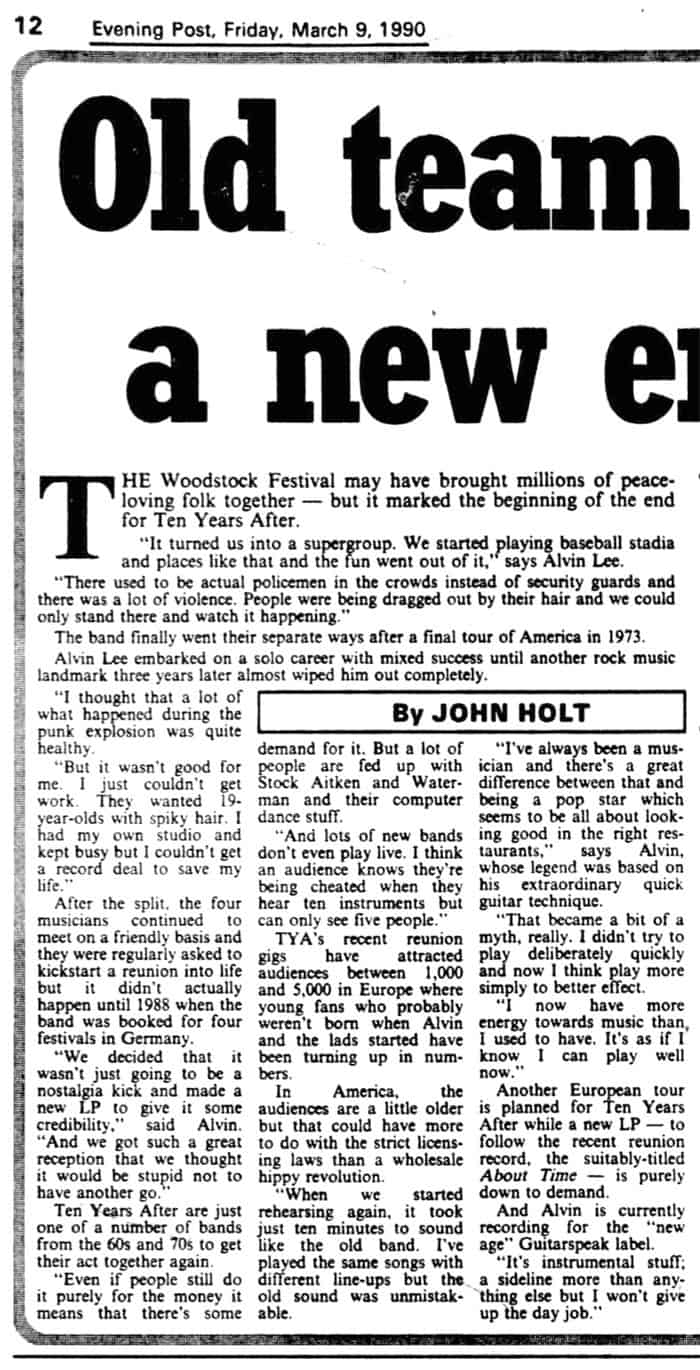
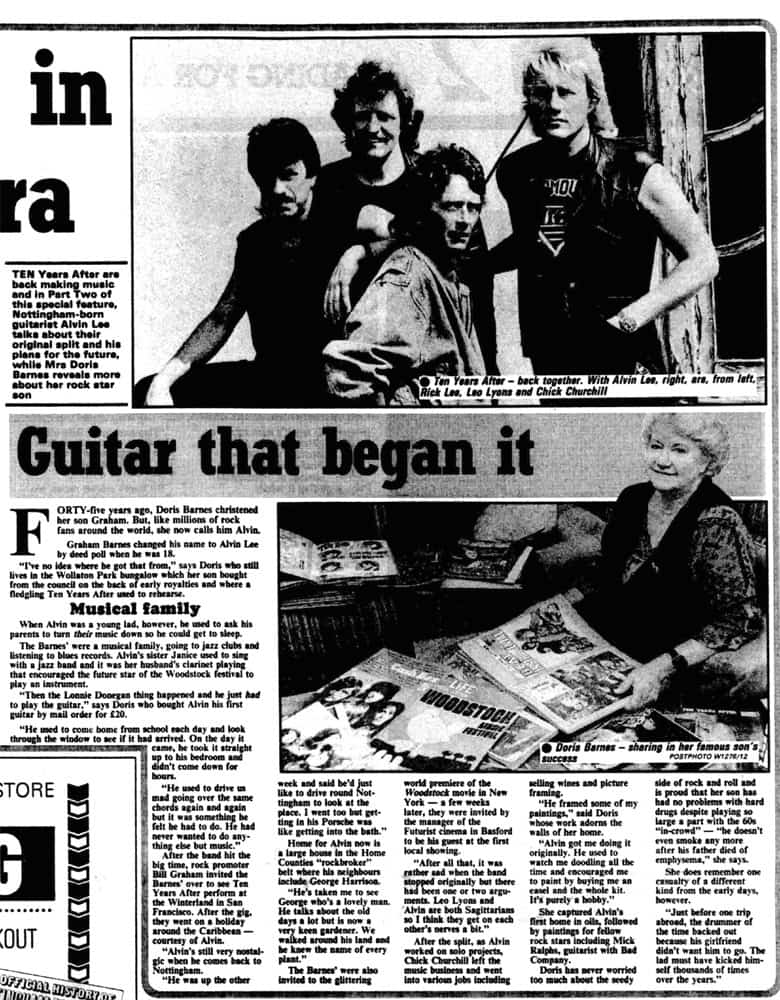
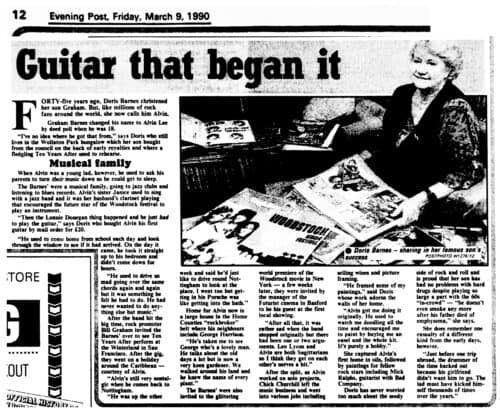
click to enlarge
Metal Hammer Magazine
Ten Years After – “Live Legends” – Castle Music – 1990
“This is not heavy metal” said Peter Burtz, our esteemed editor of the German Metal Hammer, looking in shock and horror at the video cover. So fucking what! This is Rock music and about a million times better than most of the complete crap that calls itself thrash and metal! Here are real musicians, playing great riffs and blues like “Good Morning Little School Girl” the tearaway “I’m Going Home” and Chuck Berry’s Classic “Sweet Little Sixteen” and “Johnny B. Goode”.
Get back to the roots and enjoy some unpretentious blowing at the hands of Alvin Lee (Guitar) Ric Lee (Drums) who is featured on his famous drum solo called “Hobbit”. Ric blasts away on top form and so does Alvin, backed up by his old mates Chick Churchill (Keyboards) and Leo Lyons (Bass Guitar).
By Chris Welch
Ten Years After – Short Band Biography
From The Hard Rock & Heavy Metal Encyclopaedia
Ten Years After were one of the most important blues bands of the 1960’s and early 1970’s. The band made itself immortal with the classic “I’m Going Home” especially with the version on the “Woodstock Festival” from 1969. Leo Lyons, Alvin Lee and Ric Lee had not the slightest idea of when they formed the “Jaybirds” in 1966 to set up a new project with keyboard player Chick Churchill. The quartet took up the blues and were successful from the second album. “Undead”( which contained the original version of “I’m Going Home”).
The most important characteristics of the Ten Years After albums from that period were Alvin Lee’s unstoppable guitar solos, which were super fast for that period.
On “A Space In Time” the band suddenly started to experiment, because it was tired of the “I’m Going Home” success. The material became quieter, the rhythms on the contrary became stranger every time. Solo aspirations got the upper hand. Alvin built his own studio and recorded an album with the American vocalist Mylon Lefevre and also Chick Churchill produced one album under his own name. Ten Years After reunited one more time after the album “Recorded Live” 1973 – for “Positive Vibrations” 1974; after that, the members of the band took up solo careers. Chick Churchill started to work for Chrysalis Records (back then it was Ten Years After’s record company). Ric Lee started a production company and Leo Lyons produced bands, such as “UFO”. While Alvin Lee was the only one who stayed active as a musician. First as a solo artist, and then with the band “Alvin Lee & Co” 1978-1979. again on his own and finally another time under the name “Ten Years Later”. A concert on the
“Reading” Festival was still feasible for the original line-up. But on other concerts which he gave under the name “Ten Years Later” he was assisted by musicians who were so young that they did not experience the heydays of Ten Years After. But in 1990 the original members got back together for a very successful U.K. and German dates and went down a storm.
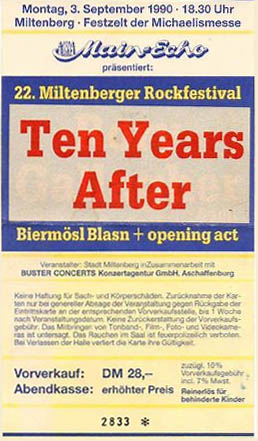
Deggendorf
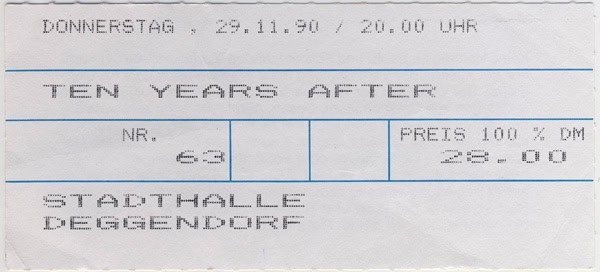
I saw Alvin Lee with Ten Years After in Deggendorf (Niederbayern) at 29th November 1990 and it was a great Concert. The townhall of Deggendorf is not very large, but Alvin was excellent and showed us his best performance. I hear Alvin Lee and TYA since I was 10 Years old. My older brother bought the album “Undead” I think in 1969 and since then I love Alvin and his music. I bought all the LP’s and CD’s and Alvin is my favourite guitar player for ever. I love the sound, his solis and his voice.
Our thanks to Franz Harles for sharing his memories with us.
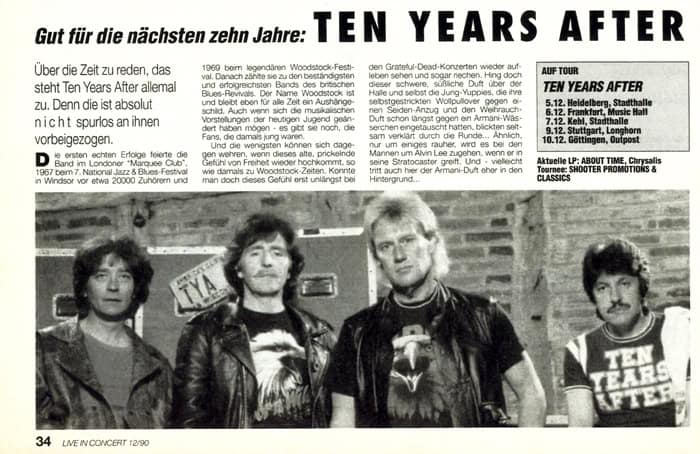
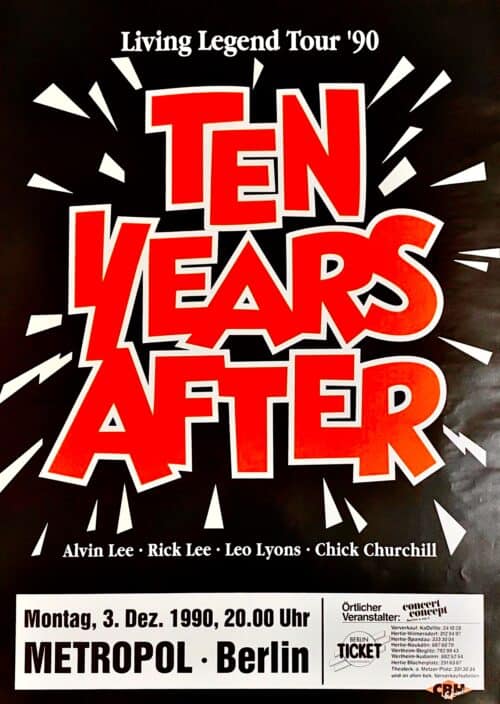
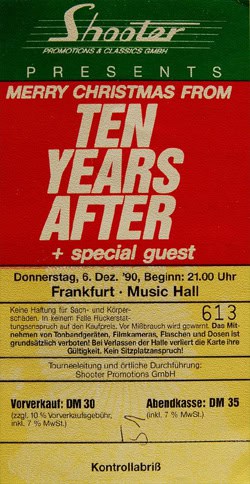
1991 – The Best of Ten Years After
England’s Ten Years After were one of rock’s most electrifying groups from the late 1960’s to the mid 1970’s.
At a time when blues-based-bands were a dime a dozen, guitarist Alvin Lee, keyboardist Chick Churchill, bassist Leo Lyons and drummer Ric Lee (no relation to Alvin) towered above the competition with a sizzling combination of tough, rootsy songs and driving ensemble work, highlighted by perhaps the hottest guitar licks in the universe. The ultimate axe god, Alvin Lee sprayed searing blue notes from his red Gibson like a crazed machine gunner, mowing down live audiences and adding an edge of danger in the studio.
The proof of this action-packed set of fourteen tracks, aptly titled “The Best Of Ten Years After”. It’s all here, their blistering signature tune, “I’m Going Home” – radio favourites like “I’d Love To Change The World” and “Love Like A Man,” which remind us Lee was a soulful singer, not just a devastating player, and plenty of classic foot-stomping rock ‘n roll.
From a scorching version of Little Richard’s “Going Back To Birmingham” to the supersonic boogie of “Choo-Choo-Mama” (roll over ZZ-Top), Alvin and the boys could rattle windows and shake walls with a feverish intensity rarely witnessed since rock’s first generation of stars (who were saluted by the bands very name, in fact – so the story continues – ten years after the birth of rock and roll – but not in fact how the band got their name. It came from Leo Lyons who while reading a Radio Times Magazine came upon the name – the rest of the guys liked it, and it stuck). Chris Wright was there. The co-founder of Chrysalis Records and executive producer of this compilation, he managed Ten Years After from the beginning and went on to produce some of their best records. Here’s how he remembers the glory days: “In mid 1967, having spent four years at Manchester University and the Manchester Business School, I was working with a booking agency called the Ian Hamilton Organisation in Manchester and operating a college booking agency throughout the Midlands and the North of England. In addition, I was running a weekly student blues night at Manchester club. “Since I was in the unique position of being able to offer opportunities to play in the north, I was inundated with phone calls from blues groups throughout the country. One was a band from Nottingham called the “Jaybirds”, who had been going since the early 1960’s having served the usual apprenticeship in such places as the Star Club in Hamburg. They were keeping the wolf from the door as the backing group for a pop trio called “The Ivy League,” but were totally bored. At every conceivable opportunity, they resorted to playing such weird and wonderful numbers as Woody Herman’s “Woodchopper’s Ball.” “The Jaybirds insisted that I book them for my blues club in order that I have the opportunity to see them. I did, paying a fee of 15 pounds or 25 pounds, out of which they had to pay all expenses, including the cost of travelling from London. “It was immediately obvious they were completely different from all other groups at the time.
They were a four piece with a great rhythm section, and most especially, Alvin Lee, who was clearly, “the fastest guitarist in the west,” even in those early days. “I immediately signed them to a management contract, but being based in Manchester was not the ideal place to develop the group’s career. We changed their name to Ten Years After and I started to operate from London, where they secured a residency at the Marquee Club. “After we made their eponymous first album in three days, we recorded their second, “Undead,” live at the London blues club “Klooks Kleek.” Over the years as studio techniques developed, we spent more time in the studio making records, but Ten Years After were essentially a live performing band, always striving to capture the intensity of their live show in the studio. “In early 1968, I received a letter from Bill Graham in San Francisco, inviting the band to appear at the Fillmore Auditorium. With barely a dollar in our pockets, we managed to get ourselves on a Pan American flight to California, where Ten Years After played back to back weekends. Then we headed to New York, to the recently opened Fillmore East. All the shows in San Francisco and New York were played to standing ovations, and American audiences quickly developed a love affair with the group.”
Leaving Deram Records after three records, Ten Years After signed with the newly formed Chrysalis, debuting on the label with Ssssh. As their American following continued to expand, Ten Years After refused to stick to a formula. Released in early 1970, “Cricklewood Green” pointed in a verity of directions, from the urgent psychedelic sounds of “50,000 Miles Beneath My Brain” to the breezy swing of “Me and My Baby”,” recalling Lee’s early interest in jazz innovators like Charlie Christian and Django Reinhardt.
Then the “Woodstock” move came out, instantly transforming Ten Years After from a rising band to runaway superstars. Like the 1969 concert itself, the film was loaded with memorable performances by such heavies as Santana, the Who and Jimi Hendrix. But Lee took a back seat to nobody with his kinetic rendition of “I’m Going Home,” a staggering explosion of atomic blues power. Continuing to tour heavily, Ten Years After would eventually notch an astounding 28 U.S. tours, the band stayed hot with “Watt. However, Lee was growing restless in the role of pop star. Accustomed to working to win audiences approval, he now found fans wildly applauding every note of a show from the start. “Sometimes I feel I can get away with playing just feedback,” he complained to Guitar Magazine in October 1971.
The band didn’t let its frustration spill over into the studio, however. They struck back with, “A Space In Time,” their most polished effort yet, then got back to roots on “Rock and Roll Music to the World,” where the title track offered this sound advice: “Give peace a chance, get up and dance!” Taking a rare break from the road in 1973, they released “Recorded Live,” a non-stop rave-up labelled “the official Ten Years After Bootleg” and the source of the definitive versions of “I’m Going Home” and Good Morning Little Schoolgirl” you find here.
Following individual side projects, the band reconvened for “Positive Vibrations,” but Ten Years After had already changed the world. With no new challenges on the horizon, they went their separate ways. All four members prospered after the break-up, with Alvin Lee enjoying a solo career, Chick Churchill becoming a manager for Chrysalis Music, Leo Lyons producing seminal heavy metal band UFO and Ric Lee joining Chicken Shack. And in 1989 brought a triumphant reunion with the “About Time” LP. However, that’s a story for another day….concludes Chris Wright: “The years we spent touring America from 1968 through the mid 1970’s were the most exciting years of my life. I hope those of you who witnessed any of those shows enjoy listening to this collection. For those of you who may be listening to the group for the first time: It is indeed unfortunate that you weren’t around in those days to participate in the excitement.” The next best thing to being there. The Best Of Ten Years After testifies to the timeless appeal of stripped-down, high-octane rock ‘n roll. Feel free to boogie one more time.
From: ‘Best of Ten Years After’ compilation, liner notes by Jon Young
The “Essential” Ten Years After – Best of Collection
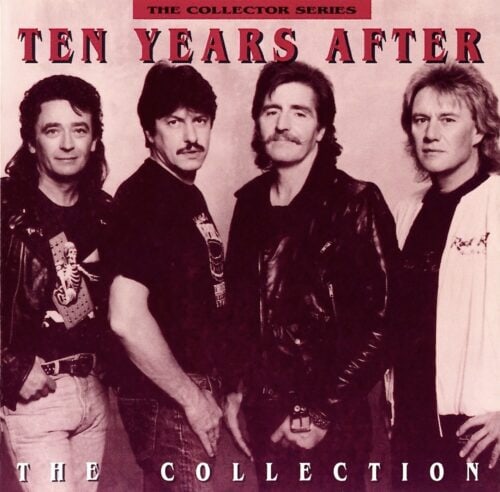
A single CD anthology of the Chrysalis recordings of Ten Years After.
Ten Years After made their reputations by playing such high profile festivals as Woodstock 1969 and The Isle of Wight 1970. The band was highlighted by the quick and inventive blues/jazz rock guitar riffs of guitarist Alvin Lee. The interplay between Alvin and organist Chick Churchill was both exciting and fun. Bassist Leo Lyons along with drummer Ric Lee were no slouches either. The music is a combination of rock, blues / boogie and jazz at its best. Ten Years After were one of the most exciting bands to come out of the second wave of the British Blues Boom.
By Carl Rosen
Essential
“Essential” from Ten Years After, is a real rarity, as it’s faultless in collecting together what is the essential recordings that are really the best of the group. Ten Years After … aimed all their time and effort at what they’d got, and worked their fingers to the bone. They must still hold the worlds record for the most tours across America from coast to coast, 28 of them it’s reported.
The main object of their talent was the “Fastest Guitarist in the West” Alvin Lee, who also handled all the vocals, song writing and stood center stage, while leaving the other three members of the band (Leo Lyons – Chick Churchill – Ric Lee) very much in subordinate roles. They weren’t cute, and they definitely weren’t trendy, as Alvin Lee used to come on stage wearing that well known Rock ‘n Roll footwear, a pair of Dutch made white clogs.
Ten Years After were England’s most electrifying band to come out of the 1960’s and into the early 1970’s and they towered over the opposition / competition with a sizzling combination of tough and ready songs, both of their own design, as well as expertly chosen cover and driving powerhouse ensemble work, that was highlighted by perhaps the hottest guitar licks in the universe. I’ve never heard anyone play faster than Alvin Lee, although on drums Ric Lee (no relation) sounds as if he’s thrashing away at dustbin lids and not high hats.
At the time, Alvin Lee was the ultimate axe hero. He sprayed searing blues notes from his Red Gibson ES-335 guitar, like a crazed machine gunner-mowing down live audiences in their masses, and adding that certain hint of danger that made their studio albums stand out from the crowd. Ten Years After always had the knack, of being in the right place at the right time. Their appearance in the Woodstock movie, which is the ultimate documentary to the Woodstock Festival, is possibly the best standout performance of the entire event. When you take into consideration that they were up against Joe Cocker, The Who, Jimi Hendrix and Santana, that alone is quite an achievement.
Alvin Lee was a soulful singer, not just a devastating Rock ‘n Roll Outlaw. Ten Years After provides their no holds barred – no nonsense – classic foot-stomping Rock ‘n Roll…
Super-Sonic Boogie. Alvin Lee, Chick Churchill, Leo Lyons and Ric Lee, could rattle windows, shake floors and walls with a feverish intensity rarely witnessed since rock’s first generation of stars. High-Octane-Rock and Roll by Ten Years After Is Essential Listening.
By Kay Wagner
Album Reviews 1991
The British rock press never quite forgave Alvin Lee for his guitar pyrotechnics in the Woodstock movie, although any solo that inspired awe and even a little envy in Jimi Hendrix was good enough for me. Both with and without Ten Years After, Alvin has been cutting blues and rock albums for three decades, but his media profile in this country isn’t so much minimal as it is missing.
In Europe and South America, though, Alvin is respected as one of British rock’s finest ambassadors from the 1960’s and has top rating alongside the likes of Eric Clapton, Jeff Beck and Peter Green as a guitar hero par excellence.
“Stonedhenge” was the bands third album from 1969, and was their first real commercial breakthrough success, besides debuting, what was to become a Ten Years After standard called “Hear Me Calling”, which was produced by Mike Vernon, and accentuated their blues roots, but left plenty of space for Alvin’s eye-blurring fretwork.
“Ssssh” – the album cover may have featured a photo by Graham Nash, but there’s no sign of three part harmonies or odes to large sea mammals (the mistake here is that the Graham Nash mentioned here is not the same one who is in the band CSNY). Instead, Ten Years After kept up the steady diet of blues, slow blues with “I Woke Up This Morning” and faster blues with “The Stomp”…. But it’s “Bad Scene” that opens up the album with a metallic rush that suggested another horizon for the band to conquer in the decade to come.
Enter “A Space In Time”, which is lucky number seven in the Ten Years After Catalogue. Released in 1971, the album certainly marked another new and unexpected change for the band…and not the way their listening audience might have expected.
With Del Newman adding a string arrangement to the song “Over The Hill” along with some off-beat experiments using a Moog Synthesiser, Ten Years After baffled many (if not all their fans) around the world. What really saved them as usual, was their constant touring schedule, because this album became their biggest-ever selling album in America.
But, the touring eventually took its toll and showed on the bands next release entitled, “Rock and Music To The World” which was another rather erratic studio album – that is until 1989.
Thereafter, Alvin Lee set out on a long, rambling solo career, that has veered between some degree of success, followed by commercial indifference and then back again.
The three Viceroy albums, imported from the States by Pinnacle, date from the last decade. “Detroit Diesel” won more attention for its George Harrison guest appearance than anything else, though it did also reunite Alvin with fellow Ten Years After veteran Leo Lyons once again, as Leo was also a guest bass player on the new album.
Ten Years After gave a concert and a television show at the same time for a capacity Madison Square Garden crowd.
The capacity crowd at Madison Square Garden had no trouble following the action when live performances by Ten Years After, Buddy Miles and Brethren were shown on a large screen video tape projection machine. Even with tickets selling for as much as $6.50 the screaming throng didn’t feel cheated.
1992

photo by Fryderyk Gabowicz

Peter Maffay Tour, Germany – February 1992
Alvin guest stars alongside Clarence Clemons, dates pt. 1 (February) and pt. 2 (May and June)
see:
Gigography
TV appearance

Space Studios – April 24, 1992

photos by Fryderyk Gabowicz

Goldmine Magazine – April 3, 1992


This Ten Years After collection convincingly makes the case, that at its best, the group was the equal or better of any of its blues-boogie-rock competition. The focus of Ten Years After was, of course, Alvin Lee’s hyperkinetic, staccato guitar style, along with his crooning vocals.
The singer / guitarist’s dominant image from early on began to overshadow the rest of the group, however, much to Lee’s own displeasure. His thinking was justified, since keyboardist Chick Churchill, with his jazzy- blues organ playing also contributed not inconsiderably to the band’s sound. Ten Years After’s overall musical style, which covered the range from blues-boogie and straight out rock to psychedelic with blues, jazz and classical influences – all of which is amply represented in this set – only further warrants Lee’s dissatisfaction with the pop star role.
The set kicks off with the title track and the first of three from the 1972 album “Rock and Roll Music To The World”. That along with the album’s “Choo- Choo – Mama” and “Tomorrow I’ll Be Out Of Town” are definitions of Ten Years After’s patented style, as are a number of other tracks here. The version of the extravaganza, “I’m Going Home,” a solid ten minutes even from 1973’s “Recorded Live” has a more jazzy blues feel than the blazingly, blues less classic rendition from the “Woodstock” soundtrack album. Elsewhere Alvin Lee attempts to crack every possible ounce of power and energy out of one simple repeated riff on, “I Woke Up This Morning” from 1969’s Ssssh and “Good Morning Little Schoolgirl” also from “Recorded Live”.
Ten Years After’s most commercially successful album was 1971’s “A Space In Time” which is represented here by the group’s best known hit “I’d Love To Change The World” and the boogie rave-up, “Baby Won’t you Let Me Rock and Roll Ya”. Two lengthy psychedelic-tinged jams, “50,000 Miles Beneath My Brain” and “Love Like A Man” both from 1969’s “Cricklewood Green” are also among the most interesting tracks included. The only less-than impressive offering is the take on Little Richard’s “Going Back To Birmingham” from 1974’s “Positive Vibrations” on which Lee does not sound particularly comfortable in his imitation of the songs author. But also from the realm of original rock ‘n roll cover material, there’s perhaps the most brain-beating version of Chuck Berry’s “Sweet Little Sixteen” a live track from 1970’s “Watt” ever recorded. The CD sound quality is excellent all-around, particularly advantageous on Lee’s numerous riff-weaving guitar solos.
Review by Matt Whorf
REPLAY Magazine 1992


Alvin Lee, whose virtuoso guitar work was first heard with Ten Years After back in the nineteen seventies, has just released a brand new solo album called “Zoom”, which includes musical contributions from George Harrison and Jon Lord. In this article he chats with Mark Ford:
Alvin Lee is in a reflective mood, in London for a day of rare interviews, to promote his new Sequel Records album “Zoom”, he’s reminiscing about earlier days of rock stardom when, as front-man of “Ten Years After” he was one of the rock world’s most revered guitarist, playing to audiences of many thousands, while the band’s albums sold in their millions around the world. In the nineteen eighties, Alvin retired to his “rock-broker belt” mansion in Buckinghamshire, content to let his music take a backseat. “Until I heard Eddie Van Halen for the first time, and his guitar work made me sit up and listen, and I knew then that I had to start practising the guitar again.”
The result was a return to solo recording, with several albums including Free Fall, RX5 and Detroit Diesel, and even a brief re-union with his erstwhile Ten Years After colleagues, Ric Lee, Chick Churchill and Leo Lyons. His new album, “Zoom” is his first in the 90’s, and is a great blend of goodtime blues and melodic rock which, if there’s any justice in this world, it should sell like hot cakes, although Alvin himself takes more philosophical / realistic view about it. “There was a period not that long ago, when I went around various record companies, and was told that they just weren’t interested in what I was doing. I’m not expecting to get into the top twenty, but it’s better to be an active recording artists than someone just relying on back catalogue sales. At least people will know that I’m still alive”, he says.
Alvin Lee has now been a professional guitarist for more than thirty years. In 1961, with his future Ten Years After musical colleague Leo Lyons, Alvin played the famous Star Club in Hamburg, Germany as a member of “The Jay Cats” They worked on the same bill as Liverpool’s The Big Three, Cliff Bennett and the Rebel Rousers, Tony Sheridan who was the big rock and roll hero of the Hamburg scene. “The Beatles had just played there for the first time, they wore tight leather suits which was quite something for the time”, Alvin recalls.
Alvin Lee’s own interest in blues-based music had started years before then even, “My Dad (Sam) used to collect ethnic chain gang-type music, I remember he once brought the famous blues singer and guitarist Big Bill Broonzy back to the house, when I was about twelve years old, just sitting there and watching him play was a big influence on me.”
In 1965, Ric Lee teamed up with the three Nottingham musicians to form a local band that became the forerunner of Ten Years After. “We started playing venues like the “Speakeasy” in London, in fact we were signed up by Deram Records, Decca’s Progressive rock label, after doing a Friday residency at the old Marquee Club. We were probably one of the first bands to start on an albums-only-deal. It was the start of underground music, and long guitar solos, and musicians being able to play what they wanted to play, and not having to think in “commercial” terms. Even Mike Vernon, the A & R guy who signed us to Deram, after Decca itself had turned down the band, said at the time, that he didn’t quite understand what we were trying to do, but thought that we were good?”
“The States really opened things up for the band. We had done very well in Britain, but when the second album, “Undead” was released in the US we got a telegram from the top American Rock Promoter, Bill Graham, who said that he’d like to book us into the Fillmore West venue in San Francisco. Our first tour of the States, in fact it lasted ten weeks, and we lost thirty thousand pounds on it, but it did establish Ten Years After as a working band.”
Alvin Lee and Ten Years After were among the bands who played the now legendary Woodstock Festival 1969. “Our appearance crossed us over into the mass market, but that was mainly due to the subsequent film of the event – “Woodstock”. We started playing vast stadiums and a lot of people said that it made us as a band, but it was probably the beginning of the end, because that wasn’t what we wanted to do. In stadiums the sound starts getting swallowed up, and we started thinking, “What’s the hell are we doing here? No one’s listening anyway” Because I came from an underground blues music background, I always thought of myself as being a real musician, not a rock star, so I rebelled against it all. In retrospect, I was very naive…I wasn’t a businessman, so I didn’t really grasp it all. At a time when I could have been earning millions of dollars, I just decided that I didn’t want to work anymore!”
What particular memories does he have of Woodstock?
“They’re very hazy, it was a long time ago, and it was the state of me in those days anyway! To us, it was just another big festival, but nothing too special at the time. It was only when the film came out that the whole event began to take on this legendary status, there were other, better festivals around the same time, but they weren’t filmed for posterity. I do remember though, that we had to travel by helicopter in order to get through the huge crowd that was there, and there was this incredible smell of marijuana drifting up from about half a million people!”
Alvin recorded his new album at his home studio with guest musicians George Harrison, Alan Young, Jon Lord and Steve Gould. “When you live on the premises, you can choose the best time for recording! George Harrison had been a guest performer on my last solo album, he’s a good mate, I just called and said, “”Any chance of you doing a little slide guitar?” It’s like a rock-broker belt where I live, there are so many old rock stars with homes here!”
He formed his own label to release the new album, and then did a subsequent marketing and distribution deal with Sequel / Castle. “The label was born out of frustration, because no major record company would commit themselves to a worldwide release for the new album. If you sign with a major label, they also want to own the publishing rights, and God knows what else. All the options are on their side. I’ve found an alternative route to that which seems to be working well.”
June 27, 1992 – Charleroi, Belgium – “Magic Pop Festival”

album release “ZOOM”


GUITAR magazine Vol 2 No.4 – July 1992


click to enlarge
BRAVO No. 32 – July 30, 1992


click to enlarge
GUITAR magazine Vol 2 No.5 – August 1992


click to enlarge


click to enlarge

From 1992 to 1998 Arnie Goodman was the president of the Viceroy Entertainment Group,
where he signed Alvin Lee, Steve Hackett, Steve Lukather, Innes Sibun and Savoy Brown.
Associated with Scott Holt, Sunset Heights, Paul Oscher, Vince Converse, Cowboy Mouth and Robert Gordon.
October 4, 1992 – German Television

October 4, 1992 German Television –
The Alvin Lee Band perform “A Little Bit Of Love” (from the ZOOM album) on
“Thomas Gottschalk Variety Show”

Thanks to RICHIE ARNDT for this CD
October 14, 1992 – Berlin, Germany


