1983

January 29, 1983 – Sportcsarnok, Budapest
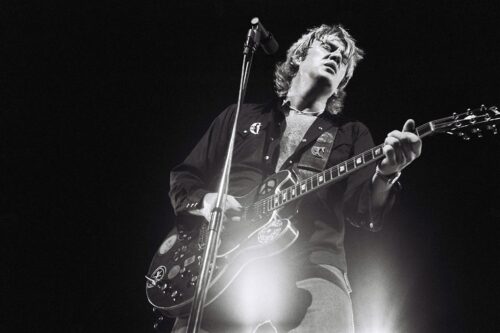
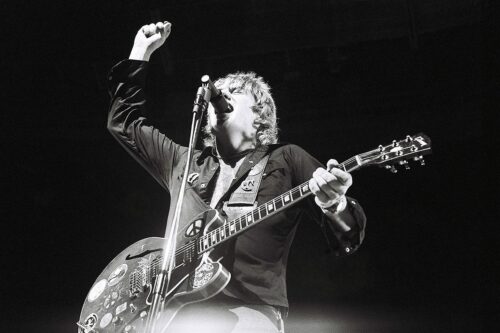
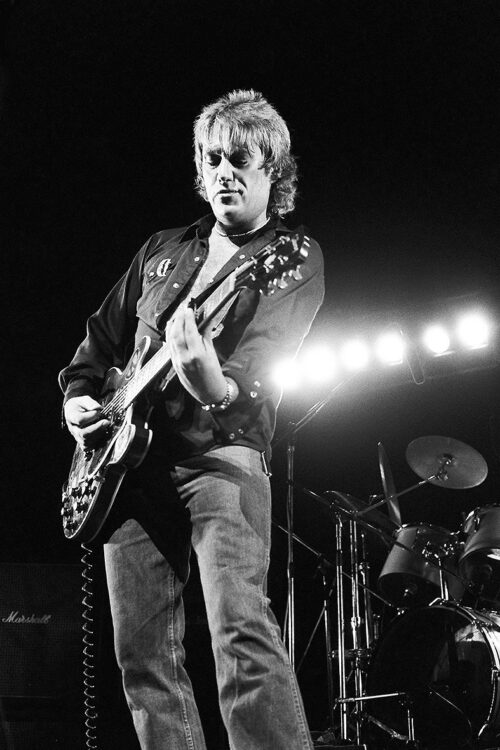
Photos by Ferenc Kalmandy
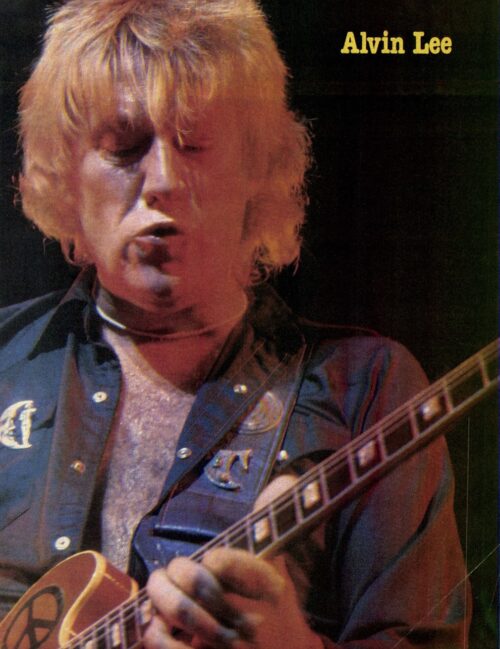
published in Világ Ifjúsága magazine (Hungary)
January 1983 – Yugoslavia

Photos Zoran Trbovič
Interview by David Sinclair — February 1983
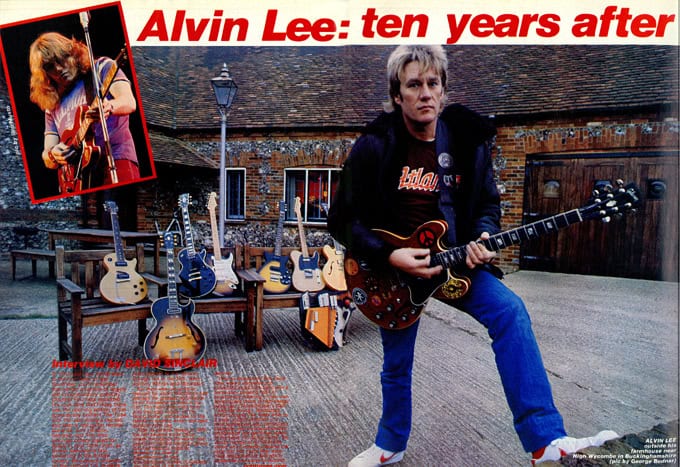
If you cast your minds back to the first week of last November you’ll remember that amidst a fanfare of largely self-congratulatory publicity, Channel Four was launched. For rock fans that Friday there was the opening edition of the sporadically brilliant The Tube with the Jam doing a live set, and later a real guitar hero’s bonanza. Jimi Hendrix, Santana, and The Who amongst others jostled for space in your front room, as British television’s first screening of the Sixties classic, Woodstock unfurled on the nation’s T.V. screens.
Also present at the festival, though not in the film, were Johnny Winter and Leslie West Mountain. But there was one guitarist featured for whom Woodstock had perhaps the greatest significance of all. For eleven minutes in the film, Ten Years After held forth with their epic version of “I’m Going Home” a showcase for the talents of vocalist, writer, and guitarist Alvin Lee.
After its general release in 1970, the film became a box office smash throughout the world, and Alvin Lee found himself leading a group that had become instantly elevated to a level of superstardom. It was simultaneously a peak of success, and the start of the group’s decline.
Prior to Woodstock, Ten Years After were a respected and successful blues / rock band with a particularly pleasing habit of occasionally dabbling in their own personalized brand of high-energy swing jazz, such as – Woody Herman’s “Woodchoppers Ball” and “I May Be Wrong, But I Won’t Be Wrong Always”. Woodstock, whilst bringing Ten Years After to a wider public’s attention in a most spectacular way, particularly Stateside, also disproportionately emphasised one particular aspect of the band. “I’m Going Home,” the climax number of an otherwise varied set of material, became the style that Ten Years After were most recognized for and which audiences now came to demand. A twelve bar Rhythm and Blues shuffle / boogie workout. “I’m Going Home” was notable for the incredible velocity of Lee’s guitar playing. The lyrics were throwaway to say the least, the keyboards inaudible, drums and bass providing a monolithic thump behind Alvin’s awesome Gibson guitar. Notes flew like supersonic laser flashes as whole sequences passed in the blink of an eye, and Alvin Lee stood there stage centre, the quintessence of Rock and Roll cool.
His features looked as if caved from granite, high cheekbones, perfect skin, and sneering down-turned mouth, all framed by a shock of thick blonde hair. He looked like an ideal of Caucasian manhood, eminently photogenic and totally confident in his mastery of his chosen craft, but then, he’d had a fair old while to develop his skill.
Alvin Lee was born in Nottingham, England on December 19, 1944. His father Sam, owned an extensive collection of blues records, and both his parents played the guitar. So there was always an instrument laying around the house. However, young Alvin’s first musical endeavours were pursued on the clarinet, an instrument which his brother-in-law- played.
After a years lessons, Alvin swapped his clarinet for Broadway Plectrum Guitar, and took chord lessons. His earliest influences were the old jazz musicians, Django Reinhardt and Benny Goodman’s guitarist Charlie Christian, but it was Rock and Roll that was starting to percolate through. “I was very into Chuck Berry and Scotty Moore, who was Elvis’s guitar player, and Jerry Lee Lewis, all straight rock and roll. I still like it the best now. I did practice about four hours a day, and when I was eighteen, I hocked myself up to the eyeballs for my first electric guitar, it was a Guy-a-tone with crystal pick-ups. Later on I got a Burns Tri-Sonic which was awful, and then I got a Grimshaw, which was the nearest thing that I could afford to Chuck Berry’s Blonde Gibson. I had that right up until the time that I bought my Gibson ES-335 which I still use today.”
His first group, featured the Guyatone guitar, was Alan Upton and the Jailbreakers. Upton was a Jerry Lee Lewis style pianist, and they played the local pubs on the weekends. Then, in 1964 Alvin teamed up with bassist Leo Lyons, and drummer Pete Evens, to form The JayBirds. Pete Evens was later replaced by Dave Quickmire, and for awhile The Jaybirds featured vocalist Farren Christy. However Christy dropped out just prior to the group going to play for six weeks at the Star Club in Hamburg, Germany.
“The singer dropped out and I just voluntarily became the singer. I was underage at the time, and had to lie my way in, but it was good experience for me. It was like getting a years training crushed into a six week period. Albert Lee was there. Around the corner, playing at “The Top Ten”. He could play the “Hound Dog” solo which had always eluded me, so I introduced myself and got it off”.
By 1967, Alvin Lee and Leo Lyons had teamed up with drummer Ric Lee (who is no relation to Alvin Lee) – along with keyboard player Chick Churchill, to form Ten Years After.
The group came riding in on the crest of the blues boom wave. (Alvin was now in his element) “Thanks in part to my father’s record collection, I suddenly found that I had this great repertoire of blues songs, that previously we could only perform at 3:00 in the morning, when the clubs had emptied out”.
Decca, in an unusual move, signed them to an albums only deal, though singles were subsequently released, most notably their 1970 hit from their album Cricklewood Green, “Love Like A Man”, which reached the top ten in the British charts. Their first album, self titled “Ten Years After” caught the ear of American promoter, Bill Graham, who booked them into his prestigious Fillmore Auditoriums, and they quickly became a major concert attraction in the States. Their albums from 1969 release “Stonedhenge” were consistently strong sellers in their native Britain.
“Underground” was a word that was bandied around at the time, and I quite liked being “underground”. I had been through the situation of wearing satin shirts and what have you, doing a mini-Elvis Presley. And I realized that with the kind of music we played, you don’t have to do that. That was good, because it suited me to just turn up in blue-jeans and a T-Shirt and not have to dress up and have your hair done and things like that”.
Ten Years After were an unpretentious but highly souped up rock ‘n roll unit. Although Leo Lyons, Chick Churchill and Ric Lee were all admirably capable musicians, the band’s principle appeal was in the dirty gritty voice and high speed guitar of Alvin Lee. Emerging as contemporaries of “Cream” (with Eric Clapton) and “The Jimi Hendrix Experience”, Ten Years After were cast firmly in that mold of 1960’s groups that adhered to principles of technical excellence and musical bravado and flash.
Alvin Lee was in those days, an unnervingly fast guitarist, and while he de-emphasises this important aspect now, he was without peer in rock guitar circles. Certainly for sheer speed, Eric Clapton couldn’t have got near him, and it’s very doubtful if even Jimi Hendrix could have matched Alvin in this respect. Check “I Woke Up This Morning” from Ten Years After’s Ssssh album and see for yourself, what I mean.
Alvin says: “We used to sell a hell of a show (put on a hell of a show). Ten Years After were specialist in blowing people (other bands) off the stage, that was our ultimate goal – it wasn’t how well we played, it was how well we went down, as long as people went home, remembering that we played above all else, then that was our motivation. Very unsubtle.”
Actually, a lot of Alvin’s speed as a guitarist derived from his background in jazz where ultra fast tempos are far more commonplace than in rock, and the super-hyper- live approach that Ten Years After utilized in their live shows, energised themselves as well as their audiences.
According to Alvin: “I never tried to be fast, it’s just that when I got on stage, all the numbers sped up, then suddenly the solo came and all of a sudden I’d think, “Hell, I’m not going to be able to handle this”, but I’d just go for it…..” But speed is not everything. The critical backlash was not long in coming and particularly after the Woodstock film was released. Alvin’s playing was branded as “tasteless”, lacking in “finesse” along with “excessive” – “self indulgent” and “all haste and no taste” among other things. It became a received wisdom that Alvin Lee, “the fastest guitar in the west” couldn’t play subtly to save his life. When in point of fact, Alvin Lee is one of the most extremely versatile guitarist capable of playing more styles of music, such as Ragtime, through to Classical and he was understandably and undoubtedly affected by these snide criticisms as indicated by his change musical direction subsequent to Ten Years After.
Woodstock the movie was the watershed in the career of Ten Years After – Alvin states: “It was a big break, but it was the start of the end for the band too. Up till then we had been playing eight to ten thousand seat venues. After the Woodstock movie it changed drastically, almost overnight to playing to 20,000 to 30,000 people every night, and along with that, the quality of the gigs dropped off as well.” That’s when I’m positive that the “Disenchantment” set in. Alvin continues: “When a band is just starting out, in the early years, all you really want to do is fill up your date sheet, to keep working. Then, if and when the band finds some success, you find that your date sheet is now full everyday of the week. You work for maybe a year before you come to the realization that you need some time off, in order to write songs etc. and that’s exactly what happened to Ten Years After.”
Alvin says: ” We just kept working and working and working, then we had to fight just to get three weeks off and the fun went right out of it. We didn’t feel that we were achieving anything particularly, it was just what I came to call “The Travelling Jukebox Syndrome”. This is where you get on stage, plug in and away you go, and do the same as you did the night before.”
Ten Years After did twenty eight American Tours alone. Each one lasting about two months each, and in the end they simply toured themselves out. Call it burn out or total exhaustion, but that’s the fact. Their last official album release as a band, came in 1974 with “Positive Vibrations” and the vibrations were no where near positive at this point. In fact, the band had already split up long before this album was released – although it was never officially announced in that way, the band just stopped, and in an interview Alvin just said, that it was over, Ten Years After ceased to exist any longer.
Alvin embarked on his solo career, in a direct attempt to shake off some of the “No Subtlety” comments.
Alvin continues: ” Some of the criticisms about me being all flash and no taste affected me personally, but I was pushing that side of it for a long while, and then I started to back off a bit and I went through that whole psychological thing of thinking, “I must do something more tasteful just to prove it”. But overall it didn’t do me much good in the long run, all it did was confuse the audiences.”
Thus a collaboration with Mylon Le-Fevre began that yielded an album called: “On The Road To Freedom” released in 1973, which established a more tasteful tone, that continued on through three albums during this period. For live work, Alvin formed a nine piece touring band: “I did a very tasty set, that worked out very nice in clubs, but put that into big arenas and it was frustrating to me, because halfway through the set, and although I’d gone off doing the unsubtle stuff, I suddenly felt that the audience was wanting some real grating rock ‘n roll. But the way that the band and the equipment were set up, we really couldn’t deliver grating rock. I was going through the fifteen watt WEM only, miked up and coming through the monitors – it’s a totally different feel to having four cabinets behind you.”
Alvin was grappling with the problem that faced all of the sixties guitar-axe heroes: how to move forward into the seventies without disappointing audiences who know you for one particular body of work, that’s rooted in the sixties. “Through that period I came back to my roots, one of the reasons for that was because I went to see Jerry Lee Lewis in Birmingham, and at the time he was playing only country songs, I came out of that concert feeling really disappointed, because he didn’t do “Whole Lotta Shakin'” and “Great Balls Of Fire”, and it occurred to me that if people come to see me, and I don’t do “I’m Going Home” and “Good Morning Little Schoolgirl” then maybe they would feel that way too.”
The combination of this thinking and pressure from R.S.O. records with whom he got a record deal in the States, led to the new formation of “Ten Years Later”. Comprising of : Tom Compton on drums, Mick Hawksworth on bass guitar, and Bernie Clarke on keyboards, they cut two albums: “Rocket Fuel” 1978 and “Ride On” in 1979. It was the start of a frustrating period for Alvin Lee, where the output had been dictated more by the record company demands than by his own artistic requirements.
“Ten Years Later was actually a joke name, it didn’t last very long. I thought that “Rocket Fuel” was quite good, and I thought “Ride On” wasn’t. That’s my personal opinion. There’s not many people that agree with what I think, even the people who follow it closely. R.S.O. specifically wanted a rock band. They particularly wanted us to play heavy rock, and so we moved towards that, but it didn’t happen the way they wanted it to, and we weren’t enjoying it that much.”
Since then, he has released two more solo albums, teamed up for six months with Mick Taylor with whom he toured in Europe and the States, and is currently working on material for a new album. He’s down to a three piece “Alvin Lee Band” for touring, comprising of: Fuzzy Samuels on bass and Tom Compton on drums, both of whom are featured on his most recent album release “RX5”. I talked to him in a sumptuously well appointed flat located near Holland Park.
Thirteen years after Woodstock, and approaching his 38th birthday, his face is lined, and he has put on weight, he remains courteous and dignified master guitarist.
What’s your view in 1982 about that Woodstock appearance? “Actually I saw it only the other day on Channel 4 and to be quite honest, I was getting really worried before my bit came up, because I was thinking, “now I’m going to watch this and I’m going to think, where have I gone since then?” musically. Often in moments of doubt, and everyone has moments of doubt, I used to think, “I’ve done my best gig somewhere in Cleveland or, I don’t know when it was, but I probably played as best I’ll ever play”. And I was quite relieved afterwards, because actually I didn’t play that well!!! The energy was good, but I did a few horrible things that I’d never do now. In fact, I’ve improved quite considerably, so I didn’t feel as bad as I thought I would.” Do you think that your best gig’s still ahead of you? “Hopefully, hopefully”. I always thought that Ten Years After had a bit of a problem getting that energy across on record sometimes.
“Yeah – we never cracked that, we never got the energy in the studio that we got live. To me there’s a whole different attitude to playing live, as opposed to playing in the recording studio.”
“Even when we’re recording live, I don’t think about the recording. I play the gig, I play to the people. I show off a bit, I go for things that I might not get, on the off chance that I might get them, and often when you’re that confident you do get them.”
“That’s where the new licks come from, those bravado tries, and in the studio I kind of go safe. You start constructing the number and it gets more subtle, and I think what Ten Years After had live was very unsubtle, and no matter how we tried in the studio, we just couldn’t get it to have that rawness. Of course a lot of it is more than sound at a gig, a lot of it is the environment – the feedback that you get from the audience. If you do something a bit outrageous and the audience loves it, it encourages you to be more outrageous. There’s no such encouragement like that happening in the studio.”
How much were you influenced by Eric Clapton and Jimi Hendrix?
“Well I wasn’t terribly influenced as far as what I actually played, but what did influence me was the effects of the way Hendrix played, and the area in which they played, gave me a good idea as to what I could get away with. I never tried to play like them, but I could play in that vein, with no problem.
Jimi Hendrix, to me personally, was an innovator. When I first heard him I didn’t know where he’s come from; the closest that I could figure, was like a psychedelic version of John Lee Hooker. After hearing Hendrix and getting into him, then I’d suddenly go into an extra long, sustained distortion bit, and really his music gave me the idea and the freedom to do that. I’d probably have not done that before I heard him.”
Eric Clapton:
“I think that I borrowed his vibrato technique; I used to vibrato very fast, and Eric used to do it so much slower, and I used to think “now, how can he do a really hot lick and then go right into that vibrato at the end of it ? But I liked it. With Eric, it’s easy to see his roots, you could look into all the Kings – Freddy King – Albert King and B.B.King and the old bluesers and things and I knew lot of it anyway.”
“I think you take a bit from everybody you hear. It all mucks in – into one thing; sometimes I hear a guitarist that nobody’s ever heard of, then or since, and you can learn something off of them too. Everybody who picks up a guitar plays something different, usually the first thing you do, you just fiddle around, just to get the feel of the instrument. Those fiddles are often the basis of their style patterns. Not reading music you see, I work in patterns and a new pattern, is a good thing to fall across. I find fewer and fewer the more I play. They get less and less. There are still hundreds.”
What advice would you give to an aspiring young guitarist, who is very anxious to achieve your kind of speed ?
“Well the speed just came from all that energy. I mean I’m not really that fast, guitarist Jazzers play much faster than me, but they ply smoothly, so it just doesn’t come across as fast. My so called fast runs are very staccato and they come out like jarring machine gun bullets, whereas a jazzer will use a smooth bloopey sound. I hit every note with attack, and I play with a lot of aggression: I think it’s more that than speed. I’ve found the way to practice is when you get new lines and new licks is to work them really slow and repeat them over and over again. If you can do three or four hours a day of that they get faster without you even realizing it”.
Do you still use the same Gibson ES-335 with all the stickers on it ? (Known Affectionately As “Big Red”)
Yeah, I bought it for 45 pounds actually, in Nottingham, with case. It was quite a good investment. It’s had a new neck. I broke the neck at the Marquee. It’s very small headroom there, and I got carried away with the old guitar, and chopped the top off. I had to send it away to Gibson, they kept the old head with the serial number on it, and spliced a new neck on it. They also re-sprayed right over the body, and I had all the stickers on, which is why they’re still there today. They’re kind of cellulosed over. It’s a dotted neck. I’ve got an additional Fender pick up on which I mainly use in the studio, and those TP-6 turnable tailpieces – I like those, they’re great, you don’t have to take your hand off to tune up. Apart from that, it’s a pretty regular one. It’s a bit of a good one.. I think it’s a 1958 model actually.”
Now do you have the action set on it ?
“Pretty high and hard. The original teacher that I had did a lot of Django tape stuff, so I got hard finger pads pretty early. I use a 54 on the bass end. because I like to hit open E’s a lot and if you have them much lighter than that, I find they ring sharp at first, so I have a very heavy bottom and a comparatively light on the top. For example: From the bottom up it’s – 54. – 44. – 28.- 15.- 12. and 9.
And Guitar Pick ?
“I use three cornered ones. I got about 12 gross of them in New York one time. With the side scrubbing I wear them out quite a bit. With the side scrubbing technique, I can turn it around and get three times the use, a very hard pick.
What amplification do you use ?
“I’ve got a Marshall 50, an old one, a small flashy one and I’ve got four outputs on it and I use four cabinets. I’ve always used that, it’s great. I’ve found that the 100 is just a bit to middley. While the 220’s are totally useless: One time I had the guys from Marshall come down, I really wanted to find out exactly why my 50 was so much better than the brand new Marshall 50’s. – and they said, it shouldn’t be any different, and they got out the old dentist’s mirror, they looked in the back, and the guy said, “Oh, this must be an old one, because they didn’t have these when I’ve been working here”. He’d found a component. I said, “Whatever it is, stick it on all of them”, and it seemed to do the trick actually.
“Also I power the valves a lot. Hell of a lot of bias on the valves, so I change the valves once a week on the road; but that gives you that high sustain. In the studio I’ve got a 15 watt WEM with one Celestion which sounds just like a stack of Marshalls milked up, they’re actually a bit better for recording”.
What sort of volume setting do you put that on ?
“Three quarters to full, I find that the Marshall 50 watts practically flat out, that’s the best sound. If you turn it down, it gets a bit dry”.
Do you have any pedals or use any other effects ?
“No, I always avoid those. I like a strong lead, that also gives me the level I need. I sometimes use effects in the studio, but I don’t put them between the guitar and the amplifier: I put them after. I do like reading about all these effects boxes. Makes me laugh; I’m so glad I don’t have any. How on earth musicians choose nowadays. You open those books and there’s 80 guitars and 300 foot pedals to choose from. It was Gibson or Fender when I started, it was quite easy to choose, if you could afford it”.
What Acoustic guitars do you have in your collection ?
“I’ve got a Martin and a Yamaha, not the most expensive Yamaha, but it’s got a turn-able bridge so I can use a wire third if I want. My favourite one is the cheapest Yamaha in their price range, with gut strings on it. That’s the one I pick up and fiddle with all the while”.
Do you use any unusual tuning at all ?
“No, very seldom do. I just mess around with them, but I don’t actually use them. I play bottle-neck in standard tuning. I’m not a great bottle-neck player”.
What do you use for a bottle-neck ?
“A torque wrench thing off of a plug spanner. A very heavy one. It’s Lowell George’s idea. I got it from him.”
Are you a guitar collector ?
“Semi, semi. What I do is, if I do a tour of America, I get a guitar when I get there and use it at the hotel and then it enters the collection. I’ve got about 40 guitars. I usually buy novel guitars. I’ve got three favourite guitars which I keep strung: the rest tend to get stuck into boxes and end up with rusty strings. I think you’re well if you can keep three guitars in good playing condition.”
It’s very often overlooked, that as well as being a guitarist, you’re also a singer.
“Well, I often overlook it too actually. I don’t really think about it much, I’m more of a shouter than a singer. I don’t profess to have much of a voice, but I think half of it is the effect of singing and playing the guitar. With my Chuck Berry upbringing, you phrase differently, you phrase a vocal lick and then you answer it with a guitar lick. I think that’s a quite natural sounding way of doing it. I also do the odd session, with people where I put a guitar solo on, and I usually play all over the vocals, if I’m not singing it. I try to make the vocals as good as possible, but I’m no Paul Rogers, and I never will be.”
What’s your view of these bands like “The Who” and “The Rolling Stones” who are still pressing on after all these years ?
“Well, I think it’s nice for us, the listeners as it were: there was a lot of pressure for me to keep Ten Years After together from the business side of things, but I knew that it wouldn’t work.. I could feel from the other guys, that there was no pulling in one direction, and the managers wanted me to, if I wanted to change, they wanted me to keep the Ten Years After name. Business wise, and looking back, that would have been good for me to do for the money, but not for the others in the band. For me it just didn’t seem right. Ten Years After was the four of us, and if I was going to change the musicians, I’d call it something else.”
How democratic or otherwise was Ten Years After ?
“It was very democratic. It was an equal band all the way down the line, and with any democratic band like that, because I was the lead guitar, and singer, I got more spotlight, I got to do more interviews which I really didn’t want to do actually. I was keen to spread the load, but with that also came a little bit of bad taste from the other boys in the band, which caused a little bit of friction”.
You also wrote and handled most of the production !
“Yeah, right, and people used to say to me – “You’re Ten Years After;” and I’d say, “I’m not”. I didn’t really want to be. I didn’t want to take all the blame to be honest.”
What are the other guys doing now ?
“Leo Lyons is producing, he’s got a studio in Oxfordshire, and he’s doing pretty good. Good producer actually. He did some time at Wessex studios; he knows his onions (Business). I’m still in touch with Leo, I go down and play him my tunes and things. Ric Lee was playing in Stan Webb’s Chicken Shack, but he’s doing managing now; I think that’s taken over from his playing more. Chick Churchill, is not in the music business anymore unfortunately. I don’t know if that’s terminal or not. He’s got into music publishing a bit”.
Can we talk a bit about your recent activities; since Ten Years Later you’ve been working solo.
“Ever since 1979-1980 I’ve found myself up until last Christmas being pressured into making albums all the while, when I haven’t really got enough fresh ideas and that’s a trap. As much as I’d like to think of myself as a musician above being a rock star or whatever you’d like to call it, when people are waving money in front of your nose and they want an album, you tend to get it done whether you think you’re ready or not. “I’ve been doing that and the last two albums I did. I didn’t even have enough songs to dare start. I got three songs for the last album – called RX5 – and I only thought two of them were any good anyway, so it’s just a matter of getting enough tracks down to make an album.”
Isn’t that a rather cynical way of doing it ?
“Oh it’s terrible. It’s just the way things were, where I was at the time and everything else, but I have stopped it now. I realize if I’m going to keep on making albums that I can’t even——I mean people used to ask me about RX5 – and I used to say, “I hate it, all of it. It’s ridiculous you know, because people who buy albums or even get them free, when they hear that, to them that’s everything I stand for and do at the time, and it’s too important just to go bumming them out.
So for the next nine months I’ve been writing pretty solid. I’ve got a target not a deadline to start recording in February. But I’m certainly not going to release anything or let anything out until I’m really happy with it. I can’t hope for an album to be successful if I don’t like it, and if it was it would be silly, because I’d have to make another one like it then.”
“So, I’ve been delving back into my roots and writing new stuff, old stuff…..and just a lot of writing. Playing more for my own pleasure, more than I’ve done in awhile.”
Alvin, I noticed at a previous meeting, where liberal supplies of alcohol were available, that you were very careful not to drink….any reason for this ?
“I never used to drink, and then I did start for awhile, and like most things, I went over the top for awhile, and then I just cut it out altogether. It didn’t really suit me, being an old hippie. I’ve never been a serious drinker, but I did start getting into playing poker with a bottle of scotch, that was with Steve Gould and Mickey Feat actually, not putting them down, they’re wonderful guys. I didn’t have to join in.”
“I’ve put on a lot of weight as well, and it was just generally no good for my health. I had a good clean out….I was going down the old Elvis road at one time, getting very puffy and doing lots of other things that I shouldn’t have been doing. But fortunately, I saw the light, and I saw myself before it was too late.”
Do you have a recording contract at the present time Alvin ?
“No, as a matter of fact I don’t at the moment. I’m looking for a new one right at this very moment, but I do have an option with Atlantic in the States, they’ve got first choice as it were.”
Are you going to do any gigs in Britain ?
“I haven’t done any for a long while. I don’t do much in England. Ten Years After never did that much in England, and the last time I tried it, there was very poor attendance anyway. So that has kind of put me off trying, although I’d love to. I wouldn’t mind playing the Marquee again actually, just to see if it’s anything like it used to be. I’ve played the Odeon. Hammersmith a couple of times, a token English gig, but there seems more interest abroad.
Possibly because when Ten Years After were kind of hitting it, I preferred not to. Well the whole band preferred to kind of keep a low profile in England, because we lived there, you know what I mean ? It’s great going over and being a rock star in America, but when you get home it’s also as nice to be able to walk the streets without having any problems. The main reason really why I’ve always been a musician is that I can’t do anything else. I don’t have a proper trade you see”.
It’s certainly been a reasonable trade so far hasn’t it Alvin ?
“Yes, but my attitude has always been that a musician’s only security is that you can sing for your supper. If you can make ten pounds down at the local pub, then you can eat. That’s really all you can count on, you can’t count on thousands of pounds and being successful. A lot of that’s fashion, waves of fashion. You can catch a wave and then lose a wave, and then you have to go back and catch another one.
The working for your supper theory keeps you more level headed. I’m certainly not afraid to get up at the “Red Lion” and do a bit – quite enjoyable sometimes, things like that. You lose the tension; put your beer on the amplifier, and turn your back to the audience occasionally – it does a musician a world of good to not have to take his profession so seriously.
But there again, even when I get up and jam, I like to deliver something; I wouldn’t like to get up and jam on a bad guitar, that I can’t play because I ……….somebody’s going to remember it. You’ve got to deliver something – and make people think about it when they go home”.
March 2, 1983 – Hulla-Baloo, Rensselaer, New York


A rare find, never seen before… many thanks to Bruce Hodges for the ticket stub
The Venue in Hell
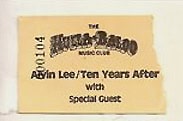
The Alvin Lee Band is just across the Hudson River from Albany, New York, at a place called The Hullabaloo.
On the good side of town in Troy you have the Rensselaer Polytechnic Insitute situated inside a plush neighborhood of historic value and full of quarter of a million dollar houses on every street, but where Alvin is playing tonight is the railway station, the whores, and every practicing alcoholic, drug dealer and criminal in our tri county area. If Alvin had a craving for any of these things or underworld activity he’s come to the right place.
This part of Rensselaer reminds me of any movie by Boris Karloff, Alfred Hitchcock and Christopher Lee all rolled into one, every twist of evil, fate and horror can happen here at any moment.This place reeks of murder, mayhem and disaster.
Alvin’s song “The Devil’s Screaming” ain’t got nothin’ on this sewer and Charlie Daniels Devil stands a better chance in Georgia than in this God-forsaken toilet of a town and this is just the parking lot!
You would think that we’d feel a little safer inside the building but it was just as bad if not worse. The only thing that saved us from turning around and going back across the river as fast as possible were two things, first my desire to see Alvin Lee play that big red Gibson guitar of his, up close and personal and second my not telling the others, that I had convinced to come with me, the truth, that I was scared shit-less!
I keep reassuring them (and myself) by saying “ah, you’re with me nothing bad can happen to you here, I’ll protect you, you’re in good hands, we’re here to have a good time, relax”. It’s a tough act when you also have to preface it with, forget about that dried blood on the freak-in wall, and that real dried up human eyeball that someone neglected to sweep up off the floor from the last slaughter that took place in here. I felt like the Wizard of Oz in Hell, pay no attention to the hairs standing up on the back of your neck and arms, or your heart beating twice as fast as normal, your desire to puke is all in your head, stop worrying will you.
I knew all about what I was getting into before I even left the house, I put on my heavy police issue motorcycle jacket that weighs in at the better part of ten pounds and prepared myself for any conflict that might arise during the evening. It would’ve been a much different story had I not brought my little sister and her husband with me, this just increased the level of stress and danger ten fold.
The Venue is a Barn:
No this isn’t a continuation of what a Hell Hole this place was, you got the background and feeling correct already, I mean it really is or was a real barn at some point. The old cow or horse stalls are now used for seating and you have to walk up a ramp to get there just like the cattle did, once upon a time. At the top of the ramp is a landing, we take a left and walk about fifty feet and we’re now looking down at the stage which is no more than ten to fifteen feet away and we sit at the table that’s in prime view.
Wood floors, ceiling and heavy wooden beams for support all over the place and it reminds me of Alvin’s own barn that he calls Space Studios back in England, from the photos I saw inside the On the Road to Freedom album. Now my mind and emotions are changing course like quicksilver, from fear and hyper awareness for our safety to “hey we’re really here, we made it” and Alvin is only a short time and distance away.
The only point that I’m not really sure about is Alvin’s tour bus, because my memory is fuzzy about whether it was along side the building when we got there or it was there a short while later.
The opening act The Lazers:
A friend of mine knew one of the band members and told me that this band was going places, they were going to be huge (not by way of this pig sty in Rennselaer, as far as I was concerned).
The band comes on, they’re out to make a point, they’re rough and tough and they all want to be stars. I believe they thought they were at Madison Square Garden opening up for Aerosmith or some such thing. The lead singer started spitting on the amps, and blowing snot all over the place (maybe a little cocaine back stage) who knows, who cares, we’re all there to see The Alvin Lee Band, to Hell with these people, since when does Alvin Lee need a warm up act?
Three songs into the Lazers’ set and the people in front of the stage are getting more restless by the minute and in-between songs the audience starts in with “Alvin, Alvin, Alvin” to which the response from the lead singer is “who gives a “F” about some has-been-once-was guitar player from some old band, we’re what’s happening right now” basically saying “look at us, ain’t we cool, we’re hot!” Not a chance pin head, you’re outta–here–gone–history! As I said three songs into their set and the audience is already bored and revolting in no uncertain terms. A hot exchange ensued between the band and the audience. I grabbed for my leather jacket once again and back into defense mode I headed.
The men on the stage started saying FU to the audience and the same FU was coming back to the band in spades, switch-blades and guns would be next and I’m thinking about protecting my little sister and nothing besides.
The band got pissed off and left the stage an hour early and the audience erupted with savage elation over this victory. Now I myself was in an emotional void between feeling sorry for the warm up band which were really very good but so arrogant as to need a damn good wacking and this crowd of savages who were craving blood, chaos and violence just to satisfy their need for primal recreation and lust. A Roman Wilderness of lions and Christians and at this point I can’t tell who is who any longer and I really believe if all Hell breaks loose I’m sure the police won’t make any effort to come here until the cold light of day or better yet noon time tomorrow. We’re on a dead end road in more ways than one and once again I’m reminded that we’re stranded and completely on our own, there is no excitement in this kind of fear and unrest and these natives are hunting heads.
Where’s Alvin:
The warm up band is long since gone and the pressure is rising and rising, not just in anticipation of the Gibson Guitar Wizard, but because you can tell by the age of this AC/DC crowd they just want action and the name Alvin Lee doesn’t mean shit to a tree here. I would venture to say maybe fifty people know of Ten Years After’s music, fifty have heard his name somewhere and the rest are just taking up space. In a total audience of two hundred people there is nothing to be gained here and I just hope this audience doesn’t turn ugly on our hero or we’re all going to get hurt before we get out of here.
It’s now been over an hour and this barn is now a Miami pressure cooker, like waiting for Jim Morrison and the Doors back when all Hell broke loose there.
So where is Alvin? I don’t have a clue, maybe he’s waiting for the money to come down, having a drink or three, having a little taste of some stash from one of the local dealers, doing an interview, or maybe keeping company with one of Rensselear’s finest street walkers. All speculation and everything that crossed my mind in this very uncomfortable and long wait. There is a point when anticipation turns directly into agony and that’s where we’re at right now and everyone is pissed-off to the maximum.
The Concert:
I don’t remember anyone introducing Alvin, all I recall is him lumbering out on stage acting very guilty and with a look of attitude on his face that said “I’m sorry but I’ll make it up to all of you right now I promise.”
At one time I had a list of all the songs he played on this night, but it has long since disappeared, but I can tell you he played about thirty songs. Thirty songs one after the other with no break in between, no sitting down, no half assed rush through and he did it all, for the better part of two hours on that barn floor stage. No false pretense, no acting the part of the star, no arrogance to be found, just the real Alvin singing and having a great time. At one point he leaned over the edge of the stage to shake the sweat off of his head and onto the teenage girls down below and he threw a guitar pick in their direction but other than that it was all straight ahead Rock and Roll Blues flat out and full force.
The long wait for him to take the stage took us all about four songs before he was truly forgiven and this locomotive was off and rolling on true Alvin Lee steam, desire and passion. What ever happened backstage or in his tour bus no longer mattered to any of us, we were rocking and rolling along.
Harmonica, a little drum stick action on his guitar but again nothing fancy or phoney. Alvin was on fire and on this night he was hitting on every spark plug. In between one song he said “is this better than MTV or what?” Of course I understood what he meant, a live performance is always better than an idiot box TV set any day of the week but I was thinking beyond his quick comment and felt sorry that Alvin may be locked into a time zone that no longer provides any realistic promise for his career and that’s why my hero has been so overlooked for so long. I thought one video on MTV from Alvin Lee would put him and Ten Years After back into the record bins for all time, never to be forgotten again, but right now Alvin appeared to be stuck.
On this tour was a drummer (of course), if it was Tom Compton, I hope I would’ve remembered but I have no idea who he was and nothing was memorable. It was the bass player who was the one to keep up with Alvin and share the same spotlight—his name is Calvin “Fuzzy” Samuels!!! That man is “F-in” crazy and not since Leo Lyons has anyone come close to beating up a bass guitar like that or been able to push Alvin along into new areas of music or to new heights. Just incredible.
Imagine attending a concert such as this. Alvin did everything except cook a midnight snack and tuck us all in for the night.
Encore:
The encore was obligatory, in the sense that Alvin gave it his all the first time around and there was no need what’s so ever for him to return to the stage due to any obligation that wasn’t already met in that two hour span. I personally clapped my hands raw in appreciation only, and not trying to persuade him to come back to give us more. We didn’t deserve more because he owed us nothing. In fact if I were him I would have grabbed the nearest chair come back out on stage, sat down and just soaked in all the love and respect that was in the air. Alvin not only earned it – he deserved it as well, that’s why I loved the man and his great talent, on this night he made me happy and proud to be in the same room with him.
Time To Go Home:
We were the first ones there and the last ones to leave.
The parking lot was now as vacant as a cementary and Alvin and his bus long since gone on to other venues, rolling on through the night.
This venue is the place where “shadows really do run from themselves” as the song by Cream goes and I’m more than happy to be getting out of this place, if it’s the last thing we ever do, sings Eric Burdon in my musical mind.
My little sister finally got to see for herself the Alvin Lee part of Ten Years After, having had to listen to his music for five years straight as her bedroom was right next to mine. Her husband liked the show but is still a big fan of Nils Lofgren, all in all it was one incredible evening never to be forgotten.
Thank you Alvin, I was spellbound, elated and enthralled beyond words to watch you do what you do, and do it better than anyone else.
Review by David Willey
A Second Opinion:
But the place I really wanted to mention is the Hullabaloo in deepest, darkest Rensselaer. This place had The Police, not once, but twice on their way up. They also presented The Talking Heads, Joe Jackson, The Boomtown Rats, Pere Ubu, The Dictators, The Dead Boys, King Crimson, Dire Straights, The Roches, Kasim Sultan and a ton of other great acts from the late 70s and early 80s. They didn’t catch on to the fact that new wavers wanted to dance, so they would put tables right up to the stage and sell tickets for each table, like the Van Dyck does now. When I saw The Police on their second visit I had a table right under Sting!
J. Martin
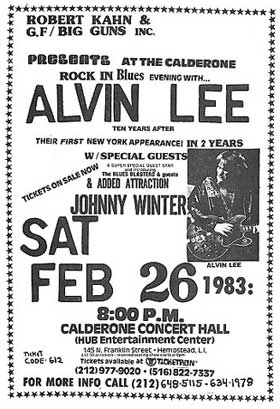
Hudson Valley Newsbeat
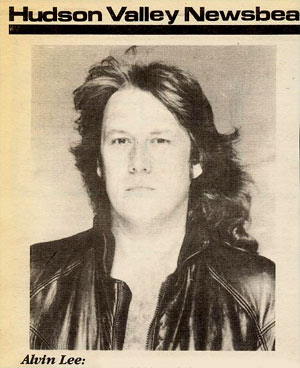
FROM MARCH 16, 1983 “THE CHANCE” (Venue) in POUGHKEEPSIE, NEW YORK
ALVIN LEE: GUITAR SAINT IN A SYN-FILLED WORLD
Most years, the tail end of February is seriously dreary. The snow on the ground has taken on a West Point grey hue, the temperatures shoot from near 50 down to the low teens, and everybody has a cold. The last week of February 1983, though, brought us Koo Stark’s left nipple in Time Magazine, the astoundingly funny team of Andy Kaufman and Fearless Freddie Blassie on David Letterman and Alvin Lee’s blistering performance at the Chance in Poughkeepsie. With his old red axe and the latest stripped down version of Ten Years After, Alvin Lee has given an awful lot of straight ahead rock fans at least a brief respite from those anguished prayers at night…”Now I lay me down to sleep, O Lord our God whither goest Rock?
From the moment that Lee walked onstage and sang the first line, “One of these days…,” the crowd at both sets roared. People in chairs leaned forward and tapped their feet. Those caught standing boogied and air guitarist filled the club. Why? The man has never had an album that everybody in the junior class had to buy, and nine times out of ten, when radio stations get a Ten Years After request, the jocks will spin the Woodstock soundtrack version of Lee’s “Goin’ Home.” So how can this pleasant, plain spoken Englishman who dresses like Joe fan inspire such happy lunacy? The answer lies, I believe, in the lines from “Rock n’ Roll Music To The World”; I tell the truth / I ain’t no star / I only shout / and leave the rest to my guitar…
Just what does he leave to his guitar? Every classic hook in rock – Carl Perkins, Leiber and Stroller, Jerry Lee Lewis, bridged by those fantastic runs that made Lee famous. I caught up with Alvin between sets, to try to find out a little bit about the man behind the fingers that reeled off “Something Like That,” “Goin’ Home” (of course), and a version of “Hey Joe” that, after the initial cheers and whistles, produced a short audience wide gasp of awe; a millisecond vision of Heaven and Hendrix. Alvin Lee belongs to a simpler, braver era of rock, when every new lick was a New Discovery, a flag on Everest. In light of all the trends that seem to originate in England, like ska, the reggae revival, the synth bands, and rockabilly a la Stray Cats, I especially wanted to know if anybody was playing the blues anymore. His answer was tinged with disappointment. “Well…some are playing, but it’s not catching on. People aren’t content with being musicians anymore. They want to be rock stars. They’re afraid if they don’t have purple hair, or act outrageous, they won’t get noticed.” I asked him if perhaps there might be a resurgence of basic, solid rock in the offing, what with Eric Clapton’s new “Money and Cigarettes” release, and Jeff Beck’s working on an album, and Jimmy Page is getting back to work. “People ask me all the time, “Are you making a comeback?”, and I haven’t been anywhere. I mean, I’ve been playing all the while,” Lee said. I said, “You’d think that they’d be banking on the old masters, with the record industry in so much trouble,” and Alvin cut me off in mid sentence, and said “I think it’s good the record industry’s in trouble. “He did not offer to explain the statement, and I felt there was no need to. In an industry obsessed with the Grails of Trendy Sounds, Marketable Concepts, and Super-Groups, there doesn’t seem to be much room for a man who wants to play small clubs because the people are closer. I asked him if he enjoyed playing at “The Chance”. “Well yeah,” he said, “except for those tables down in front. I saw all these people on the sides going wild, and right there in front, everyone was sitting. I want people right there in front of the stage, the closer the better.” The tables were gone for the second set, and the floor area was packed, which makes me believe that everyone went home happy. Even Alvin Lee.
Exciting as was Lee’s playing , it would have been incomplete without the two members of Ten Years After, (he of course means Ten Years Later) drummer Tom Compton and bassist Fuzzy Samuels. They are ultra tight, and combined a steady discipline and a joyous abandon that I haven’t seen since the Grambling band did that Coke Commercial.
Alvin Lee was warmed up by “Enola Gay” a three piece band from New York City, whose biggest asset was the guitarist’s haircut (first runner up for Best Keith Richards for the month of February. The original Enola Gay was the B-29 that dropped the bomb on Hiroshima. Need I say more?
March 13, 1983 – Park West, Chicago, IL
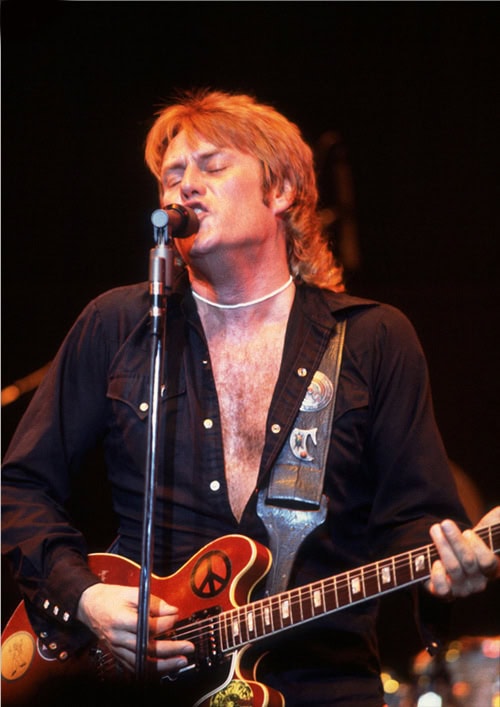
Photo Paul Natkin
May 13, 1983 – Metropol, Berlin

photo Holger Rabe
July 1-2, 1983 – Ten Years After Revival – Marquee, London
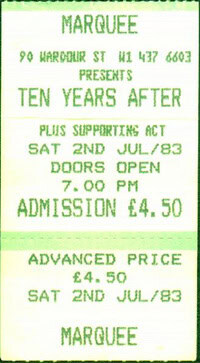
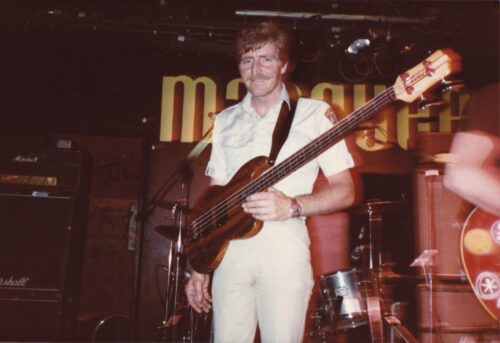
Soundcheck – photo by Luky Schrempf
Ten Years After reform with their original line-up for one night at London’s Marquee on July 2, 1983
It’s the latest of the Marquee’s Silver Jubilee reunions and brings back together:
Alvin Lee – Leo Lyons – Ric Lee and Chick Churchill.
And if you don’t get at least a twenty minute version of “Going Home” the News Page reckons you should get a refund on your ticket.

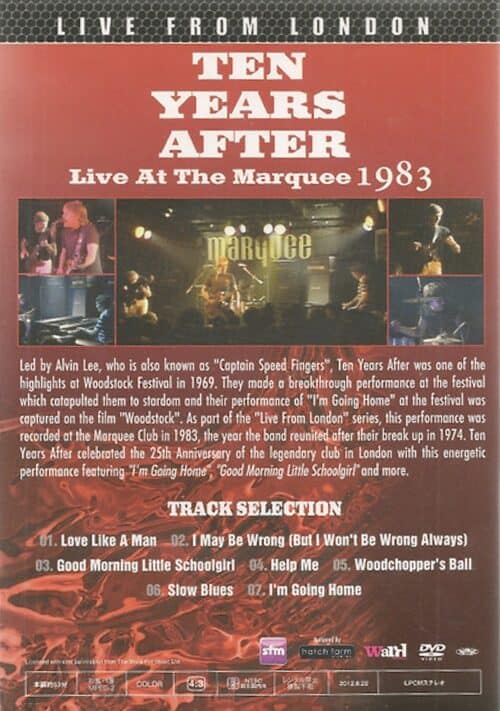
DVD Japan edition
Ten Years After – Live At The Marquee – Metal Hammer Magazine
By Pippa Lang
This video (now available on DVD) contains classic footage of Ten Years After performing live at the Silver Anniversary Celebration of the famous Marquee Club. This video / DVD will remind doubters that Alvin Lee, Chick Churchill, Leo Lyons and Ric Lee really were a major instigator of Hard Rock Music. Remember Alvin Lee beating the hell out of his guitar for “Going Home” at Woodstock? Real Rock in 1969! No, I wasn’t there, but I saw the video!
Though the band’s add little jazzy habits never really did them justice – “I May Be Wrong But I Won’t Be Wrong Always” ain’t ma cuppa tea at all – the classic legendary rock ‘n roll of “Good Morning Little Schoolgirl” and “Going Home” (Sensibly saved until the end) are proof enough of the band’s influential role in rock ‘n roll history.
The band always sweated profusely for their art, even as comparatively late as 1983, when this video was shot. Leo Lyons, in particular, throws himself into fits of frenzy, Alvin remaining more god-like and civilised about his emotional throes. Never a bum note, Alvin seems to have a magical coalition with the guitar he partnered at Woodstock – here it is still, with the same peace and cannabis-leaf stickers! He must have varnished over them long ago to keep them in pristine condition!
So there are the don’t-mess-with-me-mutherfuckers rock ‘n rollers, the strange jazz jams and, oooh yeah baby, the Blooooz – “Help Me” and “Slow Blues In C” – Help Me carries the audience along to its mighty blood-sweating climax, with Alvin dabbing at his strings with one of Ric Lee’s drum sticks at one point. “Help Me!” He cries plaintively – but I hardly think he needs any help at all. No other British band can hold court with a Blues number so successfully – a spellbound Marquee crowd can hardly believe their ears and eyes.
Through the spontaneity – filled Jazz-Rock of “Woodchoppers Ball” the horrendously wonderful and painstakingly horny “Slow Blues In C” which boast some of the juiciest keyboard-playing ever, to the grand finale: “Going Home” one of the truly classic songs of the “Woodstock Generation” with a vast number of today’s up-and-coming guitarists still trying to learn to play it as effectively as Alvin Lee does….but no chance. This is a classic video / DVD for Ten Years After buffs, and those who are earnestly interested in learning where British Metal’s roots really lie……

orig. VHS
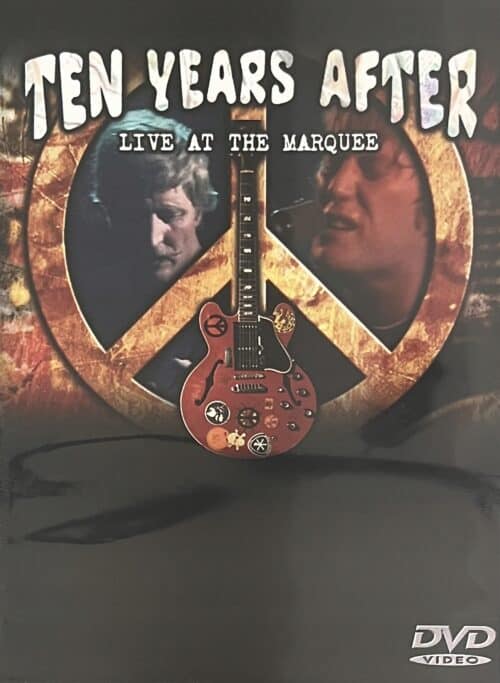
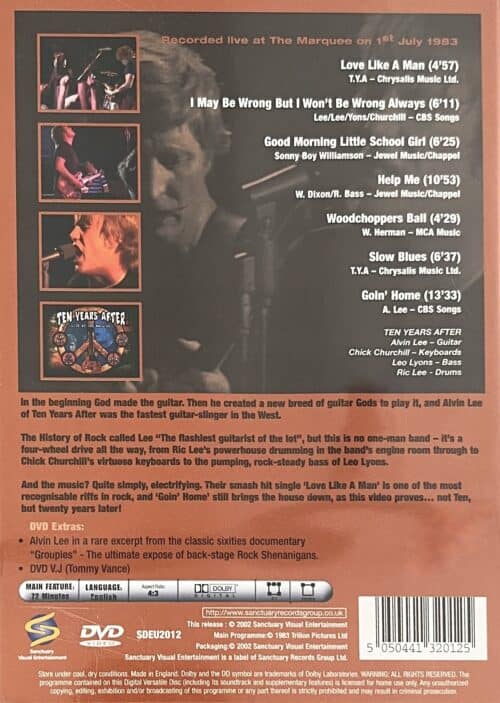
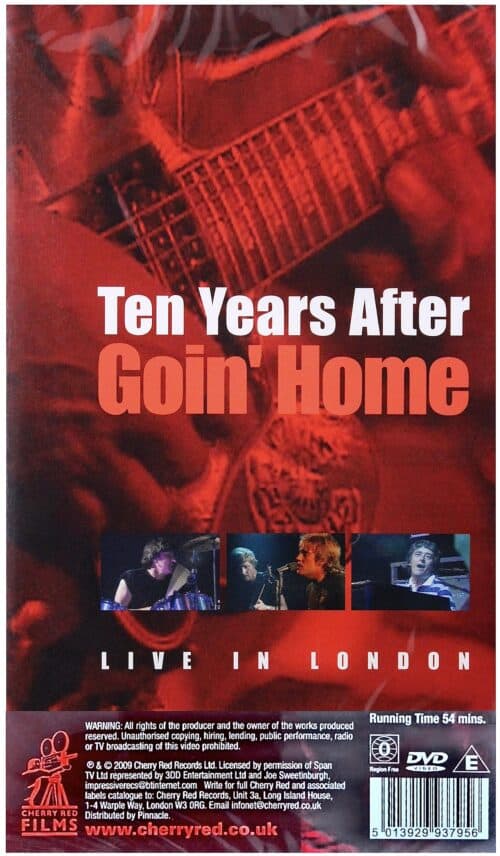
re-release 2009
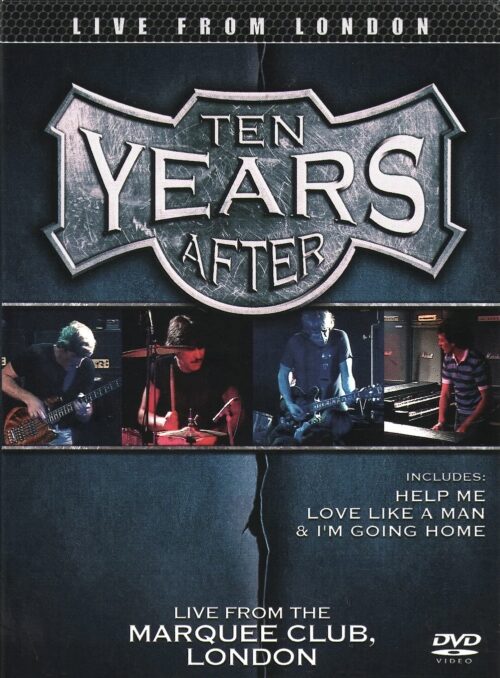
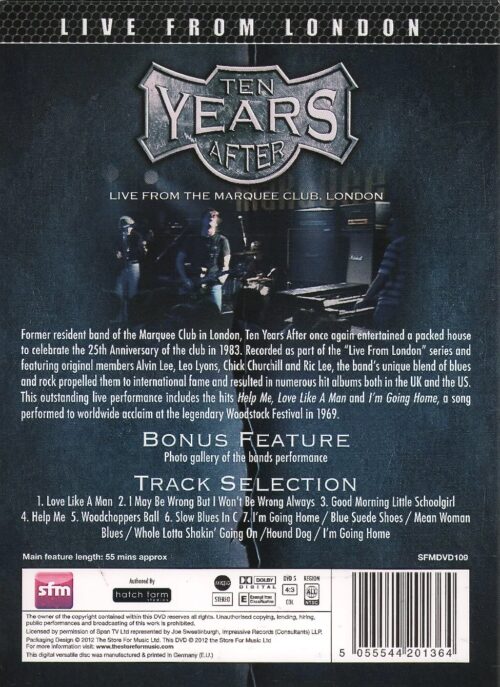
re-release 2012
The History Of Rock, issue 69, volume 6, “Heavy Duty” – UK Magazine
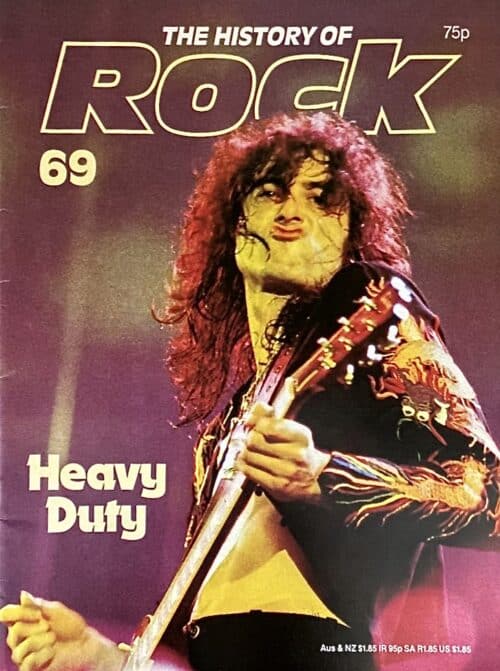
1983-1985
High-Octane Rock
Written by David Sinclair
From Alvin Lee and the Boys:
Formed in 1967, Ten Years After emerged as part of the late-Sixties British Blues Boom, becoming a big-selling album act and premier live attraction – particularly on the emergent American stadium circuit, before their break-up in 1974.
The star of their act was singer / guitarist Alvin Lee, probably the flashiest blues / rock guitarist of the lot.
Jaybirds Of A Feather:
Lee, born in Nottingham on 19 December 1944, grew up in a musical environment – both his parents played guitar. After taking lessons for a year, he joined his first local group at the age of 13. A couple of years later he paired up with bassist Leo Lyons, born 30 November 1944, and they played together in various line-ups. One of which took them to Hamburg in Germany, before meeting drummer Ric Lee, born 20 October 1945. The three of them formed the nucleus of a band called the Jaybirds. Chick Churchill, born 2 January 1946, was initially given jobs as road manager of this outfit, but soon began to make a more direct contribution as organist.
In 1967 the group decided on a change of name to Ten Years After, and swiftly established a strong reputation in the London clubs- most notably at the Marquee, where they held down a residency. At this point they met Chris Wright, who became their manager, and later, with Terry Ellis, formed Chrysalis Records.
With Wright’s help, they secured a contract with Decca Records who, perceiving the band’s underground as opposed to commercial appeal, assigned them to their new progressive label Deram and allowed them to release an album, “Ten Years After”, without the customary requirement of a hit single.
The album sold reasonably well and during the rest of the year Ten Years After played as many gigs as they possibly could, further establishing their grassroots following in Britain.
General Lee:
In 1968, Deram released a second album, “Undead”, recorded live at London’s Klook’s Kleek club. American promoter Bill Graham, impressed with the album, telegraphed Chris Wright inviting Ten Years After to play at the prestigious Fillmore West, and the band departed for what was to be the first of numerous Stateside tours.
Although the two 1969 albums, “Stonedhenge” on which Lee’s guitar work was uncharacteristically subdued, and “Sssssh”, which was a heavier, more fully produced effort, established them in the British charts, it was “Undead” that conveyed most accurately what the band was about, high-energy, high-velocity performance rock, as raw and unsubtle as it comes.
Despite the fact that Ric Lee, Leo Lyons and Chick Churchill were all extremely capable musicians, each having had more formal training than Alvin Lee, it was very much the guitarist show. Alvin Lee sang, wrote nearly all the songs and produced the albums. On stage he was always the centre of attention. A tall, well-built figure, with scowling face and thick blonde hair, he quickly became renowned for the incredible speed with which he played his familiar sticker festooned red Gibson 335. His guitar playing came to dominate proceedings to such an extent that Chick Churchill would often leave his keyboards – which were drowned by the guitar – to stand on a stack at the back of the stage and clap his hands impotently in the air. For a while audiences loved Ten Years After’s show, particularly in America, but the critical response was less than favourable.
The situation crystallized with Ten Years After’s appearance at the Woodstock Festival in 1969 and subsequent inclusion in the film of the event, which became a worldwide box-office success in 1970.
“Woodstock” featured the band storming, stomping and wailing their way through an Alvin Lee song called “I’m Going Home” – an extended shuffle / boogie 12-bar, that tended towards indulgence when taken out of context with the rest of the show. But the effect of that appearance was dramatic – the band was suddenly hoisted into a position of international superstar status.
In Britain they were rewarded in June of 1970 with their only hit single, an edited version of “Love Like A Man”, but Lee didn’t care for the number and refused to play it on “Top Of The Pops”. Meanwhile “Cricklewood Green” 1970 and “Watt” 1971 both reached the Top five in the album charts.
Ironically, Woodstock also heralded the start of Ten Years After’s decline. “It was a big break, but it was the start of the end too”, said Alvin Lee. They found themselves in an artistic straight-jacket, hedged in on the one side by audiences demanding nothing but the formula of “I’m Going Home” and “Good Morning Little Schoolgirl”, and on the other by the critics who were lambasting their lack of finesse and paucity of imagination. Moreover, the band suffered from a work schedule that left them little time to draw a breath, let alone write new songs and develop in any new directions.
Alvin Lee commented: ” We just kept working and working and working…and the fun went out of it. We didn’t feel we were achieving anything particularly, it was just what I call the travelling jukebox syndrome. Get on stage, plug in, and away you go – do the same as you did last night.” It has been reliably documented that Ten Years After undertook as many as 28 American tours, as well as appearing all over Europe.
Bad Vibrations:
The band’s last new album, “Positive Vibrations” was released in the spring of 1974, but Ten Years After had already split, having played their last British gig at London’s Rainbow earlier that year. They did, however, undertake a final American tour in 1975, and got together briefly in the studio in early 1977, though no recordings were ever released from these sessions.
Alvin Lee embarked on a solo career with mixed results. He worked initially with Mylon LeFevre, producing the country-rock-flavoured “On The Road To Freedom” in 1973 and then set up a nine piece touring band – casting himself in a more “tasteful”, laid-back role. But his new image suited neither his audience nor himself, and it wasn’t too long before he was back in the heavy-rock fold.
In late 1977 he formed “Ten Years Later” in response to record company pressures, but after two lacklustre albums they split, and since then he has again worked solo, using a three piece “Alvin Lee Band” – with bassist Fuzzy Samuels and drummer Tom Compton – for touring.
Leo Lyons became a producer, working most notably on a trio of “UFO” albums, and eventually setting up a studio in Oxfordshire. Ric Lee did a spell with Stan Webb’s Chicken Shack before moving into management. While, Chick Churchill recorded a solo album, “You and Me” in 1973, before joining Chrysalis Publishing.
Perhaps Ten Years After failed to take a firm enough stand against the many pressures that boxed them in, and perhaps they should have established a stronger musical identity as a band, rather than as a vehicle for Lee’s greased-lightning guitar. But, whatever their detractors may say, they worked long and hard, and gave many an audience one hell of a buzz.
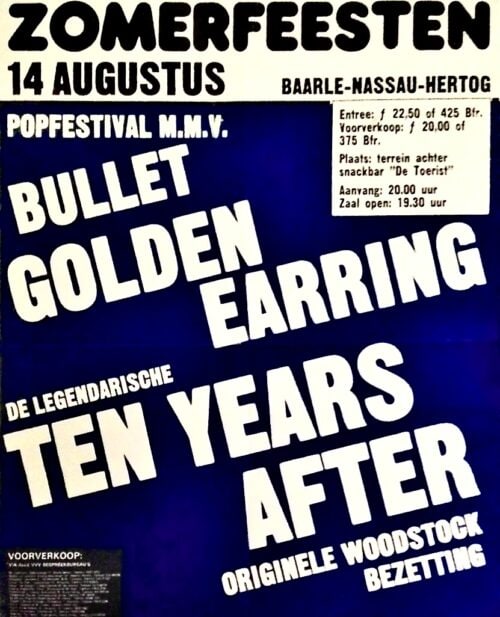
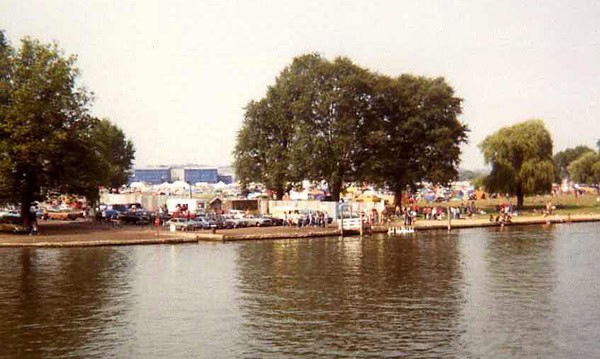
August 14, 1983 – Zomerfeesten, Baarle, Netherlands/Belgium
August 28, 1983 – Reading Rock Festival, UK
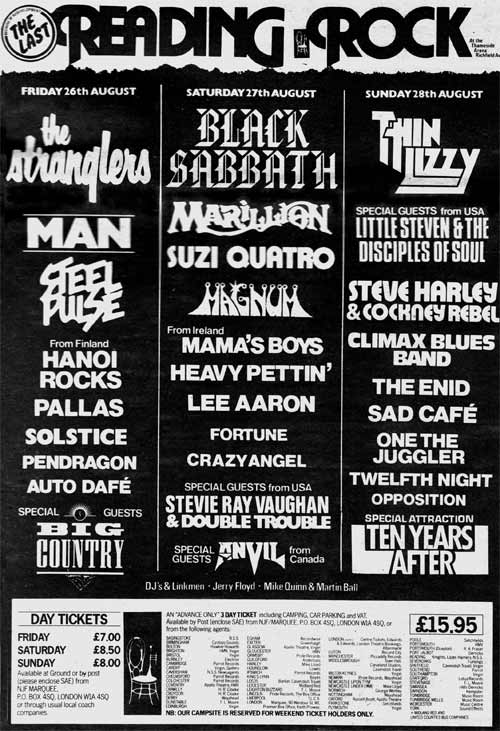
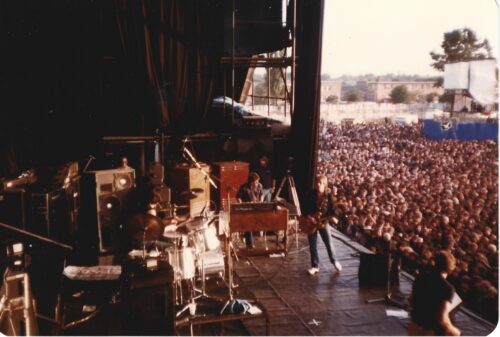
photo Alan Thomas
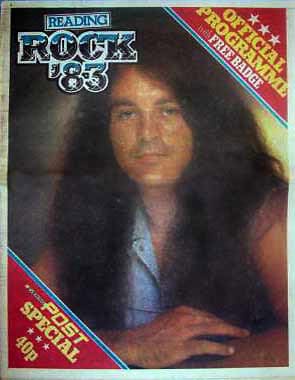
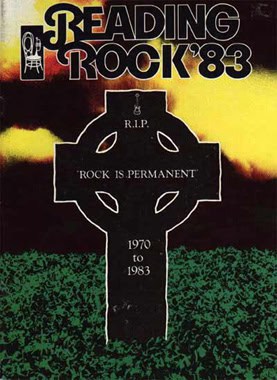
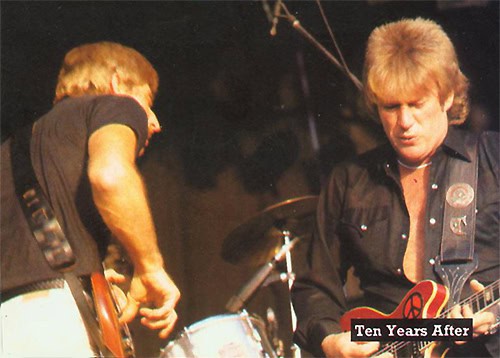
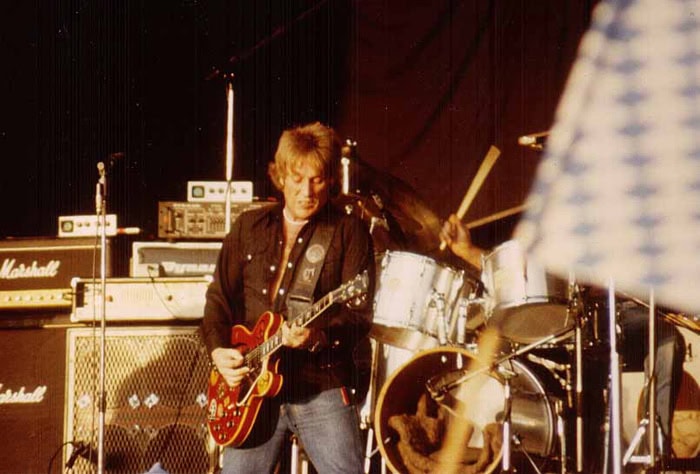
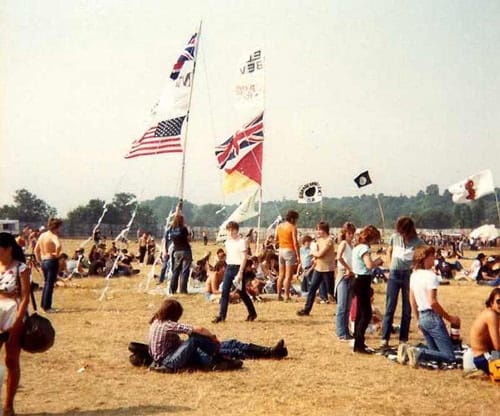
Friday Rock Show Sessions
The 1983 concert was broadcast and recorded on FM Radio, later to be released on CD under the Raw Fruit label in 1990 – It’s called “The Friday Rock Show Sessions” from the BBC.

The best bands to play the 1983 show (according to one fan) was “Ten Years After” and “Thin Lizzy”.
September 3, 1983 – Basel, Switzerland
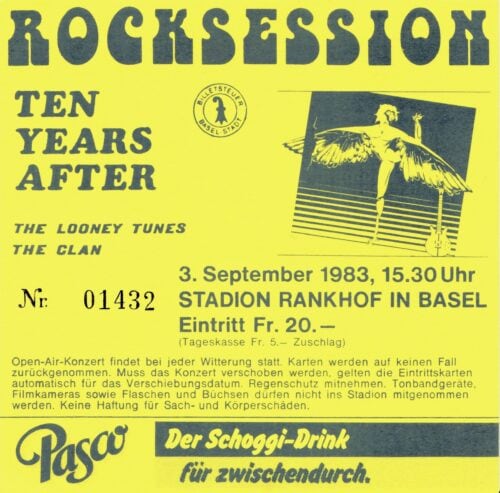
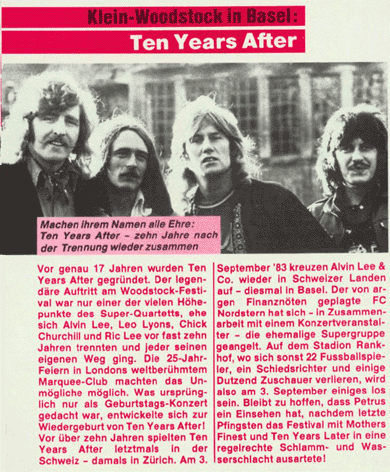

Promo photo 1993
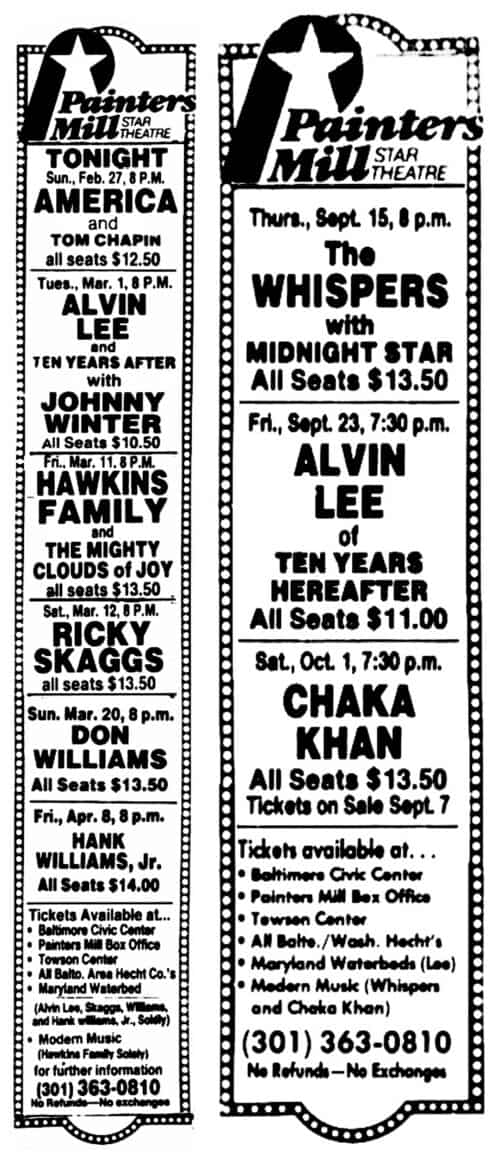
September 23, 1983 – Painter’s Mill Star Theatre, Owings Mills, Maryland
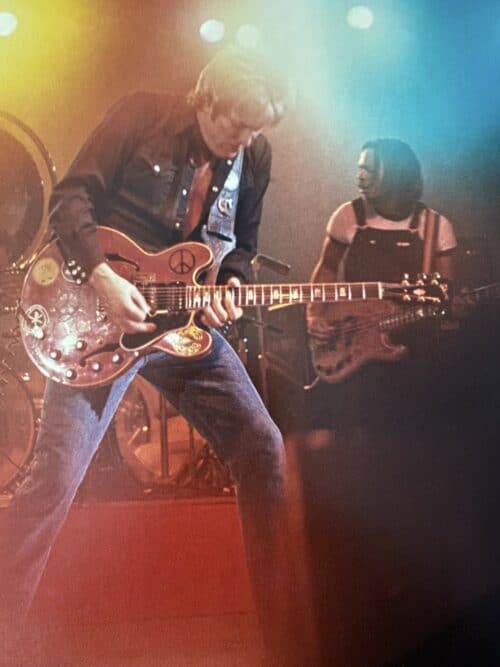

Photos Mitch Gee
1983 – itd magazine, Yugoslavia
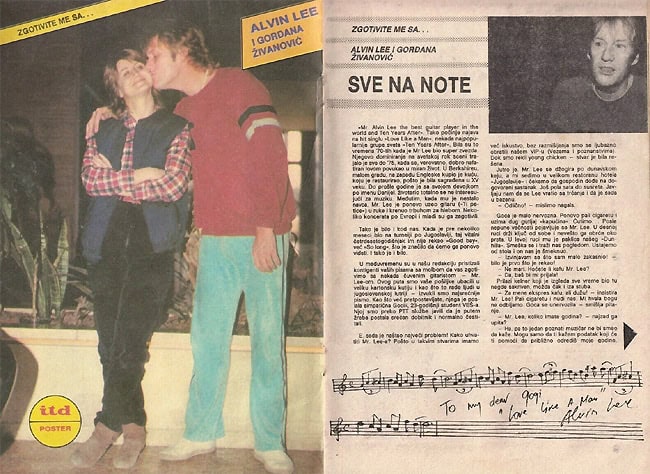
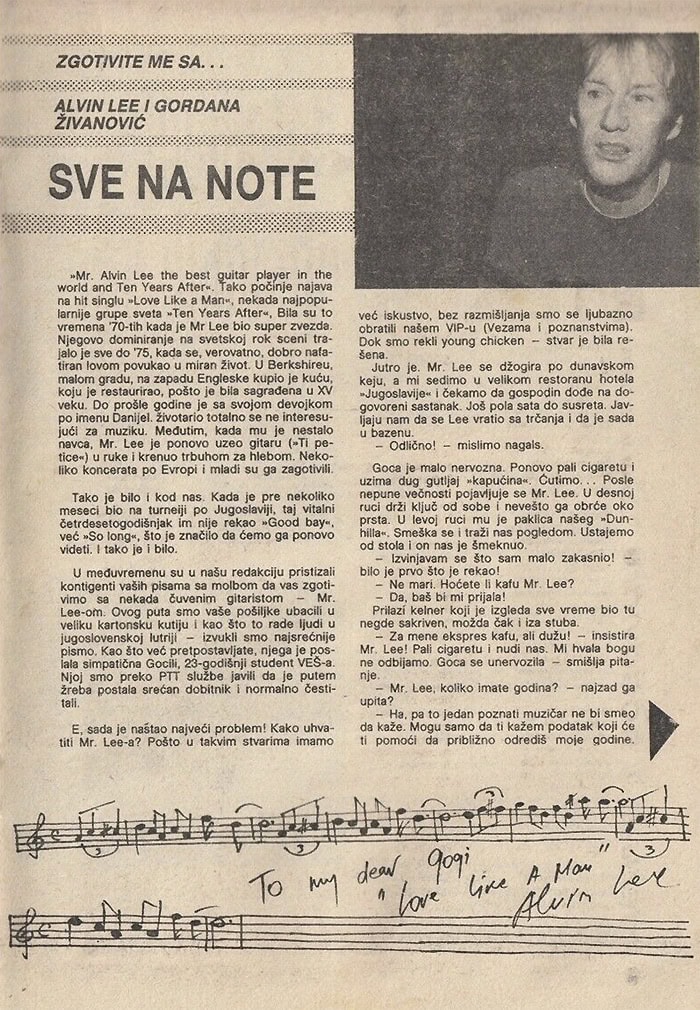
TRANSLATION:

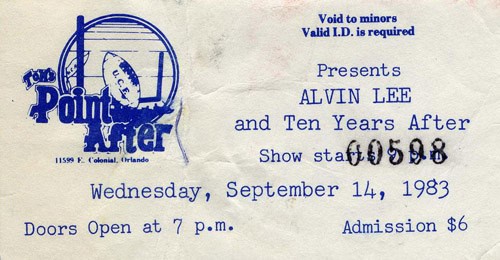
Tom’s “Point After” 1983 – Orlando Florida
October 17, 1983 – Theatre Indianapolis

Photo & Art: Jim Kirk
1984
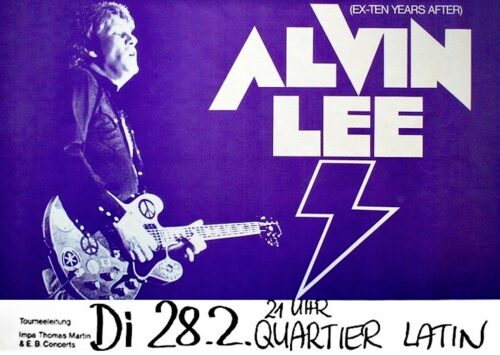
February 16, 17 & 28, 1984 – Mannheim, Nürnberg & Berlin, Germany


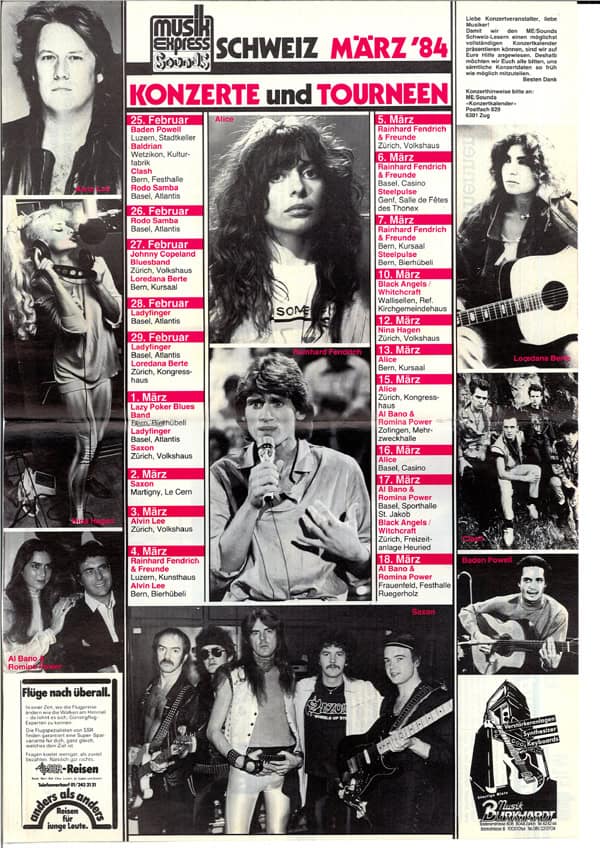
March 3 & 4, 1982 – Switzerland

April 1, 1984 – Arena, Vienna, Austria
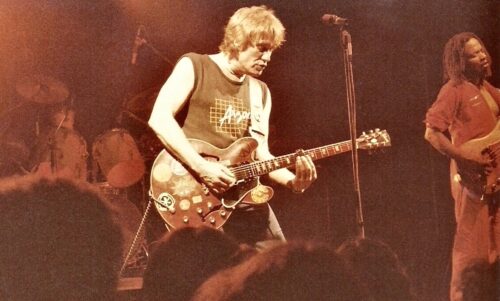
Photo by Isabella Seefriedt
Germany 1984
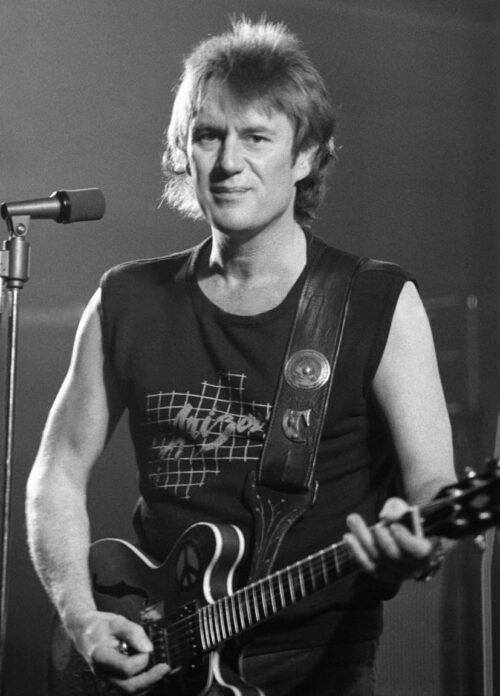
Photo by Max Kohr
August 27, 1984 – Nostell Priory Festival, West Yorkshire near Wakefield
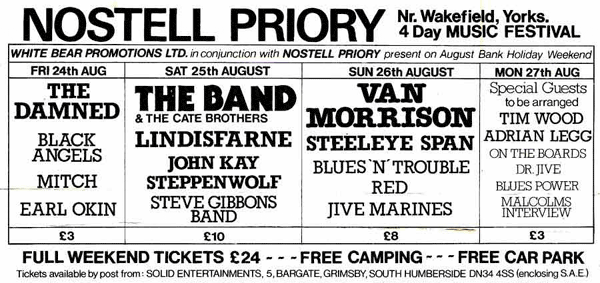
Special guest: Alvin Lee & Fuzzy Samuels
The tabloids had a field day. It was all stories of drugs, the “Peace Convoy” as it was called, (and all the rest of the negative press coverage). I was unaware of all of this due to being cut off from the outside world. Tabloid papers I realized, had their own agenda and still do.
It’s not about real news, it’s all about sensationalism. The news coverage of this event was a growing up thing for me. I seriously am not going to take any notice of scare stories or hype in a tabloid ever since.
By Noddy Guevara

On stage in the distance: “The Alvin Lee Band”


Paul, a visitor, reports:
Wakefield, West Yorkshire, England: Unlike the Glastonbury Festival, the large “Free Festival” component in the form of the travellers field that was adjacent to the main festival brought out the local authorities, who took it upon themselves to behave in an extremely hostile way when dealing with the free festival element.
This resulted in many travellers homes being trashed and them being arrested en-masse. This was just a practice session, dry-run for the “Bean-Field” action that was coming the following year, when travellers vehicles were done over, possessions thrown out onto the ground, ransacked, thrown out onto the open ground and left there while their owners were all carted off to jail. Fortunately for me I left the festival site the day before the Yorkshire police moved in. The police kept a high profile at the gates of the site throughout and the surveillance was maintained. Unfortunately, there was also a significant amphetamine and cocaine influence on the site. The local dealers were also present, and this obviously didn’t help matters with the attitude of the authorities. The day after I left, the police steamed through in masses, in a way described that was exactly like the Bean-Field event, the following year summer. Everyone was arrested and most people were charged with possession. People who swallowed their stash were charged as well with, “Internal Possession” an obscure, trumped up offence. Have you ever heard of such a thing?
The choices were simple, plead guilty, get a couple of days in jail, pay a fine and be released.
Or, fight the charges and face a possible six months in confinement while you’re waiting for your court date to come up. I heard from others who fought the charges, they spent up to six months in jail, with five to six people to a cell.
“The first hint of trouble came at a festival at Nostell Priory, West Yorkshire, England in 1984. Riot Police, fresh from disturbances at the Orgreave Coking plant, ransacked travellers’ homes and mass arrested 360 people. While at the same time, English Heritage began compiling a list of names for a civil injunction that would form the legal basis for a Stonehenge Festival ban the following year.”
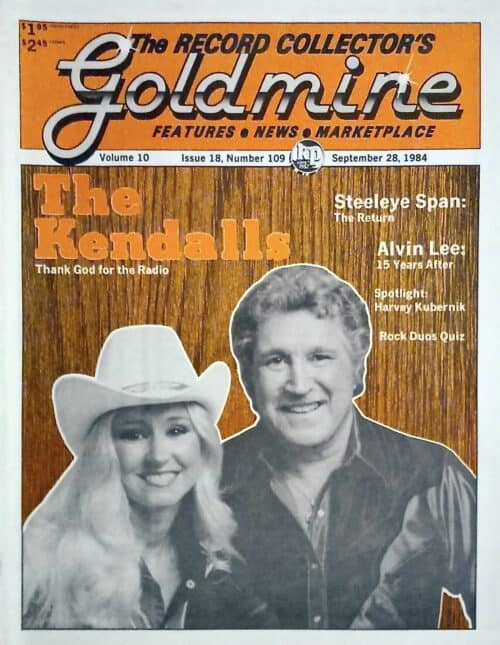
GOLDMINE magazine – September 28, 1984
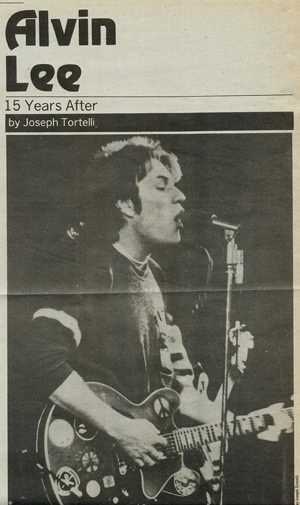
ALVIN LEE – FIFTEEN YEARS LATER
Written by Joseph Tortelli
He electrified Woodstock with his fiery guitar playing. His flash and speed elevated him to the status of pop icon. The music scribes dubbed him “The Fastest Guitar in the West.” Alvin Lee’s prominence in the rock `n roll world has declined markedly since those tumultuous days. Today his tour bus arrives at clubs, not festivals or arenas. His audience is older in age and smaller in number than it once was. But memories of the guitarist’s stunning performances with Ten Years After continues to attract the faithful. Relaxing in his plush tour bus after a torrid show at Boston’s Channel Club, the veteran rocker looks remarkably fit and youthful. He recalls his introduction to music. “I started playing clarinet,” Lee points out. “I played clarinet for about six months. I used to listen to Benny Goodman. And listening to him I got to hear Charlie Christen, who was a very good guitar player.” The guitarist from Goodman’s band had a significant effect on the neophyte musician. Lee remembers, “I went down to the pawn shop and swapped my clarinet for a guitar, much to my parents horror.” Lee’s initiation to the secrets of the guitar came through jazz, not rock `n roll. Django Reinhardt, Barney Kessel, and Charlie Christian were among his earliest influences. But the young Lee found himself intrigued by another sound too. He credits his father with introducing him to blues. “My father is a blues fanatic,” Lee says. “He used to collect chain gang songs, prison work songs, and things like that. I had a great repertoire of blues songs, thanks to my old man.”
In 1955, about a year after he picked up the guitar, Lee remembers rock `n roll hitting England. He mentions Scotty Moore, Chuck Berry and Lonnie Mack as a few of his favourite 50’s guitarist. But, he adds, ” I had a pretty wide range of influences – John Lee Hooker, Muddy Waters. I used to like Chet Atkins, too.” American rock `n roll records were not always readily available to British kids during the 50’s. Lee developed a unique method of landing the newest releases. “I used to buy all the American records,” he enthuses. “I have an aunt in Canada who used to send me all the latest American records. It was a big deal in those days to get a Chuck Berry album six months before anyone else had heard of it.”
Though he studied with a guitar teacher for about a year, Lee is essentially a self-taught musician. “I avoided taking lessions and reading music, because it will affect your style,” he says. “I never used to copy anybody else. Maybe I’d copy a style. I’d hear a Chuck Berry record and I’d play a solo the same style as him. I wouldn’t copy it note for note. In that way you can give it your own stamp. I’ve never been a good copier, probably because I can’t. If I listen to a good solo, I can’t work out the notes then play. I’d rather choose my own and just play it with a similar feel.” Lee attributes his speedy guitar technique to encouragement from appreciative audiences. “I think it comes from the adrenaline I get off playing live,” he says “When I get a good audience, I get them off and they get me off too. Sometimes I hear a tape after I’ve played and say, “Good Lord, is that me?” because I don’t know I’m doing it myself. It’s just the adrenaline the audience kicks out of you.”
The youthful guitarist knew that he was destined to become a professional musician. “I left school when I was sixteen,” he says. “I went straight into it, never had a proper job.” Like most teenagers in a similar situation, Lee played clubs near his family home in Nottingham, England. He recollects that he joined a half dozen local bands, the first of which as named the Jailbreakers. Lee’s guitar style, rooted firmly in blues, hindered his career initially. “It wasn’t accepted,” he explains. “I used to get banned from places because people couldn’t dance to the music I played. But I played it anyway.” The British blues boom of the early 60’s changed things. Local fans recognized Lee as one of the top musicians on the Nottingham circuit. Though he recorded a few demos during this period, none made it to vinyl.
Two other Nottingham lads, bassist Leo Lyons and keyboardist Chick Churchill, also gigged in area clubs. They asked Lee to join their band, the Atomites. Lee laughs, “I said, “Well, yes, but only if you change the name.” Lee dates the beginning of Ten Years After to 1965. Originally, they were called Bluesyard. But, Lee says, “We decided that was a bit too bluesy, so we chose Ten Years After.” Ric Lee, a drummer from Mansfield – which is a town about fifteen miles from Nottingham – completed the line up. All outstanding individual musicians, Lee refers to early Ten Years After as “The Cream of the Nottingham area”. Even in their earliest days, Ten Years After displayed considerable musical versatility. They played rhythm ‘n’ blues, country, jazz and rock ‘n’ roll in addition to their mainstay, blues. Oddly, the British beat which dominated the mid 60’s did not excite the members of Ten Years After. Alvin Lee appreciates the irony. “I’ve always liked American music,” he concludes. “It’s funny that Americans like English music and the British people love American music.”
Ten Years After became a staple on the club circuit in and around Nottingham. They gained a national reputation with a series of dates at London’s Marquee Club. Yet record companies had their reservations about the commercial possibilities of bluesy instrumentalists. With the success of Cream in 1966, the record labels decided that electric blues was a saleable commodity. Ten Years After signed with Deram Records. Their first album, “Ten Years After” was issued in 1967. Lee is proud that their recording contract allowed band members to showcase their musicianship and style. For an act like Ten Years After, an entire album, not simply a pop single, was essential. “We were one of the first bands to get an album deal ,” he boasts. “Before then, you did a single and if your single sold, then you could record an album. We got offers to make an album.”
The rock world, tiring of the mid – 60’s pop sounds, welcomed something different. On both sides of the Atlantic, the burgeoning progressive movement found Ten Years After a robust alternative to top forty bubble-gum. The bands late 60’s albums gained airplay on America’s FM radio stations along-side Cream, Jimi Hendrix, Jethro Tull and a host of others. A number of club tours widened Ten Years After’s trans-Atlantic appeal. According to many critics and blues enthusiasts, this was the period of the group’s greatest creative achievements. Apparently Lee agrees. ‘Undead’, a live album recorded at a British club date, remains his favourite Ten Years After release. “I enjoyed that,” he says, “because I thought it captured what the band did best.” He also includes Ssshh and Cricklewood Green as equally enduring recordings.
Ten Years After’s Tours and albums secured the band a solid place with underground rock fans. In the summer of 1969, the group was given an opportunity to expand that base dramatically. A performance before half a million rock fans at the Woodstock festival in New York State was the turning pointing the band’s career. Lee carefully notes that the Woodstock appearance, itself, did not cause a great stir. “When we did the actual festival, it was a great experience. But we carried on for about a year playing the same kind of venues for about 6 or 7,000 people.” The Woodstock film and album soundtrack were released in 1970. Ten Years After filled eleven minutes of time with the steaming rock `n roll exercise called, “I’m Going Home”. The vinyl and celluloid catapulted the band to the top of the rock ‘n’ roll world. And Lee, whose guitar playing and singing were prominently featured, emerged as a star. “The movie came out and that made a lot of difference,” according to Lee.
“Suddenly we were playing giant auditoriums in front of 30,000 people.” But the acclaim exacted its price. The hassles and pressures of touring grew with the audiences. Alvin Lee emphasizes the connection. “Although that’s when the band got really popular, that was the start of the band breaking up, because the gigs got less enjoyable then… When you play in those big auditoriums, you can hardly see the audience. You’ve got security guards and cops and echo and everything else. You play five or six nights a week in those places and it starts to get a bit more like work than playing. I think the whole band got disenchanted playing those giant places. Nobody wanted to tour after a while.”
Though the seeds of disillusionment had been planted, the groups dissolution was not at hand. More triumphs awaited. In 1970, their contract with Deram expired after six albums. Many labels expressed interest, but Ten Years After was signed by America’s leading record company, Columbia. “I think Columbia picked us because we were doing really well then,” Lee suggests. “Clive Davis came to Madison Square Garden, and he saw 20,000 people screaming and yelling for us. He’d be pretty stupid not to sign us.”
The Columbia contract resulted in the group’s first gold album, “A Space In Time”. From the fall of 1971, the LP included Ten Years After’s only top 40 single, “I’d Love To Change the World”. “A Space In Time” seemed to indicate a significant new phase of artistic growth for a band attempting to move beyond its blues rock roots. “It’s probably my favourite album as far as the songs go,” declares Lee. “I had about a year off to write those songs, which helps. You can’t write a good song in three minutes.”
But the commercial success did little to alleviate the band members personal dissatisfaction. “If touring isn’t fun,” the guitarist says, “no amount of money can make it worthwhile. You’ve got to have fun playing. If you did it for the money, you’d go crazy. If you don’t enjoy it, no amount of money in the world would be worth it.” Rumours abounded that Lee’s superstar status caused tension within the Ten Years After entourage. It was the age of the guitar hero. And Alvin Lee took his place besides his countrymen: Eric Clapton, Jimmy Page, Jeff Beck. “It was a bit embarrassing in those days,” Lee says. “People saying that I was “the fastest guitarist in the West.” And I know that I wasn’t. It was complimentary. Looking back on it, I was just a bit confused. I wasn’t too sure about putting myself around like that. I was probably a little more modest than people made me out to be. But,” he adds with a smile, “how can you be a modest, flashy rock ‘n roll guitar player?”
Through the years Ten Years After persisted, Lee pursued outside projects. “On the Road to Freedom”, a duet with American vocalist Mylon LeFevre, was issued in December 1973. The record featured an array of British superstar sidemen, including George Harrison, Ron Wood, Steve Winwood and Mick Fleetwood. “That was a little idealistic side trip,” says Lee of the album. “I met Mylon in Atlanta. We wrote a couple of songs together in a hotel room. And we had this long talk about making an album together. He had a band called Holy Smoke. I got them on the Ten Years After tour as the opening act. We wrote some more songs together, When I finished building a studio in England, he came over and we cut the record. It was all very homegrown and idealistic. It’s still one of my favourites. Nice music.” As for the supporting musicians, Lee says, “We had an all-star cast on that one. That was Mylon. He was a good hustler.”
The scorching guitarist appeared to be heading in a more mellow direction on his own. He enjoyed listening to songwriters like Paul Simon, Jackson Browne and Lowell George. The blues rocker even aspired to be counted among them. Lee acknowledges that this was not a rewarding musical endeavour. “I enjoy the music, but I wouldn’t want to play like that. I did once,” he admits. “But then I realized, “who needs two Paul Simons? I’d only be a second rate Paul Simon if I worked hard at it. So I do what I do best, which is rock `n roll and blues.”
The guitar player’s separation from Ten Years After, at first tentative, became definite and permanent in 1975. “When Ten Years After didn’t work anymore, I took about six months off and sat at home and just really went crazy,” he says. “I realized that I had to keep touring no matter what. I tried a few different things. I even had a seven piece band. For awhile, I refused to play any of the old Ten Years After songs. That was all part of living and learning. “Then on time I stopped by to see Jerry Lee Lewis. He didn’t do “Whole Lotta Shakin”. He did all country songs. I was really disappointed. Coming out of the club, I realized that when people came to see me and I didn’t play “I’m Going Home” or “Little School Girl” they’d feel the same way.”
“I grew out of wanting to be a musician’s musician and playing for myself,” Lee continues. “You can sit at home and play for yourself all you like. If you’re going to play onstage, the idea is to get people off and give them a good time. I realized that I wanted to give them what they wanted to hear – within reason. So I play 60 to 70 percent of the good old songs now.”
Alvin Lee’s October 6, 1983 set at the Channel proved his point. Accompanied by former Crosby, Stills, and Nash bassist Fuzzy Samuels and drummer Tom Compton, Lee ripped through “Good Morning Little Schoolgirl”, “Choo Choo Mama”, “I’m Going Home” and other Ten Years After memories. He also slipped in the rock chestnuts, “Sweet Little Sixteen”, “Slow Down” and “Hey Joe”. A pounding drum solo and a surprisingly entertaining bass solo by the dreadlocked Samuels supplemented the expected guitar fireworks. It was the kind of performance which had fans – perhaps imagining it was 1969 again – screaming for more. The veteran guitarist expresses enthusiasm about such club appearances. “I like doing these clubs like we did tonight,” he offers. “To me, that’s the ideal gig, because the audience is right there and you can feel them. And the sound is tight.”
Though Lee’s career sputtered during the late 70’s and early 80’s he is prepared to continue working. “I got disenchanted with recording because of the record companies wanting commercial singles which has never been my bag. To be honest, I didn’t even like the last couple of albums I did,” he confesses. “I did them too rushed. So I’ve decided to take my time. I’ve been writing for about a year and a half. The next album is going to be a good one if it takes another year. At least I’m going to like it when it comes out. With a little luck I might have something out by summer. But no promises, it’s got to be good.”
Lee still plays with his Ten Years After mates occasionally, through a permanent reunion is unlikely. “We just did the Marquee Club, where we first started playing in London. The club had its 25th anniversary, and we got together for a couple of nights there. Then we did the Reading Festival,” Lee adds. “But we decided just to do the odd festival here and there for a bit of fun. The other boys are still settled down and married. I’m just a rock ‘n roll gypsy. I love touring. Those guys like a little order in their lives.”
The singer / guitarist expects to be on the scene for some time to come. “If I’m alive,” Lee declares, “I’ll be out there. Don’t worry about that.”
December 6, 1984 – Münster, Germany
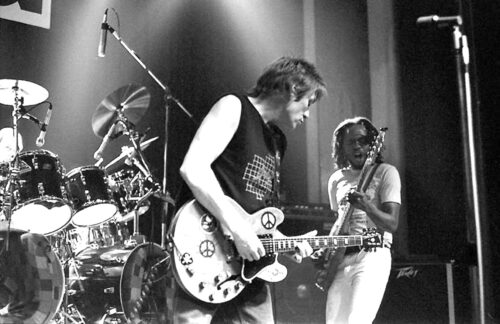
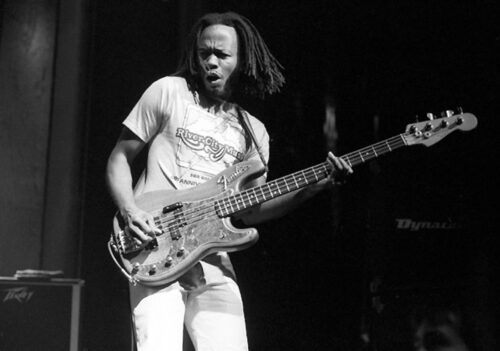
Photos by Christoph Preker
1985
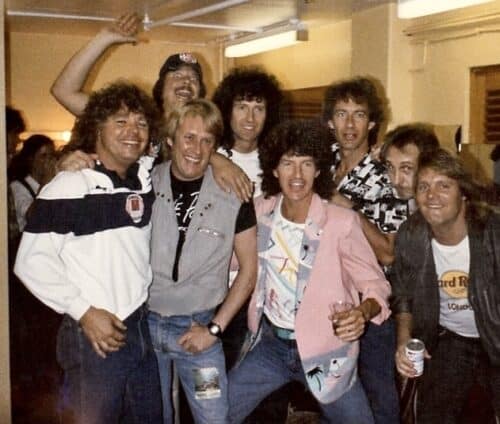
May 29, 1985 – Hammersmith Odeon
Alvin gets up to jam at an REO Speedwagon show in London, also joining in are Brian May (Queen) and John Entwistle (Who). Here is a picture taken backstage.
September 5, 1985 – Theaterfabrik, München

Photo: Fryderyk Gabowicz
1986 — Detroit Diesel
- 1986
- Alvin Lee
- Alvin Lee Band
- Boz
- Boz Burrell
- Bryson Graham
- David Hubbard
- Detroit Diesel
- George Harrison
- Joe Brown
- Jon Lord
- Steve Gould
- Tim Hinkley
- Vicky Brown
Alvin Lee – Detroit Diesel

*Detroit Diesel* is a powerful reminder of why Alvin Lee remains one of blues-rock’s most electrifying figures, and it’s made even more compelling by the caliber of musicians involved. From the opening moments, the album crackles with confidence, fusing gritty Detroit-inspired blues with Lee’s unmistakable guitar fire and veteran songwriting craft.
Alvin’s playing is, as always, the undeniable centerpiece—fast, fluid, and full of attitude—but *Detroit Diesel* benefits greatly from its distinguished company. The presence of musicians like George Harrison and Jon Lord adds both gravitas and texture to the record. Harrison’s tasteful, understated contributions bring a melodic elegance and quiet authority, while Lord’s unmistakable keyboard work injects depth and a classic rock weight that perfectly complements Lee’s guitar-driven approach.
What really makes the album shine is its balance. It isn’t just about speed or flash; it grooves hard, breathes deeply, and lets the songs develop with purpose. The rhythm section locks in with authority, providing a muscular foundation that allows Alvin and his collaborators to explore everything from swaggering blues-rock to more soulful, reflective passages.
There’s a lived-in quality to the record that feels authentic rather than nostalgic. Lee sounds energized and fully engaged, drawing on decades of experience without ever sounding complacent. The production is clean yet warm, allowing the rawness of the performances—and the chemistry between such accomplished musicians—to come through clearly.
Ultimately, *Detroit Diesel* stands as a testament to Alvin Lee’s enduring relevance and musical connections. It’s an album that honors blues tradition while showcasing the creative spark that emerges when great artists come together. For longtime fans and newcomers alike, it’s a satisfying, spirited listen that proves Alvin’s engine was still running hot.
Musicians on Detroit Diesel
Alvin Lee: Vocals, Guitar, Harmonica.
Core Band:
Tim Hinkley: Keyboards, Backing Vocals.
Steve Gould: Guitar, Synth, Backing Vocals.
Boz Burrell: Bass.
Bryson Graham: Drums.
Additional Bassists: Leo Lyons, Mick Fe’at (also backing vocals).
Guest Appearances:
George Harrison: Slide Guitar.
Jon Lord: Organ.
Joe Brown: Fiddle.
Vicky Brown: Backing Vocals.
David Hubbard: Keyboards, Synth Bass.
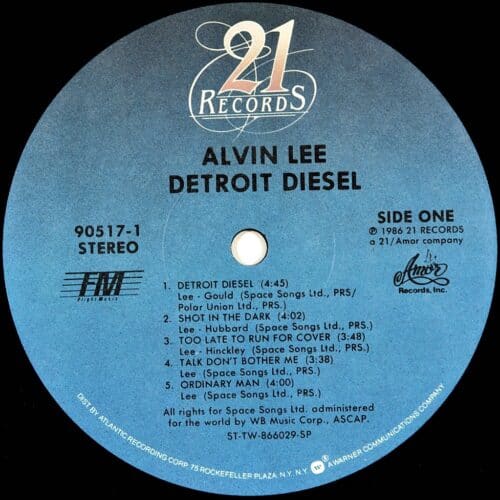
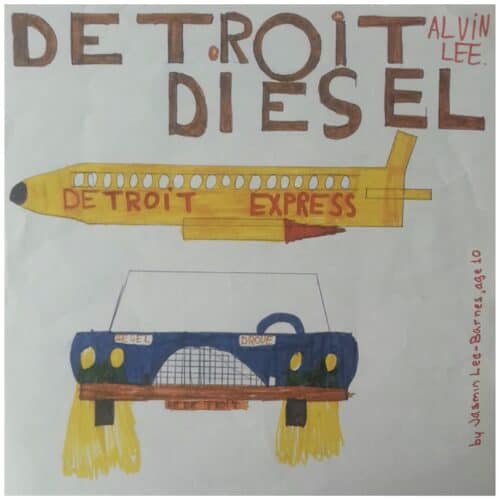
Detroit Diesel
I saw Alvin Lee with a power trio at the old Tree Cafe in Portland, Maine, in the summer of 1987. It was a small club with little space on the floor, plus a balcony above. I ended up standing the whole show, I was just to the left of the band who were on a tiny stage.
The show was fantastic! Alvin was promoting his new record release “Detroit Diesel” at the time and I went out the next day and bought a copy. He played several tracks from the album, plus some Ten Years After stuff and I was hooked. The title track has a nasty guitar solo, “Just Another Night” and “Ordinary Man” are excellent tracks.
By a fan

TRANSLATION:
NEWS GB
ALVIN LEE, the very legendary leader of TEN YEARS AFTER, is back in force. After a rather discreet concert appearance near Paris on December 20, he announced the imminent release of an album (his first in 7 years).
This album will be titled ‘Detroit Diesel’. The great guitarist was accompanied on this discographic comeback by Boz Burrell on bass, Jon Lord on keyboards, and George Harrison on guitars. Nothing but top-quality talent!
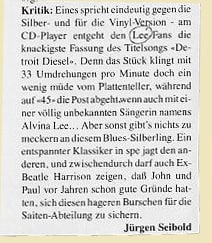
TRANSLATION:
Review:
There is a clear argument in favor of the vinyl against the CD version: on the turntable, Lee’s fans are treated to the punchiest version of the title track “Detroit Diesel”. On a CD player, the piece sounds a little tired at 33 revolutions per minute, whereas at 45 it really takes off — even with the participation of a more or less unknown singer by the name of Alvina Lee …
But aside from that, there’s really nothing to complain about with this blues album. One relaxed classic-in-the-making chases the next, and in between even ex-Beatle Harrison is allowed to show that John and Paul already had good reasons years ago to recruit this lean lad for the guitar department.
1987
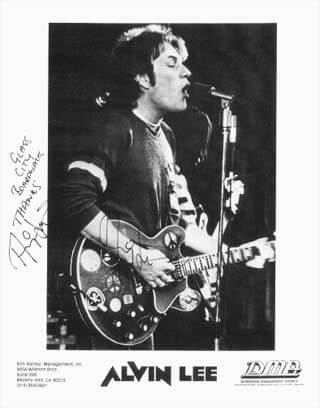
Metal magazine (USA) – January 7, 1987
Alvin Lee: Running On Diesel Twenty Years After
by Harold DeMuir (AKA Scott Schinder)
“This is my first talk for a few years,” says Alvin Lee, in the Big Apple to drum up support for “Detroit Diesel”, his first new LP in five annums. “I can’t think of anything to say,” confides the English guitarist/singer, grinning at the thought of throwing his inquisitor into a momentary panic.
Actually, Lee’s got plenty to talk about. For one thing, there’s the new album, which returns him to the steak-and-spuds hard-rock style he’s most comfortable with. Then there’s his five-year break from vinyl action, during which he seriously reexamined his musical options before arriving at the conclusion that flat-out rock ‘n’ roll was the way to go. And of course, there’s always the checkered but successful career of Alvin’s old band, Ten Years After, who busted an eardrum or two in their day.
Lee, who took up the guitar at age 13, began playing in bands in the early ‘60s, and met up with bassist Leo Lyons in 1960. The pair toured together for years (including stints on Hamburg’s legendarily nasty Reeperbahn). By 1967, they’d added keyboardist Chick Churchill, and altered their name from the Jaybirds to the spacier Ten Years After.
The quartet’s late-60s LPs – “Ten Years After”, the live-in-a-club “Undead”, “Stonedhenge”, “Ssssh.” – presented a sturdy, workmanlike blues/rock/jazz fusion, spotlighting Lee’s quick-fingered axe work. The guitarist’s instrumental prowess made TYA a solid concert draw and won them a sizeable following in the States, but Lee was already growing restless.
“I remember thinking, after “Undead” – well, that’s really it in a nutshell, now what am I gonna do next? And that’s when I started experimenting and looking for other directions, doing the odd country tune and the odd jazz-funk tune. And that’s where the direction disappeared.”
While Lee was questioning their policy, Ten Years After’s 11-minute Woodstock performance of “I’m Going Home” was increasing the group’s audience and nailing down Lee’s public image as flash guitar idol.
“The funny thing was, we did the Woodstock festival, and the movie didn’t come out before spring 1970, and we just carried on playing 2,000/3‘000-seaters and doing quite nicely. And as soon as the movie hit, that’s when we started getting 14-year-olds with their ice creams in the front row. At the time, I didn’t understand it, and I got on a bit of a high horse about it, and thought, this is not for me.”
Despite his doubts, TYA continued to tour their behinds off, pausing for the occasional LP session. “Cricklewood Green” and “Watt” found them dabbling in multiple areas, in an idealistic but half-cocked effort to stretch their style.
“Cricklewood Green” was a sort of hazy period,” Lee recalls. “A lot of people seem to like that one, but there’s a real mishmosh of songs on it. It was very natural, though. Somebody leaned on the master machine as it was going ’round, and we were all so out of it that no one noticed. It got through and was pressed up, and it’s on the record – Rrrrowww.”
“There’s a song on that album called “Working On The Road” – ‘Workin’ on the road for 15 years, blowin’ my mind and blastin’ my ears’. Even then, I was looking for some time off.”
Increasingly disillusioned with the endless roadwork and less than thrilled with the bulk of his band’s recorded out-put, Alvin became that most pathetic of creatures, the Unhappy Rock Star.
“I always thought it was what I wanted and with the initial ego of being a guitarist, it’s kind of what you shoot for. But the realization of it was the fact that we were playing inferior concerts. When you can’t see the audience because there’s a 50-foot pit full of police, in a big old concrete place with the sound echoing away, it doesn’t really make a lot of sense. And if you do that for six months solid, you start to think, ‘What the hell am I doing this for?’ It’s not for the money, because when it gets to that stage you don’t need money anymore.”
“After the success comes, and all you’re really trying to do is fill the date sheet, it’s the jukebox syndrome. You’re working and working and working, with no time for creative thought. You turn into kind of a jukebox – somebody plugs you in and you light up, and it doesn’t really seem to matter if you play well or not. You’re just repeating yourself endlessly, and the creativity that you started with just disappears. You turn into an entertainer, when all the while you were struggling to be a truthful musician.”
Lee bailed out of the touring grind for several months in 1971, recharging his batteries in preparation for the album that would become “A Space In Time”.
“All of the managers and record company people were totally against that; they couldn’t understand it, because I could have gone out and made a million bucks. There’s me saying that I don’t want to do it, and they’re all going, ‘You’re mad, get out there while you’re hot, it might not last forever.’ But this was in the ’60s, when it was very uncool for musicians to say they wanted to make money.”
“A Space In Time” was the first Ten Years After LP to channel the band’s scattered interests into a cohesive style, and spawned a hit single in the dreamier-than-usual “I’d Love To Change The World”.
“A Space In Time” is one of my favorites,” says Lee. “I had time to sit and play again, and write songs without pressure. I think that came through on that album – it was the only time it did.”
After 1972’s “Rock And Roll Music To The World” and 1973’s “Recorded Live”, TYA took an extended break from touring. Lee retreated to his 15th-century home in Berkshire, where he built a 16-track studio and recorded “On The Road To Freedom”, a countryish collaboration with American gospel/blues singer Mylon LeFevre, that featured guest appearances by the likes of George Harrison, Steve Winwood and Ron Wood.
“That was a very truthful record, and people still come up and tell me they love it. It was a very homegrown affair – we did the album cover on the kitchen table. I had a lot of faith in that album, and it took quite a lot of wind out of my sails when it failed to be recognized at all.”
Lee attributes the disc’s lackluster commercial performance to business politics. “Ten Years After hadn’t broken up, and there were a lot of reasons why managers and other business people didn’t want “On The Road To Freedom” to be a hit. Had it shot into the Top 50, Ten Years After would have been gone, because I’d have had my direction. I think that album got a very raw deal.”
In early 1974, a month prior to Ten Years After’s scheduled show at London’s Rainbow Theatre, Lee performed with a hastily-assembled nine-piece band. The show was recorded and released as “Alvin Lee And Company – In Flight”, one of the few of his albums that Lee admits to liking.
“It was a different direction for me, and I took more of a background seat. I had three soloists in the band, so I wasn’t doing every solo, and I enjoyed that. Most of the criticism leveled at me was that it was all pyrotechnics and no taste. I wanted to get away from being Captain Speedingers, and prove that I could be more tasteful.”
“For a while, I just refused to play “I’m Going Home” or “Good Morning Little Schoolgirl,” and did a totally different set. I was confusing audiences terribly, because I wouldn’t play any of the tunes they knew. I finally realized that I was a little misguided, when I went to see Jerry Lee Lewis and he did all country tunes. He didn’t do “Whole Lotta Shakin” or “Great Balls Of Fire,” and I was really disappointed. And I realized that if people came to see me and I didn’t do the songs they wanted to hear, they left with the same feeling.”
The final Ten Years After LP was 1974’s “Positive Vibrations”, whose title Lee now finds amusingly ironic. “The album’s a bit cringeworthy. Maybe the music isn’t that bad; what I remember is all the arguments in the studio. The guys in the band were all looking for their own identities, so they didn’t say, ‘OK Alv, you write all the songs and let’s go.’ They all wanted to be involved, and there was always a struggle over what we should be doing. That album was just utter confusion, really.”
“The band had really broken up three or four years before it was officially broken up, and during that whole period we were trying to wedge it together and trying to make another buck out of it. Whatever it was that we had was gone, for lack of creative time and lack of real inspiration. The band got fed up with touring, and didn’t really have any burning desire to make a record, but nobody had the nerve to let go and say ‘That’s enough.’ Instead of breaking up, we went on hammering it into each other for another four years.”
“When Ten Years After were finally looking like they were gonna break up, I was under pressure to form a new band and go out as Ten Years After. That was the management’s idea of a sensible thing to do, to keep the audience we’d built up. To me, it was the most dishonest thing I’d ever heard of.”
Instead, Lee formed another In Flight-style lineup and toured as Alvin Lee and Co. Though Ten Years After officially split in May 1975, the band was on the road again a month later, fulfilling contractual obligations with their last U.S. tour.
Lee continued to record fairly prolifically during the latter half of the ’70s, with the LPs “Pump Iron”, “Rocket Fuel”, “Ride On” (both credited to Alvin Lee and Ten Years Later) “Let It Rock”, “Free Fall” and “RX5” (both as The Alvin Lee Band). In retrospect, Lee views these as indecisive, directionless works.
“They weren’t saying, ‘This is me doing what I do best.’ They were saying, ‘This is me, experimenting with this and that, and wondering what to do.’ And that confusion came through in the music.” As an example of this dilemma, Lee points to the AOR-slick “Free Fall”, probably the most uncharacteristic LP of his career. “That was an album that was very easy to sell to the record company, because it sounded like it could be a hit. But it just wasn’t me.”
“I didn’t have any songs, so I formed a band with other songwriters and used them as a catalyst to get me going. My part in it was kind of in the background, the odd hot solo and a bit of singing. It was a pretty good record, and I enjoyed making it, but it wasn’t anything I could relate to personally, and I couldn’t really get my teeth into it when it came time to play it live. And “RX5″ was a similar kind of thing.”
Dissatisfaction with his recorded work led Lee to maintain a voluntary low profile from 1982 until this year. Though he did club tours in the U.S and Europe, as well as five TYA reunion gigs in 1983, “just to keep my hand in”, the artist spent much of his time in his home studio, sharpening his production chops and rethinking his direction.
“I found that I was going out on tour promoting albums that I didn’t particularly like”, he explains. “People would say, ‘Tell me about your new album,’ and I’d say, ‘Well, there’s one good track on it’. So I thought, I’ve got to get myself together, tie all my loose ends up, and find out what I really want to say on record – if anything – and I wasn’t even sure of that at the time.
“People were saying, ‘All you need is a hit,’ sending me tunes saying ‘This is a hit song’. They didn’t realize that I didn’t want a hit. I didn’t want to be on TV, singing something I didn’t feel comfortable with. I was more concerned with finding a niche where I could feel comfortable.”
“It’s important to have a direction, a target, something to shoot for, and I’d been lacking that for about 10 years. For a long time, it was, ‘Oh alright, I suppose I’ll do another album, if you insist’, and I needed to get outside of that. You get to a point where you can’t see the wood for the trees. Once I got outside the wood, I saw it in perspective. Once sorted out, it seems easy; but in the haze of being in the middle of it, it took me quite a while to decide what I should be doing.”
All of this eventually led Lee to decide that his old style was also his most effective. This reaffirmation of his original musical values is evident on “Detroit Diesel”, which Lee describes confidently as “the best thing I’ve done in a long, long time.” The music is, for the most part, straight-ahead bluesy hard-rock, with just enough techno frills to defuse accusations of revivalism.
Instead of turning things over to an outside producer, as he’d done on many past projects, he took charge of the recording himself, building from his original home-recorded demos with the help of such longtime cohorts as bassist Mick Fe’at, keyboardist/guitarist Steve Gould, keyboardist Tim Hinkley and drummer Bryson Graham, plus guest players George Harrison, Jon Lord and Boz Burrell.
“This is the first album I’ve done for about 10 years where I can say, This is me, as I am,” Lee states. “I started with about 150 songs, but the direction wasn’t there. I was spending ages writing songs for Simon and Garfunkel, thinking maybe I should do them. But as soon as I had the direction, I didn’t bother – I put down the acoustic guitar and cranked up my big red Gibson. If it felt right on the first few bars, I’d go with that. I wouldn’t waste time finishing a song that wasn’t in my style—once I’d figured out what my style was.”
Lee promises that, in forthcoming live performances, he’ll be “going for broke, playing rough-edged rock ’n’ roll, the way I’ve always liked it. I know I’m a good guitarist, and when I get out there I’ll be doing my best to prove it. There’s a lot of Eddie Van Halens out there now and a lot of hot licks flying around, and I just basically want to keep in there and prove my stuff as far as guitar-playing goes.”
And does he worry about “Detroit Diesel’s” falling through the commercial cracks, being neither thrash nor melodic/prettyboy semi-metal? “That went through my mind, and in fact that led me to keep back for a while. But through it all, rock ’n’ roll has never actually died. The punk thing in England was basically pretty rough rock ’n’ roll played by musicians who hadn’t really perfected their craft. And the heavy metal thing really is rock ‘n’ roll with a bit of leather.”
“A lot of intellectualizing goes on about the music and the business and everything else, and that is really why I had to clear my head. If my head’s right, and my target and my direction’s right, I can cut through all that. If this album doesn’t sell, it won’t upset me. Because I like it, and I know it’s the best I could do, and I’m happy to put it out there and give it a shot.”
“My era’s the blues – people like John Lee Hooker and Muddy Waters, who are still bashing away when they’re pushing 70. Those people are my heroes, and if I can feel the space to do that, then that’s what I’d like to do, rather than retiring to the executive suite.”

January 27, 1987 – Linz, Austria
Alvin with Luky Schrempf, father of drummer Alvin ‘Shane’ Schrempf, who is going to play in the Alvin Lee Band in about ten years’ time…
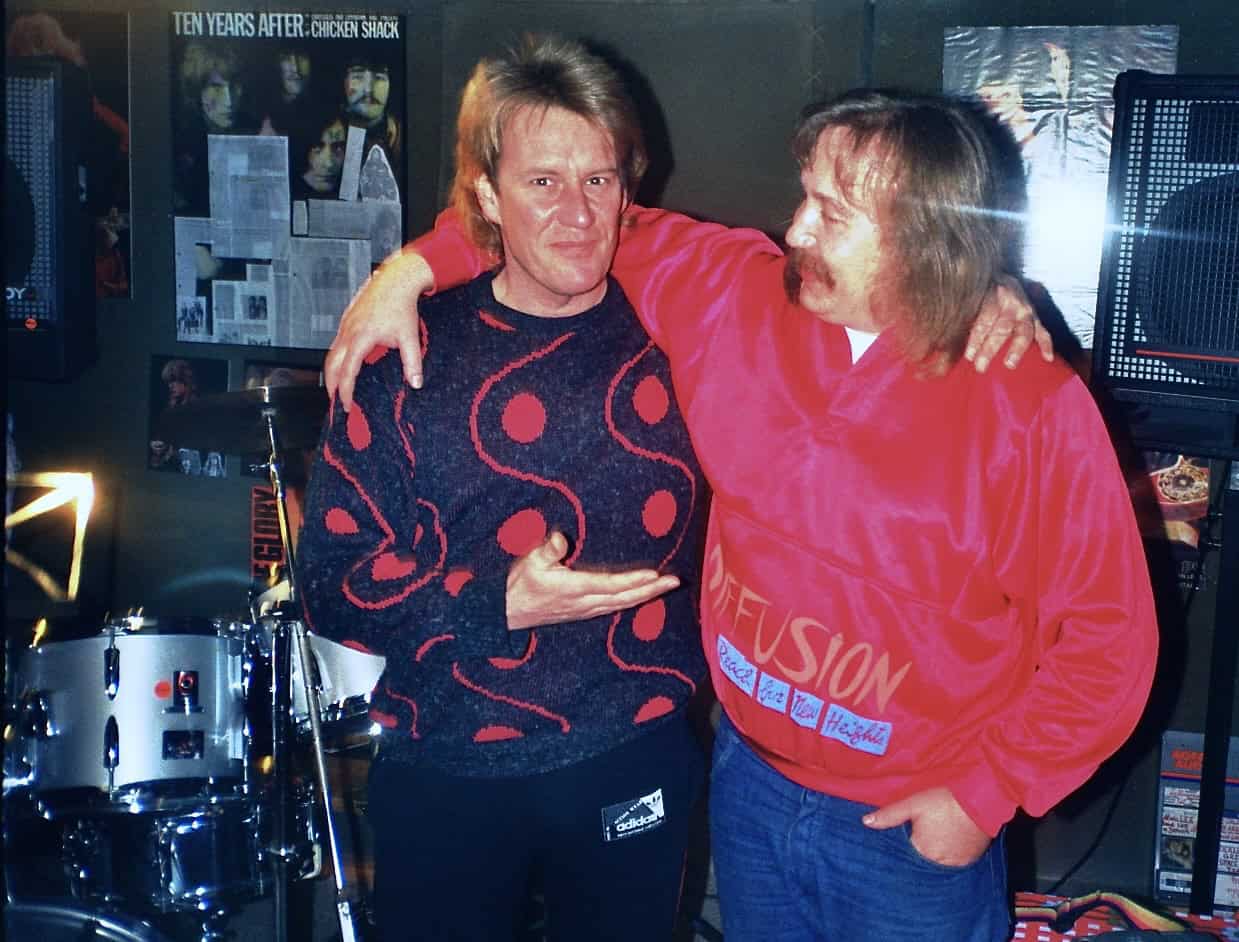

Tour Tickets


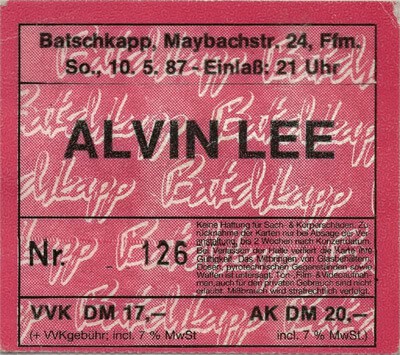
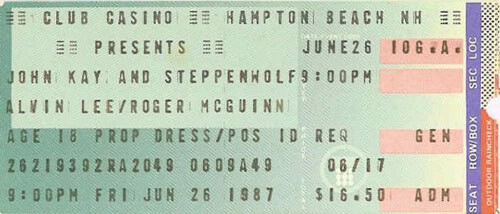
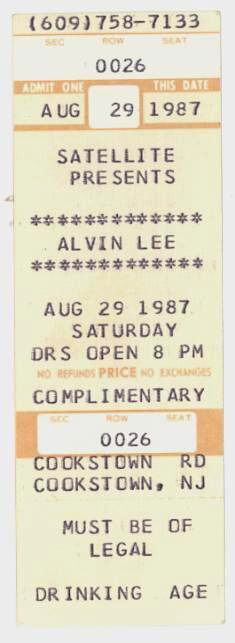
February 28, 1987 – Paradiso, Amsterdam
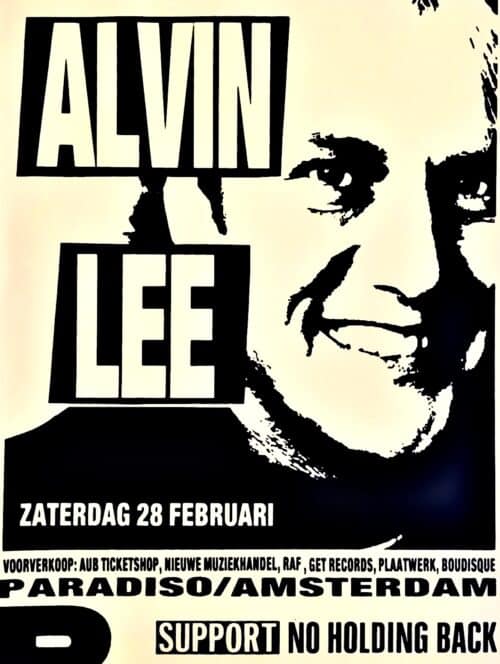
March 25, 1987 – Ottawa, Canada
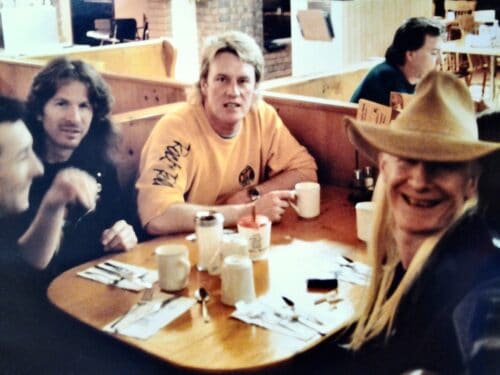
A stop on the road: Steve Gould, Randy Skirvin, Alvin Lee, Johnny Winter
Foto: David
April 3, 1987 – Holiday Star Theatre, Merrillville, Indiana

backstage photo by Rita Ritz
May 2, 1987 – Stadtfest Wien, Austria


photos: Andreas Mayer
Guitarist magazine – April 1987
Contribution by Luky Schrempf
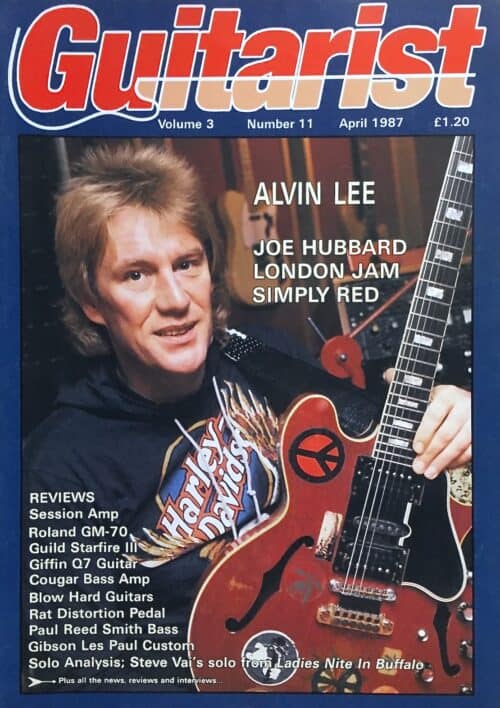
Alvin Lee – Twenty Years After The likes of Eddie Van Halen and Yngwie Malmsteen were still running around in nappies when Alvin Lee was the fastest guitar in the West. With his band – Ten Years After – Alvin captured the hopes of many aspiring string benders, and still continues to do so in the eighties, but he now performs under just his own name. His latest album, “Detroit Diesel”, is just about to be released in the UK having proved a big success in the USA. Bob Hewitt chatted with Alvin about his career and the new album.
The new album is my first one for about five years. I’ve had a long lay-off, because I found myself putting out records I didn’t like very much, mainly because of pressure from record companies to push another album out although I didn’t really have the songs! The previous album was called “Freefall”: it took about six months to come out, and then I found myself touring around the world. I would do a radio station and people would say, “tell me about the new album…” and I would say “Well, I like one of the tracks on it…” So I thought it had to stop; if I was putting out albums I didn’t like, how could I expect anyone else to like them? Basically, I’ve spent the time here in my own studio finding out new techniques and stuff like that. I’ve been doing gigs as well, plenty of them in Europe and the USA, but none in England. I’ve got a three piece working band, which sometimes goes to a four piece when the budget permits! I perform under my own name–not Ten Years After–and I have Alan Young on drums and Steve Gould on bass. Micky Fet played bass on the album, and he is in the occasional four piece outfit, because Steve can also play guitar, keyboards and sing … clever bloke! Basically, I’ve just carried on earning my living as a musician–that’s all I’ve ever wanted to do. I’ve always avoided the “Rock Star” kind of image and have never gone in for gold lame suits and things like that! To be honest, I think it’s quite a privilege to be a working musician, and to make a living out of it. That’s what my heroes have done, like Muddy Waters and John Lee Hooker, they’ve played till they’re 90 or so. Really, that’s all I’ve ever wanted to do, I’m not into getting hit records and retiring at an early age – I’ve tried retiring … it’s boring.
Tell us a little about the new album “Detroit Diesel”.
Well I think it took me a long time to find out which direction I wanted to go in, having had five years off. I’d heard all the new Eddie Van Halens and things, so I thought “How am I going to represent myself?” So I got back to the basic roots, things I like, straight ahead rock n roll blues – I figured I should do what I do best. For people who don’t know what I do, it’s like re-introducing my own style, and it’s probably nearer the old Ten Years After format as far as energy goes, and I like the songs. There is a tendency these days for record companies to want pop songs and hit songs, they are always looking for singles. I’ve always been an album artiste really, and it takes a long time to get a good song and then play it the way you want to play it, and not lose out. Sometimes it can sound commercial and lose some of its ethnic feel and sometimes its ethnic and not very commercial! Now I think I’ve brought the two together. I’ve used computer drums and triggered synthesisers and samplers, those kind of gadgets – really it’s old rock with a new slant!
Most of the work had been done here in your own studio, hadn’t it?
Yes, they are all original demo’s. I kept the same piece of tape and changed bits here and there, overdubbed and built it up. It actually sounds like a live band, but it’s quite high tech.
Who is on the album with you?
There’s a drummer called Bryson Graham, Steve, Alan and Micky from my current band. Tim Hinkley plays some keyboards, and a guy called David Hubbard who is first class with synths. Jon Lord plays Hammond Organ and George Harrison plays slide guitar on a track called Talk Don’t Bother Me. Leo Lyons from the old Ten Years After band plays bass on the title track, Detroit Diesel, and we’ve got Joe Brown playing fiddle on another track with his wife Vicky on backing vocals! Boz Burrell plays bass on one track, in fact, we used to have a band called The Gits about the time Ten Years After was folding up which Boz and myself, Mel Collins on sax and Ian Wallace on drums. That evolved into the In-Flight Band which did the Live at the Rainbow Concert, but it went a little bit too funky and tasty for its time.
The techniques used in making your latest album must be a far cry from the old days, when you first recorded with Ten Years After?
I’ll say! The first two albums from Ten Years After were recorded live in the studio. It was only four track in those days, but even then I had started to get interested in studio work. After the second album, Undead, we basically had our set down so we started experimenting and trying overdubs – all very exciting stuff in those days. Now of course, it’s a more complicated version of that. I still like the straight ahead technique, because I sometimes think today’s technology is just designed to make things take longer, and help the studios make more money! There’s no doubt about it, if you’ve got the songs and you rehearse enough, you should be able to put the album down in a few days. We always used to – those first Ten Years After albums, two days and that was it! …but nowadays bands go to exotic locations in the West Indies, and it takes 6 months or longer! Oh yeah! Keyboard overdubs this year, guitars next year… Scotty Moore is one of my real heroes, and he did some great solos on the Elvis records but he doesn’t like all this overdubbing thing at all. He always went straight onto the master tape. I remember him saying to me `I don’t like those modern recording techniques – what I like to hear goes down, if it ain’t goin’ down, I don’t know what I’m doin’… If you’re really in control in the studio, then you can use the latest technology to the best results–whether it’s done in five minutes or whatever. I remember somebody asking if I wanted to play on a Bo Diddley album, and I thought ‘great’. I went along to the studio and there was just an engineer who played the track and I played my solo. Later some friends said “What was it like to meet Bo Diddley then?”, but I never met him: I’d played on the album but never saw a soul! But I suppose that happens a lot now, you get bands recording who have never actually met each other!
What about a tour to promote `Detroit Diesel?
It’s nearly sorted. I’ve got a few more three piece gigs in Austria and Yugoslavia, then I think it will be the four piece to play the stuff from the album. I want to do gigs in this country, but I’m so out of touch here I don’t know where to start to be honest! England tends to like fads and haircuts rather than music, and I’ve found that the music press are pretty trite and don’t really help anyone. I remember when Ten Years After first came out and we were doing the Marquee, people said `You’ve got to hear this great band! As soon as we had success, the same papers turned dead against us: they wrote about a bunch of big headed gits who play in America all the time. They seem to enjoy putting you on a pedestal and then knocking you off! It’s a shame really, because I don’t think it reflects the audience’s view at all. It’s the view of a narrow minded minority – there’s always a strange faction here in England. I remember during the blues boom – because I was playing at that time – there were blues purists. If you did an Elmore James song and changed a note of the solo, they used to come up to you afterwards and tell you, you hadn’t played it properly. I used to really revolt against that, because you can play what you like as long as it sounded like a blues number. It’s funny you know, they all used to wear long leather jackets and stand around the front of the stage making notes! My musical style seems to have gone right around the houses, because I started out playing jazz and blues, then went into rock, then deeper into jazz and funk. I went off all the Ten Years After numbers – I even refused to play Goin’ Home for about a year! I’ve come back to it all now. I think it’s just a phase you go through, because a lot of artists turn against the numbers they are famous for. I remember Hendrix used to dislike Hey Joe which used to baffle me, because I thought it was a great song, in fact, I do it in my set now and it goes down a bomb!
What happened to Ten Years After – was it just the natural demise of a band?
Well we were together for nearly eight years, which is a pretty good run! After about eleven albums I think we realised we had gone as far as we could. In fact, we overworked in those early years, because every band starting off wants to fill the date sheets – and we worked for six years solid: it was six months in the States, back here for a day off, over to Germany for two months, another day off, then Italy and so on… Suddenly you’re due in the studio for an album, so you think, ‘Better write some songs then!’ We used to write songs in the taxi on the way to the recording session! I think another reason for wrapping it up, was to settle down with our families.
So the last time you all played together was the Marquee Anniversary?
Yes that’s right, followed by the Reading Festival. It was great and I actually thought somebody would say it was good to see Ten Years After together again and suggest we do it again, but nobody seemed to notice, so I let it go.
You had quite a bit of chart success with your early singles…..
Yes, we were in the top five with Love Like A Man and Love To Change The World was pretty big as well. But that was almost a sideline, because they weren’t the strong numbers in the set. We had Goin’ Home and Good Mornin’ Little Schoolgirl, they were the show stoppers at a live performance, but the singles were pulled off the album by the record company.
Talking about the early days, how did your musical career start?
Well, my father used to collect very ethnic blues records, like chain gang and work songs, so that was an early influence. Dad also played a bit on guitar, with my mother and sister, they had a country and western singing band – very small time, local church hall jobs! There was always a guitar lying around–we were a very musical family – but at the age of twelve I started playing the clarinet, although I’m never really sure why, because I didn’t like the thing! With the clarinet I started listening to Benny Goodman music, but I found I was hearing more from Charlie Christian than I was from Benny Goodman. To my parents’ horror, I swapped the clarinet for a guitar and spent a year learning jazz chords–vamping chords and listening to Barney Kessel and Django Reinhardt. Then the rock `n roll explosion hit England from America, and I think Chuck Berry was the one for me – in a way it was all the blues I was used to, melted into rock n roll, so I could understand it. I started playing lead guitar and I didn’t think the jazz chords were much use at all but in fact they came in very useful later on. I never used to copy things note for note, but just get the basic feel, doing it my way, and I think that’s how my style developed. I was Nottingham born and bred and used to play in bands around that area – in fact, I played with my first band, Alan Upton and the Jailbreakers, when I was thirteen years old at the Sandiacre Palace Cinema! Then there was Vince Marshall and the Squarecaps. I used to play lead guitar with that, and I would watch ‘Oh Boy’ on the TV and see Joe Brown and Eddie Cochran. That was the first time I’d ever seen a Bigsby tremolo arm, so I went down to Dad’s shed to make one! I got this metal thing and stuck it on my guitar, went to the gig that night at the church hall. We were doing `Milk Cow Blues. It got around to my big tremolo solo, I got hold of the arm, shook it and broke all six strings!!! Believe me there’s nothing more useless than a guitar with no strings – I just stood there and went Argh!. That first guitar was a Guyatone – Hank Marvin had one for a short while. Then I had a Burns Tri Sonic, which was an awful thing to play, but it had a good jazz sound on the front pickup. After that came a Grimshaw – the sort of poor man’s Gibson – which I traded for my first proper Gibson.
How were Ten Years After formed?
I was with a band called The Atomites. Leo (Lyons) was playing bass. He was the first bass player I met who was keen on Bill Black; in fact, Leo is one of the few players who can make an electric bass sound like a slap stand up. So I was Scotty Moore and he was Bill Black! We used to do That’s Alright Momma and stuff like that. We changed the name from the Atomites to the JayMen, then to the JayCats and then the JayBirds! The JayBirds got to be quite well known in Nottingham in the early 60’s, and that basically was the Ten Years After line up that moved to London. But we still returned to do Saturday night gigs in Nottingham!
…so you more or less turned semi-pro?
Well yes, sort of. You see, I was just waiting to get out of school, because I was playing anyway and I was very lucky with my parents, because I was coming home from gigs at 1 am when I was only 14! I didn’t go into an ordinary job; I’ve been a full time musician since leaving school. At least it meant I could have a sleep-in in the mornings! My parents used to ask when I was going to get a proper job! The third time we went down to London, we got a job in the West End at The Prince Of Wales Theatre, so we were the band in the pub scene of Saturday Night and Sunday Morning. That was quite good, it meant regular money and enabled us to set up in London, but the play only ran for five weeks, so after that we ended up backing The Ivy League on the cabaret circuit. The door really opened for us when John Mayall broke open the blues scene. We did a residency at the Marquee club when we were known as The Bluesyard, but we thought that name would tie us down too much to blues, so we changed it to Ten Years After. The Marquee gig led to the Windsor Festival and then the whole London club circuit.
We got a record deal by word of mouth really. The offer came through to our management for us to make an album–in fact, I think we were one of the first bands to make an album without making a single beforehand. At that time. The music was described as underground and I quite liked that – the fact that you don’t have to dress up to go on stage was great! To be able to go on in a t-shirt and jeans and tennis shoes – that was freedom! We used to wear these little leather things and try to look smart before, and I used to hate all that – although I was an Elvis fan, I would never have dared to wear a lamée suit or anything like that!

How did your superfast technique develop?
Basically it just came from the excitement of playing live – the adrenalin. I used to hear tapes of the band from the mixing desk after a show, and sometimes I couldn’t believe it was me playing! I really didn’t know I could play like that – Ten Years After was all about excitement and energy. I basically played guitar from the hip, an instinct or reaction if you like, because I’m not one for practicing, I’m a jammer. My attitude was to go for it, and on a good night I could get it. I sometimes didn’t know what I was doing and occasionally would mess it up, but I’d bluff my way through with conviction. It’s like the old story – if you play a horrible note, play it again and people will think you meant to do it! I think you improve when you make mistakes; if you play perfectly all the time, then you are playing too much within your boundaries, it’s time to push the boundaries and see how far you can get. All the work in a studio to do an album, that’s real work, but the fun part is going out on the road and playing live!
Talking of playing live, you did some mega gigs…
Woodstock was a particularly good memory for me. It needn’t have been, had it all gone to schedule, because we would have just flown in on the helicopter and then flown straight out again, but there was a thunderstorm just before we were due to go on stage, so we had about three hours to wait. I walked around the audience and around the lake, and really got into it all – fantastic! When the movie of Woodstock came out, about a year after the actual festival, Ten Years After really took off. It was our spot on the movie that accelerated the band up to the 20,000 seater gigs instead of the usual 5,000 seaters. There isn’t much satisfaction playing the big auditoriums though–you can’t hear anything, can’t see anything. You just see the security men, usually with cotton wool in their ears. That doesn’t really encourage you to play your best! To me, the Marquee is what gigs are all about; a thousand people crammed together with sweat dripping down the walls. It’s hot and the music is loud, and you can’t get away from it–that’s really what I like. The American clubs that I do are all like that. They’re slightly bigger than the Marquee, but it’s all back to the blues again and that’s how I cut my teeth.

Have you seen any artistes on your travels who have taken your attention…?
Well I like Mark Knopfler, his style is quite different and foreign to me, but I like that fingerpicking. That’s my hobby style really. I don’t think I could ever do it professionally. I think Gary Moore is probably the hot boy right now, in fact, he came to a gig we did in Ireland on a school roof! I met him about a year ago and he told me he was in the audience in the playground. He was at that impressionable age – while I was watching Chuck Berry, Gary Moore was watching Alvin Lee! He’s a very fine and technical musician – he can play practically anything. It’s good to be a motivator you know. I sometimes hear someone playing my licks – the ones that have become a bit trade-markish – and that’s quite a nice buzz, makes you feel a bit like a teacher. And I think, as you get older, that is one of the best things you could possibly be, to pass on the things you know. Freddy King was one of my favourites – one of the original string benders! It’s a funny thing about string bending, because I started off like Charlie Christian with a 28 gauge wound third string – and there’s no bending them at all! And then I heard Freddy King and it was like a door being opened to me – all these new licks waiting. The same with Chuck Berry – playing solos on more than one note at a time – that was a breakthrough that kept me busy for about a year, exploring all the different combinations. The more you know, it kind of gets slower and slower – the less new things there are to pick up. The hammer-on with the right hand was probably the latest thing, but they’re getting fewer and farther between – I’m happy now to stumble across a new progression, maybe once a month or something.
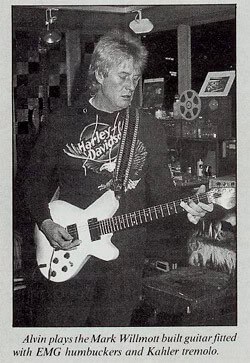
But I notice on a couple of your guitars you have Kahler tremolo systems, and I don’t think we’ve ever seen you use one on stage.
That’s right. Actually I was a bit of purist before I got hung up on them, but I used one in the studio and I wanted to get the same effect live, so I put one on a stage guitar – just in case. But I’m a convert now – put Kahlers on everything, piano, saxophone drums…!!!
Have you done any session work with other artistes or friends?
Well, Gary Moore lives nearby and we’ve had a few jams – but nothing on tape yet. But it’s funny being, for want of a better word, a legendary guitarist, I don’t get as much other work as I’d like. People tend to think “Oh, he doesn’t need any work” so they don’t ask me but, as a matter of fact, I’d love to do it. So I’m putting out a call in Guitarist Magazine–anyone who wants some session work, I’ll do it – and I won’t charge a fortune either!!!
And you have the advantage of owning your own studio…
I’ve been interested in studio technique since the very early days at Olympic – a sort of amateur engineer if you like; I really enjoy it. I get bands in here to do demos – and proper tracks as well, but I’m an amateur engineer because I’d hate for anyone to be relying on me. But occasionally, if I’m not under pressure, I can get really good sounds – but I can’t guarantee! I think having a background knowledge makes you a better recording musician, and it’s taken years because it is only recently that it’s all started coming together, logically. It’s always been a kind of mystery – and that’s what makes it so interesting. In the early studio days you used to go in to record, and they wouldn’t even let you hear it back! They would say `That was fine, now what else have you got… Having this place is great for experiments and ideas; you can just pick up your guitar, switch on and away you go – instead of losing ideas. Really, for a professional musician and a recording musician,
it’s down to the songs and the creativity. Playing is fun and song writing is hard, actually creating music is hard. That’s where the work comes in and where the time is consumed. I’ve probably got about 500 hours of great jams on 16 track; I’ve had all sorts of great musicians down here, but we all play in E for half an hour or A for half an hour. It’s some of my favourite music, but you can’t do anything with it.
Do you try and escape from those common blue keys?
Well yeah, that’s the whole trick. It’s finding something that goes with E that isn’t A – but sounds as natural, that’s the hard thing. You have got to make it flowing and natural and not fall into the three chord trap. Basically I like 12 bar and I like three chords. The thing is to use four chords and that’s where the jazz and the funk got me out of that – an easy way out. I’m still trying to make basic rock n roll sound like 12 bar with three chords – but not use those three chords! I’ve always found that, no matter what you do performance-wise in front of the general public, I’m always aware of what other musicians think. Sometimes there will be one guy in the front row and you can tell he’s a guitarist because his eyes are transfixed on your left hand! Suddenly I think I’d better watch it because this guy is watching me very closely – so I’d better come up with something good here…!
Presumably, when you do a gig nowadays, it’s obligatory to pull out some of the old favourites?
Well, I enjoy it. It’s always been obligatory and I revolted against it for a while. In fact, when I had the In Flight album, I did a set that had no Ten Years After numbers in it at all – I thought I would have a change after 8 years of the same material, so I was playing funky and jazzy stuff with Mel Collins. But I remember going to see Jerry Lee Lewis in Birmingham and he did all country music–no Great Balls Of Fire or any of the well-known stuff and I was really upset. So, from that night on, I thought maybe people who came to see me would be disappointed if I didn’t do the favourites. From then on I’ve never had any reservations about playing them. I mean, if you’re making money, then you’ve got to give people what they like. It’s fine to be a musician but if the public are paying to see you they want entertaining, and you have to play what they want. Actually, that was quite a turn-around for me, because I was quite a reluctant entertainer for most of those Ten Years After years – I used to play a bit begrudgingly sometimes. I mean that happens; you get to the point where you walk on stage and everyone is cheering before you’ve even played a note. Some nights you would play pretty badly, in your own estimation, and nobody would seem to notice – other nights I would play really well and no one would seem to notice either! It’s a difficult pill to swallow: you begin to think `What am I really doing – just being a cardboard cut-out and going on stage to do these songs, like a juke-box. I think that attitude comes from doing too much, because we used to work all the time and had hardly any time to write songs, so the set stayed pretty much the same for about five years! But I’m enjoying it now, because I’m not working to that intense level – I’ve actually enjoyed the last five years touring without an album – it’s been great. You don’t have all those interviews and all that circus thing to do, but the new album is out now so I think I’ve got to go out and work a bit more. But that’s good too, because you’ve got to stretch. I’ve actually found a lot more enjoyment in playing now that I’ve got back to the kind of gigs I like – and the kind of music. It’s just taken me this long to work it all out in my own head. I used to be out on the stage wondering what I was doing it for. Now I know what I’m doing it for, and that means a lot. When there are times that I get a bit rough on the road – and I love being on the road, but there are bound to be times when you think `What the hell am I doing this for? Really, you’ve got to be doing it for yourself because if you’re doing it for other people you start resenting it. If you’re doing it because your manager has made you, then you start not liking the manager, but I have a much more mature attitude nowadays. But getting back to the old numbers, they will all be in with the new set from the Detroit Diesel album – Goin`Home, Good Mornin Little Schoolgirl, and Help Me Baby. They are key numbers in the set, because you have to open with a strong number and then you can play a blues or back off a bit – Schoolgirl is always a lift to start things off. Love Like A Man is a very simple riff that goes down a bomb – I meet lots of people who tell me it’s the first thing they learnt to play on guitar. It’s easy to play, but when you play live it still works. I don’t know why it is, there is no secret in any particular combination of notes, it’s just certain notes together really click. I think you can get over-complex and play something that sounds good to us as musicians, but it goes right over the heads of the audience – it’s what pleases the ears that matters.

Well we are sitting here in your studio Alvin, and I see the room is full of guitars, so you are obviously something of a collector…
That’s right, and here is my famous 1958 Gibson 335 that I bought for £45 in Nottingham – best investment I ever made – even had a fitted case!
How did it come to be covered in so many stickers?
Well, they just got thrown on actually. But when I broke the neck at The Marquee, owing to the ceiling being so low, I sent it back to Gibson for repair and when it was returned, they had lacquered over all the stickers – so they couldn’t come off anyway!

You’ve done some work to the 335 yourself over the years…
Oh yes, I’m a keen dabbler! I’m always changing pickups and re-wiring. The Gibson has the original 1958 PAF humbuckers with the covers removed, and a Fender pickup in the middle to give a bit more top – it’s good for the studio – lots of cut and fizzytop. I used to buy Hofner and DeArmond pickups and mess about with those as well. The 335 is still my main guitar: I think it’s the size of the body–it fits me quite well. I love to play Strats but I prefer to play them sitting down for some reason. I enjoy Les Pauls, but they feel too small and heavy. I’m just used to the 335. I bought this old Strat from a girl in Texas, who took lessons for a week and then put the guitar in the attic, along with this lovely Fender tweed amp.
The whole lot only cost 400 dollars; they didn’t seem to value old guitars so much then. The most I’ve ever paid is 1,400 dollars for this 1958 335, which was lost at the Gibson factory and found later under a pile of old wood. It was cased, so it’s totally unmarked with the most beautiful blonde flamed top – just lost in the factory for twenty years! Dave Edmunds is after it actually… When we were touring the States, my guitar would be in the equipment truck, and I wanted one to play in the hotel room. So at the beginning of each tour, I would go into stores and try find interesting guitars – like this Gretsch Chet Atkins. It’s got a good acoustic sound as well, so I could play it in the hotel room without an amplifier – this was the days before Pignose amps!
When I got home to England, I would just hang them up and buy another one on the next tour and so on. I never really wanted or needed 40 or so guitars, it was just easier than taking them back once you had got an American guitar over to England. I’ve got about six 335’s, including a 12 string, and if I ever find a half decent red one, I’ll get it anyway and try and make it into a stage guitar. My original red 335 has done every gig with me, up until December of 1986, and then the Tokai company came along and measured everything to make an exact replica of it. To finish off I got Mark Willmott, who does my serious guitar work, to fit a Kahler and shave the neck a little. Tokai were going to put this model into production – The Alvin Lee Model – but they have stopped the production of semi-solids at the moment, so it could be another rarity to hang on the wall.
Basically I’d like to get together with some company and get a model into production – I’ve never even had a spare stage guitar, I just take the one and change the strings before the set. If a string breaks, it’s a quick drum solo while I change it! I wanted a Fender six string bass, but ended up with this Rickenbacker which is quite rare and unusual. I’ve got a Wal bass which I like – I’m quite keen on playing bass now.

What about your onstage set up, what happens after the guitar?
Curly lead…!! I tried those radio transmitters once – for about an hour, until one of the crew came along and said ‘Where’s your lead? That’s not rock n roll’. I thought he was dead right, so I scrapped it. I had the radio, but I was still turning around and stepping over an imaginary lead anyway!! It didn’t sound the same as a lead though. You see my guitar is matched perfectly to this old 50 watt Marshall I’ve got; it’s ancient! In fact a guy came down here from Marshall – Mike his name was- – nd he said it was built before his time, he found a component in there he didn’t even know about! I don’t know about pre-amps and foot pedals. I think the answer is to get an amplifier input level that matches your guitar perfectly. I use the 50 watt Marshall full up – I mean people used to think we were loud because I used to use 10 Marshall cabinets one time – but I only had the one 50 watt amp. I liked the dispersion! I tried the 100 watt, but it was too middley I prefer the 50, flat out – it’s great.
You’ve got a Roland guitar synth in the corner…
Yes, it’s a present from George Harrison. He got bored with it – and I got bored with it too. It’s fun. But it’s more of a toy unless you know particularly what you want to get out of it. Then I find you are not playing a guitar like a guitar – it’s easier to use a keyboard to get those sounds.
How did you manage in those early days when there was no such thing as light gauge strings?
Because of my early jazz leanings, I was quite late changing over. I just used a first string on the third or something like that to start with, but I’ve always liked heavy strings. The set I use now are 54, 44, 28, 15, 12, 9. I did a gig with Frank Zappa once and at the end we decided to have a little jam, so I, so I played bass and gave him my guitar – but he couldn’t play it! The action was up a bit and he likes it laying on the frets – one of the things I noticed about Gary Moore, he has a high action and heavy strings. I like a big heavy bass string to hit that with gusto.
What about the guitar you used for the Roger Chapman tracks?
It’s built by Mark Willmott, but we are still working on the shape – it’s not quite right just yet. Actually we need a name for it, so if any of your readers have a good idea let us know. It gives a great sound, and I used a Rockman for the tracks you heard – I think the Rockman covers most needs – clean and dirty. I’ve got some interesting little WEM Dominator amps – 15 watt output with one 12 Celestion – sounds like a stack of Marshalls when you mike them up. For live work though, it’s the 335 – curly lead and the Marshall – no effects!
We’ve got two gentlemen here in the studio who have been your assistants for how long?
Nineteen years! John Hembrow and Andy Jaworski. John is my tour manager and Andy is the sound man – they help with everything – guitars, amps, door hinges, car repairs! We’ve been all over the world together and we’re just off to Yugoslavia and Austria with the three piece, then hopefully when the album is released here, some UK dates. Who knows, we might link up in the Blue Bore Cafe one night on the way up to Newcastle! Just like the good old days… It’s funny, I don’t know where to play in England – like the Universities have probably never heard of me these days – same with the little clubs – it’s difficult.
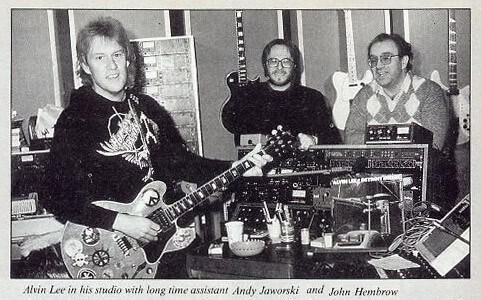
Maybe it’s time to go out and educate the masses again – not Ten Years After but Twenty Years After?
Could be the case – yes!! I think that’s it in a nutshell. I’ve got to get out and about and be seen again – I can’t think of anything better to do anyway – it beats watching television, that’s for sure!
Article written by Bob Hewitt
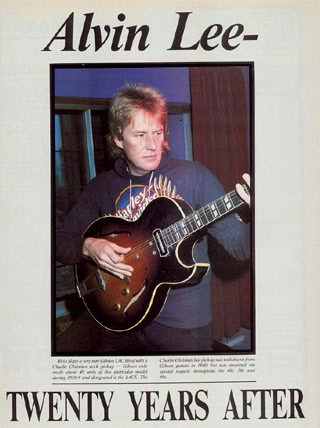


Ear of Newt Review – Alvin Lee in Vancouver, Canada 1987
At the old Expo Theatre on August 8, 1987. Headlining band is John Kay and Steppenwolf.
There are a lot of rock and roll superstars that today’s average rock fan never had the opportunity to see live, either due to drug overdoses (Jimi Hendrix / Tommy Bolin) car crashes (Marc Bolan), plane crashes (Ronnie Van Zandt / Randy Rhoads), or other tragedies.
Then there are those rock heroes that remain alive, but just fade into oblivion, either because their current material is not popular enough, or because they just don’t care. Fortunately for fans of classic British Blues – Rockers, Ten Years After, the heart of that band is still pumping and with the same fury it possessed fifteen years ago. That heart belongs to Alvin Lee, and last Saturday (August 8, 1987) at the Expo Theatre it instilled real life into a crowd of 2,500 fans. When Lee ran onstage, bellowed, “Are you ready to rock `n roll?” and then headed straight into “One of These Days,” it was like being transported back to Chilliwack Junior High School, where we used to spend hours in the parking lot, playing air guitar to 8-track editions of “A Space In Time” and “Ten Years After Recorded Live”.
Lee has not lost any of the dazzling speed that made him such a huge favourite back then, and on “Good Morning Little Schoolgirl” he showed that he can still use a mike stand to play slide. While introducing his version of “Hey Joe”, Alvin noted that, “everybody gets the blues – even on a sunny day”. Then he went ahead and blew those blues away with a killer guitar solo, that he played with a drum-stick. “I’m gonna bring out my old Woodstock guitar for this one”, he announced, before using his trusty red, semi acoustic guitar with peace symbol sticker on it, as he knocked off “I’m Going Home”, tossing in bits of “Blue Suede Shoes”, “Whole Lotta Shakin Going On” and “Hound Dog”. For the encore, Lee played his trade-mark show closer, “Choo Choo Mama” as well as a rowdy version of “Rip It Up”. He never got around to doing “I’d Love To Change The World”, but no one was complaining. There was nothing to beef about, except that Alvin Lee should have been the headliner. That honour went to John Kay and Steppenwolf, and though they also took minds back to the late 1960’s and 1970’s they didn’t do it with nearly the same authority (conviction) as Alvin did. Oh sure, people danced in their seats to tunes like, “Magic Carpet Ride”, “Born To Be Wild” and “The Pusher” but they do that every time the band hits town. For his part, John Kay did look good dressed all in black, with black guitar and shades (sun-glasses), strutting slow and cool the whole time.
The group’s choice of Argent’s “Hold Your Head Up” as an encore went over well with the crowd. However, the new material they previewed from their up-coming album, “Rock and Roll Rebels”, sounded pretty average, and not the least bit rebellious. I would much rather invest in a new copy of “A Space In Time”.
Review by Newt.


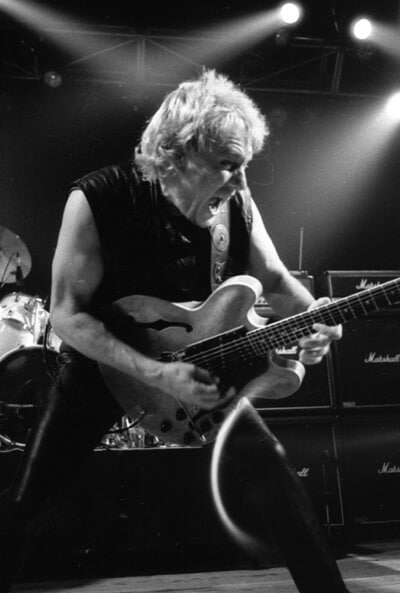
Photos by Jacky Moutaillier