1980


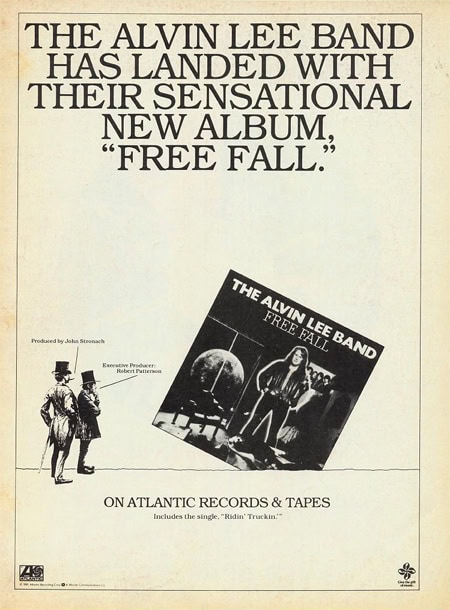
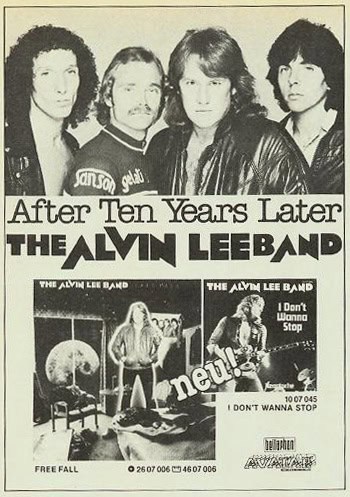
Rock Scene Magazine 1978-1981
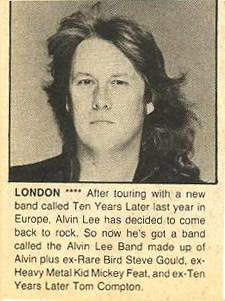
NME – October 11, 1980

Music Week – October 11, 1980

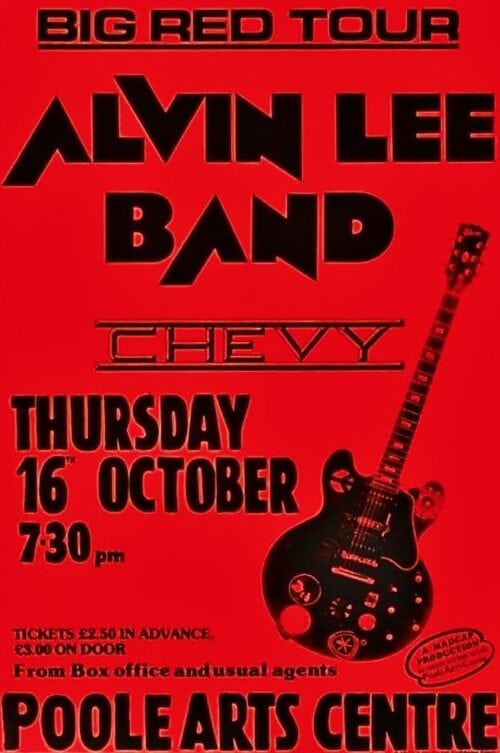
October 16, 1980 – Poole
Music Week – November 22, 1980

“Ciao 2001” magazine (Italy) – December 14, 1980


Translation:
**From our correspondent**
**LONDON.** Alvin Lee, the hero of the mythical Woodstock, “the fastest guitar in the West,” one of the most idolized rock guitarists, today has a wife, a daughter and is 35 years old. Yet he is still “on the road.” After about fifteen years of musical ups and downs with Ten Years After, alone or with the more recent Ten Years Later, Alvin continues as a good rock’n’roller on his pioneering path in contemporary music. Alvin Lee stands on the threshold of the Eighties with a brand-new band, made up of excellent musicians not too young, but with a vitality and freshness that are rare nowadays.
“The Alvin Lee Band” has been around for about six months and, after a long warm-up, the first album, *Free Fall*, has finally arrived, already released in England and scheduled for early January on Ricordi in Italy. With the album also come the tours and, after the USA between the old year and the new, Europe will follow.
The English tour has just ended and the last two dates were a Friday and a Saturday at the Lyceum, a regular meeting place for a lot of British R’n’R. Naturally *Ciao 2001* was present.
The interview took place in the offices of Avatar, the record company of which Alvin is a part owner. Introduced by the very sweet Maxine, absolute mistress of the field at Avatar, we find ourselves facing Alvin and Tom Compton, the hyperactive drummer of the Band.
**2001 —** I heard that your last attempt to come and play in Italy failed — what happened?
**Alvin —** The tour was ready a couple of months ago, but then partly for legal reasons concerning the export of money and partly for some messes created by the promoter, nothing more came of it. It’s a pity because we had a series of dates and new venues on the list that I had never even heard mentioned.
**2001 —** Any other attempts for the future?
**Alvin —** We hope to include some Italian dates in the next European tour that starts in February; perhaps in Italy in April, who knows.
**2001 —** What memory do you have of the Italian concerts of seven or eight years ago, with T.Y.A.?
**Alvin —** It went very well. Ten Years After were very successful in Europe, especially in Germany, and as far as I’m told I still have a good reputation in Italy.
**2001 —** You have a wife and a daughter (4 years old — Ed.). How do you reconcile rock’n’roll and family?
**Alvin —** For me it’s all rock’n’roll, I assure you; I don’t find it difficult to devote myself to music and family at the same time.
**Tom —** Just imagine a guy who has already written a song for his daughter, and sooner or later we’ll record it.
**2001 —** Alvin, I think you must have played “I’m Goin’ Home” at least a thousand times.
**Alvin —** At least!
**2001 —** Aren’t you fed up with it?
**Alvin —** Yes, I got fed up with it once, some time ago, and for a long period we never played it, but then that individual arrived (Tom laughs — Ed.) who one evening in the studio started pounding on the drums and “I’m Goin’ Home” was reborn, took on a new life. And damn it, we had a lot of fun and put it back into the set.
**Tom —** It’s a perfect finale, you can vary it as much as you want, turn it into boogie or fast blues, you can stretch it out and it always satisfies the audience as well as us who play it.
**Alvin —** And then the people who come to our concerts always wait for a bit of the old Alvin Lee; we’ve tried to play only new material, but in the long run it was nonsense, something was missing. “I’m Goin’ Home” is a vehicle, it’s not an end in itself; you can express yourself, there’s all the rock and roll of a generation inside it. I’ll probably play it for another thousand times!
—
### *Free Fall*
**2001 —** In your latest album, *Free Fall*, you worked completely on your own, without keeping any account of critics, public, commercial considerations? In other words, could you finally do what you like, or not?
**Alvin —** No, I don’t think so. Unfortunately you have to take into account all the things I mentioned. You can’t make ten blues and rock’n’roll tracks on two sides. *Free Fall* is certainly not mass rock’n’roll, but I like making music, I like doing things that are more “soft” if you like. For example—
**Alvin —** I would really like not to have any role; I think that even being invested with a certain social responsibility, as a human being I absolutely don’t feel the so-called “expression of my time.” I play and that’s it, I do what I like and what works best for me. I only think I’ve given something to a lot of people, of having placed my brick for R’n’R and that’s enough for me.
**2001 —** Do you read or write music calmly, what you do, your music or your solos?
**Alvin —** No, I’ve never done it and never will. Anyone who reads and writes music soon learns to despise music.
**2001 —** A provocative question: a reunion of T.Y.A.?
**Alvin —** No, certainly not.
**2001 —** Why, did you break up, do you hate each other?
**Alvin —** We simply didn’t have anything more to say.
**2001 —** Tom, your drum kit is immense, it seems like it never ends!
**Tom —** Yes, and it’s not even all of it; there are other pieces, spare parts. Every now and then another branch is added, kind of like a forest. Actually, I remember that at the beginning it was known as the Compton Drum Plantation (the Compton plantation).
—
## The Concert
It took place, as mentioned, at the Lyceum, a former dance hall of cyclopean dimensions, at the back of the Strand, in the heart of the City of London. Alvin arrives a little late; brief introductions and finally the four are on stage. The meaning of “plantation” immediately becomes evident in reference to Tom’s drum kit: the jungle of drums, bass drums, crash cymbals, cymbals and electronic toms would scare Franz Di Cioccio. Alvin seems to have put on weight, a slight double chin, but his gaze, his hair, the white clogs are always the same. The Gibson 335, red, full of stickers, the neck completely worn from use, so familiar, takes us back in time.
Alvin starts rather calmly, almost shyly, two or three songs from the new album; there is also “Ridin’ Truckin’,” really beautiful, perhaps one of the best things done after T.Y.A. Among the very varied audience, but more than thirty years old, there is a handful of Germans and Dutch who shout until the encore of “Goin’ Home.” Listen to the opening attacks of the songs recorded for the double *Live* in Germany and you will find exactly the same atmosphere.
Half an hour passes and finally the evening ignites. Alvin hammers the chords against the microphone stand, the attack of “Sweet Little Sixteen” unmistakable, sounds so memorably familiar. The audience sways. Alvin Lee works hard, sweats, he is no longer twenty years old; the voice comes out powerful, the same as always. Then “Slow Blues in C,” endless; the very fast and masterful “Silly Thing” gives us a moment to breathe, the emotional tension too high. And finally, rhetorically asked “where did you think it was going?”, the answer, a roar: “Goin’ Home.” Hearing it start with that initial cascade of notes, always perfect, always in time, one wonders how he does it, but beyond the technique, the desire to penetrate the mystery, we abandon ourselves for one last run at full speed. It’s an almost twenty-minute race, with a mixed finale: Chuck Berry, Lee Lewis, Presley, the bis, the final farewell, “Choo Choo Mama.” Tom comes down from his drums, Alvin as if by magic has shaken ten years off his shoulders.
**Nicola Bandini**

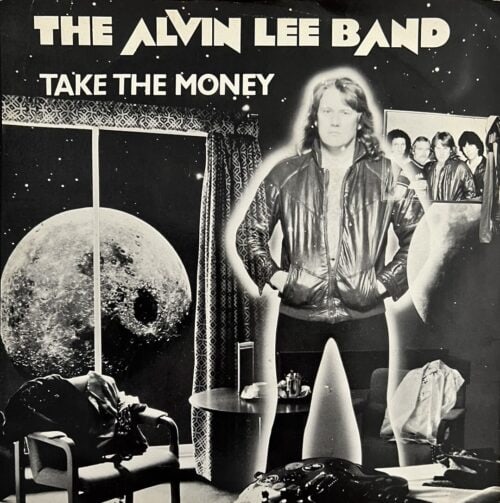
Single Spain – I Don’t Wanna Stop / City Lights
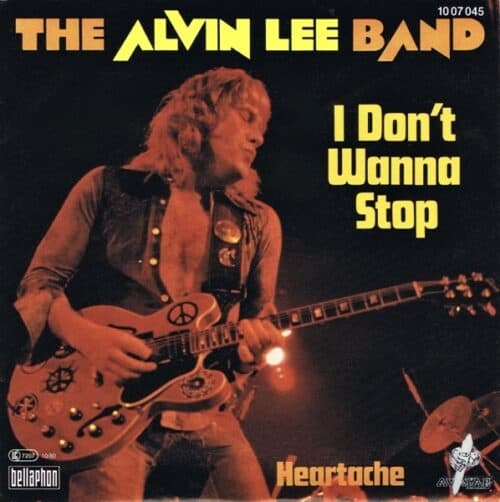
Single – I Don’t Wanna Stop / Heartache

1981
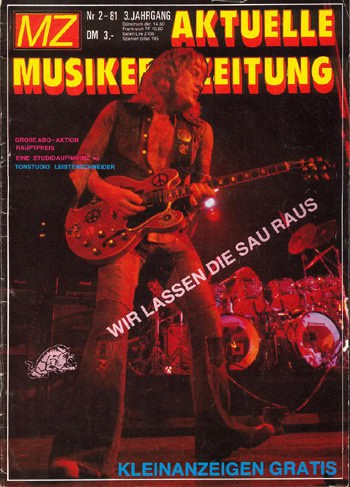
**MZ – Aktuelle Musiker Zeitung, 1981, Nr. 2, 3. Jahrgang**
**Vergiss Die Jahre – Alvin’s tut’s auch…** (Es wird ausdrücklich darauf hingewiesen, dass dieser Artikel etliche Fehlinformationen und teils schräge persönliche Ansichten des Verfassers enthält, wird jedoch der Vollständigkeit halber nicht gekürzt)
Die Katze lässt das Mausen nicht und der Alvin Lee das Rocken nicht. Immer wieder, ganz entgegen dem Boxer-Motto des „they never come back“, taucht dieser Gitarrist der gehobenen Spitzenklasse aus der Versenkung auf. Totgesagte leben länger, gemäß dieser Devise hat sich der einstige Macher und Boss der legendären Ten Years After am Ende des letzten Jahres wieder zurückgemeldet und wieder mal eine Platte vorgelegt.
Etwas fülliger ist er geworden, was man schnell feststellen konnte bei der Sendung des Woodstock-Filmes im Fernsehen vor einigen Tagen, als sich Lee mit seinem Super-Knüller „I’m Going Home“ präsentierte.
Angefangen hatte alles Mitte der 60er Jahre in Nottingham. Ein 20 jähriger, schlagsiger Gitarrist namens Lee zog gemeinsam mit dem Bassisten Leo Lyons durch die dortige Musikszene, spielte in diversen Bands wie „The Atomites“, „The Jaycats“, und „The Jaybirds“, wobei sie im Soge der Beatles auch – allerdings ohne Erfolg – in Hamburg aufkreuzten.
Auf der Suche nach dem Erfolg entstand im Mai 1967 eine weitere Band, in der Lee fleißig mitmischte: Ten Years After. Gemeinsam mit Lyons sowie Schlagzeuger Ric Lee und Keyboardspieler Chick Churchill trat Lee, der am 19.12.1944 geboren wurde, im Londoner Marquee auf, erntete erste Erfolge auf dem 7. National Jazz und Blues Festival in Windsor.
Noch im Jahr 67 entstand die erste LP „Ten Years After“. 1968 gab die Band ihr USA-Debüt und brachte die Live-Platte „Undead“ sowie „Stonedhenge“ heraus, wobei diese einen der Höhepunkte in der Karriere dieser Gruppe markierten.
Musikalisch bewegten sich Ten Years After auf den Spuren alter Blueser, spielten diesen Blues ziemlich hart, ließen Rock-Boogie- und Jazzelemente einfließen. Nicht dank zuletzt von TYA lief in England Ende der 60er ein Blues-Revival ab, das enormen Umfang erreichte.
Der große Durchbruch gelang Lee und Company im folgenden Jahr beim legendären Festival von Woodstock, wo sie mit „I’m Going Home“, das schon auf „Undead“ zu hören war, voll abhausten, diesen Song zu einer Jugendhymne machten. Von da an war dieser Song das Markenzeichen von Lee, der sich mehr und mehr zum totalen Boss von TYA entwickelte, was der Band oft den Vorwurf einbrachte, nur noch Lee’s Begleitmusiker zu sein. 1968 kam „Ssssh“ auf den Markt. Ten Years After – gerüchteweise soll der Gruppenname die Entstehung einer Blues-Band zehn Jahre nach Elvis’ ersten Erfolgen signalisieren – waren etabliert und eine der meistgefragtesten englischen Bands. Markenzeichen der Band waren Lee’s rasende Gitarrenläufe, seine unverkennbaren Riffs, die Ten Years After Songs unverwechselbar machten und später dem Gitarreroft im Wege standen, doch davon später.
Im folgenden Jahr brachten TYA „Cricklewood Green“ und „Watt“ heraus, „A Space In Time“ und „Rock and Roll Music to the World“ folgten in den beiden nächsten Jahren, nachdem die Gruppe die Plattenfirma gewechselt hatten, von Deram zu Chrysalis gegangen waren. Deram brachte 1972 noch „Alvin Lee und Company“ auf den Markt, auf der Lee’s Orgie „Boogie On“ mit einer Viertelstunde Spielzeit enthalten war.
Einen weiteren Höhepunkt stellte dann 1973 das „Recorded Live“ Doppelalbum dar, auf der sich Alvin Lee fast als Alleinunterhalter mit endlosen Soli präsentierte. Schon zuvor hatte die Fachpresse den Engländern – zu Recht – ihre musikalische Unbeweglichkeit zum Vorwurf gemacht. Die Band spielte sich auf ihrer Masche tot, brachten kaum Neues, was auch das 1974er Album „Positive Vibrations“ belegte.
Um den Jahreswechsel 1973–1974 ging Lee dann Solo-Pfade, die Band löste sich auf. Chick Churchill nahm mit „You und Me“ eine Solo-LP auf, auf der auch Leo Lyons und Ric Lee mitmischten. Trotz der Bekanntheit und den Erfolgen, die Ten Years After während ihres knapp siebenjährigen Bestehens aufwiesen, gelang es ihnen nur einmal, einen Single-Hit in den Top-Ten zu platzieren, „Love Like A Man“. Dieser erreichte am 11. Juli 70 Platz sieben in England, drei Wochen später Platz neun in Deutschland. Aber ansonsten – gähnende Leere, was TYA-Single-Hits angeht.
In den folgenden Jahren tat sich Lee sehr schwer, von seinem Image als „fastest guitarist of the world“ wegzukommen, neue Wege und Möglichkeiten zu finden. Dass er sich dabei oft selbst im Weg stand und auch mancherlei Quatsch verzapfte, hat ihm ein Negativ-Image eingebracht, das zum Teil auch heute besteht und ihm nachgetragen wird. Nach der Auflösung von Ten Years After spielte Lee bei Plattenaufnahmen von Splinter (74/75) Jerry Lee Lewis (73) und George Harrison (74) mit und brachte auch eigene LP’s heraus.
Zunächst „On the Road to Freedom“ mit Mylon LeFevre (73), einem kanadischen soullastigen Sänger. Mit vor der Partie waren Steve Winwood, Jim Capaldi, Ron Wood, Mick Fleetwood, Andy Stein (Ex Commander Cody), Reebop Kwaku Baah (Ex Traffic) und Bob Black, ebenfalls von Commander Cody. Heraus kam eine sehr ausgewogene, leicht folkig angehauchte, meist sanfte Platte, eingespielt von hervorragenden Musikern, die sich als echtes Team ohne großen Boss erwiesen. Von der anschließenden Tournee, die er unter Namen „Alvin Lee & Co“ absolvierte, wurde im Londoner Rainbow Theatre ein Live – Mitschnitt gefertigt und als Doppel – LP „In Flight“ auf den Markt gebracht. Mit Musikern wie dem Saxophonisten Mel Collins, Ian Wallace (dr), Tim Hinkley (keyb), Alan Spenner (bg) und Neil Hubbard (g) präsentierte Lee ein ungemein breites musikalisches Spektrum: es waren stark soul- beeinflusste Passagen enthalten, geschickt eingebaute Jazz – Elemente, aber auch der rockige Blues kam nicht zu kurz. Mal dynamisch, voller Power, dann wieder entspannt, locker. Es war voll gelungen und überraschend vielschichtig, was Lee da vom Stapel ließ.
„Pump Iron“ aus dem Jahr 1975, mit derselben Besetzung und einigen weiteren Musikern eingespielt , ging in dieselbe Richtung. Laidback, relaxed, so richtig zum Träumen zumeist, mit ein paar swingenden Boogie -, bzw. bluesigen Stücken. Ein Jahr später kam dann „Sa-guitar“, 1976 – die allerdings nicht mehr lieferbar ist, und über die ich nichts sagen kann, da ich sie nie zu Gesicht bekam.
Im Juni 1977 tourte Lee auch wieder mal durch Deutschland, und er bekam in Offenburg bei „A Summer Festival“ für seinen Gig relativ gute Kritiken. Verrissen wurde dagegen „Let It Rock“, das Chrysalis als Sampler nach seinem Wechsel zu Polydor auf den Markt warf. Abfallmaterial der vorherigen Werke wurde zusammengeschustert und kostete Lee wieder einiges von seinem Renommee, das er sich mühsam wiedererkämpft hatte.
Doch auch seine folgenden Produktionen bedeuteten einen unverständlichen Rückfall in offenbar doch noch unbewältigte Ten Years After Zeiten. Schon der Name seiner neuen Band zeigte, wo es langgehen sollte: Ten Years Later. Sich selbst und seine alten Riffs plagierend, zeigte sich Lee auf „Rocket Fuel“ 1978. Der Auftritt in der Rocknacht im Oktober 1978 unterstrich diesen Eindruck, vor allem die x-te Wiederholung von „Goin’ Home“, das Lee mittlerweile totgespielt hat. Auch auf der nächsten LP „Ride On“, die eine Studio – und eine Live – Seite beinhaltet (mit dem Song vom Heimgehen natürlich) offenbarte es sich, dass Lee nach seinen hoffnungsvollen Ansätzen in den Jahren zuvor doch wieder nur auf der Stelle trat. Lee entwickelte mit Tom Compton am Schlagzeug und Mick Hawksworth am bass zwar viel Power und versprühte viel Energie, aber irgendwie war die ganze Sache zu abgedroschen, um neue Fans anzulocken. Dies muss Lee auch aufgegangen sein, denn es folgte eine längere Pause, in der man nichts von ihm hörte. Nach einem weiteren Wechsel der Plattenfirma (er ging zu Avatar, in Deutschland von Bellaphon vertrieben) und Ende des vergangenen Jahres legte er mit „Free Fall“ seine bisher letzte LP vor. Als Alvin Lee Band mit Steve Gould (Gitarre)und Mickey Feat (Bass) und Tom Compton (Schlagzeug) agierend, erhielt er auch ansprechende Kritiken, die aber alle zwischen den Zeilen den Tenor beinhalteten: gut, wenn man die alten Ten Years After – Zeiten unberücksichtigt lässt.
Alvin Lee’s Spektrum ist wieder breiter geraten: sanfte, balladeske Songs, mit einem würzigen Schuss Pop (durchaus positiv gemeint) wechseln mit blueslastigen Stücken und auch richtig fetzende und rockende Kracher sind auf dem Album enthalten. Dass das Feeling des rockigen Rhythm und Blues noch heute durch seine Adern jagt, beweist er eindrucksvoll (u.a. „Ridin’ Truckin’“).
Es wurde ja auch Zeit, dass dieser Gitarrenheros wieder einmal im positiven Sinne von sich reden macht. Schließlich hat der mittlerweile fast 36jährige oft genug bewiesen, wie gut er sein kann.
Philipp Roser / MZ – Musiker Zeitung
TRANSLATION
**MZ – Aktuelle Musiker Zeitung, 1981, No. 2, 3rd year**
**Forget the Years – Alvin Does Too…** (although the article contains in places erroneous information and opinionated statements it is reproduced here as it is quite comprehensive)
The cat doesn’t give up mousing, and Alvin Lee doesn’t give up rocking. Again and again, completely contrary to the boxer’s motto “they never come back,” this top-class guitarist resurfaces from obscurity. Those pronounced dead live longer; in keeping with this maxim, the former driving force and boss of the legendary Ten Years After made his return at the end of last year and once again released a record.
He has become somewhat fuller, something that could quickly be noticed during the television broadcast of the Woodstock film a few days ago, when Lee presented himself with his super smash hit “I’m Going Home.”
It all began in the mid-1960s in Nottingham. A 20-year-old, lanky guitarist named Lee moved through the local music scene together with bassist Leo Lyons, played in various bands such as “The Atomites,” “The Jaycats,” and “The Jaybirds,” and in the wake of the Beatles they also showed up in Hamburg—albeit without success.
In the search for success, another band emerged in May 1967, in which Lee was heavily involved: Ten Years After. Together with Lyons as well as drummer Ric Lee and keyboard player Chick Churchill, Lee, who was born on 19 December 1944, appeared at London’s Marquee and reaped first successes at the 7th National Jazz and Blues Festival in Windsor.
Still in 1967, the first LP *Ten Years After* was released. In 1968 the band made its U.S. debut and released the live album *Undead* as well as *Stonedhenge*, which marked some of the high points in the group’s career.
Musically, Ten Years After followed in the footsteps of old bluesmen, played this blues quite hard, and incorporated rock-boogie and jazz elements. Not least thanks to TYA, a blues revival took place in England at the end of the 1960s, reaching enormous proportions.
The big breakthrough came for Lee and company the following year at the legendary Woodstock festival, where they tore the place apart with “I’m Going Home,” already heard on *Undead*, turning the song into a youth anthem. From then on, this song was Lee’s trademark, as he increasingly developed into the total boss of TYA, which often earned the band the accusation of being merely Lee’s backing musicians. In 1968, *Ssssh* came onto the market. Ten Years After—rumor has it that the group’s name was meant to signal the emergence of a blues band ten years after Elvis’s first successes—were established and one of the most in-demand English bands. Hallmarks of the band were Lee’s frenzied guitar runs and his unmistakable riffs, which made Ten Years After songs instantly recognizable and later stood in the guitarist’s way—but more on that later.
In the following year, TYA released *Cricklewood Green* and *Watt*; *A Space in Time* and *Rock and Roll Music to the World* followed in the next two years, after the group had changed record labels, moving from Deram to Chrysalis. Deram released *Alvin Lee and Company* in 1972, which included Lee’s orgy “Boogie On,” with a playing time of a quarter of an hour.
Another high point came in 1973 with the double album *Recorded Live*, on which Alvin Lee presented himself almost as a one-man entertainer with endless solos. Even earlier, the specialist press had—rightly—accused the Englishmen of musical stagnation. The band played itself to death on its formula, brought hardly anything new, which the 1974 album *Positive Vibrations* also demonstrated.
Around the turn of the year 1973–1974, Lee then went his solo way, and the band broke up. Chick Churchill recorded a solo LP, *You and Me*, on which Leo Lyons and Ric Lee also took part. Despite the fame and successes that Ten Years After achieved during their nearly seven-year existence, they managed only once to place a single hit in the Top Ten: “Love Like a Man.” It reached number seven in England on 11 July 1970, and three weeks later number nine in Germany. Otherwise—yawning emptiness as far as TYA single hits are concerned.
In the years that followed, Lee found it very difficult to shake off his image as the “fastest guitarist in the world” and to find new paths and possibilities. The fact that he often got in his own way and also spouted quite a bit of nonsense earned him a negative image, some of which still persists today and continues to be held against him. After the breakup of Ten Years After, Lee played on recording sessions for Splinter (74/75), Jerry Lee Lewis (73), and George Harrison (74), and he also released his own LPs.
Initially there was *On the Road to Freedom* with Mylon LeFevre (73), a Canadian singer with strong soul influences. Also involved were Steve Winwood, Jim Capaldi, Ron Wood, Mick Fleetwood, Andy Stein (ex-Commander Cody), Reebop Kwaku Baah (ex-Traffic), and Bob Black, also from Commander Cody. The result was a very balanced, slightly folk-tinged, mostly gentle album, recorded by excellent musicians who proved themselves to be a real team without a dominant boss. From the subsequent tour, which he undertook under the name “Alvin Lee & Co,” a live recording was made at London’s Rainbow Theatre and released as the double LP *In Flight*. With musicians such as saxophonist Mel Collins, Ian Wallace (drums), Tim Hinkley (keyboards), Alan Spenner (bass guitar), and Neil Hubbard (guitar), Lee presented an extraordinarily broad musical spectrum: there were strongly soul-influenced passages, cleverly integrated jazz elements, and plenty of rocking blues as well. At times dynamic and full of power, then relaxed and loose again. What Lee delivered here was thoroughly successful and surprisingly multifaceted.
*Pump Iron* from 1975, recorded with the same lineup and a few additional musicians, went in the same direction. Laid-back and relaxed, mostly perfect for dreaming, with a few swinging boogie and bluesy numbers. A year later came *Sa-Guitar* (1976), which is no longer available; I cannot comment on it, as I never got to see or hear it.
In June 1977, Lee toured Germany once again, and he received relatively good reviews for his gig at “A Summer Festival” in Offenburg. In contrast, *Let It Rock* was torn apart by critics. Chrysalis released it as a sampler after his move to Polydor. Leftover material from earlier works was cobbled together, costing Lee once again some of the reputation he had painstakingly rebuilt.
However, his subsequent productions also represented an incomprehensible relapse into what were evidently still unresolved Ten Years After days. Even the name of his new band showed where things were headed: Ten Years Later. Plagiarizing himself and his old riffs, Lee appeared on *Rocket Fuel* in 1978. His appearance at the Rocknacht in October 1978 reinforced this impression, especially the umpteenth repetition of “Goin’ Home,” which Lee has since played to death. The next LP, *Ride On*, which contained one studio side and one live side (naturally including the song about going home), also revealed that after the hopeful approaches of previous years, Lee was once again merely treading water. With Tom Compton on drums and Mick Hawksworth on bass, Lee generated plenty of power and energy, but somehow the whole affair was too worn out to attract new fans. Lee must have realized this himself, because a longer break followed during which nothing was heard from him. After another change of record label (he moved to Avatar, distributed in Germany by Bellaphon), he released *Free Fall* at the end of last year, his most recent LP to date. Performing as the Alvin Lee Band with Steve Gould (guitar), Mickey Feat (bass), and Tom Compton (drums), he received respectable reviews, but all of them implicitly carried the same message: good—if one ignores the old Ten Years After era.
Alvin Lee’s range has broadened again: gentle, ballad-like songs with a spicy dash of pop (meant positively) alternate with blues-heavy tracks, and the album also includes truly rousing, hard-rocking numbers. That the feeling for rocking rhythm and blues still courses through his veins today is impressively demonstrated (e.g., “Ridin’ Truckin’”).
It was high time that this guitar hero once again made positive headlines. After all, the now almost 36-year-old has proven often enough just how good he can be.
Album Release “RX5”
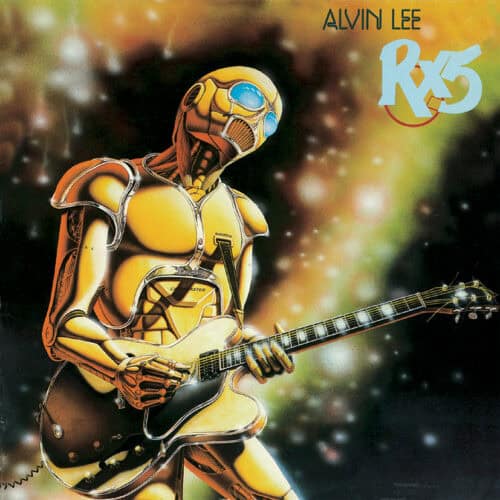
Released in November 1981, RX5 is Alvin’s ninth solo album (with the bonus track “Shuffle It” added on the re-release), featuring eleven tracks in total. It was his second recording for Atlantic Records. This is no blues album, but rather a diverse and confident blend of high-quality mainstream rock and roll, with a ballad or two included for good measure.
Alvin’s songwriting has rarely been stronger, and the guitar work is consistently exceptional — played with both precision and genuine emotional weight.
It’s an album that reveals itself as a winner the more often you play it, especially when you take the time to really listen to what’s going on.
A hit album that never was — but one that truly deserved to be.

Single (Spain)
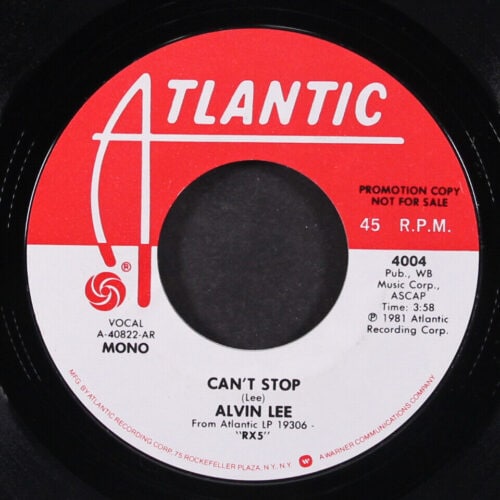
Promotion Single
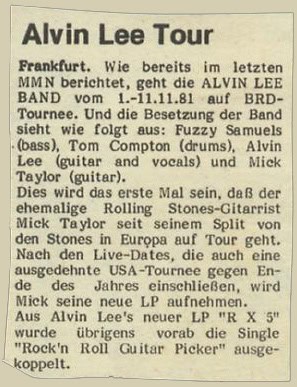
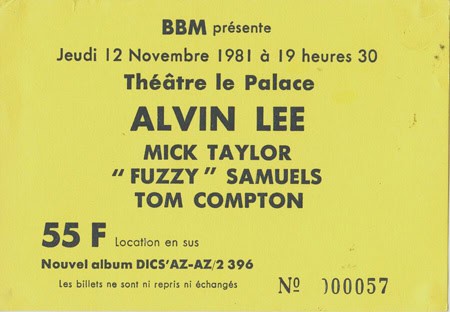
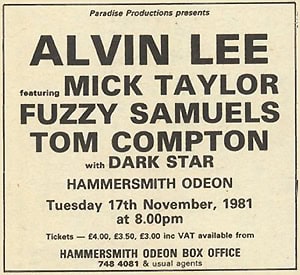
Alvin Lee and Mick Taylor
Autumn of 1981 – European and North AmericanTour
Alvin Lee – guitar / vocal
Mick Taylor – guitar
Fuzzy Samuels – bass guitar
Tom Compton – drums

tour t-shirt
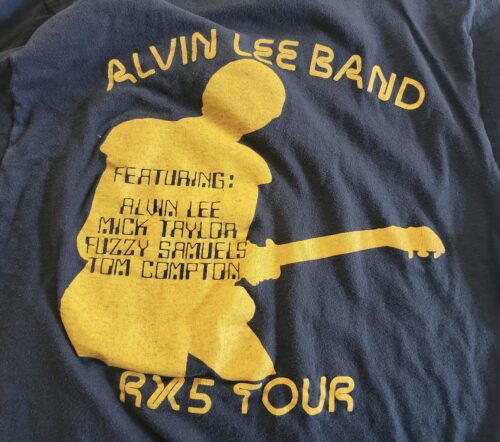
October 26 through November 14
Mick Taylor hooks up with the Alvin Lee Band for a tour that brings them to Italy, Germany, France and the UK before heading to North America.
It should also be noted here, that Alvin and Mick did some recording at Alvin’s Space Studios in Buckinghamshire, England. These are as yet unidentified / unfinished and unreleased recordings.

October 28, 1981 – Milano, Italy
Photos by Fabio Treves

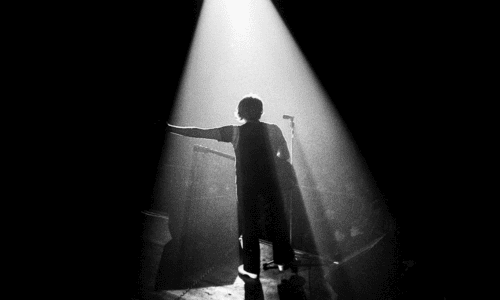
October 29, 1981 – Teatro Tendastrisce, Rome, Italy


Photographer: Luciano Viti


November 19 through December 21
The Alvin Lee Band joines Black Sabbath on their 1981 “The Mob Rules” tour as their opening act.
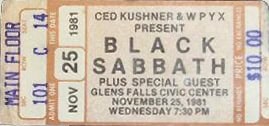
At the Glens Falls Civic Centre on November 25, 1981 – all the radio and newspaper announcements said Black Sabbath with special guest, with no mention of Alvin Lee or band members. The venue is a Hockey Rink, and not at all conducive for a rock concert, or any musical event for that matter. The sound echoes off of every metallic thing in the place. You get a wall of distortion that’ll make your head ring days later. It’s beyond uncomfortable, it’s damn painful. I know this first hand, having seen Jethro Tull there. Also noted here, this was the tour where Mick jumped the Alvin Lee ship and joined The Rolling Stones in Kansas City at the Kemper Arena show (Nov 30). It was Keith Richards who personally invited Taylor to be a part of the Rolling Stones.
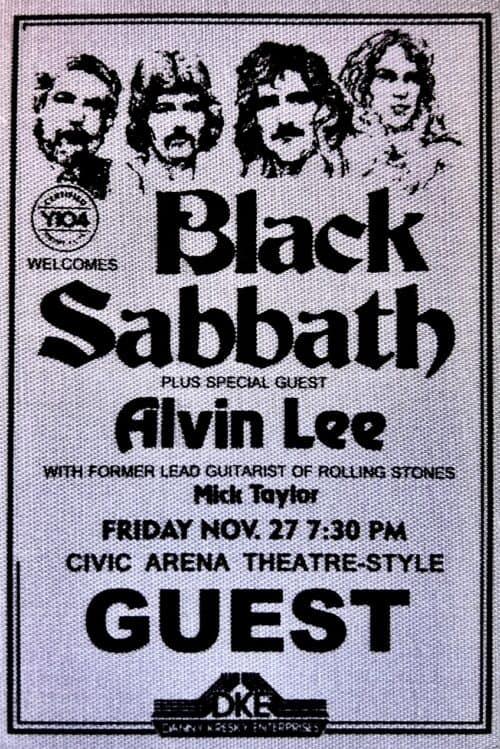
Backstage pass
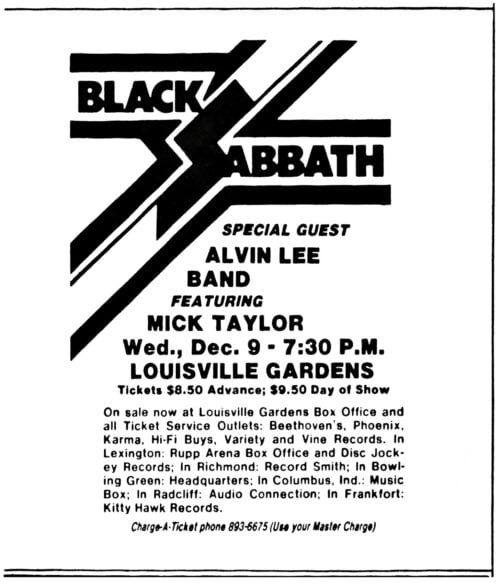
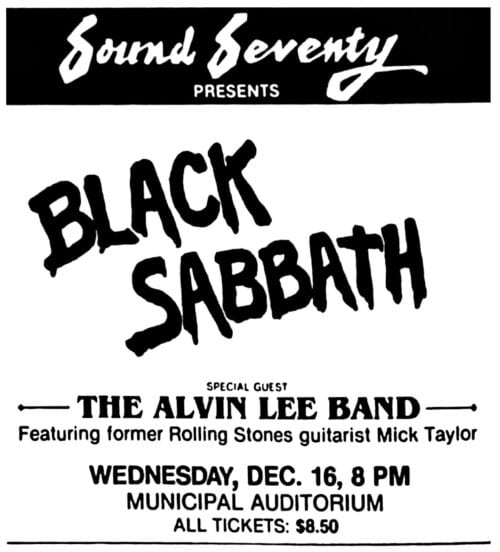
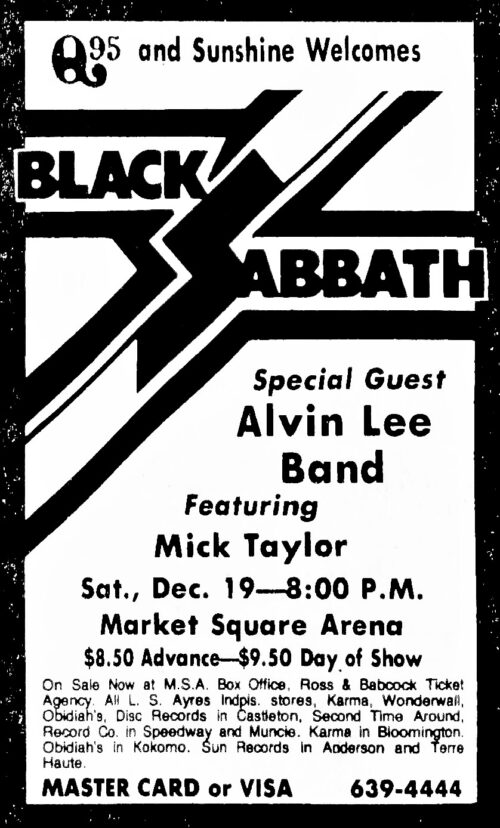
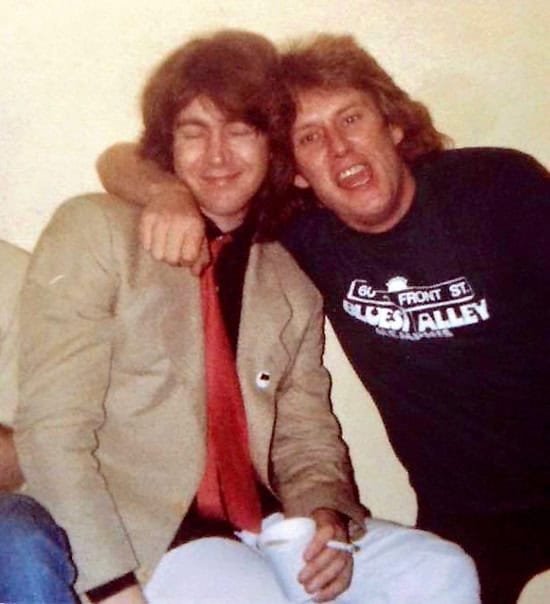
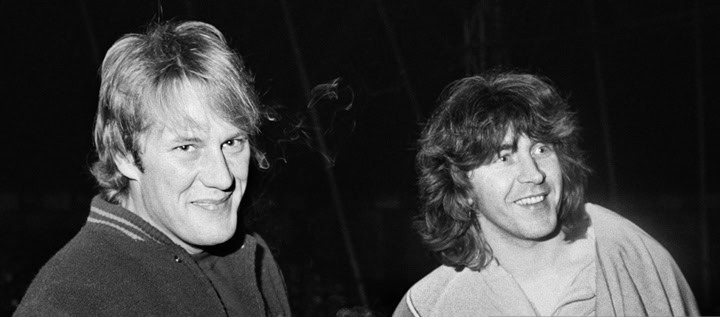
Alvin Lee and Mick Taylor
CIAO 2001 magazine (Italy) – November 29, 1981

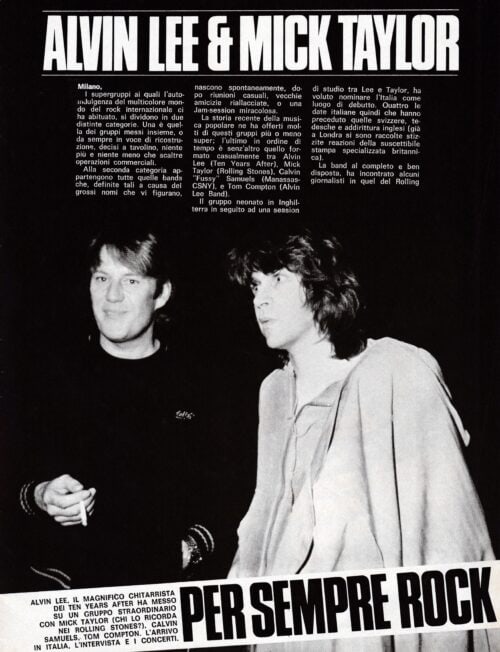
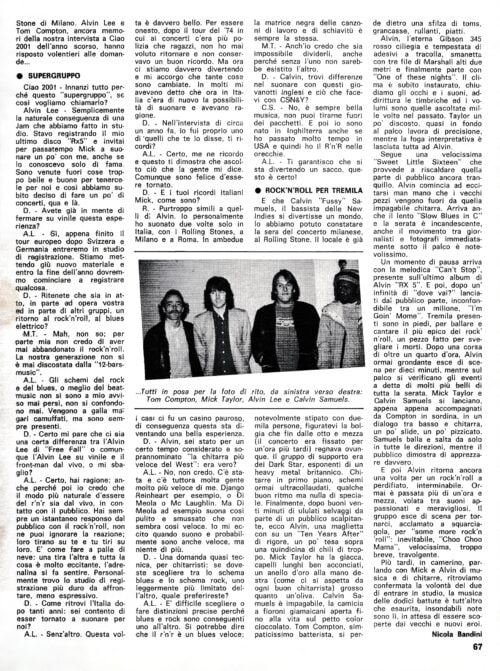
TRANSLATION:
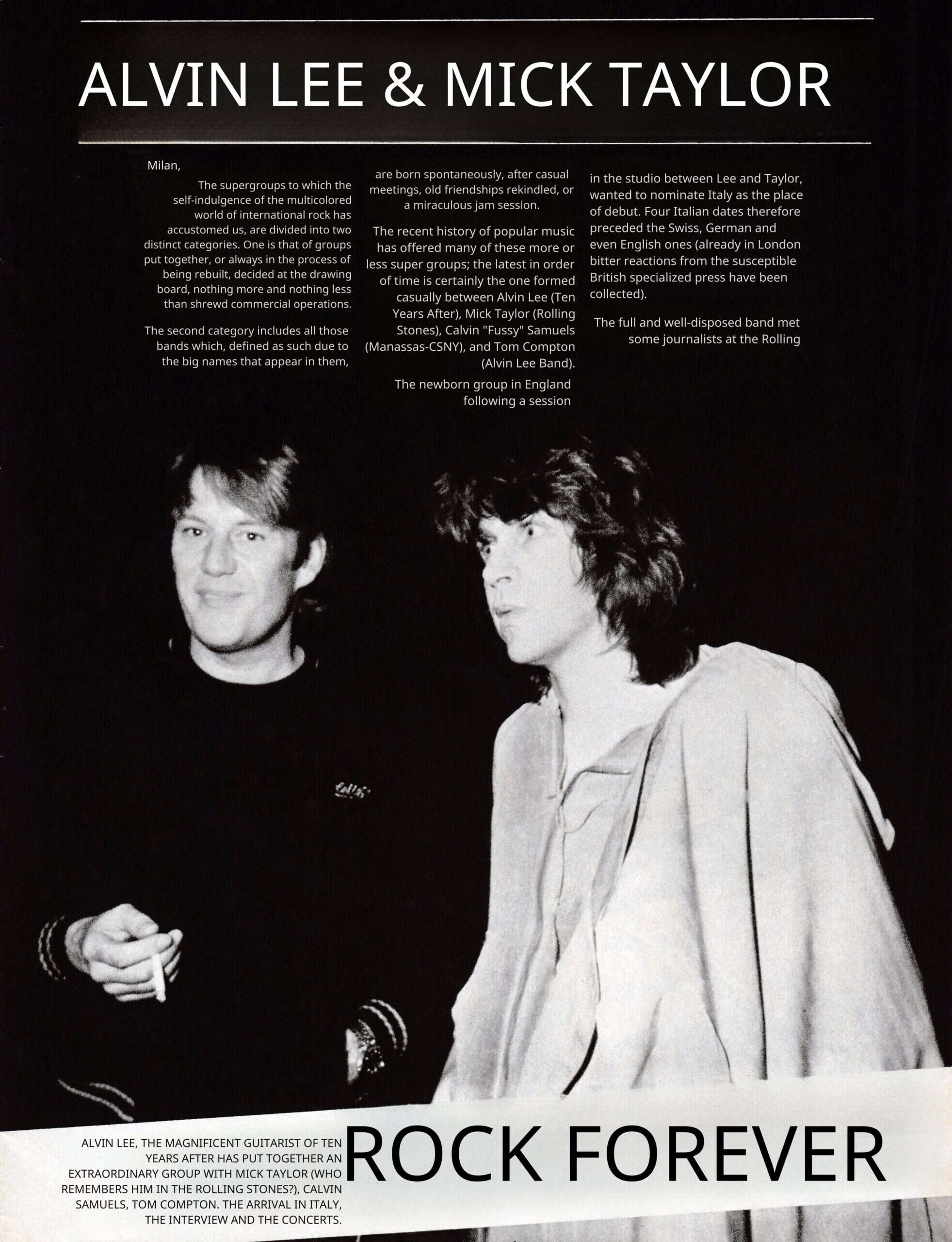
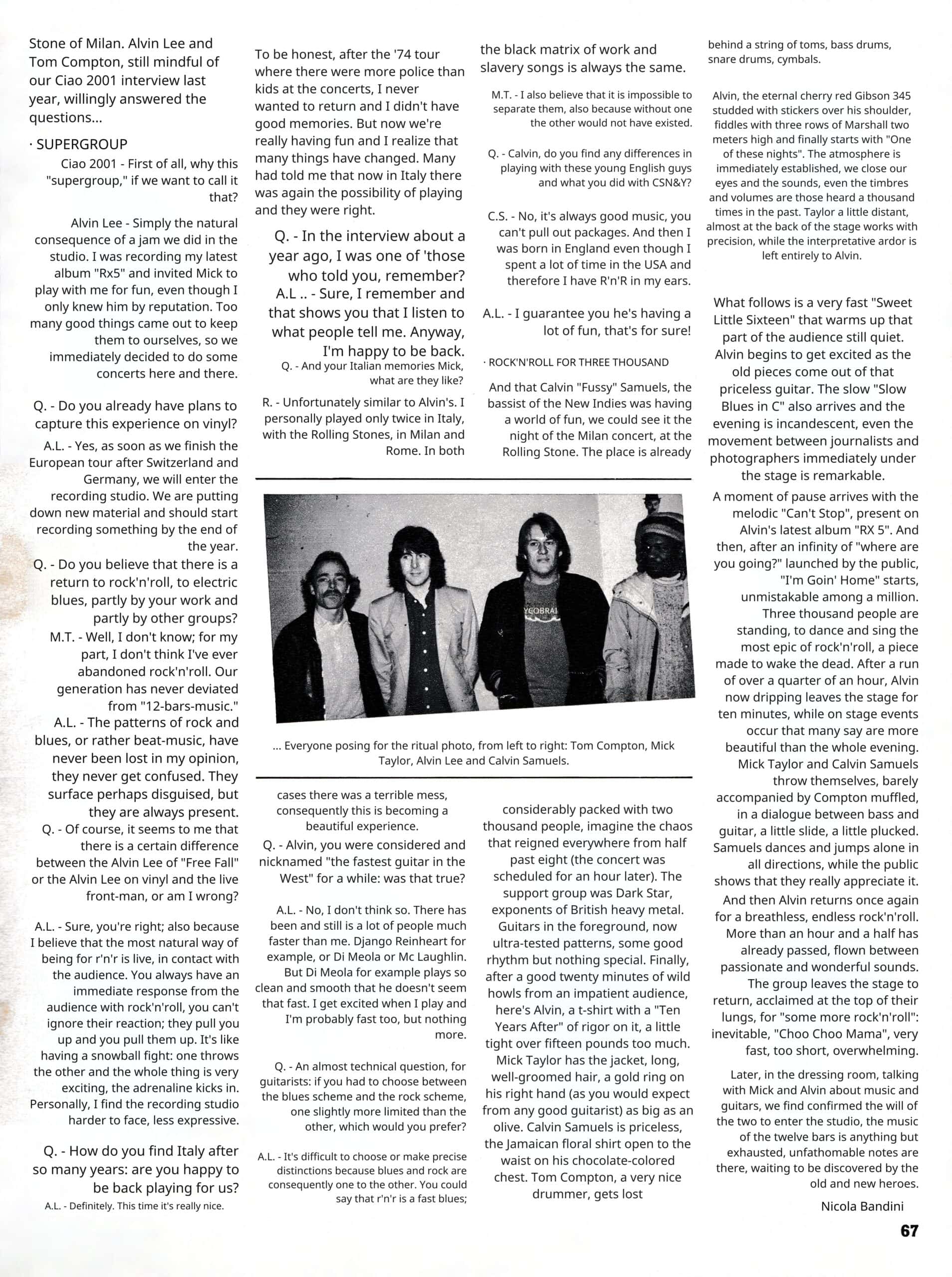
click to enlarge
December 20, 1981 – International Amphitheatre, Chicago, IL
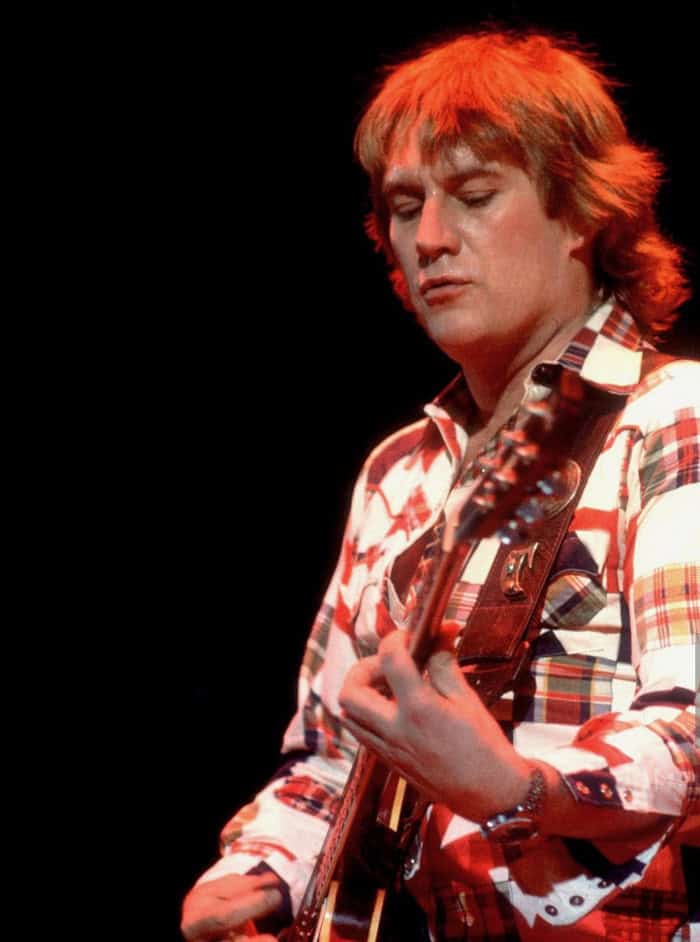
Photographer: Paul Natkin
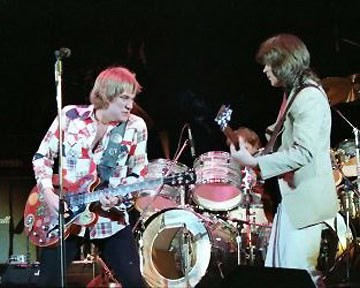
1982

Gas Tank (UK TV show)
‘Gas Tank’ (1982–1983) was a refreshingly raw and energetic television music show that aired on Channel Four in the U.K. Hosted by Rick Wakeman, the program captured the spirit of early-1980s rock culture with an immediacy few shows of the time managed to achieve. Its format was informal and inviting: set in a bar-room style studio, Wakeman would interview guest artists over a drink or two, before they performed live with him and his house band in front of a small studio audience seated in groups at tables. The performances ranged from pre-arranged versions of classic songs to entirely new pieces created just for the show, giving each episode a unique and spontaneous energy.
What set ‘Gas Tank’ apart was its willingness to spotlight artists who lived on the edge of the mainstream — performers driven more by urgency and authenticity than commercial calculation. Rick Wakeman frequently cited the show as “the perfect opportunity for musicians from different bands to work together,” highlighting the collaborative spirit that defined the series. Notably, the episodes featuring Alvin Lee showcased his exceptional guitar work and enduring passion for rock and blues, offering viewers a rare glimpse of a seasoned artist still very much alive in his craft. These appearances added a compelling blend of veteran expertise and raw energy, perfectly embodying the show’s commitment to honest, unvarnished music.
Viewed today, ‘Gas Tank’ stands as a compelling document of its time: bold, unapologetic, and rooted in the belief that rock music works best when it is loud, honest, and slightly dangerous. Rather than smoothing out the rough edges, the show embraced them — and that commitment to authenticity, spontaneity, and musical camaraderie is precisely what gives ‘Gas Tank’ its enduring appeal.
EPISODES:
Alvin Lee at Gas Tank TV Show, Episode 5
playing with the house band feat.
Rick Wakeman – Keyboards
Tony Ashton – Piano
Chas Cronk – Bass
Tony Fernandez – Drums
Rock And Roll Guitar Picker / I Maybe Wrong But I Won’t Be Wrong Always
includes a interview with Alvin Lee
other guests are Suzy Quatro, Ian Paice and Steve Hackett
recorded at Ewart Television, Wandsworth, England, broadcast on Channel 4
Alvin Lee at Gas Tank TV Show, Episode 1
playing with Eric Burdon:
‘Trying To Get Back To You’ by Rose Marie McCoy & Charles Singleton in 1954, famous by Elvis Presley in 1956
Medley feat. ‘Lawdy Miss Clawdy’ by Lloyd Price in 1952 / ‘Be Bop A Lula’ by Gene Vincent & Bill ‘Sheriff Tex’ Davis in 1956
Alvin Lee at Gas Tank TV Show, Episode 3
playing with Chris Farlowe
‘Call It Stormy Monday (But Tuesday Is Just As Bad)’ by T-Bone Walker in 1947
‘Lucille’ by Richard Penniman & Albert Collins in 1956, famous by Little Richard in 1957
additions to the house band are Rick Parfitt (Status Quo) & Ian Paice (Deep Purple)
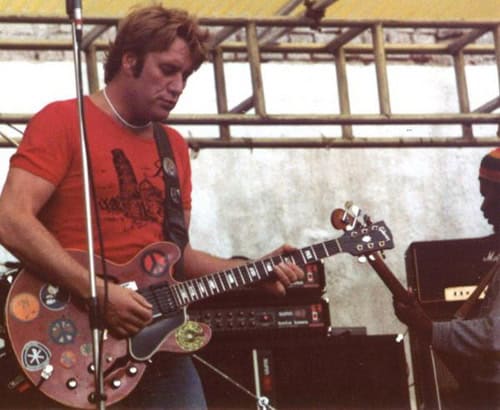
Alvin Lee ‘live in Austria’
May 13, 1982 – Majski Rock Blues Festival, Beograd, Serbia

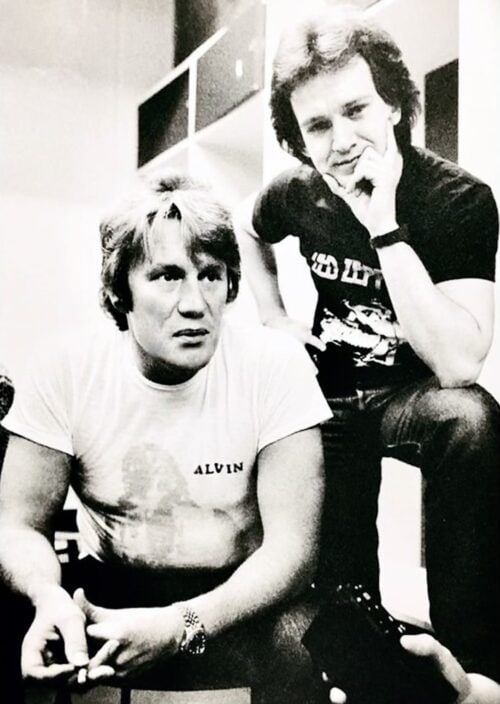
Alvin with photographer Brian Rasic
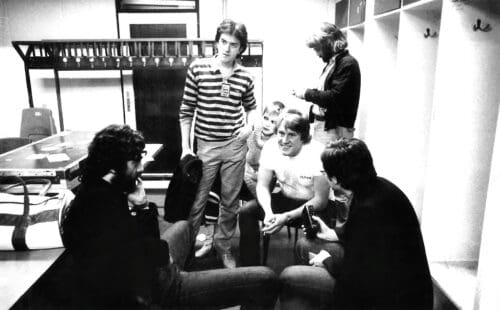
photos: Brian Rasic
July 20, 1982 – Nyon, Switzerland
photos by the festival photographer (name unknown)
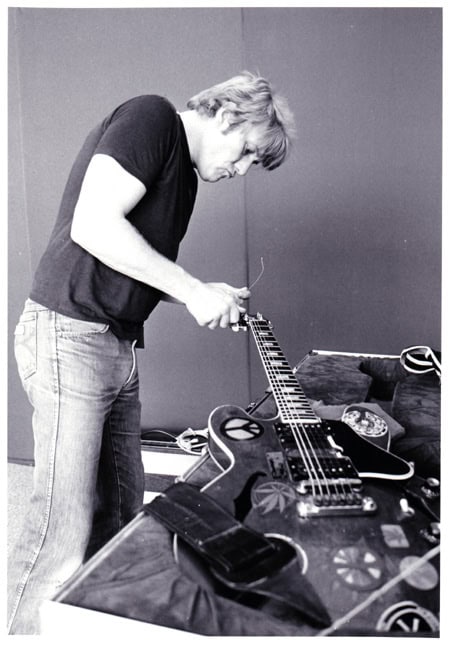



Musica & Som No. 74 July/August 1982 – Portugal


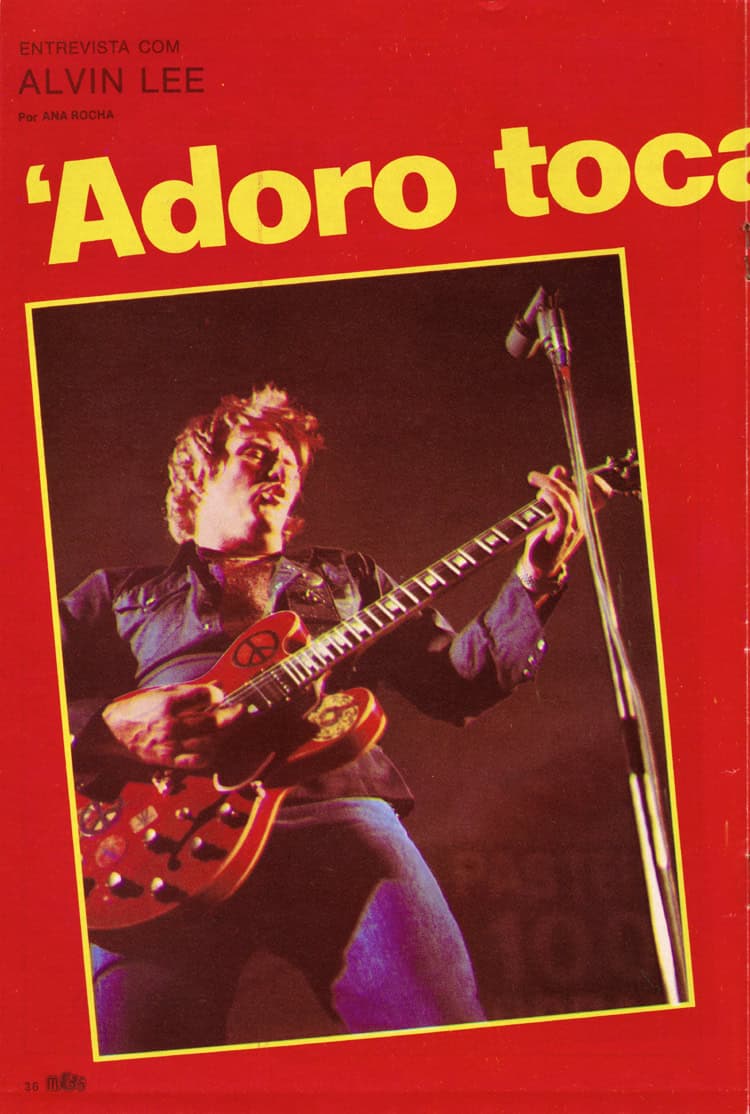


TRANSLATION (by AI):
## **ALVIN, THE MAGNIFICENT**
A certain expectation, tinged with excitement, hovered in the air. When the lights went out and he appeared on stage, red guitar in hand, the safety barriers placed in front of the stage were suddenly pressed in by the small crowd that moved toward the Pavilion of the Belenenses, on a warm June night.
Most of these kinds of scenes often happen without warning at Rock ’n’ Roll concerts, in their origins, usually when one finds a particular type of individual endowed with a certain presence, a certain magnetism that is difficult to define, but always effective. This time, that individual was called **Alvin Lee**. He carried with him the entire mythical charge of a guitar hero, a species in danger of extinction…
Lisbon, 1982, a warm Friday night. Alvin Lee is in the city and there is a certain expectation to see live one of the most silent legends of Woodstock. Calvin “Fuzzy” Samuel (formerly with Stephen Stills’ band and CSN&Y) on bass, and Tom Compton on drums, are ready. When the stage lights come on, Lee greets the audience vaguely and launches decisively into the first song of the night. A little cold.
As he takes the pulse of the crowd, still describing those vague faces that gather before him. From the very first note, well up high, as always outside, even in Ten Years After’s later days. In any case, that electrifying torrent of decibels seems to be an indispensable condition not only for the audience, perhaps, but above all for the guitarist himself. He is in his element, in his way of playing. In fact, Lee was never a musician capable of instantly reaching a transcendent level of feeling—indispensable in any kind of music.
However, with the precious help of the demolishing rhythm of the Samuel/Compton duo (with Ric Lee/Leo Lyons at other times), he progressively finds his way, laboriously building, note by note, so as to suddenly disarm the listener’s state of mind, allowing him to ascend to privileged moments, taking behind him his audience. At the margin of each theme, at the margin of each solo, a process parallel but autonomous in relation to the events unfolding around him, everything gradually passes in this way, until the climax.
He achieves it in full creative frenzy, swept away by the magnificent—a little god of excess. To conquer or die. To play until exhaustion. To touch the edge of one’s own limits. To find contact, to shape empathy, to establish communication before the final explosive and infernal outburst—until he reaches it.
And Alvin Lee reaches it. Quickly.
With the sensory effort of someone who is very used to doing it. In a short time, he grabs the audience, asserts himself over it, and leads it. With the first objective achieved, a second phase of the ceremony begins—to revive the memory of unforgettable themes, fabulously played. First, “Love Like a Man,” a classic composition from TYA, which definitely raised the concept to a higher level. A vague murmur in the room, when the first notes are heard.
It is important here to pause briefly to stress that, in certain aspects, Alvin Lee’s music approaches and evokes hard rock (or heavy metal, if you prefer…). It differs from it, however, due to the rare use he makes of distortion. Quite the contrary of the noisy channel of the aforementioned sonic plague (with evident envy), Lee has always preferred clarity and precision, filling space almost exclusively through the infinite multiplication of notes and not simply through their prolongation.
Undoubtedly, clichés and repetitions abound in Alvin Lee’s playing (although it may not appear so at first glance). But, curiously, the juxtaposition of accelerated and incessant clichés and repetitions produces a magnificent chain reaction, endowed with its own personality. It becomes curious, at times, to note that, suddenly, a note or a chord seems to be perfectly redundant and indispensable at the same time.
This is essential at a certain point in musical tissue; its exhaustive repetition by agile guitarist fingers ends up producing a result, creating an emotion. And that is precisely what, since the days of TYA, has led many people to wrinkle their noses—especially those sensitive to this strange and verbose game of guitar. For them, in short, everything is summarized, in Alvin Lee, as a matter of speed and the quantity of notes produced in a minimal space of time. And that shocks them.
It is known that, with Alvin Lee, much more than mere formalism or technique (which Lee had in abundance, no doubt), what matters above all is having the patience to establish with the musician a certain form of complicity, as valid, after all, as any other in musical terms. To believe, in short, that Alvin Lee’s music cannot be reduced to a simple set of easily recognizable effects, nor is it superficial, but above all a matter of attitude and language.
“Do you want to hear the blues?”, Alvin Lee asks a boisterous audience, definitively surrendered to that sonic whirlwind. I don’t know the name of the theme, but it quickly leads me back to the atmosphere of the first TYA albums.
In 1967, Ten Years After were scrupulously catalogued as a blues band, as were, moreover, groups such as Jethro Tull or Fleetwood Mac. This was called the “blues boom,” or “British blues.” The fashions needed labels, and new groups of all eras have needed the labels of fashions, whatever the quality of their music. Consequently, the TYA brand image was, for some years (1967–70, with the release of the album *Cricklewood Green*), that of a blues-rock band. Alvin Lee embraced themes such as “Spoonful” or “Help Me,” with interventions whose duration invariably led to astonishment and immediate admiration.
Alvin Lee and Leo Lyons had known other habits of the high-level rock circuit (London, Hamburg…), and had always felt attracted to strongly rhythmic and “felt” music, whether it came from jazz, blues, or rock. It is interesting to note that, even after the band’s break-up, TYA’s music was successively labeled as jazz-rock, blues-rock, and, behold, hard rock. As for the connection, however, the same elements were always present: rhythmic force, solos played at 100 miles an hour, emotional impact.
Now, it is true that the blues perfume was very marked in certain interpretations by the group, but let us be convinced: any amateur of B.B. King would easily do something similar. But at this point the label ends, to truly mark the musician.
In the case of Alvin Lee, in fact, one never hears a theme that aims to exactly reproduce what happened before; quite the opposite. There exists, in fact, a whole abyss that separates Alvin Lee from the old Chicago bluesmen. An abyss of context and of perspective. Nevertheless, the same happened to all the great British guitarists of the 1960s, from Eric Clapton to Peter Green, passing through Papa Mayall. Consequently, it is not on this side that Alvin Lee’s music can be attacked. He did no more than adapt to his type of music what he loved, attributing to it a very personal character.
“Convention Prevention,” one of TYA’s blues compositions, for example, only for a short time sticks to a blues rhythm, because quickly everything begins to change, to agitate, to accelerate. Ric Lee, on percussion, sets the engine running, and then, successively, Chic Churchill, Leo Lyons, Alvin Lee, at an increasing speed.
“Good Morning Little Schoolgirl,” an old bluesman classic by Isaiah Ross, also illustrates the special treatment given by Lee to his blues interpretations: the guitar quickly finds its path, riffs follow one another at breathtaking speed, the paroxysm increases—it is impossible to remain indifferent to that crescendo of devastation.
For all these reasons, perhaps, it is that TYA (and Alvin Lee) were never truly placed among the best of their time. Not because of lack of quality, but because of the exclusivity of the musician. In other words, if heavy metal is not the sheer volume with which it is played, but the mouthful of whoever currently plays it. Said and not said. Quite the contrary.
*Carlos Marinho Falcão*
—
## **MORE DIFFICULT LIVE**
Sooner or later it had to happen. And it did, at the end of ten years of criticism: practically all jazz manifestations in Lisbon—on records and live—forced me to begin my text by speaking of aesthetics.
Aesthetics—what is it? It is the theory of values applied to the so-called “artistic” manifestations (in fact, it is more than that, but for our case, it serves perfectly). Like almost all jazz lovers now in their forties, I saw the light of day born from the mouth of Charlie Parker’s saxophone. Whether I understood it or liked it when I heard it for the first time is irrelevant. I listened so many times, for so many years on end, that I could not help but eventually come to truly like it.
Everything I was later able to understand—backward or forward—came through bop. By refusing, conceding, marveling, or turning my back in boredom, it was always as if I were engaged in recognizing a new terrain, from which I always returned home. Incredible—
—
It was already well past two in the morning when this conversation with Alvin Lee began. He smelled of soap, not tired, professional and attentive, without concern for time limits, although he had to catch the train to Porto a few hours later. Outside, in the middle of the street, at the promoter’s insistence, he agreed to give an interview after hours, about 60 minutes after the fantastic show he had given at the Belenenses.
Scattered through the corridors and lounges of the hotel, completely deserted at that hour of the morning, the three of us—Carlos Marinho Falcão, Luís Ramos (photographer), and your servant—waited with some expectation for the elevator door to open and let this old Sixties superstar pass by, so charismatic and virtuosic. Newspapers and French publications always referred to Alvin Lee as “Le Beau Alvin,” an absolutely correct expression in this case. The interviewee is a specimen of the masculine sex of the most finished beauty, with a face not devastated by the years.
As soon as he left the elevator, he greeted us pleasantly, sitting in the only available place, on the sofa, next to Carlos, who immediately stood up to exchange places with me, settling him into the armchair opposite.
**Alvin Lee (laughing)** — Ah! That’s much better!
**M&S** — I’m still impressed by tonight’s show, by its strength and impact. Are your concerts usually like this?
**Alvin Lee** — Tonight’s concert was a good show. I think the others I do are similar. Today’s audience, however, was a rock ’n’ roll audience. Exceptional. The audience was absolutely devastating!
**M&S** — You were using the same guitar as at Woodstock, weren’t you?
**Alvin Lee** — I always play the same guitar. For me it is exactly like an old friend. I’m very used to it. For a guitarist like me, the older the guitar, the better it sounds. It’s an affective issue.
**M&S** — You were one of the biggest superstars of the 60s. From one moment to the next, you abandoned the race. Was that voluntary?
**Alvin Lee** — That superstar thing is an invention of the media and social communication. In America they started writing and saying that I was a rock star. I want to be known as a musician! I love playing guitar. As for being or not being a star, that is of little importance to me. Names and labels interest me little.
**M&S** — Currently, what is your composition method? Do you write alone or do the others participate?
**Alvin Lee** — I really like working with others. I don’t like composing alone. I like having someone close to me. That way my ideas become more balanced, with others’ collaboration.
**M&S** — Mick Taylor has played a lot with your band lately. How did that come about?
**Alvin Lee** — It happened naturally, without any special story behind it. He appeared in jam sessions at the studio, and we talked about playing some concerts together. But we never thought it would last long. We did it for the pleasure of doing it.
**M&S** — Do you prefer live albums or studio recordings?
**Alvin Lee** — There is a certain difference in precision between the two types of LPs. It’s very difficult to capture in the studio the freshness of live sound during a show. If you play a wrong note during a concert, it almost goes unnoticed. In the studio, you have to go back and redo it. People worry more, in the studio, about doing everything right.
**M&S** — What about future work—more precisely, your next album?
**Alvin Lee** — I think my last two works are okay, but I want my next one to be more ethnic. I want to do it more from an ethnic perspective… probably, very probably, it will be based on blues, rhythm and blues…
**M&S** — I imagine being a guitarist of your kind requires a very special effort…
**Alvin Lee** — Oh yes! It requires immense effort, a lot of work, a lot of self-discipline. To reach a reasonable level, it’s necessary to practice endlessly, 3 to 4 hours a day. I practiced a lot. I started as a kid. The issue isn’t what you play, it’s playing and gaining a lot of practice.
**M&S** — Do you think guitarists today worry much about acquiring the practice you talked about?
**Alvin Lee** — I think today’s guitarists want to look good, want to become stars at any cost. They’re more rock stars than musicians. I’m not very interested in being fashionable. I know what I can do with my guitar. The press oscillates a lot in its opinions about any artist.
**M&S** — How do you manage to endure so many years in such a wearing business? There were musicians who couldn’t take it, like Steve Winwood…
**Alvin Lee** — I love this life I lead. I have no other profession. I wouldn’t know how to do anything else.
**M&S** — How many years have you been doing this? Fifteen? Eighteen?
**Alvin Lee** — About twenty years. In fact, one of the reasons that led me to end Ten Years After was precisely the fact that they didn’t want to go on tour. I would get very nervous if I didn’t play for a few months, and they didn’t see that.
**M&S** — If you had to summarize the balance of an entire 20-year career in a few words…
**Alvin Lee** — Hmmmm… I can say, with conviction, that I’ve been very lucky over the years, and I’ve taken advantage of that luck. In the early days, I was always broke. In the first eight years of my career, more precisely. We felt happy just to play and to have an audience willing to applaud us. In fact, the little money we earned, we had no time to spend. We came straight from tours. The manager would say, “Look, here’s the money,” and we would immediately leave again, so we had no time to eat. I’ve always been someone who believed in dreams. And the reality of dreams has to be taken as a commitment. I always tried to assume my commitments. I think the fight for an ideal is valid and excellent. Everyone must have a goal and try to reach it. If they don’t, they become frustrated. And I think a musician owes a lot to his audience. The audience can do a lot for an artist. It can push him forward.
**M&S** — Why did you perform in Portugal with only two other musicians?
**Alvin Lee** — I think that in a band where there are only three elements, everyone has to work much harder. Our band is basically a rock ’n’ roll band. If there were more of us, we’d have more difficulty hearing each other.
—
**M&S** — I heard that for some years you stopped playing “Goin’ Home” live. Did the Woodstock festival and film influence that decision?
**Alvin Lee** — If I look back, I see that the film made us tremendously famous all over the world. After the film started circulating worldwide, the fame of *Ten Years After* reached a peak. We started to have a younger audience. Before, people listening to us were between 18 and 24. After the film came out, our audience included huge numbers between 13 and 20. We began to give shows for more than 20,000 people. Everything started to be done on a large scale, and things began to lose their grace. We liked playing in small clubs, feeling close to the audience. For three or four years, I refused to play the song that made me so well known. Then one day, one of the band members suggested the theme and I took it up again. It was Tom, my drummer, who was responsible for including the theme in live performances. I thought it was funny to play a theme like that, and from then on I decided to interpret it more often.
**M&S** — Do you think the lyrics of “Goin’ Home” have a special meaning, or are they just like any other lyrics?
**Alvin Lee** — To tell the truth, I’ve already written over 200 songs, and I can say that all of them correspond to a construction scheme in which arrangement and assembly play a role. I wrote the lyrics to “Goin’ Home” during a concert. The audience wouldn’t shut up — they wanted more and more. And *Ten Years After* had nothing else to give, so I started doing the number right there, composing it as I was playing. I think that in rock ’n’ roll, themes aren’t very important. Lyrics are a pretext for singing. They sound good that way, and that’s how a theme is built. In this type of music, lyrics don’t have very deep meaning.
With all this conversation, it was already almost four in the morning. Alvin Lee was still there, fresh and ready for another five hundred questions. A mime, it’s clear. My morale, which had last been seen around one in the morning, trying to hide under the carpet of the room, was completely gone. My smile was as worn out as a diplomat’s smile. Hunger was so strong that I couldn’t even hit the mark anymore. On top of that, the room was so cheerful that it felt like a catacomb. So all that was left was to make a dignified retreat.
**Overall impression** — Alvin Lee is one of the most sensational people I have ever met: an excellent musician, gentle, attentive, professional without tantrums or fuss, carefully weighing his answers. In short, any adjective such as marvelous, sensational, exceptional, and the like would fall far short of reality.
